Preamble
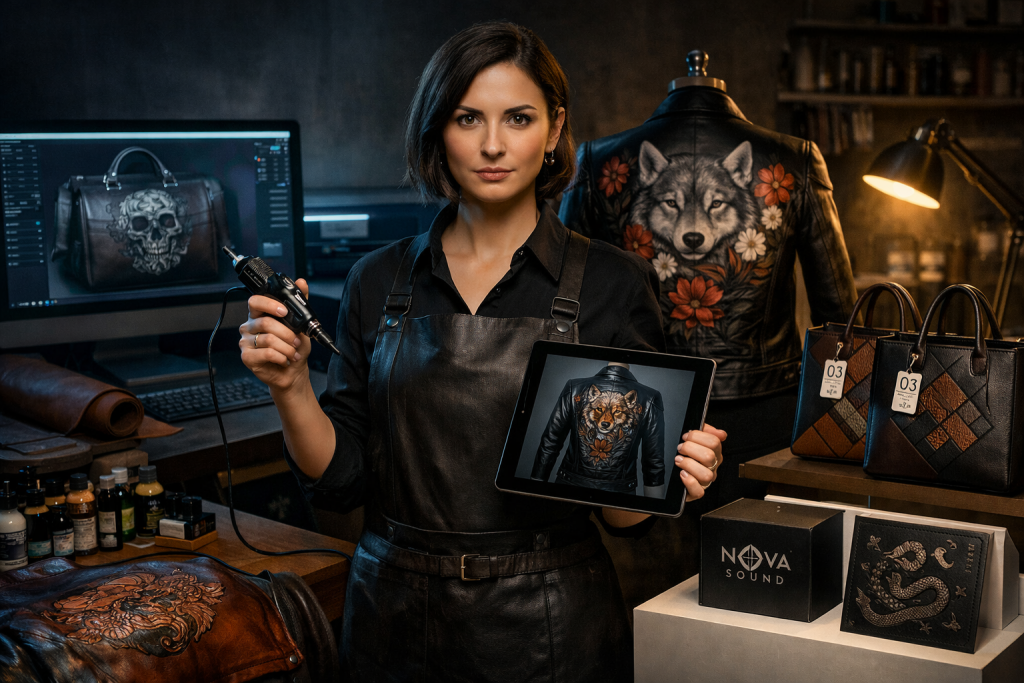
Tattoo artistry has always been intimate, permanent, and deeply personal. Yet the economic model behind it remains constrained by hours, chair time, and physical endurance. This document sets out a deliberate shift. It explores how tattoo-grade artistry can evolve beyond skin and into leather, creating objects that carry identity, story, and permanence in a new form.
“TATTOO ART ON LEATHER” is not a side project. It is a structured commercial venture that merges craftsmanship, digital tooling, IP strategy, and brand building. It recognises three converging forces shaping modern markets: the demand for personalisation, the maturation of the creator economy, and the fusion of handcraft with production technology.
This vision outlines how a single artist can transition from time-bound service income to scalable product, licensing, and B2B revenue streams. It provides operational clarity, governance structure, risk mitigation, and phased growth pathways. It is both creative manifesto and business blueprint.
Executive Summary
This Vision Document defines the strategic, operational, and commercial blueprint for establishing tattoo-grade wearable art on leather goods as a primary business venture and revenue stream. It synthesises the unique intersection of tattoo artistry, leathercraft, digital production, brand-building, and entrepreneurial strategy.
The opportunity sits at the convergence of three fast-growing markets: premium leather goods, personalisation culture, and creator-economy commerce. The model can be entered at low capital cost and scaled through a clear phased pathway — from bespoke commission studio through to licensed IP brand.
This document covers nine strategic pillars: Stakeholder Analysis, Service Value Analysis, Service Design, SWOT/PESTO/Risk, Business Requirements, Business Case, Outline Business Plan, Future Possibilities, and Revenue Exploration — plus implementation pathways for each business model.
1. Stakeholder Analysis
1.1 Stakeholder Identification
The venture involves five primary stakeholder groups, each playing a distinct role in the ecosystem.
Creators & Operators
- Lead Tattoo Artist / Ana — primary creator, brand identity, quality custodian
- Leatherworker / Finisher — surface prep, edge finishing, stitching repairs
- Production Assistant — masking, sealing, packing, order management
- Digital Production Operator — laser engraving, UV/DTF transfers, file prep
- Business Manager / Ana — client relations, finance, contracts, strategy
Customers
- Individual Collectors — biker/alt fashion communities, sneakerheads, tattoo enthusiasts
- Gifting Customers — premium personal gifts (weddings, anniversaries, memorials)
- Brand Collaborators — independent boutiques, music labels, subculture brands
- Corporate Clients — employee gifting, VIP activations, event merchandise
- Wholesale / B2B — brands requiring consistent personalised volume runs
Channel & Platform Partners
- E-commerce Platforms — Shopify, Etsy, direct website
- Social Platforms — TikTok, Instagram (primary demand generation)
- Retail Boutiques — concept stores, tattoo studios, fashion independents
- Event Organisers — tattoo conventions, pop-ups, brand activations
Suppliers
- Blank Goods Wholesalers — leather bags, jackets, wallets, accessories
- Leather Tanneries & Craft Suppliers — specialist leathers, dyes, finishes
- Print & Laser Bureaus — outsourced UV/DTF, laser engraving services
- Packaging & Fulfilment — branded boxes, tissue, shipping partners
- 3D Print Services — stamps, jigs, emboss dies
Governance & Risk Stakeholders
- IP / Copyright Holders — third-party design licensing, artist collaborators
- Legal Counsel — contract templates, trademark, IP policy
- Payment Processors & Platforms — Stripe, PayPal, Shopify Payments
- Insurance Providers — professional indemnity, product liability
- Regulatory Bodies — trading standards, international product compliance
1.2 Stakeholder Pain Points
| Stakeholder | Primary Pain Point | Secondary Pain Point | Emotional Driver |
| Individual Customer | Cannot find wearable art that reflects personal identity at quality level | Generic customisation lacks artistic authenticity | Self-expression, exclusivity |
| Corporate Client | Gifting is impersonal, forgettable; no memorable brand touchpoint | Lead times from agencies too long | Brand prestige, recipient delight |
| Brand Collaborator | Sourcing artists who can deliver consistent production quality | IP ownership and usage rights unclear | Credibility, creative differentiation |
| Tattoo Artist | Revenue ceiling from chair time; no scalable income channel | Skills not monetised beyond skin | Creative freedom, financial independence |
| Retail Boutique | Limited exclusive product offering; commoditised stock | Slow replenishment cycles | Differentiation, margin improvement |
1.3 Stakeholder Needs
| Individual Customer | Bespoke or limited-edition pieces; quality guarantee; clear process and proofing; artist story |
| Corporate Client | Consistent quality at volume; fast turnaround; invoicing; brand alignment; NDAs available |
| Brand Collaborator | Creative flexibility; IP clarity; co-branding opportunity; measurable exclusivity |
| Tattoo Artist / Ana | Predictable revenue; creative expression beyond skin; scalable systems; IP protection |
| Retail Boutique | Wholesale pricing; exclusivity agreements; replenishable SKUs; POS materials |
| Platform Partners | Clean IP; compliant listings; high-quality imagery; positive review management |
1.4 Required Service / Product Features
Non-Negotiable Features
- Commission intake system with proof approval workflow
- Material acceptance criteria and surface condition checklist
- Layered warranty tiers (standard, premium, refresh subscription)
- Clearly documented IP ownership — two contract variants (commission vs buyout)
- Photography/mockup delivery as part of every commission
- Scalable SKU system for drop and B2B fulfilment
Differentiating Features
- AI-assisted design previews / AR placement mockups pre-production
- Numbered certificate of authenticity (COA) for limited editions
- Durability testing documentation (abrasion, flex, UV resistance)
- Repair & Refresh subscription service for prior customers
- Modular swappable panel system for collectors
1.5 Stakeholder Ecosystem Map
The ecosystem is structured around Ana as the central creative and commercial node, with value flowing outward across four rings.
| Core (Inner Ring) | Ana + Production Team — art creation, QC, client management, IP ownership |
| Operational Ring | Suppliers (blanks, print bureaus, packaging) + Channel Partners (Shopify, event organizers) |
| Customer Ring | Individuals, gift buyers, corporate clients, brand collaborators, boutiques |
| Peripheral Ring | Legal, insurance, payment processors, platforms governance, regulatory bodies |
| Adjacent Interests | Tattoo convention ecosystems, streetwear influencers, luxury gifting consultants, wedding planners, music/event promoters, pet portrait communities, sustainability advocates (upcycle narrative) |
2. Service Value Analysis
2.1 Value Proposition
Core Statement: “We transform tattoo-grade artistry into permanent wearable art on leather — handcrafted commissions and limited drops that carry the authenticity of skin art, built to outlast trends.”
Secondary Statement for B2B: “Artist-made leather personalisation at the scale your brand demands — from VIP gifting to product drops — backed by documented quality standards and IP-safe originals.”
2.2 Value Streams
| Value Stream | Description | Stakeholder Served | Revenue Model |
| Bespoke Commission | One-off hand-painted leather art on customer-supplied or studio-sourced item | Individual, gifting | Fixed fee + deposit |
| Limited Drop | Curated series of 25–200 units; pre-order mechanic; designed in-house | Collector, boutique | Product sale + pre-order |
| B2B Customisation | Volume personalisation (laser/UV) for corporate or brand clients | Corporate, brand collab | Per-unit + setup fee |
| Licensing / Royalty | Original flash designs licensed to manufacturers or other artists | Brand, platform | Royalty % + flat licence |
| Refresh Subscription | Annual recoat/repair service for prior customers | Individual | Monthly/annual sub |
| Event Activation | Live customisation at pop-ups, festivals, brand events | Brand, corporate | Day rate + per-piece |
| Education / Courses | Teaching leather art techniques to other tattoo artists | Tattoo artist community | Course fee |
2.3 Benefits by Stakeholder Group
| Stakeholder | Functional Benefit | Emotional / Strategic Benefit |
| Individual Customer | Unique, durable wearable art; quality-tested; clearly communicated process | Identity expression; owning a piece of genuine artist culture |
| Corporate Client | Memorable gifting at scale; brand story embedded in product | Brand prestige; recipient retention and loyalty uplift |
| Brand Collaborator | IP-clear co-creation; access to artist audience; differentiated product | Cultural credibility; limited-edition hype mechanics |
| Tattoo Artist / Ana | Diversified income; scalable without chair time cap; brand equity build | Creative expansion; business ownership; legacy building |
| Retail Boutique | Exclusive / semi-exclusive SKUs; high-margin artisanal goods | Curation credibility; community alignment |
2.4 Strategic Alignment
The venture aligns to three macro trends sustaining long-term demand:
- Personalisation Economy — consumers increasingly pay premium for items that express individual identity rather than mass-market brands.
- Creator Economy Maturation — artist-owned brands commanding direct-to-consumer distribution without intermediary gatekeepers.
- Craft + Technology Convergence — hand artistry authenticated by story and provenance; production efficiency unlocked by laser, UV, and AI tools.
3. Service Design
3.1 High-Level Service Blueprint
| Phase | Customer Action | Frontstage (Ana/Team) | Backstage / Systems |
| Discovery | Finds via TikTok/IG/Etsy; views process content | Content published; enquiry CTA visible | Social scheduling; link-in-bio to intake form |
| Enquiry & Intake | Completes commission form; selects product type and design direction | Reviews intake; checks leather acceptance criteria; sends quote | Typeform/Jotform; CRM entry; quote template |
| Proof & Approval | Reviews AI mockup or sketch; requests revisions | Creates digital proof; sends for approval; collects deposit | Procreate/Photoshop; proof email workflow; Stripe deposit |
| Production | Awaits update; receives WIP photo | Prepares surface; applies art; seals; QC check | SOP checklist; abrasion test swatches; photo documentation |
| Delivery & Aftercare | Receives item + COA + care guide; posts unboxing | Ships with branded packaging; follows up post-delivery | ShipStation/Shopify; COA template; aftercare PDF |
| Retention | Renews refresh subscription; refers friends; buys next drop | Drop notification email; refresh reminder at 12 months | Email automation; CRM; subscriber list |
3.2 User Journeys
Journey A — Individual Commission
- Trigger: sees TikTok time-lapse of jacket backpiece creation
- Clicks link-in-bio → lands on commission page
- Completes intake form: leather type, design concept, dimensions, timeline
- Receives quote + deposit invoice within 48 hours
- Approves AI mockup; pays deposit (50%)
- Receives WIP photo at midpoint
- Final approval → pays balance
- Item ships with COA, care guide, and branded packaging
- 12-month refresh reminder email sent automatically
Journey B — Corporate / B2B
- Trigger: procurement manager searches for premium gifting supplier
- Contacts via website or LinkedIn
- Receives B2B proposal: SKU options, volume tiers, IP usage terms, timeline, invoicing
- Sample order (3–5 units) placed and approved
- Full order placed; production scheduled via laser/UV process
- QC photos sent at batch completion
- Branded bulk delivery; tax invoice issued
- Quarterly check-in for repeat orders
Journey C — Limited Drop
- Trigger: Ana announces drop concept via Instagram Stories and email list
- Pre-order page opens: design choice, leather blank, size/placement
- Pre-orders close after 72 hours or quantity cap hit
- Batch production executed; tracked lot QC
- All orders shipped simultaneously with numbered COA
- Unboxing content shared; community engagement drives next drop sign-ups
3.3 Key Touchpoints
| Social Content | Process videos, before/after, artist story — primary trust and demand builder |
| Intake Form | First brand experience post-discovery — must feel premium and clear |
| AI Mockup | Removes purchase anxiety; reduces revision rounds and disputes |
| WIP Photo | Builds excitement; confirms progress; reduces anxiety on expensive items |
| Packaging & COA | Physical brand moment; unboxing content driver; perceived value anchor |
| Aftercare Guide | Trust-builder; positions refresh subscription as natural next step |
| Refresh Reminder | Retention mechanism; recurring revenue trigger; community reinforcement |
3.4 Supporting Processes
- IP Screening — every commission design checked against in-house IP policy before acceptance
- Surface Acceptance — leather type/condition checklist completed before production starts
- Proof Approval — no production begins without written digital approval on record
- QC Protocol — abrasion and flex swatch tests documented per batch
- Warranty Register — all issued warranties logged with product ID and customer record
- COA Numbering — sequential numbering system maintained across all limited editions
3.5 Required Capabilities
| Capability | Current Status | Development Path |
| Hand-painted leather art | Core strength — tattoo skill directly transferable | Develop leather-specific finishing SOP |
| AI design proofing | Requires tooling — Procreate + Photoshop mockup pipeline | Establish standard mockup templates within 30 days |
| Laser/UV production | Outsource initially | Bring in-house at proven demand (>50 repeat SKUs/month) |
| B2B contracting | Needs legal templates | Commission contract lawyer for 2 core templates |
| E-commerce operations | Shopify setup required | Launch within 60 days; integrate intake form and CRM |
| Content creation | Existing tattooing content competency | Adapt format to leather process; test weekly cadence |
4. SWOT, PESTO, and Risk Analysis
4.1 SWOT Analysis
| STRENGTHS Tattoo-grade linework: unmatched in leather customisation marketPolymath background: business strategy + artistry + entrepreneurial mindsetLow startup cost: hand-applied techniques require minimal equipmentAuthentic brand story: artist-owned, identity-driven narrativeDual market access: B2C and B2B from day oneExisting content creation skills from tattooing practice | WEAKNESSES Time-for-money constraint: hand production doesn’t scale without systemsLeather finishing is a different craft: SOP development requiredNo existing product brand equity or leather customer databaseIP risk from customer requests: policy and contracts needed immediatelyChargebacks and disputes: customer-supplied luxury item liabilityContent-to-conversion pipeline not yet tested for leather |
| OPPORTUNITIES Massive under-served premium personalisation marketTattoo convention ecosystem: direct access to ideal communityCreator economy: monetise audience across multiple product layersAI + laser tools reduce production time without compromising qualityBrand collaboration trend: independent artists sought for credibilitySubscription/refresh model: recurring revenue with existing customersLicensing model: decouples income from labour hours at scale | THREATS IP/copyright infringement risk from customer requestsCopycat studios replicating technique once social content circulatesPlatform dependency: Etsy/IG takedowns can disrupt revenue overnightRaw material cost volatility: leather and specialist finishesLuxury brand trademark risk if modifying branded goods at scaleEconomic downturn reducing discretionary premium spendBurnout from capacity pressure without systematic production model |
4.2 PESTO Analysis
| PESTO Factor | Issue / Trend | Impact | Response |
| Political | UK/EU IP enforcement; Brexit customs delays | Medium — adds cost and compliance layer to EU exports | Use IP-safe original art policy; factor customs into pricing |
| Economic | Premiumisation trend; disposable income pressure on mass market | High positive — premium personalisation is resilient; entry-level squeezed | Position clearly in premium/collector tier; offer tiered pricing |
| Social | Identity culture; self-expression economy; tattoo mainstreaming; sustainability narrative | High positive — cultural tailwind driving demand | Lead with artist story; add upcycle/vintage narrative as sub-brand |
| Technological | AI design tools; UV/DTF print advances; laser engraving democratisation; AR try-on | High positive — reduces production cost and client friction | Adopt AI mockups early; outsource print then internalise at scale |
| Organisational | Solo operator model is vulnerable; needs systems to scale | Medium risk — burnout and quality inconsistency without process | Build SOPs and commission assistant before demand overwhelms capacity |
4.3 Risk Assessment & Mitigation
| Risk | Likelihood | Impact | Mitigation Strategy |
| Copyright infringement from customer requests | High | High | Strict ‘original art only’ intake policy; customer attestation in contract; DMCA process on all channels |
| Damage to customer-supplied luxury item | Medium | High | Intake waiver; condition photo log; professional indemnity insurance; clear liability cap in contract |
| Platform takedown (IP complaint) | Medium | High | Diversify channels (own website + Shopify); maintain email list independent of platforms |
| Chargeback disputes | Medium | Medium | Non-refundable deposit policy; written approval on proof before production; payment gateway chargeback plan |
| Quality inconsistency on scaled volume | Medium | High | SOP for every process stage; QC swatch tests; outsource only to vetted bureaus |
| Revenue concentration in commissions | High | Medium | Diversify into drop model + subscription + B2B within 12 months |
| Copycat competition | Medium | Medium | Brand IP registration; COA system; release strategy (cropped previews); licensing offering makes copying less attractive |
| Supply chain disruption (blanks/leather) | Low | Medium | Dual-source blanks from day one; 4-week safety stock buffer |
5. Business Requirements
5.1 Functional Requirements
| FR-01 | Commission intake system: online form capturing design brief, leather type, timeline, budget, IP attestation |
| FR-02 | Digital proof workflow: AI mockup or sketch delivered within 72 hours of deposit; written approval required before production |
| FR-03 | Payment processing: deposit (50%) at booking; balance on delivery; B2B invoicing with 30-day terms option |
| FR-04 | Product catalogue: defined menu of SKUs (jacket, bag, wallet, sneaker, tag, hardware) with fixed placement tiers |
| FR-05 | Warranty issuance: unique COA number per limited-edition unit; warranty tier documented in customer record |
| FR-06 | Drop mechanics: pre-order page with quantity cap, countdown timer, waitlist capture |
| FR-07 | Subscription management: refresh service reminder at 12 months; renewal billing automation |
| FR-08 | B2B proposal template: volume tiers, unit pricing, IP usage terms, timeline, NDA option |
| FR-09 | QC documentation: swatch test photos stored per batch; defect rate tracked per SKU |
| FR-10 | IP screening: every design request reviewed against internal policy before quote issued |
5.2 Non-Functional Requirements
| NFR-01 — Turnaround | Standard commission delivered within 4 weeks; rush service within 10 days (at premium) |
| NFR-02 — Quality | Zero visible delamination, cracking, or dye bleed within 6 months under normal use |
| NFR-03 — Reliability | Order confirmation within 24 hours; proof within 72 hours; shipping notification same day |
| NFR-04 — Scalability | System must handle 20 commissions/month without quality degradation before hiring assistant |
| NFR-05 — Security | Customer data GDPR-compliant; payment via PCI-compliant processor; IP documents stored securely |
| NFR-06 — Brand Consistency | All customer-facing materials (forms, emails, packaging, COA) aligned to brand style guide |
| NFR-07 — Platform Independence | Revenue not entirely dependent on any single platform; own-domain website operational from launch |
5.3 Business Rules
- BR-01: No production commences without written proof approval on record.
- BR-02: Customer-supplied goods accepted only after condition waiver and photograph log completed.
- BR-03: No reproduction of copyrighted or trademarked imagery without documented licence.
- BR-04: All deposits are non-refundable once production proof is approved.
- BR-05: Limited edition drops are numbered sequentially; numbers are never reused.
- BR-06: IP in all original artwork created by the studio remains with the studio unless explicitly assigned via buyout contract.
- BR-07: B2B clients require signed order confirmation and NDA (if confidential IP involved) before production.
5.4 Assumptions & Constraints
Assumptions
- Tattoo artistry skills transfer to leather surfaces with practised technique adaptation (2–4 weeks of testing).
- Social media content from tattooing practice creates transferable audience for leather products.
- UV/DTF outsourcing is available at commercially viable rates for small-batch orders.
- Demand signal from social media is sufficient to validate product lines before large inventory purchase.
Constraints
- Solo operator capacity limit: maximum ~20 hand-painted commissions per month without additional staff.
- Start-up budget assumed to be modest: equipment purchases phased against revenue proof.
- Jurisdiction: primary market UK/EU — IP and consumer protection law applies.
- Customer-supplied luxury goods carry irreplaceable value — operational caution required.
5.5 Dependencies
| Legal Contracts | Commission contract and buyout template must be ready before first paid commission. |
| Insurance | Professional indemnity and product liability in place before accepting customer-supplied goods. |
| Shopify / Intake Form | E-commerce and intake system live before GTM campaign launch. |
| Blank Goods Supplier | At least one primary and one backup supplier contracted before drop model launches. |
| AI Mockup Pipeline | Mockup workflow tested and templated before marketing commissions. |
| Print Bureau | UV/DTF outsource partner tested and vetted before B2B volume orders accepted. |
6. Business Case
6.1 Problem Statement
Tattoo artists are highly skilled visual creators whose income is structurally limited by the hours-for-money model of tattooing. The market for personalised premium leather goods is large and growing, yet it lacks the authentic artistry and cultural storytelling that tattoo artists naturally provide. Existing leather personalisation is either luxury-priced and inaccessible, or low-quality and commoditised. No operator currently bridges tattoo-grade artistry with leather at commercial scale.
6.2 Strategic Rationale
- Diversifies revenue away from single-channel chair time dependency.
- Leverages existing artistic skills and audience in a tangential but highly monetisable category.
- Creates scalable IP assets (original flash libraries, product lines) distinct from the time-bound service of tattooing.
- Builds a brand that can outlast the artist’s physical working years — foundational legacy value.
- Positions Ana at the intersection of three converging trends: personalisation, creator economy, and craft-technology fusion.
6.3 Options Analysis
| Option | Description | Investment Level | Risk / Reward |
| Option 0 — Do Nothing | Continue tattooing only; no leather venture | Zero | Lost opportunity; income ceiling unchanged; no diversification |
| Option 1 — Commission Studio Only | Hand-painted leather commissions as a studio add-on; no product or drop | Low (£500–£2,000) | Fastest to revenue; capacity constrained; no brand equity |
| Option 2 — Commission + Drop Model | Commissions fund brand; drops build brand and collector base | Medium (£2,000–£8,000) | Best balance of speed, margin, and brand building |
| Option 3 — Full Brand Launch | All streams launched simultaneously: commission, drop, B2B, licence | High (£10,000+) | Maximum upside; maximum operational risk for solo operator |
Recommended: Option 2 — phased over 12 months, beginning with commissions and first drop within 90 days.
6.4 Costs, Benefits & Value Realisation
Estimated Start-Up Costs (Option 2 Phased)
| Materials & Starter Kit | £400–£800 (paints, dyes, sealants, prep chemicals, brushes, airbrush) |
| Photography & Mockup Setup | £200–£500 (lightbox, tripod, mockup software subscriptions) |
| Website & E-commerce | £200–£600/year (Shopify plan, domain, email marketing tool) |
| Legal Contracts | £500–£1,500 (two core templates: commission, buyout) |
| Insurance | £300–£800/year (professional indemnity + product liability) |
| Blank Goods (First Drop Inventory) | £500–£2,000 (25–50 units at wholesale) |
| Packaging & Branding | £300–£700 (branded boxes, tissue, hangtags, COA cards) |
| Total Estimate | £2,400–£6,900 initial investment |
Revenue Projections — Year 1 (Conservative)
| Month 1–3 (Validation) | 5 commissions/month @ avg £350 = £5,250 total |
| Month 4–6 (Growth) | 10 commissions/month + 1 drop (50 units @ £85 avg) = £10,750 |
| Month 7–12 (Scale) | 15 commissions/month + 2 drops + first B2B = £35,000–£50,000 H2 |
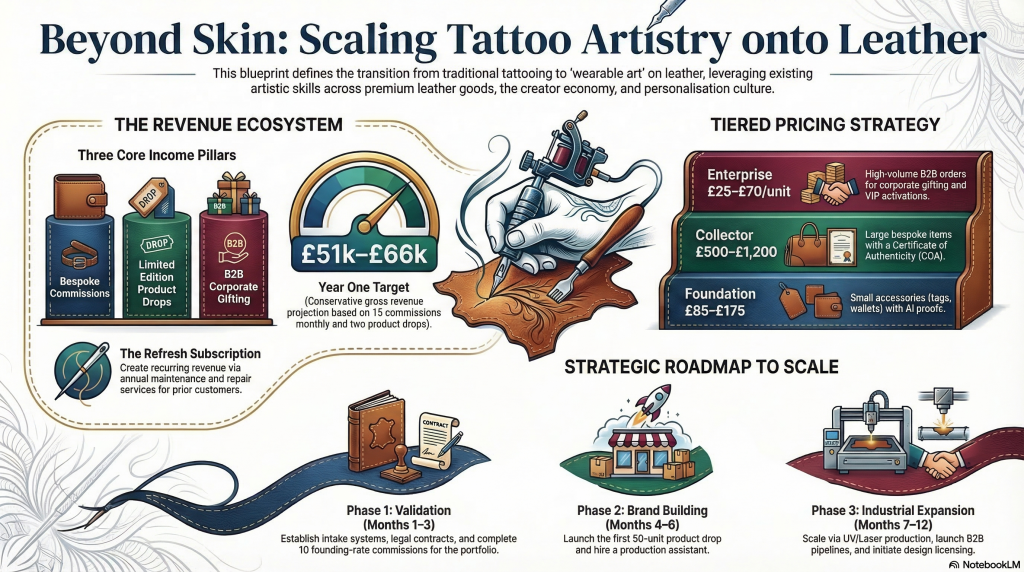
| Year 1 Total (estimated) | £51,000–£66,000 gross revenue at target run rate |
| Year 2 Target | £90,000–£140,000 with licensing, subscription, and recurring B2B added |
6.5 Success Metrics
| Revenue per Commission (target) | ≥ £300 average (excluding material costs) |
| Monthly Active Commissions | 10 by Month 4; 15+ by Month 9 |
| Drop Sell-Through Rate | ≥ 80% within 72-hour pre-order window |
| B2B Client Retention | ≥ 1 repeat B2B client within 6 months |
| Chargeback Rate | < 1% of transaction value |
| Defect / Rework Rate | < 3% of units produced |
| Social Follower Growth | ≥ 20% month-on-month for first 6 months |
| Email List (own platform) | ≥ 500 subscribers by Month 6; ≥ 2,000 by Month 12 |
| Subscription Renewals | ≥ 60% annual renewal rate on refresh service |
7. Outline Business Plan
7.1 Vision & Mission
Vision: To become the most recognised name in tattoo-grade wearable leather art globally — a brand where artistry, authenticity, and craftsmanship converge into objects that outlast trends.
Mission: To give tattoo artistry a life beyond skin — translating the discipline, creativity, and cultural depth of tattooing into leather goods that carry identity, story, and lasting quality.
Values: Authenticity | Craft | IP Integrity | Client Care | Creative Fearlessness
7.2 Target Markets
Primary — Individual Collector/Enthusiast
Demographics: 25–45, disposable income, strong identity expression culture. Psychographics: tattoo community, sneakerhead, biker/alt fashion, music subculture. Geography: UK primary; EU and USA via e-commerce.
Secondary — Gift Buyer (Premium & Gifting Occasions)
Demographics: 30–55, purchasing for self or partner. Occasions: weddings, anniversaries, memorials, milestone events. Channel: Etsy, Google search, Instagram referral.
Tertiary — Corporate / Brand
Sector: entertainment, music, luxury retail, tech (VIP gifting). Channel: direct outreach, LinkedIn, referral from boutique partners. Value: high unit volume, repeat orders, brand credibility.
7.3 Operating Model
| Phase 1 (0–3 months) | Sole operator. Hand commissions only. Customer-supplied + small blank inventory. Build intake, proof, contract infrastructure. |
| Phase 2 (4–6 months) | Add production assistant (part-time). First drop. Outsourced UV/DTF for B2B test order. Laser engraving via bureau. |
| Phase 3 (7–12 months) | Expand B2B pipeline. Launch refresh subscription. Second laser or UV print investment if volume justifies. Licensing conversation with first partner brand. |
| Phase 4 (Year 2+) | Hire full production assistant. Private label SKUs. Licensing programme active. Consider artist collective/roster model. |
7.4 Revenue Model
| Commission Fee | Fixed price by size/placement tier + deposit structure. Premium for rush and customer-supplied luxury items. |
| Product Sales (Drops) | Direct DTC; pre-order mechanic; limited units; premium for numbered/signed. |
| B2B Unit Price | Volume-tiered per-unit rate + setup/design fee; invoiced net-30. |
| Licensing Royalty | 5–15% of wholesale per unit; flat annual licence option for flash packs. |
| Subscription (Refresh) | £35–£80/year for annual recoat + scuff-repair service. |
| Event Activation | Day rate (£800–£2,500) + per-piece fee for live personalisation events. |
| Education | Online course (recorded) + premium workshop (in-person or live-stream). |
7.5 Go-to-Market Approach
Phase 1 GTM — Demand Validation
- Post 3x weekly process content: TikTok time-lapse + Instagram before/after
- Pin commission enquiry link in bio; use ‘comment DROP to join waitlist’ mechanics
- DM outreach to 50 engaged followers offering ‘founding customer’ rate for first 10 commissions
- Attend one local tattoo convention in Month 2 with sample work and commission sign-up sheet
- Pitch one local boutique for consignment or wholesale relationship
Phase 2 GTM — First Drop
- Announce drop concept on Stories 2 weeks prior; collect email sign-ups
- 72-hour pre-order window; maximum 50 units; numbered COA announced
- Unboxing content filmed with first customers; shared organically
- Email list nurtured monthly with behind-the-scenes content + next drop teasers
Phase 3 GTM — B2B Pipeline
- LinkedIn outreach to brand managers and gifting consultants
- Create B2B landing page with case study from first corporate order
- Approach 3 music labels/bands for artist collaboration deal
- Pitch at corporate gifting trade event or experiential marketing conference
7.6 Governance & Delivery Approach
| Decision Making | Sole director (Ana) with quarterly business review against KPIs |
| Financial Management | Monthly P&L review; separate business bank account; bookkeeper from Month 4 |
| Quality Governance | SOP document updated quarterly; defect rate reviewed monthly |
| IP Management | IP register maintained; copyright notices updated; legal review annually |
| Risk Review | Risk register reviewed at each quarterly business review |
| Delivery Milestones | M1: infrastructure live. M3: 10 commissions. M6: first drop. M9: B2B client. M12: licence partner. |
8. Future & Novel Possibilities
8.1 Innovative Extensions
Comment-to-Product Engine
The most-saved or most-commented design concept each week becomes a limited pre-order drop. Social audience becomes the product development team. Infinite idea supply with zero market research cost.
AR Placement Preview
Customer uploads a photo of their jacket or bag; AR tool overlays the proposed design at correct scale before they order. Eliminates purchase anxiety; dramatically increases conversion on high-ticket items.
Modular Swappable Panel System
Laser-cut or hand-sewn leather panels attached via concealed Velcro or zip-rivet system. Customers collect panels — seasonal, collab, commemorative. Creates a recurring physical ‘playlist’ for their garment.
Tattoo Flash Licensing Library
Publish a curated library of original flash designs available for licence by leatherworkers, engravers, and print studios. Passive income from IP; transforms copycat risk into revenue.
‘Kintsugi’ Repair Art
Visible mending service: cracked, faded, or damaged leather goods repaired with artistic gold-line accents and new motifs. Turns damage into a feature. Unique narrative: ‘broken and made more beautiful.’
3D-Texture Tattoo Effect
Combine laser etching, hand dye-fill, and layered sealant to create tactile raised-line art on leather — a ‘scarification’ aesthetic unique to leather and not achievable on any other surface.
Event Activation Kit
Portable laser engraver + template library + speed-optimised blanks (dog tags, bag tags, small wallets) for live personalisation at festivals, brand launches, and pop-ups. Extremely high content value and word-of-mouth.
8.2 Long-Term Service Evolution
| Year 1–2 | Commission studio + drop brand. Build audience, IP library, and process systems. |
| Year 3–4 | Licensing programme active. Artist roster/collective. Retail presence (own flagship or concession). |
| Year 5+ | Private label manufacturing line. B2B as primary revenue channel. Brand licensing to international partners. |
| 10-Year Vision | The canonical brand for tattoo-grade leather art globally — licensing, product, education, and artist certification. |
8.3 Potential New Markets
- Pet Portrait Hardware — engraved metal tags + painted leather leash handles; massive gifting market
- Heritage & Memorial — coordinate/map plates, family crest leather goods, memorial art on jacket
- Wedding & Ceremony — full wedding ‘kit’ (bridal jacket, ring pillow, vow scroll, engraved cufflinks)
- Corporate Luxury Gifting — global expansion; high-margin, low-volume executive gift programmes
- Artist Education — online courses teaching leather art to other tattoo artists worldwide
- Sustainability / Upcycle — vintage leather rescued and transformed; powerful ESG and story narrative
- Music / Entertainment Collab — tour merchandise reimagined as collector leather rather than screen-print
8.4 Scalability Opportunities
- Digital Production Scale — UV/DTF and laser enable 10x volume with linear (not exponential) cost increase
- Artist Roster Model — recruit vetted artists to fulfil under brand standards; Ana as creative director
- Licensing Programme — IP generates revenue with zero production labour at scale
- Course / Community Membership — knowledge product scales to unlimited students globally with marginal cost
- International Shipping — digital product (design files, licences) scales instantly across borders
9. Revenue Exploration
9.1 Income Streams
| Stream | Type | Margin Profile | Scale Potential |
| Hand Commission | Active / Labour | High per-piece; capacity limited | Low — constrained by hours |
| Drop / Product Sales | Product | Medium–high if margin managed | Medium — depends on production method |
| B2B Customisation | Volume Service | Medium — tighter margins, higher volume | High — repeatable systems |
| Licensing / Royalty | Passive IP | Very high — near zero marginal cost | Very High — scales with partner network |
| Refresh Subscription | Recurring Service | Medium — predictable, low-effort | Medium — grows with customer base |
| Event Activation | Project | High day rate; limited frequency | Low–Medium — geography and diary bound |
| Education Courses | Digital Product | Very high — create once, sell many | Very High — global, asynchronous |
| Wholesale (Boutique) | Product | Lower margin — trade pricing | Medium — reliable and brand-building |
| Consulting | Advisory | High hourly — Ana’s polymathic edge | Low — time bound; valuable selectively |
9.2 Tiered Service Levels
Individual / Consumer Tiers
| Tier | Offering | Price Range | What’s Included |
| Foundation | Small placement (tag, wallet panel, bag charm) | £85–£175 | AI proof, basic seal, care guide |
| Signature | Medium placement (sneaker, bag panel, belt) | £200–£450 | AI proof + sketch, premium seal, COA, photo box |
| Collector | Full backpiece (jacket, large bag) | £500–£1,200 | AI proof + mid-WIP + final photo, numbered COA, branded case, 1 free refresh |
| Legacy | Bespoke multi-piece set or heirloom commission | £1,200–£3,500+ | All above + buyout IP option + white-glove delivery |
B2B / Corporate Tiers
| Tier | Minimum Order | Unit Price Range | Features |
| Sample | 3–5 units | Full retail + 20% | QC proof photos; no volume discount |
| Partner | 20–99 units | £45–£120/unit | Brand alignment consultation; IP licence included; net-30 payment |
| Enterprise | 100–500+ units | £25–£70/unit | Dedicated production slot; SLA; NDA; account manager access |
9.3 Pricing Concepts
| Artistry Anchoring | Price anchored to artistry + time + rarity, not materials. ‘This is not a bag — this is a painting you wear.’ |
| Deposit Structure | 50% non-refundable deposit at booking secures slot and covers material risk. |
| Rush Premium | Standard 4-week; 10-day rush at +40%; 72-hour rush (small items only) at +80%. |
| IP Buyout Premium | Full copyright assignment: commission price × 3–5 depending on commercial reach. |
| Numbered Edition Premium | #1 of any limited edition commands 20–30% premium over standard run price. |
| Subscription Discount | Annual refresh sub at £55 vs £80 single service — incentivises commitment. |
| Bundle Incentive | Jacket + matching wallet + bag tag: 15% discount vs individual pricing. |
9.4 Monetisation Pathways by Model
| Business Model | Primary Revenue Mechanism | Supporting Revenue Mechanisms | 12-Month Revenue Target |
| Commission Studio | Per-commission fees, deposit-secured | Rush fees; IP buyout add-ons; portfolio licensing | £30,000–£50,000 |
| DTC Drop Brand | Product sales (pre-order drops) | Wholesale to boutiques; drop collab fees; email list monetisation | £25,000–£60,000 |
| B2B Vendor | Per-unit customisation at volume | Setup/design fees; rush SLA; NDA premium | £20,000–£80,000 |
| Licensing / IP | Royalty per unit or flat annual licence | Flash pack sales; certification programme | £5,000–£25,000 (Year 2+) |
| Artist Collective | Commission on artist revenue + platform fee | QC fee; training programme; brand licensing | £15,000–£40,000 (Year 3+) |
9.5 Implementation Pathways by Model
Model 1: Commission Studio — Implementation Pathway
- Week 1–2: Set up intake form (Typeform); draft commission contract; open business bank account; establish social content cadence (3x/week)
- Week 3–4: Test 3 commissions at ‘founding rate’ for portfolio and process validation
- Month 2: Raise to full pricing; build Shopify commission booking page; add AI mockup to workflow
- Month 3–6: Systematise via SOP; hire part-time assistant; introduce rush tier and IP buyout option
- KPIs: 10 commissions by Month 3; AOV ≥ £350; < 2% dispute rate
Model 2: DTC Drop Brand — Implementation Pathway
- Month 1: Design first drop concept (8–12 SKUs); source blank goods from wholesale supplier
- Month 2: Build pre-order page on Shopify; email list capture via social (‘DM DROP to join list’)
- Month 3: Launch 72-hour pre-order; fulfil via hand-finishing; photograph every unit for content
- Month 4–6: Analyse sell-through; refine SKUs; launch Drop 2 with outsourced UV/DTF for volume
- Month 7–12: Establish quarterly drop calendar; pitch one boutique wholesale account per drop
- KPIs: ≥ 80% sell-through within 72 hours; AOV ≥ £95; ≥ 500 email subscribers by Month 6
Model 3: B2B Customisation Vendor — Implementation Pathway
- Month 1–2: Create B2B capability one-pager; approach 5 target brands/agencies; commission 1 sample batch at cost
- Month 3: Convert first paying B2B client; document production SOP for consistency at volume
- Month 4–6: Vett UV/DTF bureau partner; test 50-unit batch for quality and turnaround
- Month 7–12: Build pipeline of 3+ repeat B2B clients; introduce SLA and NDA options; price for minimum 30% gross margin
- KPIs: 1 B2B client by Month 4; ≥ 3 repeat clients by Month 12; margin ≥ 30%
Model 4: Licensing / IP — Implementation Pathway
- Month 1–6: Create original flash library (minimum 20 designs); register copyright where commercially viable
- Month 6–9: Approach 2 leatherworkers and 1 boutique brand with pilot licence offer
- Month 9–12: Issue first licence agreements; track royalty income; refine licence terms based on partner feedback
- Year 2: Expand licence partner network; launch ‘Certified Studio’ programme for vetted licensees
- KPIs: 3 active licences by Month 12; royalty income ≥ £500/month by end of Year 2
Model 5: Artist Collective — Implementation Pathway
- Year 2 Activity: Once brand and process are proven, recruit 2–3 artists with compatible styles
- Establish quality training programme (SOP + supervised samples); onboard under brand standards
- Take 20–30% commission on collective artist revenue; manage customer-facing brand, QC, and fulfilment
- Year 3: Platform model with dedicated artist profiles; brands can commission specific artists from roster
- KPIs: 3 vetted collective artists by Year 2 Q4; collective revenue ≥ £5,000/month by Year 3
10. Additional Considerations
10.1 Financial Management
- Open a dedicated business current account from Day 1 — never commingle personal and business funds.
- Track unit economics per SKU: labour hours, material cost, reject rate, shipping — review monthly.
- Build a 3-month cash buffer before purchasing laser or UV printer equipment.
- Engage a bookkeeper (cloud-based) from Month 4 at latest; register for VAT threshold tracking from Day 1.
- Consider R&D tax credits or Creative Industry reliefs (UK) where applicable for equipment and process development.
10.2 Personal Brand & Content Strategy
- Ana’s polymath identity is a competitive advantage: business consultant + tattoo artist + entrepreneur is a rare and compelling narrative.
- Separate content pillars: (1) craft process, (2) business-building journey, (3) finished art reveal — each serves a different audience segment and algorithm.
- Document the journey of building the business — this meta-content audience can convert into course buyers and licensing clients.
- Maintain a consistent content schedule even during high production periods; batch-create content monthly.
10.3 Psychological & Wellbeing Considerations
- Commission work carries emotional weight — customer-supplied luxury items, custom memorial art, rejected proofs. Build in emotional boundaries and clear communication protocols.
- Burnout risk is real in solo creative businesses. Cap commissions before demand, not after overwhelm.
- Build ‘white space’ into the calendar: creative R&D time, personal tattooing, learning — these feed the business as much as execution time.
10.4 Community & Culture
- The tattoo community is the most authentic marketing channel. Showing at conventions, collaborating with respected tattooers, and engaging authentically in culture matters more than paid ads.
- Avoid positioning that feels extractive of tattoo culture; lead with genuine artistry, not commercial language.
- Build a waitlist community — members who feel early access and belonging will become the most powerful word-of-mouth advocates.
10.5 Technology Adoption Roadmap
| Immediate (Month 1) | Procreate + Photoshop mockups; Typeform intake; Shopify; basic CRM (HubSpot free) |
| Short-term (Month 3–6) | AI mockup generator (Mockey or custom Photoshop templates); email automation (Klaviyo); ShipStation |
| Medium-term (Month 6–12) | Outsource UV/DTF bureau; laser bureau relationship; Illustrator for vector prep |
| Long-term (Year 2+) | In-house laser engraver; 3D printer for stamps/jigs; potentially UV printer or heat press |
| Optional (Year 3+) | AR try-on MVP; custom app for drop mechanics; artist roster management platform |
10.6 Exit & Valuation Strategy
Building toward a business with genuine enterprise value — not just a self-employed income — requires deliberate choices from early in the journey:
- Build IP assets (original flash library, brand, trademarks) that have value independent of Ana’s labour.
- Create recurring revenue (subscriptions, licensing) that demonstrates revenue quality to any future acquirer or investor.
- Document all processes in SOPs so the business can operate without Ana at its centre — a requirement for any meaningful valuation multiple.
- A product brand with repeatable SKUs, margin history, and digital audience can be valued at 0.5–2.5× annual revenue. A pure service business may trade at 1–3× SDE (Seller’s Discretionary Earnings).
- Build relationships with adjacent brands early — a formal acquisition or brand licensing deal is often the best ‘exit’ for a niche artisan brand.
Conclusion
Tattoo art on leather represents a strategic expansion, not a departure. It builds on existing mastery while unlocking scalable, defensible, and brand-driven income streams. By combining structured operations, IP protection, phased growth, and disciplined financial management, this venture can move from commission studio to recognised global brand.
The opportunity lies in disciplined execution. Protect intellectual property. Build systems before scale. Diversify revenue early. Develop recurring income. Own the customer relationship. Document processes so the business can operate beyond the founder.
If implemented with focus and governance, this model shifts the artist from practitioner to brand architect. It creates assets that appreciate in value. It builds cultural credibility while generating commercial resilience. It transforms craft into enterprise.
This is a living strategy. Review quarterly. Adjust deliberately. Scale intentionally.
Appendix: Quick-Reference Summary
Priority Action Plan — First 90 Days
| Week | Action | Owner | Success Indicator |
| 1 | Draft commission contract + intake form; open business bank account | Ana + Lawyer | Contract signed off; form live |
| 1–2 | Set up Shopify and link-in-bio; establish content cadence | Ana | Website live; 3 posts published |
| 2–4 | Run 3 test commissions at founding rate for portfolio + SOP development | Ana | 3 pieces complete; SOP draft written |
| 4–6 | Raise to full pricing; add AI mockup workflow; get professional indemnity insurance | Ana | First full-price commission booked |
| 6–8 | Source blank goods supplier; design first drop concept (10 SKUs) | Ana | Supplier contracted; designs drafted |
| 8–10 | Build drop pre-order page; begin email list capture via social | Ana | Page live; 200+ email subscribers |
| 10–12 | Launch first drop (72-hour pre-order, 50 units max) | Ana + Assistant | ≥ 40/50 units pre-sold |
This document is a living strategy. Review quarterly. Evolve deliberately.