Frameworks, Validation, Accreditation, and the Role of AI-Driven Information Ecosystems
PREAMBLE
I have been following Professor Jiang: Predictive History – YouTube and analysing it through the limited but relevant lenses I possess namely my understanding of History, pattern recognition statistics, probability, analysis (PESTLE attributes) and game theory. What struck me is that this work represents an emerging body of knowledge one that is both intriguing and controversial. That led me to reflect more broadly on how emergent knowledge evolves into a recognised academic discipline, how such fields are assessed, and how they relate to existing bodies of knowledge.
My analysis expanded beyond predictive history itself. I began considering the wider context of the AI era specifically the increasing dependence on AI summaries and social‑media‑driven interpretations, the widening gap between validation and assumption, and the tension between academic rigour, industry adoption, and emergent epistemologies. These gaps raise important questions about how new knowledge is evaluated, legitimised, and integrated. In the course of this exploration, I wrote an article examining these issues.
Interestingly, I also went further although this part is not included in the article. I began conceptualising an application built around predictive history itself. I drafted the vision, software requirements, heuristics, and a preliminary modelling framework for how such a system could operationalise an emerging field. This exercise demonstrated that it is possible to construct a structured research and development pathway for those who wish to formalise predictive history into a methodological framework. I used that interest as a springboard to examine the broader question of how emerging knowledge domains are formed, validated, challenged, and potentially matured into full academic disciplines.
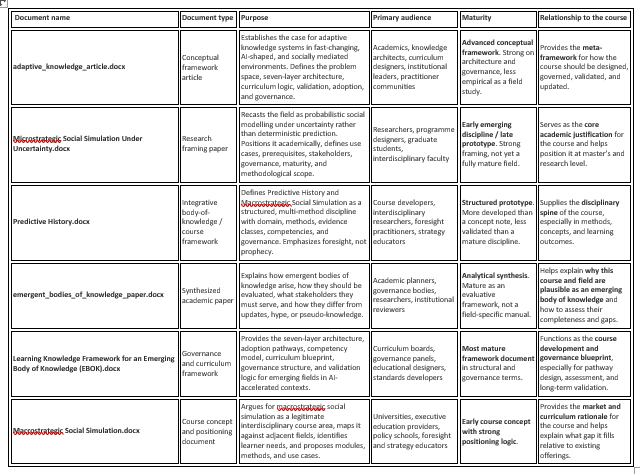
As usual some references: Microstrategic Social Simulation
Introduction: When Knowledge Outruns Institutions
We are living through an era in which the traditional guardians of knowledge, universities, journals, professional bodies, and accreditation systems, no longer hold a monopoly on the creation, validation, or distribution of expertise. Social media platforms, AI summarization tools, and real-time information aggregation have dissolved the once-clear boundaries between academic research, journalism, entertainment, practitioner knowledge, opinion, and what might be described as the emerging folk theories of the future.
This is precisely why unconventional bodies of knowledge, predictive history, futurology, game-theory-based forecasting, techno-cultural analysis, and scenario planning, have gained significant traction online. They spread because they are accessible, fast, emotionally resonant, and often accurate enough to feel credible. But they also attract sustained criticism for lacking the methodological rigor, peer review structures, governance frameworks, and epistemic safeguards that established academic disciplines depend upon.
The pattern is familiar. A new form of analysis emerges at the edges, on YouTube, on Substack, in podcasts and newsletters. It attracts an audience before it attracts a framework. It gains practitioners before it gains a curriculum. And it accumulates credibility through usefulness rather than validation. This is not a new phenomenon. Practitioners of management consulting, data science, and UX research all walked this same path before their fields were codified, taught in universities, and recognized by professional bodies.
What is new is the speed of that process, and the degree to which AI is now both accelerating and distorting it. AI summarization tools can collapse the distinction between novice and expert in hours. Social media platforms reward virality over validity. The result is an information ecosystem in which new knowledge forms proliferate faster than institutional responses can manage them.
A body of knowledge can be built deliberately, can emerge socially, and can even be created in advance of need.
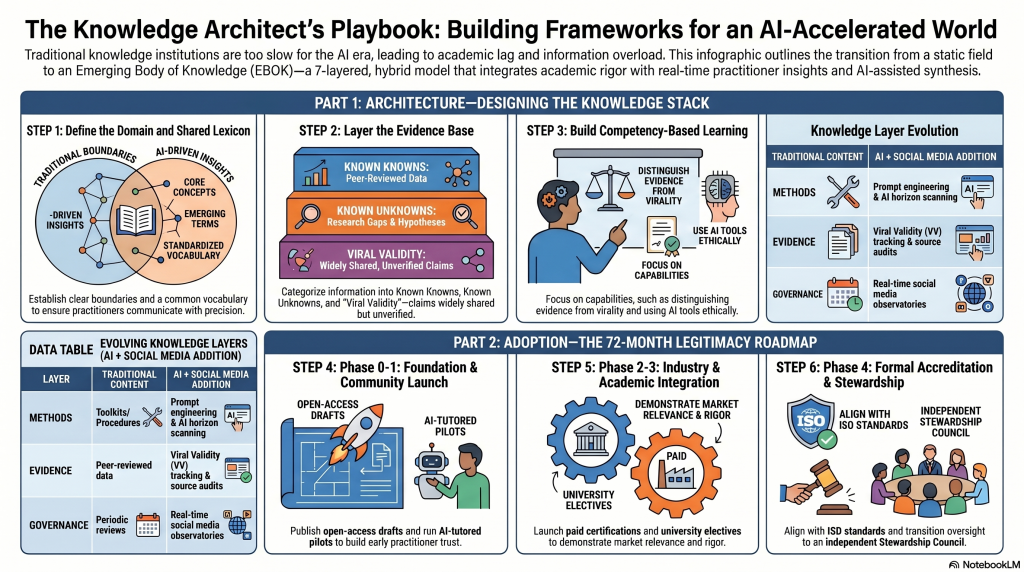
This article takes that challenge seriously. It proposes a new model: a hybrid body of knowledge that is academically rigorous, socially adaptive, and AI-literate, designed explicitly for a world where information moves faster than institutions. It examines the structural gaps that justify such a body of knowledge, outlines the architecture required to build it, addresses the thorny questions of validation and accreditation, and confronts the honest critique that any new field must survive.
The argument is not that traditional academic frameworks are obsolete. It is that they are insufficient on their own for a knowledge landscape that has fundamentally changed.
PART ONE
The Problem Space: Why Existing Knowledge Systems Are Failing
1.1 The Academic Lag Problem
Traditional academic knowledge systems are built for stability. The canonical cycle, observation leading to theory, theory to method, method to peer review, peer review to canon formation, and canon formation to eventual revision, is designed to filter out noise and protect against premature consensus. In stable domains, this is a strength.
In fast-moving domains shaped by AI, digital platforms, and rapid cycles of technological and social change, it is a liability. By the time a new practice is observed in the field, studied by researchers, written up, peer reviewed, revised, published, and incorporated into curricula, the field has often already moved on. The academic clock and the practitioner clock are no longer synchronized.
This lag is not merely inconvenient. It creates a vacuum. And vacuums are filled, sometimes by genuinely useful alternative knowledge systems, sometimes by speculative frameworks with no methodological grounding, and increasingly by AI-generated synthesis that can mimic the surface appearance of expertise without its substance.
1.2 Industry Knowledge Without Formalization
Practitioners accumulate deep, hard-won domain knowledge that rarely finds its way into curricula, standards, or qualifications. This knowledge lives in heads, in organisational memory, in communities of practice, and in the informal networks that constitute the real intellectual infrastructure of most industries.
When practitioners attempt to teach what they know, they frequently discover that their knowledge is not organized in a form that can be easily transmitted. It is tacit, contextual, and embedded in practice. The absence of formalization is not a failure of practitioners. It is a structural gap: the bridge between practitioner insight and teachable, assessable, governable knowledge has not been built.
1.3 AI-Driven Information Overload and Shallow Confidence
AI tools can now summarize thousands of sources instantaneously. This collapses what was previously a significant epistemic barrier: the time and effort required to achieve competent overview of a domain. That barrier was imperfect and often inequitable. But it served a filtering function. Working through a substantial literature, even imperfectly, forced a kind of engagement that built genuine understanding.
When that process can be compressed into minutes, the result is often shallow confidence: the ability to speak fluently about a domain without the underlying conceptual architecture required to navigate its genuine complexity. Distinguishing evidence from noise, identifying methodological weaknesses in studies, understanding what the literature does and does not establish, these capabilities are not produced by summarization. They require developed judgment, and judgment requires structured formation.
1.4 Social Media as an Unaccountable Knowledge Engine
Social media platforms have become, by default, the world’s largest knowledge distribution systems. They were not designed for this purpose. They were designed for engagement, and engagement is optimized by emotional resonance, novelty, and social reinforcement, none of which correlate reliably with epistemic quality.
The result is an environment that systematically rewards speculative frameworks over careful ones, bold predictions over qualified ones, and accessible narratives over accurate but complex ones. Knowledge that gains traction on these platforms does so not because it has survived scrutiny, but because it has achieved virality. And virality, as any knowledge architect knows, is not the same as validity.
Yet dismissing social media as epistemically irrelevant would be a serious error. These platforms are where communities of practice now form, where new fields find their early audiences, where practitioners share the working knowledge that never makes it into journals, and where the signals of genuinely emerging domains first become visible.
Knowledge is socially produced through participation, and social media is now the largest participation engine in history.
1.5 The Rise of Alternative Knowledge Systems
Predictive history, futurology, and game-theory-based forecasting represent a category of knowledge system that has developed largely outside academic institutions while attracting substantial practitioner communities. These fields are not without intellectual seriousness. Their methods, using historical pattern recognition, scenario modelling, and strategic reasoning under uncertainty, have genuine analytical power.
What they lack is the institutional infrastructure of mature disciplines: validated methods, peer review, governance structures, competency frameworks, and legitimacy pathways. They exist in a zone between serious intellectual work and public entertainment, frequently derided by academics for their lack of rigor and by practitioners for the academics’ lack of relevance.
This is the gap this article addresses. Not by claiming that predictive history or futurology are wrong, but by arguing that the knowledge they represent could be structured, validated, and institutionalized without losing the accessibility and relevance that made it valuable in the first place.
PART TWO
The Framework: Architecture of a New Body of Knowledge
A body of knowledge is the organized map of what a field claims is worth knowing. It defines the domain, establishes the vocabulary, articulates the foundational principles, specifies the methods, identifies the evidence base, describes the competencies, and creates the governance structures that allow the field to evolve without losing coherence.
The architecture described here draws on the seven-layer knowledge stack as the structural foundation. Each layer is distinct, but all seven are interdependent. Weakness in any one layer undermines the integrity of the whole.
Layer 1: Domain Definition
The field addresses the intersection of AI-accelerated knowledge creation, real-time information ecosystems, social media epistemology, anticipatory and emergent knowledge practices, and hybrid academic-practitioner learning environments.
It is explicitly and unapologetically concerned with how knowledge is created, validated, taught, and used in fast-changing environments. This is not a general theory of knowledge. It is a practical framework for navigating and building knowledge systems in conditions of rapid change, epistemic complexity, and technological acceleration.
The domain boundary is important. A body of knowledge without clear domain boundaries cannot be taught, cannot be assessed, and cannot be governed. It becomes a catch-all that claims everything and commits to nothing. Domain definition is not a constraint on ambition. It is the condition of credibility.
Layer 2: Vocabulary and Concepts
Every mature field has a shared lexicon that allows practitioners to communicate with precision and efficiency. Without shared vocabulary, every conversation must start from scratch, every disagreement conflates conceptual differences with empirical ones, and knowledge cannot accumulate across practitioners.
The core vocabulary of this field includes: learning outcomes, competencies, weak signals, provisional frameworks, anticipatory knowledge, community uptake, validation and governance, evidence classification, knowledge layering, and backward design. These terms are not arbitrary. Each performs a specific epistemic function. Each marks a distinction that matters for the practice of the field.
Layer 3: Foundational Principles
Five foundational principles structure the field’s approach to knowledge:
– Knowledge must be layered, not flat. A domain contains concepts, principles, methods, tools, cases, ethics, and frontier issues. Treating these as equivalent is a category error with practical consequences.
– Evidence must be transparent, not assumed. Evidence may be scientific, professional, scenario-based, practice-based, or emergent, but its nature and limitations must be explicitly labelled.
– Frameworks must be revisable, not static. The knowledge that a field codifies at any given moment is a best current understanding, not a final truth.
– Teaching must be capability-based, not content-based. Start from what learners must be able to do, not from what content happens to exist.
– Governance must be continuous, not episodic. Knowledge in fast-moving domains does not wait for scheduled reviews.
Layer 4: Methods and Practices
The field draws on an established and expanding toolkit. Backward design and the ADDIE framework provide the architecture for curriculum development. Horizon scanning and scenario analysis provide methods for integrating anticipatory knowledge responsibly. Communities of practice provide the social learning infrastructure. Rapid validation cycles and AI-assisted synthesis provide the operational tools for working at speed without sacrificing rigor. Case-based reasoning provides the bridge between principle and practice.
The movement from emerging practice to codified method follows a recognizable path: weak signal, community experimentation, provisional frameworks, pilot teaching, feedback, revised methods, partial codification. This is not a linear process. It is iterative and recursive.
Layer 5: Evidence Base
Evidence in this field is classified across three categories. Known Knowns are established findings with substantial evidential support from multiple independent sources. Known Unknowns are areas of active inquiry where current evidence is preliminary, contested, or incomplete, and where provisional frameworks must be labelled as such. Unknown Unknowns are genuinely emergent domains where the field operates in exploratory mode, where scenario analysis and anticipatory methods replace false certainty.
This classification is not a ranking. It is a transparency mechanism. Practitioners who cannot distinguish between what is established, what is provisional, and what is speculative are not equipped to use knowledge responsibly in conditions of rapid change.
Layer 6: Competencies and Learning Outcomes
Competencies define what learners must be able to do as a result of engaging with the body of knowledge. They are not content summaries. They are performance specifications. In this field, core competencies include: evaluating AI-generated information for quality and bias; distinguishing evidence from virality; designing adaptive learning systems; building and governing knowledge frameworks; applying anticipatory reasoning responsibly; and using AI tools ethically within knowledge creation processes.
Level Competency Domain Core Capability Primary Activity
Beginner Knowledge Literacy Understands layered knowledge, evidence types, and AI-mediated information Critical reading, source evaluation
Practitioner Knowledge Application Applies methods, evaluates sources, builds small frameworks Framework design, analysis
Advanced Knowledge Architecture Designs full frameworks, curricula, and governance models Curriculum design, standards work
Expert Field Stewardship Governs knowledge systems, leads revisions, sets standards Policy, governance, accreditation
Layer 7: Governance and Validation
Governance answers the question that most new fields avoid until it becomes urgent: who decides what the field knows? A body of knowledge without governance is not a field. It is a collection of opinions held by whoever has the loudest voice at any given moment.
Governance structures for this field include a Stewardship Council for strategic oversight, an Evidence Panel for source validation and reclassification, a Curriculum Board for learning pathway maintenance, and a Community Assembly for practitioner feedback. These bodies operate through an annual review cycle, a weak-signal watchlist, a module retirement protocol, open draft consultations, and an accreditation alignment review.
Codify what is stable, mark what is provisional, test what is emerging, and design for revision.
PART THREE
The Development Plan: Building the Curriculum
3.1 Starting With the Capability, Not the Content
The most common error in curriculum design is starting with what the course team knows, rather than with what learners need to be able to do. The result is a curriculum that reflects the intellectual interests of its creators rather than the needs of its learners or the demands of the environments in which those learners will operate.
Backward design corrects this error. Define the capability first. In this case: learners must be able to navigate, evaluate, create, and govern knowledge in AI-accelerated environments. Then define what evidence of that capability would look like. Then design assessments that would produce that evidence. Then, and only then, design the learning activities and content that would prepare learners for those assessments.
3.2 Programme Architecture
The programme is structured across four levels. The Foundation level develops the conceptual infrastructure: an understanding of knowledge systems, the new epistemology created by AI and social media, and the nature of evidence and uncertainty. The Intermediate level develops the methodological toolkit: knowledge creation methods, scenario and futures methods, and social learning models. The Applied level moves into practice: knowledge architecture studio work, AI-assisted research, and case labs working with real-time knowledge challenges. The Capstone requires learners to build something: a new framework, method, or micro-body of knowledge, presented to a governance panel and validated through peer review.
3.3 Assessment Strategy
Assessment is aligned throughout with the competencies. Framework design tasks test the ability to build structured knowledge architectures. Critical evaluation essays test the ability to distinguish evidence from opinion and virality from validity. Case-based analysis tests the ability to apply methods to real situations. AI-assisted research audits test the ability to use AI tools critically and responsibly. The capstone project tests integrated capability across all domains. Peer review and community validation tests the social and governance skills that the field requires.
3.4 Audience Calibration
The body of knowledge serves multiple audiences, each of whom requires a tailored pathway through the material. Academics require emphasis on the epistemological foundations and methodological justifications. Practitioners require emphasis on the applied methods and governance tools. Policymakers require emphasis on the evidence classification system and the governance structures. Analysts and researchers require emphasis on the horizon scanning, scenario, and anticipatory methods. Students entering the field for the first time require the full foundation pathway before specialization.
PART FOUR
Accreditation: Earning Legitimacy, Not Declaring It
Legitimacy is not declared. It is earned through use, recognition, and institutional adoption. This is a principle that every new field must internalize before it attempts to navigate the accreditation landscape.
The conventional understanding of accreditation, that a university or professional body validates a programme and thereby confers legitimacy, gets the causality partly wrong. Accreditation attaches to the programme, not to the underlying idea. And programmes earn accreditation not simply by meeting formal criteria, but by demonstrating relevance, rigour, and uptake.
4.1 Formal Accreditation Pathways
Formal accreditation pathways operate through universities, professional bodies, and standards organizations. University validation provides the most comprehensive form of formal legitimacy, but also the slowest. Professional body recognition, from organizations such as chartered institutes, professional associations, and standards bodies, provides more targeted legitimacy within specific practitioner communities. Standards-based alignment with frameworks such as ISO or established sector standards provides a third pathway that is particularly relevant for fields with significant practitioner adoption.
4.2 Informal Legitimacy Pathways
Informal legitimacy is often underestimated by those focused exclusively on formal accreditation. Community adoption, in which a significant practitioner community uses the framework and finds it useful, is frequently the precursor to formal recognition rather than its consequence. Employer recognition, in which organizations begin specifying the framework as a preferred qualification or competency standard, provides a market-based legitimacy signal that academic and professional bodies take seriously. Open-framework governance, in which the framework is made publicly available and invites community contribution, builds the breadth of adoption that eventually attracts institutional attention.
The legitimacy trajectory is consistent across mature fields: usefulness leads to community adoption, community adoption leads to institutional recognition, and institutional recognition leads to formal validation. Attempting to short-circuit this process by declaring legitimacy before it is earned is one of the most reliable ways to undermine a new field’s credibility.
4.3 Intellectual Property and Stewardship
The intellectual property architecture of a new body of knowledge requires careful design. Copyright protects expression, not ideas. This means that the handbook, the diagrams, the course materials, the brand, and the certification system can be owned and protected. The field itself, the underlying ideas and general methods, cannot be owned and should not be. Attempting to do so would undermine the community adoption that provides the field’s social legitimacy.
Stewardship is the real locus of power. The ability to maintain, update, govern, and evolve the framework is more strategically valuable than any attempt to restrict access to the ideas. A field that is freely used but poorly governed will fragment. A field that is well governed and openly accessible will cohere and grow.
PART FIVE
Adoption: Building Traction in the Age of Social Media
A body of knowledge that is designed but not adopted is a theoretical exercise. Adoption requires a strategy that recognizes the realities of the current information ecosystem without being captured by them.
5.1 The Traction Sequence
Traction for a new body of knowledge follows a predictable but non-linear sequence. Accessible summaries establish the field’s core argument in a form that can travel across social platforms. Visual frameworks provide the shareable artifacts that allow the argument to be communicated in formats suited to different audiences and channels. Open workshops create the community experiences that move passive observers into active participants. Communities of practice provide the ongoing social infrastructure that sustains engagement between formal programme touchpoints.
Strategic use of social platforms does not mean abandoning epistemic standards in favour of virality. It means understanding that the initial audience for a new field is built through accessibility and usefulness, not through institutional endorsement. Institutional endorsement follows demonstrated value, not precedes it.
5.2 Institutional Partnerships
Partnerships with academic institutions, professional bodies, and major employers provide the credibility signals that allow a new field to move from community adoption to institutional recognition. These partnerships are most effective when they begin with small, clearly defined collaborations, pilot programmes, advisory roles, research partnerships, that demonstrate value before requesting formal endorsement.
The discipline required here is considerable. The temptation to claim institutional affiliation before it is genuinely established is significant, and the damage to credibility when such claims are challenged is severe. The field’s legitimacy architecture must be built on actual relationships, not aspirational ones.
5.3 Maintaining Credibility in a Noisy Ecosystem
Maintaining credibility in an information environment characterized by noise, speed, and the constant temptation toward overstatement requires active governance of the field’s public presence. This includes clear communication about what the field claims and does not claim, explicit labelling of provisional and speculative content as distinct from established findings, and a consistent willingness to engage with criticism rather than avoid it.
A new field that responds to criticism by dismissing critics or retreating from public engagement will not survive. A field that engages with criticism systematically, updates its frameworks in response to valid challenges, and maintains intellectual honesty about the limits of its knowledge, will earn the durable credibility that formal accreditation alone cannot provide.
PART SIX
Quality Controls and Safeguards
Every body of knowledge requires explicit safeguards against the risks that are specific to its domain. For a field operating at the intersection of AI, social media, and rapidly changing knowledge environments, those risks are considerable and must be addressed directly.
6.1 Academic Rigour
Academic rigour in this field requires the same standards of evidence classification, methodological transparency, and peer accountability that mature disciplines apply, adapted for the conditions of the field. This does not mean importing the slow validation cycles of traditional academic publishing into a domain where they would be counterproductive. It means applying the underlying principles, systematic inquiry, explicit evidence standards, honest acknowledgment of limitations, and openness to challenge, through mechanisms suited to the field’s operational tempo.
6.2 Real-Time Relevance
A body of knowledge that achieves academic rigour but loses real-time relevance has solved the wrong problem. The weak-signal watchlist provides the mechanism for maintaining relevance without compromising rigour. It creates a formal process for identifying emerging developments, evaluating their significance, and integrating them into the framework at the appropriate evidence classification level, clearly labelled as provisional until further validation is achieved.
6.3 Methodological Transparency
Practitioners must be able to trace the evidential basis for any claim in the framework. This requires explicit documentation of the methods by which knowledge was produced, the sources from which it was drawn, and the limitations that apply. It also requires a clear distinction between what the framework asserts with confidence, what it treats as working hypothesis, and what it acknowledges as genuinely unknown.
6.4 Ethical Use of AI Tools
AI tools present specific governance challenges for this field. AI can accelerate research synthesis, identify patterns across large literatures, and support the kind of horizon scanning that the field depends upon. It can also produce superficially plausible but substantively unreliable output that, without careful human oversight, could be incorporated into the framework as established knowledge.
The governance standard required is straightforward in principle: AI tools may be used to support human research and analysis processes, but may not substitute for human judgment on matters of evidence classification, methodological evaluation, or framework design. Human accountability for the content of the framework is non-negotiable.
PART SEVEN
The Honest Critique: Why This Approach Works and Why It Might Fail
7.1 Why It Works
This approach reflects how modern fields actually emerge. The pattern of weak signal, community experimentation, provisional codification, pilot teaching, feedback, and revision is not a theoretical model. It is an accurate description of how management consulting, data science, UX research, and numerous other fields that are now mature disciplines actually developed.
The framework acknowledges AI as a partner in knowledge creation rather than treating it as either an oracle or a threat. It uses governance structures to maintain the coherence and credibility that social media environments systematically erode. It is adaptive without being shapeless, and it is rigorous without being rigid.
Perhaps most importantly, it begins from a realistic assessment of where legitimacy actually comes from in contemporary knowledge ecosystems. Not from declaration, but from demonstrated usefulness, community adoption, and the slow accumulation of institutional recognition.
7.2 Why It Might Fail
Institutions resist hybrid knowledge systems for structural reasons, not simply through conservatism. University accreditation processes, professional body recognition criteria, and standards alignment procedures are all designed for disciplines with clear disciplinary homes. A field that sits at the intersection of AI studies, education, epistemology, and organizational practice may find that it fits neatly into none of the available categories.
Social media may distort or oversimplify the framework in ways that undermine its epistemic integrity. The pressure to produce content that travels well on social platforms will consistently push toward the accessible over the accurate, the bold over the qualified, and the simple over the complex. Maintaining epistemic standards while achieving the social media traction required for early adoption requires a degree of editorial discipline that many emerging fields do not sustain.
AI-generated content presents a specific and growing risk. As AI tools become capable of producing increasingly sophisticated output in the language of the field, the distinction between genuine expertise and AI-mediated simulation of expertise will become harder to maintain. The field’s competency frameworks and assessment systems must be designed with this risk explicitly in mind.
Without strong governance, the field will fragment. The history of emerging fields is full of examples of promising frameworks that dissolved into competing sub-communities, each claiming ownership of the field’s identity, none willing to invest in the shared governance infrastructure that would have allowed the field to cohere and grow.
Finally, critics may argue with some legitimacy that the field lacks a single disciplinary foundation. The interdisciplinarity that is its strength is also its vulnerability. Established disciplines provide a coherent methodological tradition, a shared canon, and a community of scholars who have invested their careers in its development. A field that synthesizes across multiple disciplines must work harder to establish the same sense of coherent intellectual identity.
PART EIGHT
Conclusion and Next Steps: A Body of Knowledge for a Moving World
A body of knowledge does not have to wait until a field is fully scientific. This principle, which runs through the intellectual history of every applied discipline, is the foundation on which this proposal rests.
In a world shaped by AI, social media, and the accelerating pace of technological and social change, waiting for the consensus that traditional academic validation requires is no longer a viable strategy. The knowledge that practitioners need is being produced faster than institutions can validate it. The frameworks that make sense of rapidly changing environments are being built outside the academy because the academy cannot build them quickly enough.
This is not an argument against academic rigor. It is an argument for extending rigour to the mechanisms and timescales that fit the domain. A body of knowledge designed for fast-changing environments must itself be fast enough to remain relevant, while maintaining the epistemic standards that distinguish it from the noise of the information ecosystem it seeks to navigate.
The future belongs to knowledge systems that are structured, transparent, adaptive, anticipatory, governed, evidence-aware, and socially grounded.
The new body of knowledge proposed here is not a replacement for academic disciplines. It is a bridge: between academic rigour and practitioner insight, between formal validation and community adoption, between the slow consensus of institutional knowledge and the rapid emergence of genuinely new understanding in AI-accelerated environments.
Immediate Next Steps
Three actions are required to move from framework to field. First, publish the framework in a form that invites community engagement. An open draft, available for comment, with a clear governance process for incorporating feedback, establishes the social infrastructure that adoption requires.
Second, pilot the curriculum with a community of practitioners willing to engage with both the content and the process of developing it. Pilot teaching is not a test of whether the framework is correct. It is the mechanism through which the framework becomes more correct.
Third, engage with at least one formal institution, whether a university, a professional body, or a standards organization, in a clearly defined collaboration that does not claim endorsement it has not yet earned, but begins the relationship through which endorsement eventually becomes possible.
The field will not be built through a single publication, however comprehensive. It will be built through the accumulated work of a community of practitioners who find it useful, govern it seriously, and are willing to revise it honestly when the evidence demands it.
That community is the body of knowledge. The documents, frameworks, and curricula are its artifacts. The governance is its discipline. The practice is its proof.
ABOUT THIS FRAMEWORK
This article is produced within the Adaptive Knowledge Systems Body of Knowledge (AKS-BoK) framework. It draws on the seven-layer knowledge stack, the AKS-BoK curriculum blueprint, the Certified Knowledge Architect competency framework, and the governance model described in the source documents. It is intended as a public-facing conceptualization of the field, suitable for presentation to academic, practitioner, and institutional audiences.