Preamble: Why industry analysis must become a living, challengeable system
Most industry analysis still arrives too late, sits in disconnected reports, and stops short of the decision it was meant to inform. State of Play proposes a different model: an analyst-governed intelligence platform that connects market evidence, internal knowledge, risks, investment signals, policy change and scenario planning into a living view of an industry and an organisation’s place within it.
This matters now because strategic change no longer arrives from one source. Technology, geopolitics, climate constraints, regulation, capital flows and supply-chain shocks increasingly interact. A company can understand its current market and still be unprepared for the adjacent technology, policy shift, cost curve or competitor model that changes it.
The investigation began with a practical question: why do organisations commission market reports, horizon scans, risk assessments and strategy exercises separately, then struggle to turn them into a defensible decision? The reader will gain a framework for understanding State of Play as a strategic-intelligence workbench, the users it serves, the value it creates and the pathway for building it.
1. Concept Summary
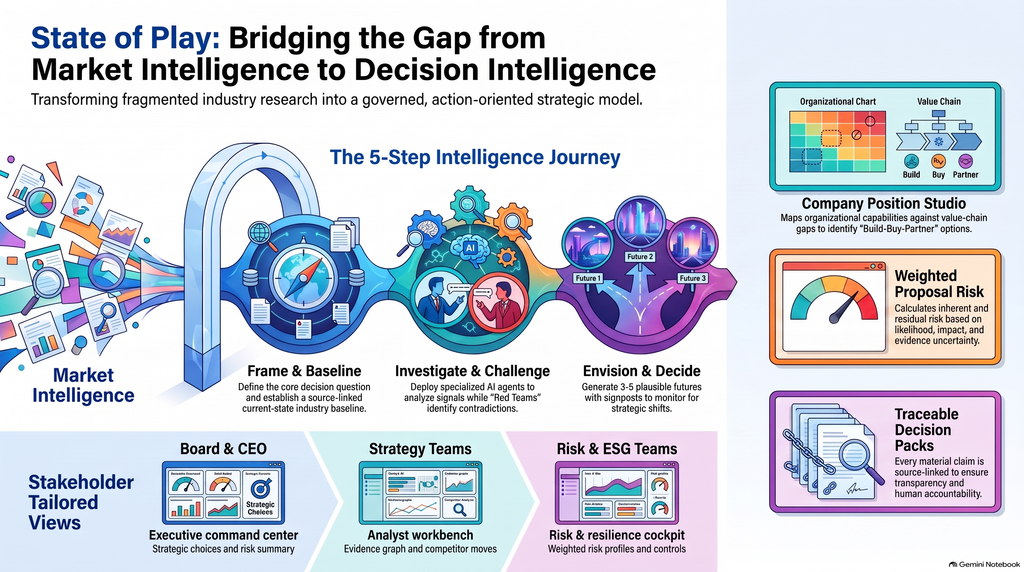
State of Play is an AI-assisted, analyst-governed strategic-intelligence platform. It helps users understand an industry’s current condition, identify signals of change, model their own position within that industry, test alternative futures and decide where to act.
Its central question is simple:
Should this organisation, investor, sector or country continue with its present model, improve it, or build toward a different future?
The platform combines established strategic methods, including PESTLE, SWOT, Porter’s Five Forces, value-chain analysis, BCG-style portfolio analysis, capability assessment, risk analysis and scenario planning. It then adds three things that traditional reports often lack:
- A multi-country and cross-industry perspective.
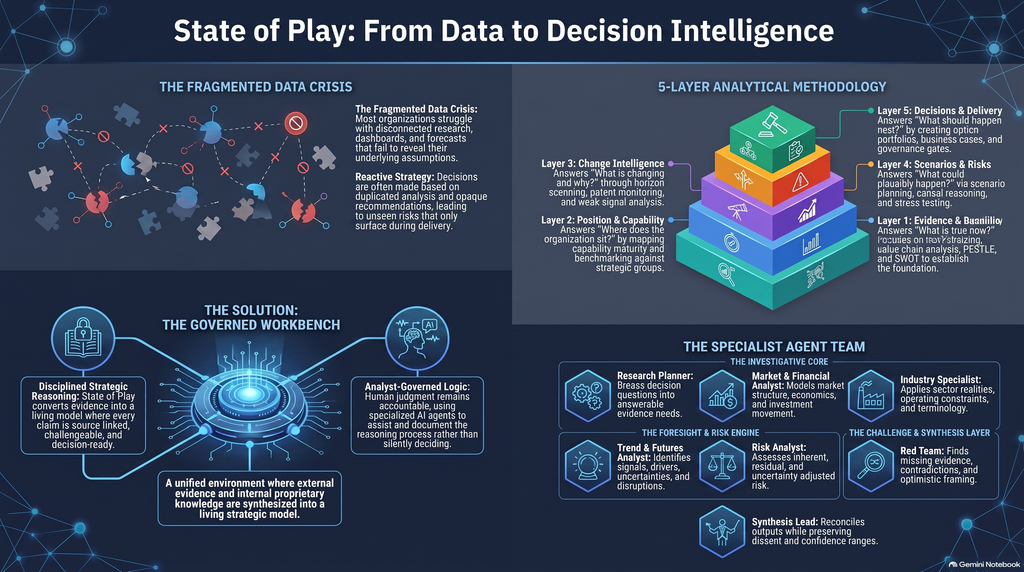
- A governed team of specialist AI agents that can investigate, challenge and synthesise.
- A decision model that makes assumptions, sources, uncertainty, dissent and risk visible.
The hypothesis is not that AI should replace intelligence analysts. It should make their work more comprehensive, traceable and responsive. The human analyst defines the question, governs evidence, challenges the findings and remains accountable for the final recommendation.
A State of Play output is not an unsupported prediction. It is a set of plausible, evidence-linked scenarios, each with trigger conditions, risks, opportunity pathways and decision gates.
As usual Link to support documents: Architecture, SRS, PRD, vision, market analysis, user journey, and risk doc: State of Play
2. Context and Drivers
Technology
Generative AI, agentic workflows, knowledge graphs, retrieval systems and advanced analytics now make it possible to analyse far larger volumes of structured and unstructured information. However, access to information is not the same as understanding.
The strategic problem is increasingly one of synthesis. A signal in academic research, a venture investment, a new standard, a pilot programme and a supply-chain constraint may all describe the same emerging transition. Most organisations do not have a system that links them.
State of Play uses technology to connect evidence, rather than simply summarise it. It can examine market data, reports, patents, policy documents, internal presentations, interviews, investment pipelines and operational data within one governed analytical environment.
Regulatory
Regulation is now a market-shaping force, not simply a compliance afterthought. Carbon border measures, AI regulation, data sovereignty requirements, product standards, public procurement rules and sector-specific assurance obligations can create or close markets.
For example, a manufacturing investment may look viable based on demand and cost alone, yet become uncompetitive if future carbon rules, energy standards or local-content policies alter the economics. State of Play treats regulation as a scenario driver and a proposal-level risk factor.
Market
Markets are fragmenting. Global scale remains valuable, but resilience, local supply, specialist capability and regulatory fit increasingly matter alongside unit cost.
The steel example makes this tangible. A country considering steel capacity should not only ask whether it can build a large conventional plant. It should assess energy availability, scrap supply, specialty-steel demand, construction patterns, logistics, export rules, industrial skills, financing and the potential for modular capacity. The best future model may not resemble the traditional one.
Social
Workforce expectations, demographic change, consumer trust, skills availability and public legitimacy shape adoption. A technically sound strategy can fail when it lacks capability, local acceptance or a credible social benefit.
State of Play therefore analyses people as a strategic variable: skills, role changes, leadership readiness, institutional capacity, customer behaviour and stakeholder confidence.
Environmental
Climate risk, resource scarcity, waste, energy cost and biodiversity constraints increasingly affect investment decisions. These drivers are not separate ESG considerations. They directly influence cost structures, insurance, regulation, access to capital and operational resilience.
The platform can test how environmental pressure affects a proposed investment, supply chain, operating model or national development pathway across several time horizons.
Geopolitical
Trade fragmentation, strategic competition, sanctions, critical-mineral dependencies, export controls and data sovereignty now influence industry viability. An industry cannot be analysed only through domestic competition.
State of Play therefore compares countries and regions according to factors such as energy, raw materials, skills, infrastructure, finance, demand, political risk, regulation and strategic alignment.
3. Framework and Methodology
State of Play uses a five-layer analytical model.
| Layer | Core question | Methods |
| Evidence and baseline | What is true now? | Market sizing, value chain, competitor analysis, PESTLE, SWOT, financial analysis |
| Position and capability | Where does the organisation or place sit? | Capability maturity, strategic-group mapping, benchmarking, operating-model assessment |
| Change intelligence | What is changing and why? | Horizon scanning, venture and patent monitoring, policy tracking, weak-signal analysis |
| Scenarios and risks | What could plausibly happen? | Scenario planning, causal reasoning, stress testing, weighted risk profiles |
| Decisions and delivery | What should happen next? | Option portfolio, MCDA, business case, roadmap, KPIs, governance gates |
The process begins with a decision question. Examples include:
- Should a company enter a new market or exit an existing one?
- Which technology pathway should a manufacturer back?
- Which sectors should an investor prioritise over the next five years?
- How should a region build capability in green steel, health technology or AI infrastructure?
- What risks could invalidate a proposed strategy?
The platform then develops a baseline of the industry, the organisation or place being assessed, and the external forces affecting both. It creates three to five scenarios rather than a single forecast.
Each scenario is built from explicit variables:
- Critical uncertainties, such as energy cost, regulation, adoption speed or trade conditions.
- High-impact drivers, such as technology maturity, capital availability or skills.
- Cross-industry analogies, validated before use.
- First-order effects, such as a new technology lowering cost.
- Second-order effects, such as a shift in supplier power or workforce demand.
- Third-order effects, such as changes in regulation, location advantage or industry structure.
- Signposts that show whether the scenario is becoming more or less likely.
The weighted risk profile assesses every proposed action against likelihood, impact, reversibility, exposure, time-to-effect, dependency concentration, regulatory uncertainty, execution capability and reputational consequences. It should distinguish between manageable implementation risks and risks that challenge the logic of the proposal itself.
4. Use Cases
Corporate strategy and business-unit positioning
A non-specialist executive may want to understand where their company sits in an industry, rather than commission a full market-intelligence project.
The platform can assess competitive position, customer segments, profit pools, operating capability, innovation exposure, market-entry options and strategic vulnerabilities.
The outcome is a Company Position Studio: a clear view of where the business competes today, where it could credibly compete next and what capabilities it must build or acquire.
Dependencies include access to internal financial, operational and customer information. The value is a more defensible strategy conversation between executives, finance, operations and product teams.
Investment and corporate development
Investors and corporate-development teams need to evaluate a market, a company, a technology or an acquisition target under uncertainty.
State of Play can combine market trajectory, venture activity, research pipelines, competitors, policy exposure, capital intensity and downside risks. It can compare several investment theses and identify the evidence that would strengthen or weaken each one.
The outcome is an investment decision pack with scenario-based returns, risks, confidence scores and monitoring indicators.
Industrial and economic development
Governments, development agencies and regional bodies need to decide which industries are realistic opportunities, rather than simply fashionable ones.
The platform can assess whether a region has the prerequisites to build a sector: skills, energy, finance, infrastructure, supply chains, research capacity, public procurement, market access and regulatory readiness.
The outcome is a sector-development roadmap that distinguishes between an aspiration, a viable capability pathway and an investable proposition.
Product, innovation and technology strategy
Product leaders can use the platform to test whether a new proposition has a durable place in an evolving market.
It can assess customer need, technology readiness, competitors, substitute solutions, pricing, route to market, regulation and implementation risk.
The value is early identification of conditions that would make a product viable, premature or strategically misaligned.
Risk, compliance and resilience
Risk, legal, compliance and ESG teams can use State of Play as a forward-looking risk environment rather than a static register.
The Risk Cockpit can map proposed initiatives against regulatory change, dependencies, sustainability exposure, supplier concentration, data risk, reputation and geopolitical conditions.
The outcome is a living risk profile linked directly to strategic choices, owners and mitigation actions.
5. Stakeholder Analysis
| Stakeholder | Interests | Influence | Contribution | Constraint or risk |
| Executives and boards | Better strategic choices, accountability, resilience | High | Decision authority, priorities, investment | May seek false certainty or oversimplification |
| Strategy and intelligence teams | Research quality, speed, traceability | High | Analytical standards, evidence validation | Capacity limits and information overload |
| Business-unit leaders | Growth, competitive position, operational practicality | High | Internal data, market insight, implementation ownership | May favour local priorities over enterprise strategy |
| Finance and investors | Returns, downside protection, capital allocation | High | Valuation, cost and risk discipline | Can overweight short-term metrics |
| Product and innovation teams | New opportunities, portfolio direction | Medium | Customer insight, experimentation, technology knowledge | Can overestimate adoption speed |
| Risk, legal and compliance teams | Regulatory fit, assurance, reputational protection | Medium | Control frameworks and risk judgement | May engage too late in the strategy process |
| Governments and regulators | Growth, resilience, public value, security | High | Policy, incentives, standards, procurement | Political cycles and budget constraints |
| Universities and research bodies | Translation of research into impact | Medium | Research signals, specialist expertise, talent | Commercialisation gaps |
| Consultants and researchers | High-quality client insight and repeatable methods | Medium | Domain expertise, facilitation, interpretation | Need confidence in source quality and IP protection |
The platform should therefore provide different dashboards, not one generic interface.
- Analyst Workbench: evidence register, agent controls, assumptions, source quality, contradictions and research tasks.
- Executive Command Centre: strategic choices, scenario comparison, risk exposure, financial logic, decision gates and recommended actions.
- Company Position Studio: competitive position, capability gaps, customer and segment analysis, peer benchmarking and strategic options.
- Scenario Lab: drivers, uncertainties, scenario narratives, signposts, stress tests and alternative futures.
- Risk Cockpit: proposal-level risks, mitigations, owners, dependencies, risk trends and residual exposure.
- Public Value and Place Dashboard: sector readiness, local capability, economic impact, policy options and regional comparisons.
- Investor Lens: market trajectory, funding, innovation pipeline, company comparators, investment thesis and downside cases.
6. Business Case
The market opportunity lies in the gap between generic information platforms and high-cost strategic advisory work. Organisations already spend significant sums on market reports, consulting engagements, intelligence subscriptions, risk tools, scenario workshops and internal analysis. State of Play combines parts of those activities into a governed decision environment.
Existing products demonstrate demand for individual parts of this proposition.
AlphaSense and similar platforms demonstrate the value of searchable expert content and financial research. CB Insights shows the appeal of tracking venture activity, technology categories and market signals. Quid and comparable tools show how visual exploration can reveal themes across large data sets. ITONICS and Futures Platform demonstrate demand for structured foresight, trend and scenario work. Aladdin and enterprise risk platforms show that decision-makers value risk visibility when allocating capital.
However, these categories are often separate. They may investigate information, track trends, manage risk or support forecasts, but do not consistently combine industry analysis, organisation position, scenario logic, proposal-level risk, explicit dissent and decision delivery in one analyst-governed workflow.
The commercial model can include:
- Subscription access by organisation, team or analyst seat.
- Premium data connectors and specialist-industry packs.
- Scenario and risk modules for strategy, investment and public-sector users.
- Consulting and facilitated strategic-intelligence engagements.
- White-label sector intelligence products for institutions, industry bodies and advisory firms.
- An enterprise edition with private knowledge integration, governance controls and audit trails.
Key cost drivers include data licensing, secure infrastructure, model inference, retrieval and indexing, domain model development, human quality assurance, integrations and enterprise security.
ROI should not be measured only through research time saved. It should include avoided strategic error, faster investment decisions, better capital allocation, earlier risk detection, reduced duplication, improved stakeholder alignment and stronger evidence for board or funding decisions.
Scalability depends on a strong common core, then configurable sector and country layers. The platform should not attempt to know every industry perfectly on day one. It should begin with a few sectors where change is visible, stakes are high and data can be structured, such as industrial transformation, energy, critical minerals, health technology, food systems and AI infrastructure.
Conclusion
State of Play is an argument for moving from passive market intelligence to active decision intelligence.
The valuable output is not a larger report, a more polished dashboard or a confident forecast. It is a shared, challengeable picture of the present, a disciplined view of plausible futures and a practical pathway for action.
Its strength lies in the connection it creates: between public evidence and private knowledge, between industry shifts and organisational capability, between opportunity and risk, and between a scenario and the signals that would validate it.
In a period where companies, investors and countries must make large decisions under uncertainty, this is the real proposition. State of Play can help them see not only what is happening, but what must be true for a proposed future to work.
Implementation Steps
Phase 1: Foundation
Build the governed analytical core.
Include an industry-and-country briefing wizard, evidence upload, source register, PESTLE, SWOT, Porter and value-chain templates, configurable analyst roles, assumptions log and executive report generation.
Success metrics: time to create a first strategic brief, source traceability rate, analyst satisfaction and report-quality assessment.
Decision gate: proceed when users can complete a source-linked baseline and identify material assumptions without relying on ungoverned AI output.
Phase 2: Validation
Test the product with two or three high-value sectors and real decision questions.
Introduce Company Position Studio, competitor analysis, cross-country comparison, scenario templates, weighted risk profiles and human-review workflows.
Success metrics: pilot completion rate, decision-maker usage, percentage of recommendations accepted for further evaluation, evidence-confidence accuracy and user trust.
Decision gate: proceed when the platform demonstrates that it changes or improves a real strategic decision, not simply accelerates research.
Phase 3: Scaling
Expand reusable reference models, sector packs, data connectors and collaboration features.
Add venture, patent, university research, policy, pilot and procurement signal tracking. Develop role-specific dashboards for investors, corporate teams, consultants and public-sector bodies.
Success metrics: repeat use, paid conversion, time saved per analysis cycle, number of reusable industry models and breadth of active teams.
Decision gate: scale when the common platform can be configured for a new sector without extensive custom development.
Phase 4: Governance
Strengthen assurance, permissions and accountability.
Implement role-based access, private-data segregation, source provenance, confidence scoring, approval gates, decision audit trails, red-team review and model-performance monitoring.
Success metrics: material claims with traceable sources, unresolved contradictions surfaced, risk actions assigned to owners, audit-readiness and user confidence.
Decision gate: enable enterprise and public-sector deployment when governance operates as a product capability, not a manual workaround.
Phase 5: Future State
Develop State of Play into a living strategic twin.
The future platform continuously updates the baseline, tracks scenario signposts, monitors risks, learns from decisions and maps how people, capabilities, processes, technologies, costs and external conditions interact.
Its future value lies in helping organisations move from periodic strategy exercises to an adaptive strategic operating model: one that can recognise change early, test options openly and act before the market has already moved.