Preamble
Some business ideas are culturally specific. Others are structurally transferable.
This briefing focuses on the second category. It identifies business models from Japan and Brazil that can move into the USA, UK, and continental Europe this week, not in theory, but with clear demand signals and operational logic already proven at home.
The analysis ranks opportunities by size. Small opportunities can launch with lean capital and fast validation. Medium opportunities require partnerships and systems. Large opportunities reshape sectors such as retail, payments, compliance, and platform ecosystems.
Each top idea is selected based on three criteria. Existing pull in the origin country. Structural pain in the target Western market. Feasible localisation.
The goal is not novelty. The goal is transferability. Using the Global idea business scout ideas that travel 2nd of march 2026 Global Business Idea scout
This week’s brief
1.Create a prioritised list of Japan‑origin ideas that could successfully transfer to Western markets this week. Group the ideas into small, medium, and large opportunities, and explain why the top idea in each category was chosen. Ideas may be products, services, apps, online platforms, or hybrids. For each idea, identify which Western market—USA, UK, or continental Europe—offers the best fit and outline any localisation needed.
2. Create a prioritised list of brazil ideas that could successfully transfer to Western markets this week. Group the ideas into small, medium, and large opportunities, and explain why the top idea in each category was chosen. Ideas may be products, services, apps, online platforms, or hybrids. For each idea, identify which Western market—USA, UK, or continental Europe—offers the best fit and outline any localisation needed.
Japan
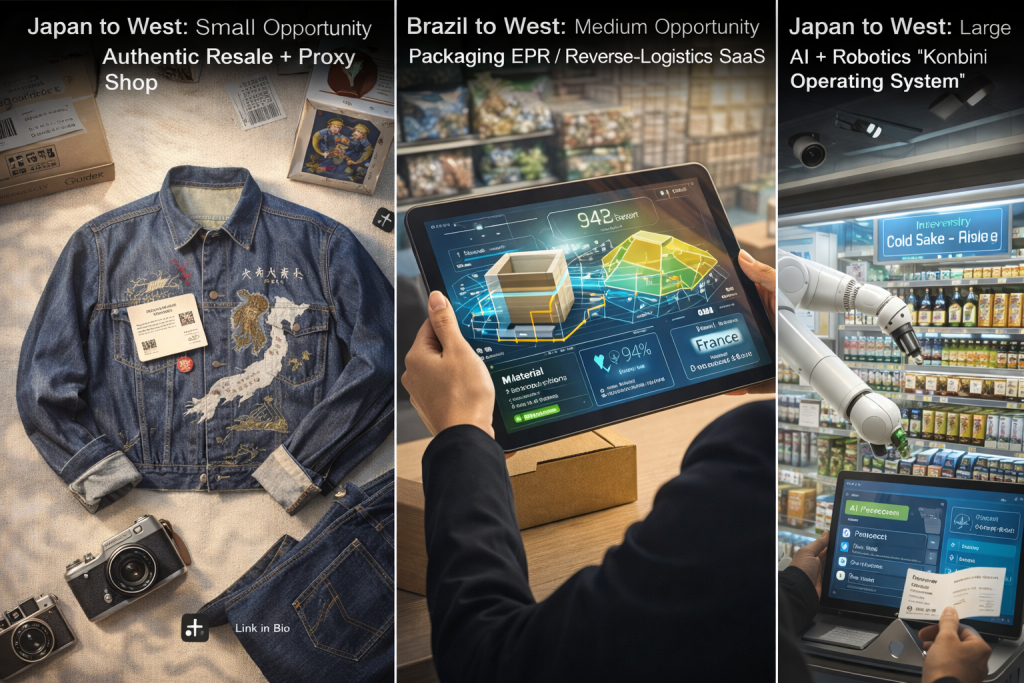
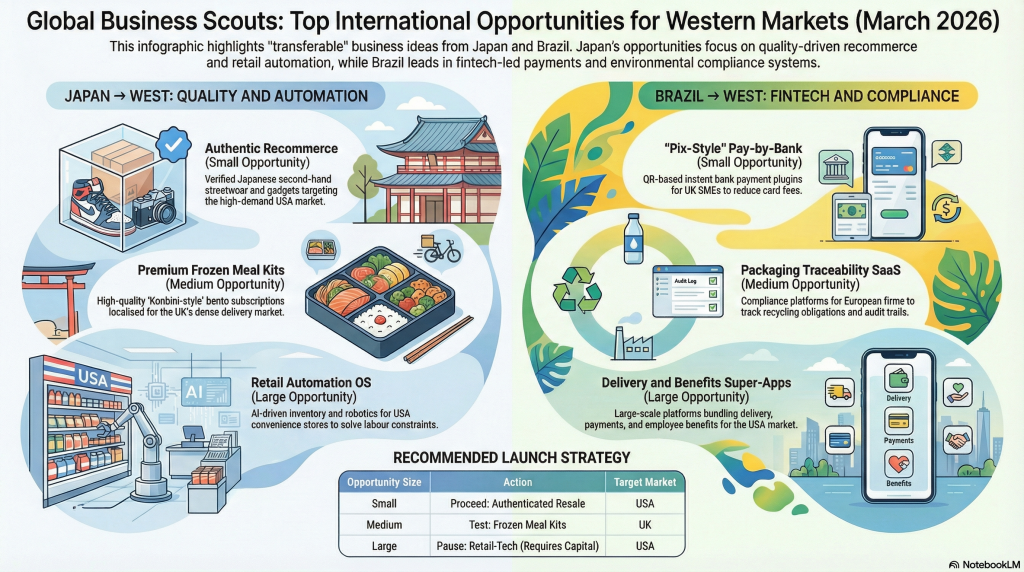
Here’s a this-week (Mar 1–7, 2026) shortlist of Japan → West business ideas, prioritised within Small / Medium / Large (using the cost sizing you asked for). I’m picking ideas that (1) already have “pull” signals in Japan, and (2) translate culturally with minimal friction. SMALL (low budget): Japan-to-West “Authentic Resale + Proxy” shop (with verification)
What it is (hybrid product + service + online):
A curated storefront (Shopify/Etsy + TikTok/IG) that sells authentic Japanese second-hand: streetwear, vintage denim, Japanese workwear, niche gadgets, camera gear, anime collabs—bundled with authentication + condition grading + “proxy sourcing” for customers.
Why it’s #1 in Small:
- Japan’s second-hand/recommerce ecosystem is mature and quality-focused (a real cultural advantage).
- There’s growing infrastructure for cross-border access (Mercari has been moving toward global browsing/shipping for Japanese listings).
- Low upfront cost: you can start with pre-orders / deposits and ship weekly.
Best “West” market for this top Small idea: USA
- Biggest depth of demand for Japanese streetwear/anime/culture + high willingness to pay for rare items.
- Localization notes: strong trust layer (authenticity guarantees, returns policy, duties transparency), and US-friendly sizing/condition standards.
Other Small ideas (ranked):
2) Japanese “functional snacks” micro-import (low sugar / health-positioned, small MOQ via distributors) — aligns with health + snack trends.
3) Matcha micro-brand (single-origin, ceremony-to-latte education, subscriptions) — demand is strong but supply/pricing can be volatile; still great if positioned premium.
MEDIUM (mid budget): Japanese “Frozen Meal Kit” subscription, localized
What it is (product + subscription + ops):
A Japanese-style frozen meal kit brand (think: “konbini-quality at home”)—bento sets, donburi bowls, ramen kits, high-protein options—sold via DTC subscription + retail pilots.
Why it’s #1 in Medium:
- Japan is pushing convenience food into higher quality ready-to-eat and longer-life formats; frozen kits are a direct exportable pattern.
- The broader “ready-made meals” market signal in Japan is strong (big market, still growing).
- Western consumers already understand meal kits—but Japan’s edge is portion control, variety, and quality discipline.
Best “West” market for this top Medium idea: UK (then expand into EU later)
- The UK is geographically compact (cheaper cold-chain logistics than pan-EU) and has strong adoption of subscription food delivery.
- Localization notes: allergen labeling rigor, taste calibration (less sweetness, salt expectations), and “weekday convenience” branding over “exotic Japan.”
Other Medium ideas (ranked):
2) “Omotenashi” service productisation for hospitality (training + playbooks + mystery shopping + customer feedback systems) — “export Japan’s hospitality standards” is explicitly being discussed as an overseas opportunity.
3) Smart retail micro-automation package for independent stores (simple AI demand forecasting + camera-based shelf alerts) inspired by konbini innovation.
LARGE (high budget): AI + Robotics “Konbini Operating System” for Western convenience retail
What it is (B2B platform + integration + services):
A retail automation solution bundle for convenience stores/small-format grocers: inventory forecasting, AI cameras, restocking robotics, digital signage optimization, possibly “unmanned / low-staff” store ops.
Why it’s #1 in Large:
- Japan’s convenience leaders are actively piloting AI cameras, robotics, and back-office forecasting to solve labor constraints—these are exactly the same pain points Western retailers have.
- There’s visible momentum around “alternative retailing technologies” and automation in Japan’s retail ecosystem.
- Big contract sizes + recurring revenue (SaaS + maintenance + hardware leasing).
Best “West” market for this top Large idea: USA
- Most buyer density (chains + franchise networks), biggest budgets, and the strongest ecosystem for retail-tech pilots.
Other Large ideas (ranked):
2) Remote “avatar customer service” for stores (in-store screens + remote agents for multilingual support, coverage, accessibility) — Japan has been testing versions of this in convenience contexts.
3) Warehouse/logistics automation for mid-market operators (less sexy, huge pain point) — Japan’s logistics automation pressure is well documented and maps to the West too.
Quick “where to launch” summary (USA vs UK vs Europe)
- USA = best for: resale/export culture goods, retail-tech, robotics (largest addressable market + buyers).
- UK = best for: subscription food formats + hospitality/service concepts (fast testing, tight geography).
- Europe (EU) = best for: sustainability-forward resale and premium craft—but expansion means multi-country compliance and language/local ops, so it’s best as phase 2 unless you already have EU capability.
What I’d do first (fastest validation this week)
Pick one #1 (Small/Medium/Large) and run a 7-day test:
- Small resale/proxy: list 30 items + run 5 paid TikToks/IG reels + measure conversion and repeat interest.
- Medium frozen meal kits: landing page + waitlist + 2 pop-up tasting nights + price sensitivity test.
- Large retail-tech: 10 discovery calls with convenience operators + a paid pilot LOI target.
Proceed: Small (Japan-to-West authenticated resale + proxy) in the USA
Test: Medium (frozen meal kits) in the UK
Pause: Large unless you already have capital/partners (it’s high upside, but heavy lift)
Brazil
Below is a prioritised “Brazil → Western markets” transfer list for this week (w/c Mon 2 Mar 2026), grouped into Small / Medium / Large opportunities. I’m using Brazil’s real signal advantages right now—especially Pix (including Pix Automático / recurring pay-by-bank) and new packaging reverse-logistics/compliance pressure—as the “exportable edge.” (Spreedly)
(Structuring logic aligned to a requirements/traceability style so you can turn a pick into a build plan quickly.)
Solo-founder to small team; fast MVP)
1) “Pix-style” Pay-by-Bank Subscriptions + QR Checkout plugin for SMBs (Top pick)
- What it is: A Shopify/WooCommerce/booking-platform plugin that makes pay-by-bank feel like Pix: QR at checkout + one-tap bank auth + recurring mandates (for memberships, classes, utilities-style billing).
- Best Western fit: UK (strong open-banking rails + consumer familiarity with bank transfers; easiest pilot surface). (KU)
- Localisation needed:
- UK: integrate Open Banking payments + VRP/recurring where available; instant bank transfer UX + strong refund/dispute flows.
- Positioning: “lower fees than cards, fewer chargebacks, instant settlement.”
- Why this is #1 (Small): Brazil proved that account-to-account instant payments can take massive share, and Pix Automático specifically unlocks recurring revenue without cards—a very “transferable painkiller” for Western merchants facing card fees + subscription churn. (Spreedly)
2) WhatsApp-first “conversational commerce” kit for local services
- What it is: Templates + lightweight CRM to turn WhatsApp chats into quotes, deposits, and reminders (cleaners, salons, trades).
- Best Western fit: Continental Europe (WhatsApp-heavy markets like Spain/Italy/Portugal). (KU)
- Localisation: GDPR-first consent + message policies; integrate local invoicing norms.
3) “Instant payout” micro-earnings platform for gig workers (tips, advances, settlements)
- What it is: A wallet/payout layer enabling near-instant settlements for marketplaces (creators, couriers, temp staffing).
- Best Western fit: USA (large gig economy; faster payouts are a strong lever). (KU)
- Localisation: KYC/AML, payroll/tax treatment, state-by-state compliance.
4) Micro-merchant “anti-fraud for pay-by-bank” risk scoring
- What it is: Simple fraud + refund tooling for pay-by-bank flows: device fingerprint, anomaly detection, merchant rules.
- Best Western fit: UK first, then EU. (KU)
- Localisation: PSD2/SCA alignment, dispute workflow that matches local schemes.
Medium opportunities (team + partnerships; 3–12 month rollout)
1) Packaging EPR / Reverse-Logistics Traceability SaaS (Top pick)
- What it is: A compliance platform that tracks packaging placed-on-market, recycled content, take-back obligations, and audit trails—built from the same “digital traceability + targets + penalties” playbook Brazil is moving to.
- Best Western fit: Continental Europe (EPR complexity + enforcement intensity is highest; multi-country compliance is a real budget line). (KK/KU)
- Localisation needed:
- Map to each country’s EPR schemes + reporting formats.
- Supplier onboarding flows + ERP connectors.
- “Proof pack”: audit exports, regulator-ready documentation.
- Why this is #1 (Medium): Brazil’s 2026 plastics/compliance direction mirrors the kind of reporting + traceability burden that EU firms already feel—so the transfer is less about “inventing demand” and more about shipping a better compliance operating system. (Baker McKenzie)
2) “Full-commerce” enablement for traditional retailers (store → marketplace + fulfillment)
- What it is: A service/platform that helps grocers and big-box retailers outsource storage + delivery to a partner network (3PL + last-mile) while retaining pricing control.
- Best Western fit: UK (dense geography, fast delivery expectations). (KU)
- Localisation: retailer margin protection, substitution rules, cold-chain SLAs.
3) City-scale “dark store → cash-and-carry hybrid” for SMB horeca supply
- What it is: Fast replenishment for restaurants/cafes: bulk pricing + same-day delivery.
- Best Western fit: USA (large metro areas) or EU (dense cities). (KU)
- Localisation: alcohol/food handling regs, local supplier relationships.
4) Drone-delivery “corridor operator” for regulated commercial routes
- What it is: Not a drone startup—an operator that secures permissions, runs routes, and sells delivery capacity to brands/logistics firms.
- Best Western fit: USA (scale + appetite, but regulatory complexity). (UU)
- Localisation: aviation approvals, insurance, community acceptance, noise/privacy policy.
- Brazil signal: iFood investment/partnership activity indicates serious operationalisation momentum. (Autonomy Global –)
Large opportunities (venture-scale; multi-year; heavy integration)
1) “Everyday Super-App” bundling delivery + payments + employee benefits (Top pick)
- What it is: A platform move: delivery/marketplace + wallet + benefits (meal/commuter) + SME tools—mirroring Brazil’s ecosystem expansion pattern.
- Best Western fit: USA (benefits market size + fragmented tooling makes bundling attractive). (KU)
- Localisation needed:
- Benefits rails: integrate with existing benefits administrators; compliant handling of employee funds.
- Strong antitrust/competition counsel and partner strategy.
- Why this is #1 (Large): Brazil’s leaders (notably iFood) are signalling platform expansion + massive investment cycles, and benefits are a powerful “frequency + retention” anchor that can defensibly expand LTV in Western markets too. (Reuters)
2) National-scale “pay-by-bank for e-commerce” network with incentives
- What it is: Merchant coalition + consumer rewards to shift volume from cards to bank payments.
- Best Western fit: Continental Europe (cross-border SEPA dynamics; merchants already fee-sensitive). (UU)
- Localisation: scheme governance, bank partnerships, consumer guarantees.
3) Marketplace-led grocery expansion model (platform + retailer partnerships)
- What it is: Marketplace adds grocery at scale via retailer partnerships + fulfillment-as-a-service.
- Best Western fit: Continental Europe (multi-banner retail landscape). (KU)
- Brazil signal: major platform/retailer partnership motion in grocery category. (Reuters)
4) “SMB operating system” layered on top of delivery/commerce platforms
- What it is: Banking, inventory, demand forecasting, procurement—sold to the merchants already on the platform.
- Best Western fit: UK (SMB digitisation + fintech adoption). (KU)
- Localisation: integrations (Xero/Sage), VAT workflows, SME lending compliance.
What to do next (fastest validation path)
Pick one “Top pick” and run a 7-day test:
- Small: recruit 20 UK subscription merchants (gyms/classes) → measure checkout conversion + fee savings vs cards.
- Medium: interview 10 EU brands with EPR reporting pain → pre-sell pilot with 1 compliance manager as design partner.
- Large: map one benefits rail + one commerce rail → build partnership thesis + unit economics.
Proceed / Test / Pause: Test (run the smallest paid pilot you can inside 7–14 days).
Conclusion
Ideas travel best when they solve an existing Western pain point with a model that has already been stress tested elsewhere.
From Japan, authenticated resale, frozen convenience meal systems, and AI driven retail automation show clear structural alignment with US and UK demand. From Brazil, pay by bank subscriptions, packaging compliance traceability, and platform bundling models demonstrate how financial and regulatory innovation can migrate across borders.
The strategic insight is simple. Do not export culture alone. Export operating systems. Export infrastructure patterns. Export monetisation mechanics.
If you want to act, choose one top ranked idea and validate within 7 to 14 days. Test conversion. Test compliance appetite. Test partner interest.
Ideas that travel are rarely invented from scratch. They are identified, translated, and executed with discipline.
Abbreviations & Uncertainty Tags
- KK = Known Known (high confidence)
- KU = Known Unknown (directionally likely, needs validation)
- UU = Unknown Unknown (high uncertainty / sensitive to surprises)