Preamble
What Are Canvases? Canvases are visual, one-page strategic planning tools that break down complex topics into digestible sections or building blocks. They’re designed to help teams collaborate, think systematically, and document key elements of a project, business, or strategy in a structured format.
The concept was popularized by Alex Osterwalder’s Business Model Canvas, which transformed how entrepreneurs and businesses think about their models by organizing nine key elements on a single page. This post is related to: Performing AI Discovery in the Age of Enterprise Transformation
Key Characteristics of Canvases
Visual Structure – Information is organized in boxes or sections, making it easy to see relationships between different elements
Collaborative – Designed for team workshops where multiple people contribute ideas using sticky notes or digital tools
Iterative – Living documents that evolve as understanding deepens
Holistic – Capture the big picture while ensuring important details aren’t overlooked
How to Use Canvases
1. Preparation Phase
- Choose the right canvas for your project type
- Gather relevant stakeholders (typically 3-8 people)
- Set aside dedicated time (usually 1-3 hours)
- Prepare materials (sticky notes, markers, or digital tools like Miro/Mural)
2. Workshop Process
- Start with context – Briefly explain the project or challenge
- Work section by section – Don’t try to fill everything at once
- Use sticky notes – One idea per note, encourages participation
- Build on others’ ideas – Collaborative, not competitive
- Ask “what if” questions – Challenge assumptions
3. Typical Flow
- Begin with sections you’re most confident about
- Move to adjacent, related sections
- Save the most uncertain areas for last
- Look for connections and dependencies between sections
4. After the Session
- Document – Take photos or create digital versions
- Validate – Test assumptions with customers/users
- Iterate – Update based on new learnings
- Share – Keep visible to the team for ongoing reference
Common Usage Patterns
Kick-off workshops – Start new projects with shared understanding
Strategy sessions – Align teams on direction and priorities
Problem-solving – Break down complex challenges systematically
Communication tools – Explain concepts to stakeholders visually
Documentation – Capture decisions and rationale in accessible format
The power of canvases lies in their ability to make abstract concepts concrete and facilitate productive conversations that might otherwise get stuck in endless debate or analysis paralysis.
Tools: There are many online collaboration tools with group participation features (create template and reuse) or go old school if in person sticky notes and or white board. Take photo of exercise (if permitted) and transfer to digital or transcribe.
See an example case study below : AI Scrum Assistant for Daily Stand-ups and Kanban Management
There is a further section below called Other Canvas for Alternatives Use Cases
Idea trigger 1: you can create an AI interactive agent or custom GPT to create and complete a canvas (I will create a custom GPT in the future) .
Idea trigger 2 : Create an AI Scrum Assistant for Daily Stand-ups and Kanban Management
🔍 AI Discovery First Look – Capture Canvas
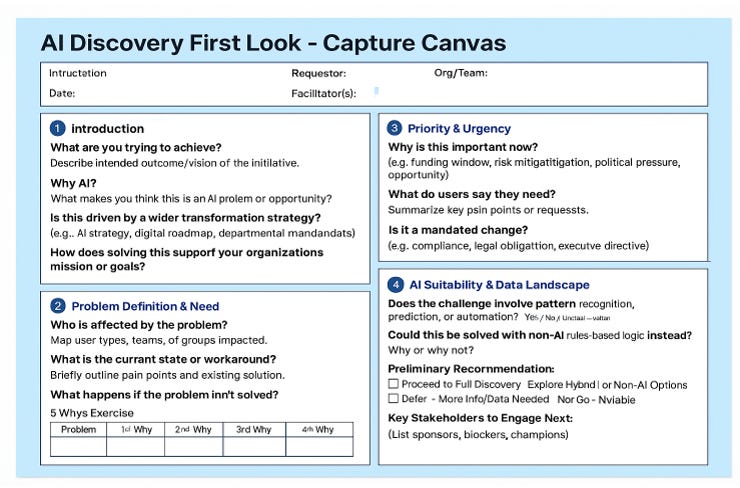
🧭 Introduction
- Date:
- Requestor:
- Org/Team:
- Contact Info:
- Facilitator(s):
- Submission Summary (AI project request submission Gateway or Equivalent):
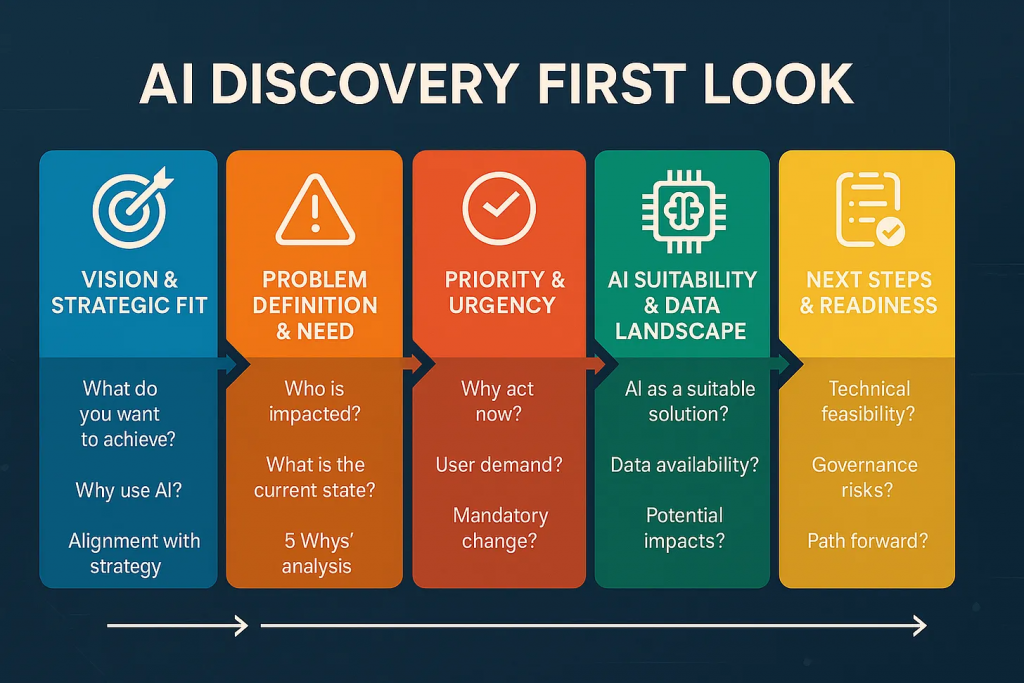
(Paste or summarize request info here) - Who are the stakeholders?1️⃣ Vision & Strategic FitWe want to understand your vision and how you got here.
- What are you trying to achieve?
Describe intended outcome/vision of the initiative. - Why AI?
What makes you think this is an AI problem or opportunity? - Is this driven by a wider transformation strategy?
e.g., AI strategy, digital roadmap, departmental mandate. - How does solving this support your organization’s mission or goals?
- Who is affected by the problem?
Map user types, teams, or groups impacted. - What is the current state or workaround?
Briefly outline pain points and existing solutions. - What happens if the problem isn’t solved?
- 5 Whys Exercise
- Why is this important now?
e.g., funding window, risk mitigation, political pressure, opportunity. - What do users say they need?
Summarize key pain points or requests. - Is it a mandated change?
e.g., compliance, legal obligation, executive directive.
- Does the challenge involve pattern recognition, prediction, or automation?
Yes / No / Unclear – explain. - Could this be solved with non-AI rules-based logic instead?
Why or why not? - What data is available?
- Volume, variety, velocity
- Ownership and access
- Completeness and bias concerns
- Who would be affected by an AI system?
Consider inclusion, fairness, and transparency.
- Current Technical Capabilities:
Infrastructure, internal AI/data skill sets, tooling. - Governance or Legal Considerations:
Any early red flags or escalation triggers? - Preliminary Recommendation:
☐ Proceed to Full Discovery
☐ Explore Hybrid or Non-AI Options
☐ Defer – More Info/Data Needed
☐ No-Go – Not Viable - Key Stakeholders to Engage Next:
List sponsors, blockers, champions.AI Discovery First Look Canvas output – Case StudyAI Scrum Assistant for Daily Stand-ups and Kanban Management🧭 Introduction- Date: June 17, 2025
- Requestor: Sarah Chen, Engineering Manager
- Org/Team: Product Development Team, TechFlow Solutions Ltd
- Contact Info: s.chen@techflow.com, +44 7123 456789
- Facilitator(s): Mike Thompson (AI Discovery Lead), Jennifer Park (Scrum Master)
- Submission Summary (AI project request submission Gateway): Project classified as AI/ML Project – Natural Language Processing category. Medium strategic priority. Team size: 4-8 people. Timeline: 3-6 months. Budget: £50k-£250k. Regulatory requirements: GDPR compliance needed for employee data processing.
- Who are the stakeholders?
- Primary: Development Team (12 developers), Scrum Masters (3), Product Owners (2)
- Secondary: Engineering Leadership, HR (data privacy), IT Security
- External: None identified
- Primary Users: 12 software developers across 4 scrum teams
- Secondary Users: 3 Scrum Masters, 2 Product Owners
- Impacted Stakeholders: Engineering leadership (visibility), clients (delivery predictability)
- “Stand-ups feel like a waste of time – we just repeat what’s in Slack”
- “I spend more time updating tickets than coding”
- “I can never remember what everyone said to update the board properly”
- “Cross-team dependencies get lost because boards aren’t current”
- “New team members don’t know what format to use for updates”
- Volume: 2 years of Jira ticket history (~3,000 tickets), Slack messages from dev channels (~50,000 messages), previous stand-up recordings (limited – 20 hours)
- Variety: Structured data (Jira fields, user stories), semi-structured (Slack), unstructured (meeting notes, recorded speech)
- Velocity: Daily updates from 12 developers, ~60 new tickets/month
- Ownership: IT owns Jira/Slack data, HR approval needed for voice processing
- Completeness: Good ticket history, limited historical stand-up data
- Bias concerns: Language preferences (native vs non-native English speakers), team culture differences
- Infrastructure: Cloud-based Jira/Confluence, Slack Enterprise, basic Azure/AWS setup
- Skills: 2 developers with ML experience, 1 data engineer, strong DevOps capabilities
- Tooling: Existing CI/CD pipelines, monitoring tools, but no AI/ML platform yet
- GDPR: Employee voice data processing requires explicit consent and data handling protocols
- HR Policy: Need to establish AI monitoring boundaries and employee rights
- Data Security: Voice data and meeting transcripts need encryption and access controls
- Intellectual Property: Ensure AI doesn’t expose sensitive project information
- Champions: Sarah Chen (sponsor), dev team leads who are frustrated with current process
- Decision Makers: CTO (budget approval), Head of Engineering (strategy alignment)
- Blockers/Skeptics: Traditional Scrum Master who prefers manual process, privacy-concerned developers
- Experts: Data Protection Officer (GDPR), IT Security (voice data handling), UX researcher (user adoption)
- Clear AI use case (NLP, automation, pattern recognition)
- Strong business justification with measurable pain points
- Available data sources and technical foundation
- Strategic alignment with transformation goals
- Manageable scope for initial implementation
- User-Centered Discovery: Detailed user journey mapping, consent mechanisms, adoption strategies
- Technical Discovery: NLP model selection, integration architecture, real-time processing requirements
- Data Discovery: GDPR compliance framework, data quality assessment, bias mitigation strategies
- Ethical Discovery: Employee monitoring policies, transparency requirements, fairness across communication styles
- Secure full discovery budget approval (£15k)
- Establish cross-functional discovery team
- Schedule stakeholder interviews and workshops
- Initiate GDPR impact assessment
- Begin technical architecture exploration
- What are you trying to achieve?
- AI/ML-Specific CanvasesMachine Learning Canvas – Created by Louis Dorard, this is a template for developing new or documenting existing predictive systems that are based on machine learning techniques GitHub – louisdorard/machine-learning-canvas: Template for developing new or documenting existing predictive systems that are based on machine learning techniques. Currently in HTML.
- AI Canvas Template – Offers a comprehensive, 90 to 120-minute workshop template that helps teams to understand the final vision of AI or ML products AI Canvas Template | Miroverse
- AI Product Canvas Template – Helps develop innovative AI products by defining capabilities, data requirements, and ethical considerations for AI solutions AI Product Canvas Template | Miro
- Deep Learning AI Canvas – Visual Paradigm template for deep learning projects
- AI Ethics CanvasesData Ethics Canvas – A tool for anyone who collects, shares or uses data to identify and manage ethical issues at the start of a project and throughout The Data Ethics Canvas | The ODI
- Open Data Institute: https://theodi.org/insights/tools/the-data-ethics-canvas-2021/
- AI Open Charter: https://aiopencharter.com/user-guide-ethical-ai-canvas/
- Website:
- Open Ethics Initiative: https://openethics.ai/canvas/
- Website: