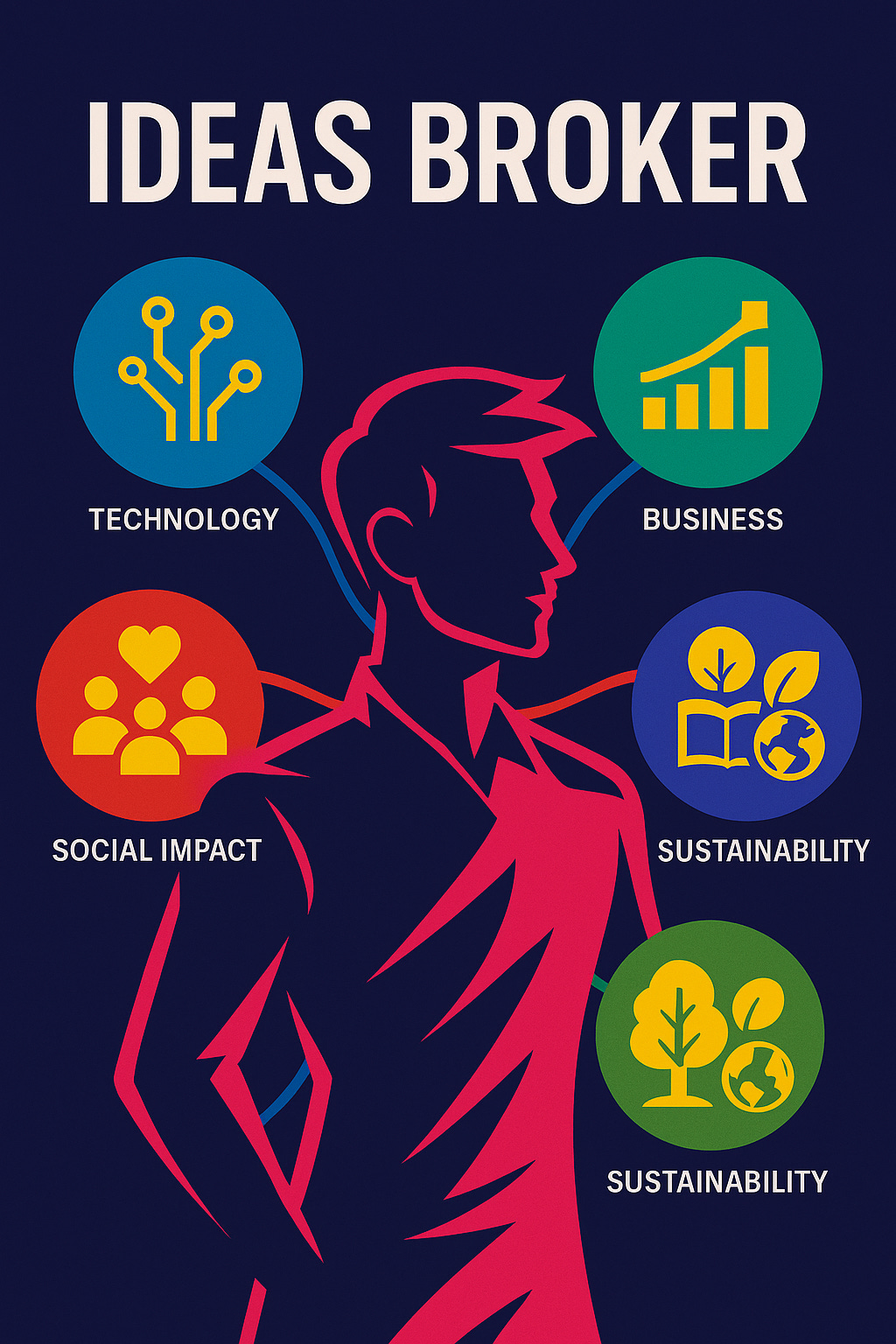
In a world where knowledge is fragmented, creativity is commodified, and innovation feels both urgent and elusive, a new kind of professional is quietly taking shape: the Ideas Broker. The role will be called different names depending on context and domain.
Imagine someone who sees what others don’t someone who can connect trends in fintech to cultural shifts in sub-Saharan Africa, who can map a sustainability strategy using insights from neuroscience, or who moves between art, strategy, and systems like a conductor leading a cross-genre symphony. That’s an Ideas Broker.
But here’s the catch: there’s no neat LinkedIn category for this. No established MBA track. No legacy firm with a corner office titled Chief Broker of Ideas. And yet more than ever this is the role organizations, start-ups, governments, and communities are desperately in need of.
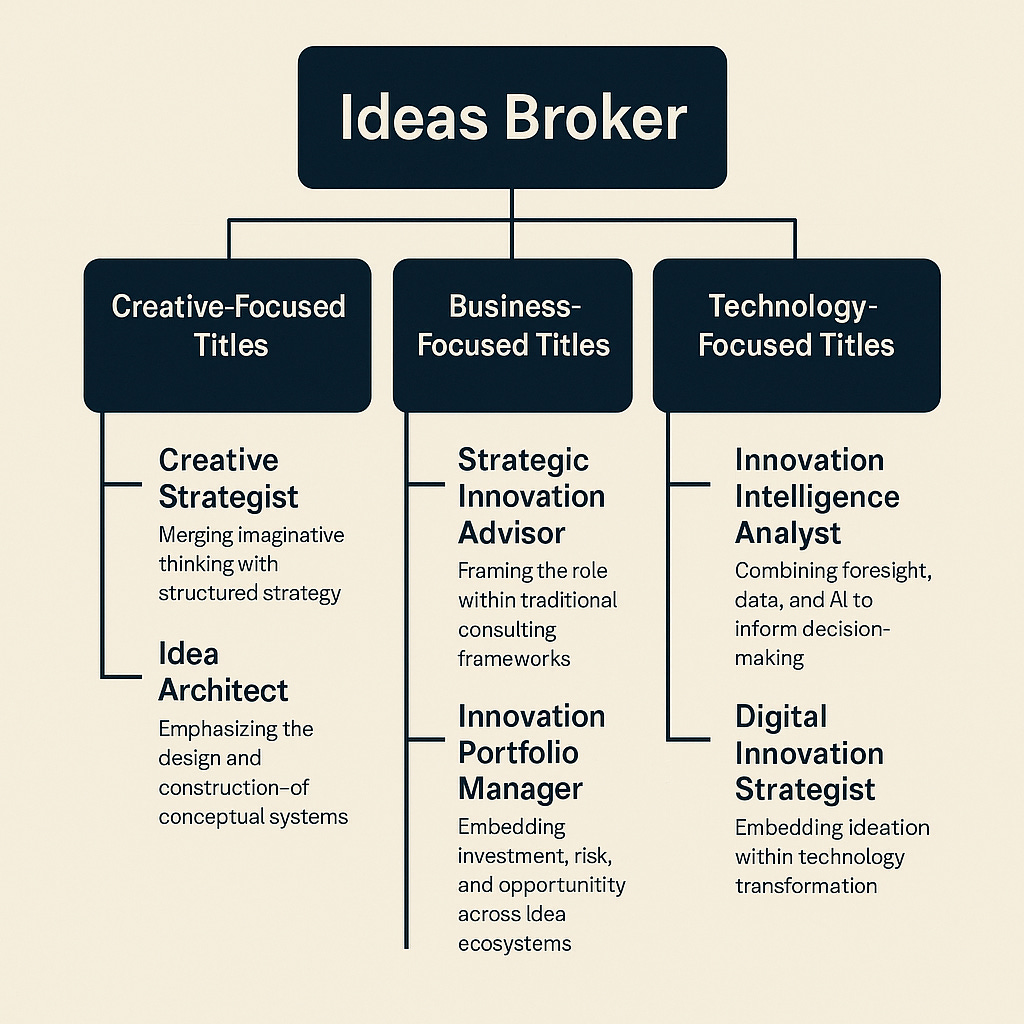
The current career map of this role is professionally aligned to (not limited to):
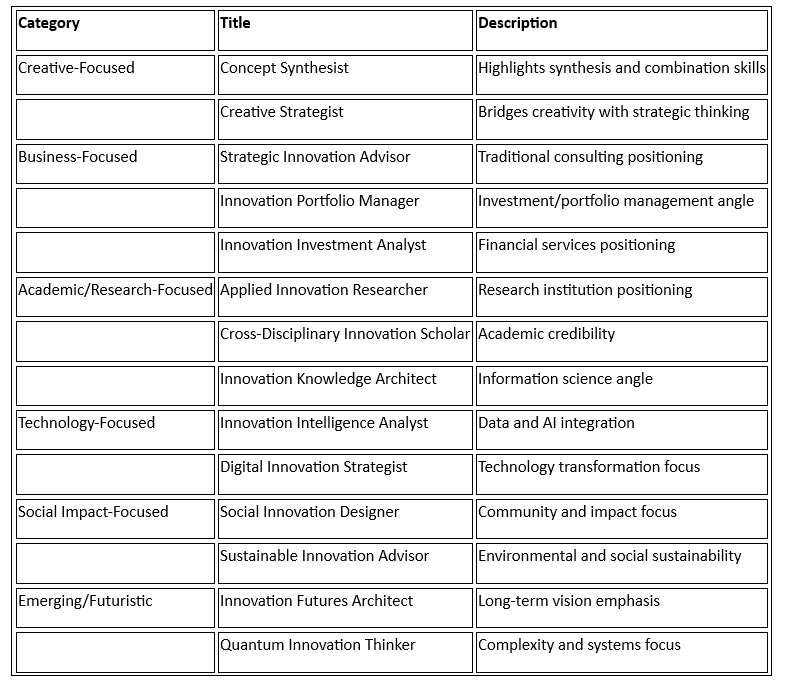
The inspiration for this was Six thinking Hats Edward de Bono and Sabrina Ramonov : Domain; Technology and Artificial intelligence, when she is wearing her consulting hat, her title would be….? I will let her decide
See full Career framework: Definition , Career path , Potential Income : Ideas Broker detailed career framework . Remember A conceptual framework is a visual or written representation of the relationships between different concepts, constructs, or variables. It provides the user, the navigation of the concept though the research and documentation of best practice. You chose the process, methodology or portions that works for you (don’t try to implement it all. I will do a story time post about a failure to launch a full iterative development framework as a process prior to the introduction of Agile ). It is a reference guide subject to new knowledge, improvement, and domain application).
Ideas Trigger : Create a Custom GPT or APP for the framework
🧭 Defining the Role: What Is an Ideas Broker?
At its core, the Ideas Broker is a synthesis-driven strategist: a person who gathers, analyses, and combines insights from various fields to produce innovative, context-sensitive solutions. They operate across disciplines, industries, and cultures, acting as a kind of translator between worlds.
They are not inventors in the classic sense, nor are they just consultants, creatives, or analysts. Rather, they are orchestrators of cross-pollination: able to take a kernel of an idea from one domain and help it thrive in another.
And because the title “Ideas Broker” may raise eyebrows in conventional settings, they often go by more professionally recognized names:
- Creative Strategist – Marrying storytelling with structured insight.
- Innovation Portfolio Manager – Weighing risk and reward in evolving ecosystems.
- Applied Innovation Researcher – Anchoring creativity in evidence-based practice.
- Digital Innovation Strategist – Navigating tech shifts with human-centred thinking.
- Social Innovation Designer – Tackling real-world problems with imagination.
🧠 The Skills Map: What It Takes to Be One
Becoming an Ideas Broker isn’t about a single degree or career path: it’s about assembling a toolkit across domains. Here’s a taste of what’s involved:
🧩 Analytical & Synthesis Skills
- Pattern recognition across industries
- Scenario planning and futures thinking
- Systems mapping and model design
🎨 Creative Problem-Solving
- Design thinking, TRIZ, and lateral ideation
- Concept development and prototyping
- Visual storytelling and communication
📚 Research & Knowledge Management
- Trend analysis, IP mapping, and information architecture
- Content curation across academic and non-traditional sources
🤝 Soft Skills that Make it Work
- Empathy, active listening, cultural sensitivity
- Negotiation, facilitation, and mentoring
- Adaptability, resilience, and cognitive flexibility
📈 Strategic & Business Acumen
- Market analysis and business modeling
- Innovation metrics and ROI measurement
- Portfolio and change management
This isn’t your average career checklist: it’s a dynamic, evolving blueprint that encourages continual reinvention and curiosity.
🧗♀️ Building a Career Without a Blueprint
Unlike traditional professions, there’s no linear path to becoming an Ideas Broker. There are, however, three overlapping routes:
- Academic + Creative: Pairing a liberal arts, psychology, or philosophy degree with design thinking or strategic foresight credentials.
- Consulting + Innovation: Blending client-facing problem solving with creative industry exposure.
- Tech + Systems: Leveraging AI, data, or digital platforms to reimagine human-centered solutions.
Whether you’re a polymath, generalist, or recovering specialist, the key is to curate your own hybrid identity—one that matches your strengths with real-world relevance.
Its always worth remembering that in some circumstances: experience and intellect beats formal education . Can you package that knowledge, intellect and experience as useful bodies of knowledge. Proof that vision and grit can sometimes outpace a diploma: Microsoft – Bill Gates dropped out of Harvard to co-found Microsoft with Paul Allen. It became the world’s dominant software company and helped define the personal computing era. Apple – Steve Jobs left Reed College and teamed up with Steve Wozniak and Ronald Wayne to launch Apple. Their innovations revolutionized consumer electronics and design. Facebook (now Meta) – Mark Zuckerberg left Harvard in his sophomore year to focus on Facebook, which grew into the world’s largest social media platform. Oracle – Larry Ellison dropped out of both the University of Illinois and Chicago City College before founding Oracle, a global leader in database software and enterprise solutions. Dell Technologies – Michael Dell left the University of Texas to build custom PCs from his dorm room. Dell became a major force in personal computing and enterprise tech
💼 Where the Work Happens (And Who Pays)
Ideas Brokers create value across diverse sectors, and increasingly, they’re being hired or founding firms to solve sticky, systemic problems. Clients range from:
- Fortune 500 companies and fast-scaling startups
- Government agencies navigating policy complexity
- NGOs designing community-led interventions
- Academic institutions rethinking curricula
- Venture capitalists seeking novel insights and deal flow
Revenue streams are equally diverse:
- Consulting retainers and innovation audits
- Workshop design and ideation sprints
- Speaking, publishing, and digital content
- Licensing methodologies and tools
- Platform-based commissions and community-building
Think of it as intellectual entrepreneurship, where ideas are the currency, and impact is the metric.
📊 Why Now? Why You?
Over 70% of executives cite innovation as a top strategic priority, but many admit they don’t know how to do it well. Traditional firms are too siloed, design studios are often too execution-focused, and internal teams too stretched.
That’s the Ideas Broker’s sweet spot not to replace existing models, but to connect them. You’re the one who bridges the gaps, identifies the overlaps, and unlocks new pathways.
And with AI, sustainability, and geopolitical instability reshaping our landscape, the need for human-centered, interdisciplinary synthesis has never been greater.
🚀 Your First Steps
Curious if this is the path for you? Here’s how to begin:
- Audit your experience across industries, disciplines, and projects
- Join 3–5 communities at the intersection of creativity, strategy, and innovation
- Create a portfolio of 10–15 case studies where you helped translate or adapt ideas
- Design your professional identity: pick a core title, support it with flexible ones
- Launch something small: a Substack (like this one), a workshop, a tool, a collaboration

🪄 A New Professional Identity
We are living through a renaissance of interdisciplinary possibility. The most powerful professionals of the future won’t be those who specialize in one thing but those who specialize in connecting.
That’s the Ideas Broker: part analyst, part artist, part entrepreneur, part futurist.
So if you’ve ever been told you’re “too curious,” “too cross-cutting,” or “hard to label” congratulations. You may already be walking the Ideas Broker path.
The only thing left is to name it, shape it, and share it.