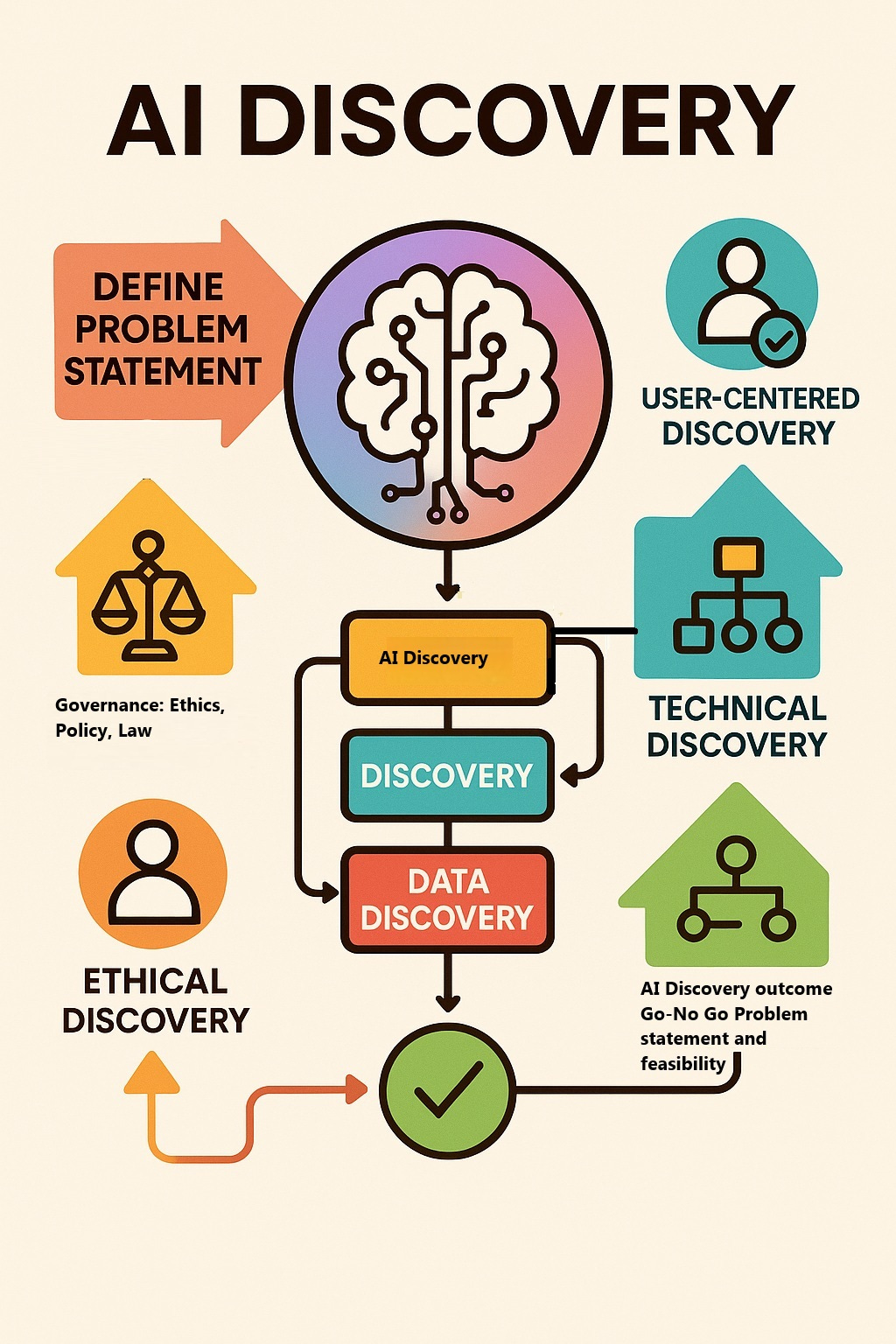
Preamble: AI Discovery in the Age of Enterprise Transformation
Artificial Intelligence (AI) has evolved from a specialized technology to a foundational pillar of enterprise strategy. Across sectors, organizations are increasingly seeking AI-powered solutions to boost productivity, inform decision-making, and secure competitive advantage. This surge (Project requests, pipeline is overloaded) in adoption underscores the need for structured discovery processes that guide AI assessment, implementation, and transformation at scale—while ensuring sustainable and ethical outcomes.
However, several challenges must be addressed during the discovery phase:
- Assessment Complexity: Is the initiative strategically aligned and technically viable? Is it an AI project ?
- Implementation Readiness: Can the organization integrate AI into existing workflows with appropriate governance and ethical oversight?
- Transformation at Scale: How will AI affect legacy systems, workforce capability, and regulatory compliance?
This document presents a two-phase digital discovery framework that helps organizations tackle these challenges systematically, ensuring AI initiatives are designed for impact, feasibility, and accountability.
Introduction
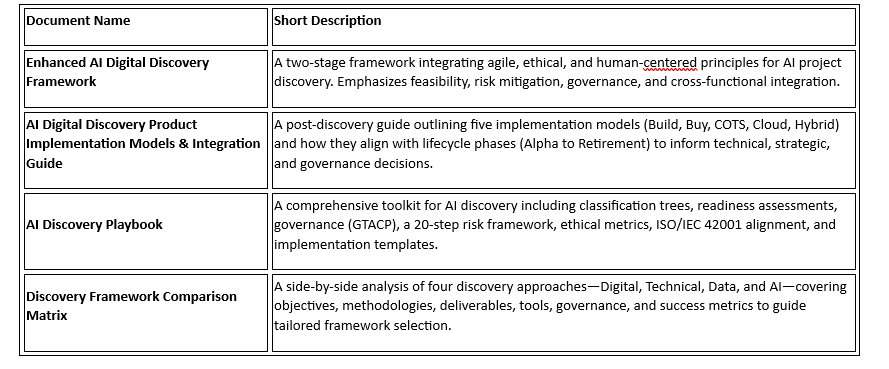
This guide outlines a two-stage AI-focused digital discovery process, supported by an AI Playbook It draws on best practices from the UK Government Agile Discovery model, GTACP AI governance, ISO/IEC 42001, and comparative frameworks spanning digital, technical, and data domains. This and supporting documents in the repository should be used as an input to creating your own AI discovery process and Playbook
Repository for AI Discovery or PDF Folder
To help with the decision on AI classification Adapt AI Classification Decision Checklist for Software Projects
Structured Digital Discovery Process
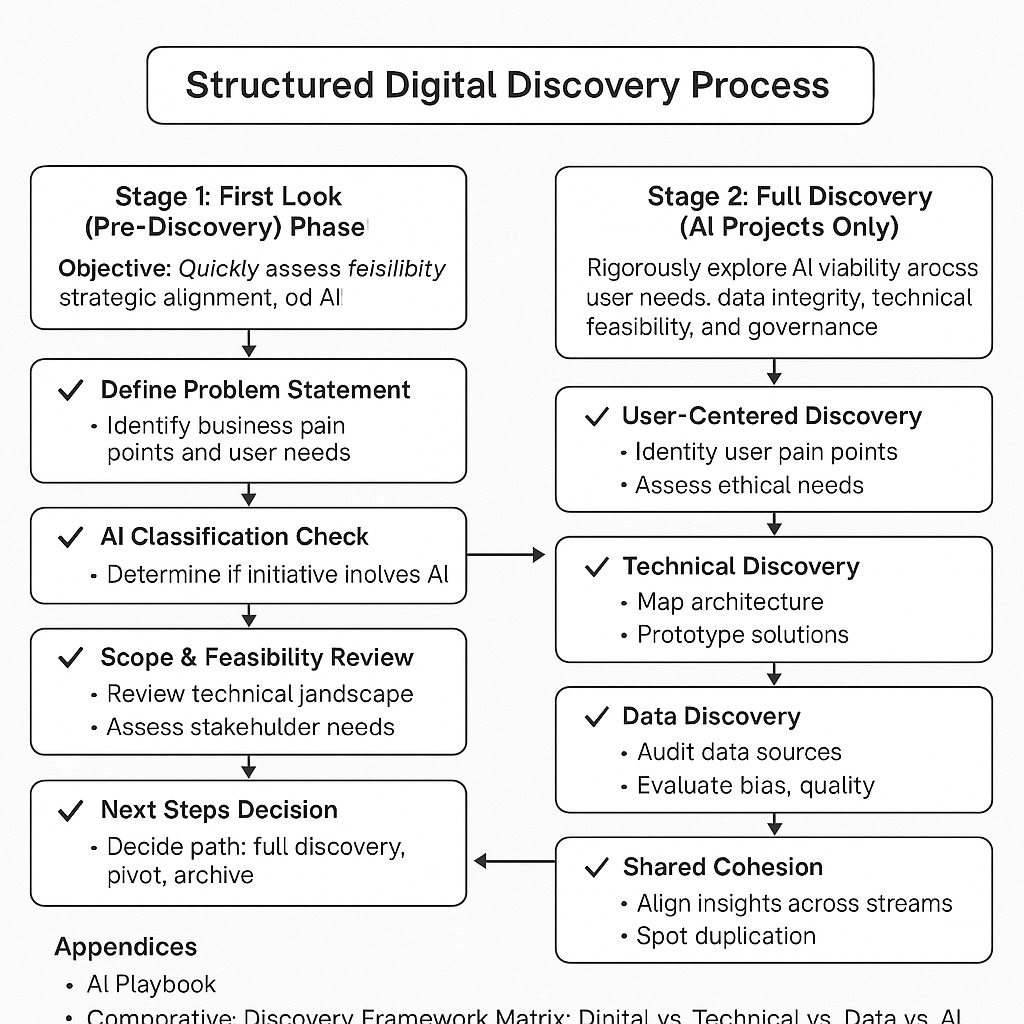
Stage 1: First Look (Pre-Discovery)
Objective: Rapidly assess initiative feasibility, strategic alignment, and whether it qualifies as AI-driven.
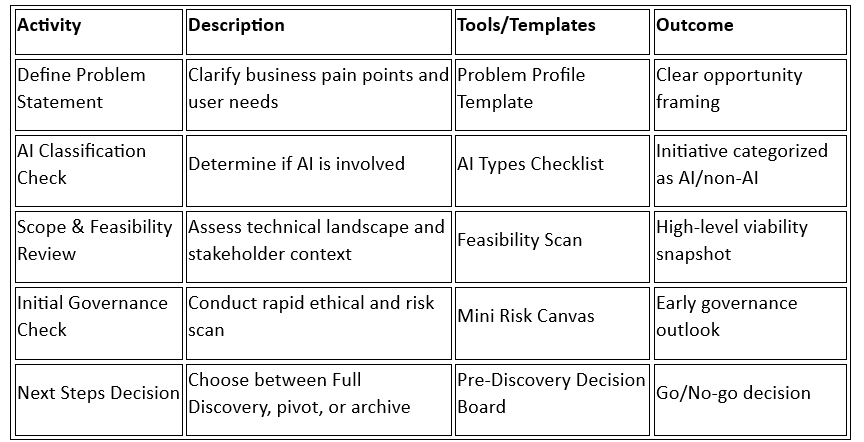
Timeline: 3–5 days (extendable to 1–2(4) weeks for complex initiatives)
Stage 2: Full Discovery (AI Projects Only)
Objective: Conduct in-depth exploration of user needs, data integrity, technical feasibility, and ethical considerations.
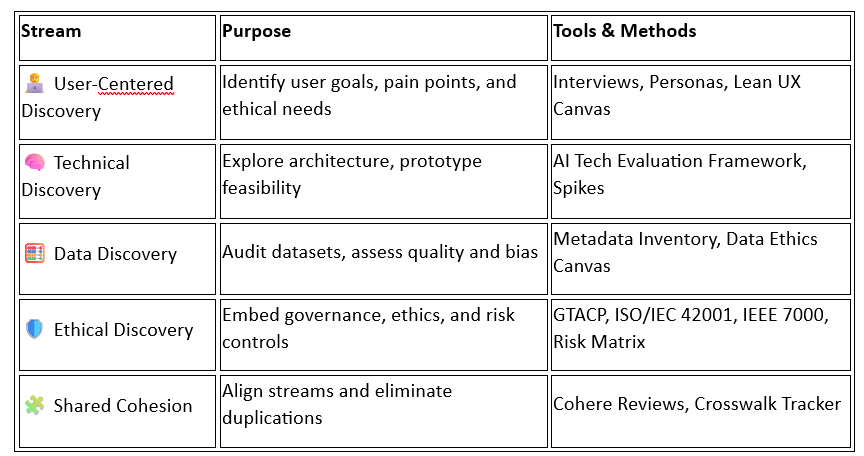
Timeline: 4–12 weeks
Trigger: Go decision from Stage 1 + Funding secured
The role and importance of AI policy , AI ethics and AI governance in AI discovery
AI policy, ethics, and governance form the critical foundation for responsible AI discovery, serving as essential guardrails that ensure artificial intelligence projects deliver societal benefit while minimizing potential harm.
AI policy establishes the regulatory framework and organizational standards that guide decision-making throughout the discovery process, ensuring compliance with legal / Government / International (AI policy) requirements and alignment with strategic objectives.
AI ethics provides the moral compass that helps teams navigate complex questions about fairness, bias, transparency, and human impact, data ownership, embedding principles of respect for human dignity and rights (PESTLE) directly into the design and development process.
AI governance creates the structural mechanisms—including oversight boards, decision-making processes, and accountability frameworks—that translate policy and ethical principles into actionable practices and measurable outcomes. Together, these three pillars transform AI discovery from a purely technical exercise into a holistic process that considers not just what can be built, but what should be built, ensuring that AI initiatives are viable, ethical, and aligned with both organizational values and broader societal good. Without this integrated approach, organizations risk developing AI systems that may be technically sophisticated but ethically problematic, legally non-compliant, or ultimately harmful to the communities they are meant to serve. See Checklist AI Discovery Governance Policy & Ethical Checklist for reference, review and adaptation. There are real challenges : Availability of expert resources, complexity and agility. The second is adaptation and flexibility as the technology is usually in advance of legislation and corporate policy
🧭 Implementation Framework
Core Steps
- Business Alignment: Define vision, KPIs, and strategic alignment
- Governance Integration: Use the GTACP model: Govern, Transparent, Assure, Cohere, Promote
- Risk & Ethics Workshop: Use the 20-point risk matrix to assess exposure
- Prototype & Test: Build proof-of-concept demos; conduct UX testing
- Feasibility Review: Validate deliverables or define remediation plans
🧑🤝🧑 Key Roles & Responsibilities (RASCI)
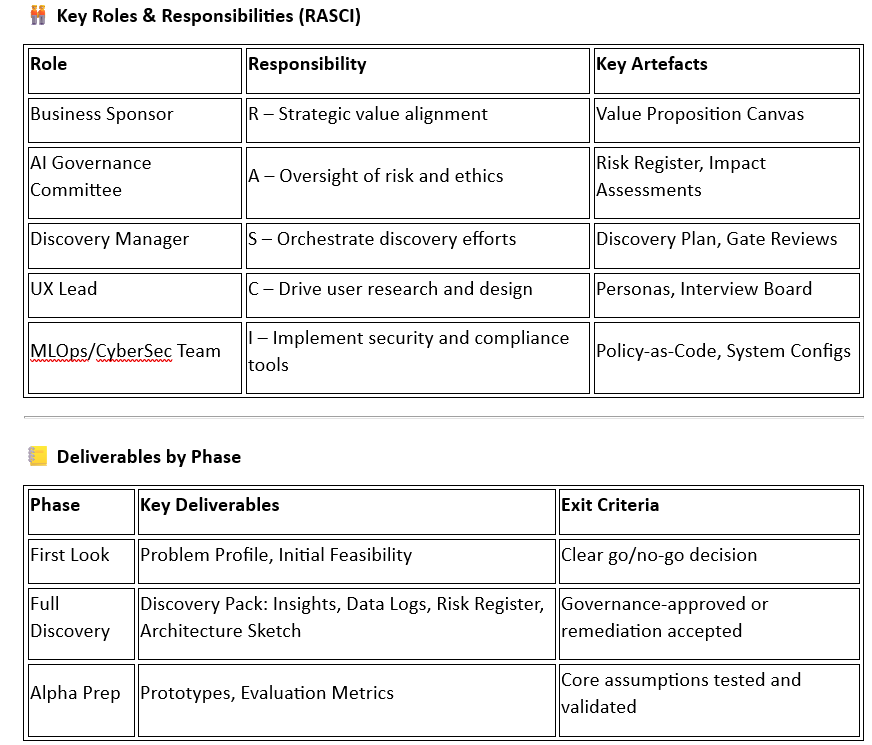
AI Discovery : Key Deliverables Framework
This framework should be tailored to specific organizational needs, project scope, and timeline constraints. The Discovery Lead should prioritize deliverables based on stakeholder requirements and implementation approach. There should be templates for every deliverable with explanations of how to use it . It ensures consistency, Identity\style and it enables stakeholder understanding of documents they are co-creating, assessing, reviewing and sign-off. It promotes engagement with the artifacts. AI Discovery Deliverables Framework . Never assume that the stakeholders understand your in house terminology and jargon be prepared to explain and over time create example that enable stakeholder understanding . If necessary create a generic AI Discovery glossary and a project specific one as that references the generic as needed.
AI Discovery: Tools & Technology Selection Framework
This framework provides guidance for selecting appropriate tools, software, hardware, and facilities to support AI Discovery activities across different engagement modes (in-person, remote, hybrid) and discovery phases. The framework supports tool selection for workshop facilitation, investigation techniques, communication, ideation, documentation, artifact creation, deliverable production, review processes, sign-off procedures, and co-creation activities. This framework should be customized based on organizational context, discovery scope, and stakeholder requirements. This exercise should reference and review and consider, reuse of existing, tools, technology stack and licences (All organisations should organise and audit organisational tools, software, licences , usage ,policy and cost of ownership). Regular review and updates ensure optimal tool selection as technology evolves and discovery practices mature. AI Discovery Tools & Technology Selection Framework
Conclusion: From Exploration to Execution
As AI continues to redefine how organizations innovate and compete, the need for deliberate, ethical, and strategically aligned discovery processes has never been greater. The frameworks and tools outlined in this guide are not just checklists—they represent a mindset shift toward responsible AI adoption.
By embracing a structured two-stage discovery process, supported by robust governance (GTACP), industry-aligned standards (like ISO/IEC 42001), and multidisciplinary collaboration, organizations can move beyond experimentation. They can design AI solutions that are technically feasible, ethically sound, and truly impactful.
Whether you’re launching your first AI initiative or scaling a mature portfolio, this playbook provides the foundational scaffolding to ensure clarity, confidence, and cohesion—from first look to full delivery. The future of AI isn’t just about what we build, but how—and why—we build it.
📎 Appendices
Detailed documents in Repository : AI Discovery , AI Discovery Governance Policy & Ethical Checklist , AI Classification Decision Checklist for Software Projects
Appendix A: AI Playbook
- AI Classification & Use Case Matrix
- GTACP Governance Implementation Guide
- 20-Step Risk Assessment Framework
- Ethics Success Metrics (e.g., Equalized False Negative Rate)
- ISO/IEC 42001-aligned Audit Checklist
- AI Evaluation Scorecard (ROI, data quality, risk, stakeholder alignment)
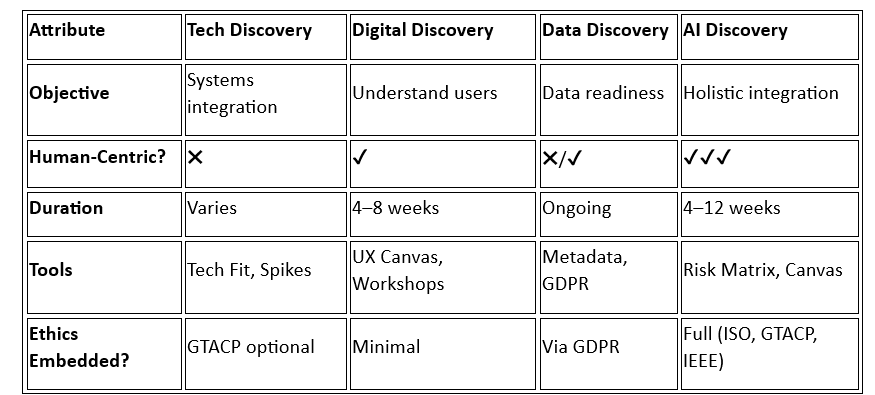
Appendix B: Comparative Discovery Framework Matrix
📈 Continuous Improvement
- Include “[Ethics]” tags in sprint-level user stories
- Automate data mapping, risk logs, and governance reports
- Maintain a Discovery Knowledge Hub and Patterns Library
Appendix C: Delivery Team Overview
Discovery Lead: Ensures structured process execution and stakeholder alignment
Product Owner: Defines priorities and scope
AI Governance Board: Oversees ethical and regulatory compliance
Technical Architect: Designs solution architecture
Data Scientist: Leads data quality and model design
UX Designer: Creates user-centric interfaces
Business Analyst: Captures business requirements
Project Manager: Coordinates deliverables and team operations
Regulatory Advisor: Provides legal and compliance insights
Stakeholder Group: Represents users, experts, and external collaborators