Preamble: Which Path to Abundant Computing and Power for the AI Age?
Artificial Intelligence is rapidly becoming one of the largest consumers of electricity in the modern economy.
The latest generation of AI training clusters already requires hundreds of megawatts of power, and future facilities may demand gigawatts of continuous electricity—equivalent to the output of major power stations. As nations race to build AI capabilities, energy infrastructure is emerging as the primary constraint on computational growth.
This challenge has sparked renewed interest in a range of unconventional energy solutions. Some proposals focus on expanding terrestrial generation through renewables, nuclear power, and energy storage. Others look upward toward the stratosphere and even space itself.
Two concepts stand out.
The first is the vision of orbital data centres and space-based solar power systems that exploit continuous sunlight above Earth’s atmosphere.
The second is a family of atmospheric technologies, including high-altitude solar aircraft, stratospheric platforms, energy kites, tethered aerostats, and elevated solar arrays capable of harvesting more consistent solar energy while remaining connected to terrestrial infrastructure. Both approaches promise abundant clean energy. Both seek to reduce dependence on overstretched electrical grids.
Yet they differ dramatically in cost, complexity, technological maturity, maintainability, and deployment timelines.
This article examines both pathways through the lenses of engineering feasibility, economic viability, sustainability, operational readiness, and long-term strategic value to answer three critical questions:
If the goal is abundant clean energy for AI and data centres without overwhelming terrestrial grids, which architecture is most likely to work first, scale fastest, and remain economically viable?
“The question is not which technology is more futuristic. The question is which technology can deliver abundant clean energy for AI first, at scale, and at a cost society can afford.”
The third question is cynical: If I wanted to raise hundred of billions of dollars which proposition sounds attractive now with no rigorous assessment of feasibility for the future?
YouTube: https://www.youtube.com/watch?v=T-cOntELlg0
Executive Summary
Artificial intelligence is driving an unprecedented demand for electricity. The next generation of AI data centres may require gigawatts of continuous power comparable to the output of large power stations.
This has reignited interest in radical energy concepts including:
- Orbital data centres
- Space-based solar power (SBSP)
- Small Modular Reactors (SMRs)
- Offshore energy systems
- Atmospheric solar platforms
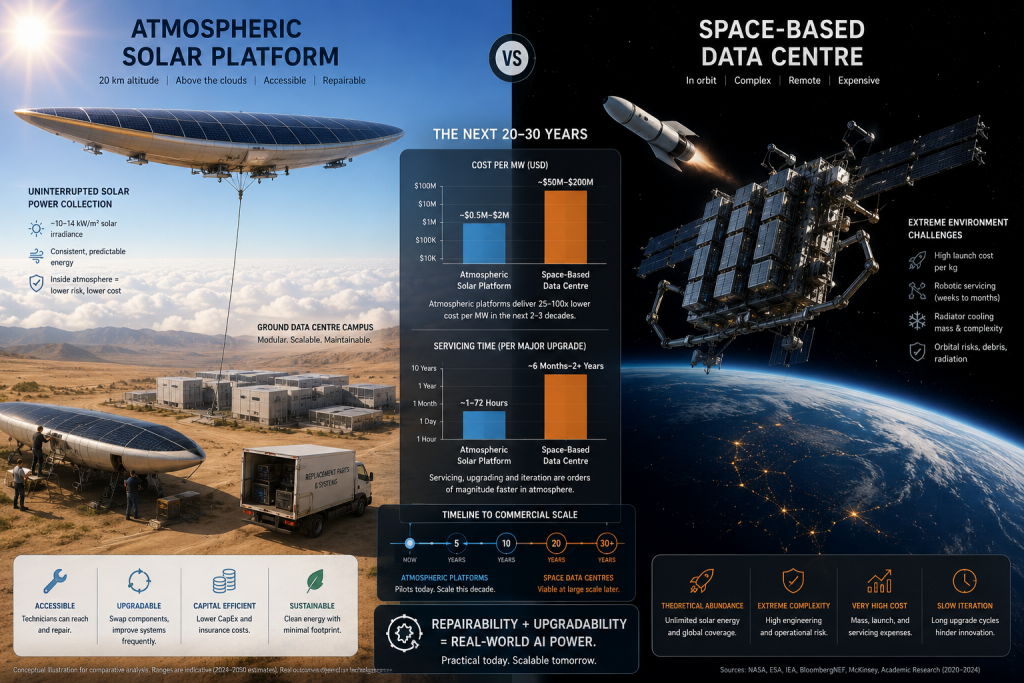
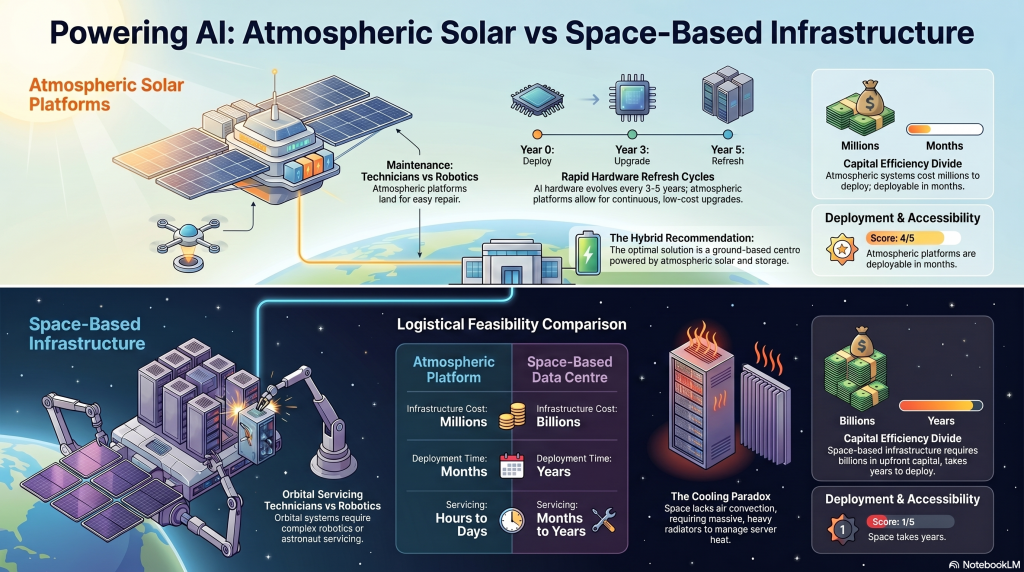
While space-based data centres capture public imagination and benefit from continuous solar exposure, atmospheric solar platforms may represent a more practical and economically viable pathway during the next two decades.
This article examines the engineering, economic, sustainability, operational, and strategic implications of both approaches and evaluates which architecture is most likely to provide scalable clean power for future AI infrastructure.
The Core Challenge: AI’s Energy Appetite
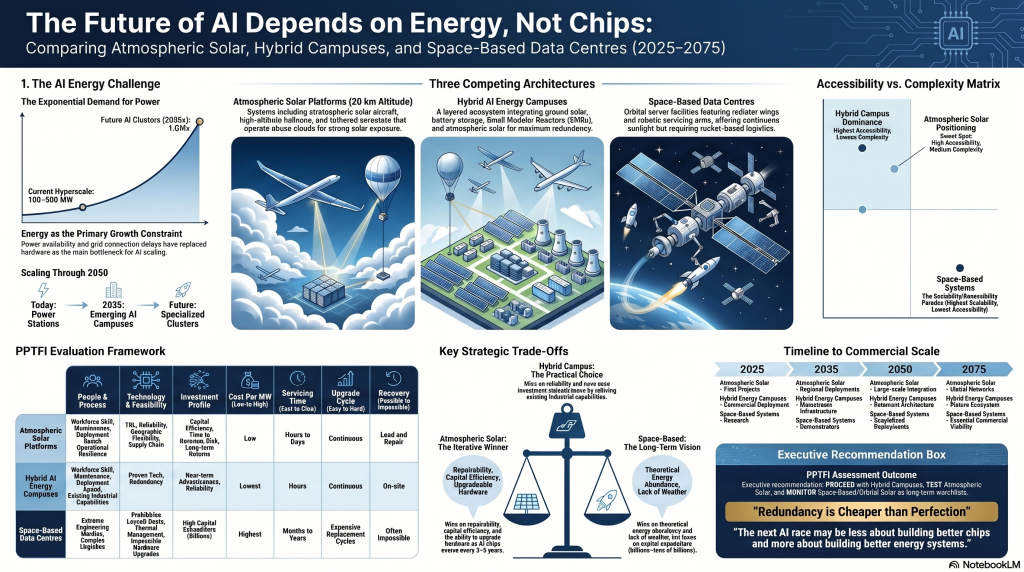
The limiting factor for AI is increasingly not computing hardware. It is electricity.
Modern hyperscale AI facilities already consume hundreds of megawatts. Industry forecasts suggest future AI campuses may require:
- 100–500 MW today
- 1 GW+ within the next decade
- Multi-GW clusters in the longer term
The challenge is compounded by:
- Grid connection delays
- Renewable intermittency
- Rising electricity demand
- Carbon reduction targets
- Data sovereignty requirements
The result is a global search for abundant, reliable, low-carbon energy.
Two Visions of the Future
Vision 1: Space-Based Data Centres
The concept is straightforward: Deploy large-scale computing infrastructure in orbit powered by continuous solar energy.
Advantages frequently cited include:
- Nearly constant sunlight
- Potential passive thermal management
- No terrestrial land constraints
- Access to space-based energy generation
- Potential integration with future orbital manufacturing
Advocates argue that orbital infrastructure could eventually support massive computational expansion without burdening terrestrial grids.
Vision 2: Atmospheric Solar Platforms
Atmospheric systems operate within Earth’s atmosphere, typically between 15–30 km altitude.
Examples include:
- High Altitude Platform Stations (HAPS)
- Solar-powered pseudo-satellites
- Stratospheric aircraft
- Energy kites
- Tethered aerostats
- Elevated solar arrays
- Power-beaming demonstrators
These systems harvest higher-intensity solar energy above most clouds and weather systems while maintaining direct access to terrestrial infrastructure.
Engineering Reality Check
The Challenge of Orbital Infrastructure
The primary obstacle is mass.
Modern hyperscale data centres consist of:
- Servers
- Power systems
- Cooling systems
- Batteries
- Networking equipment
- Structural infrastructure
A terrestrial 100 MW facility can contain tens of thousands of tonnes of equipment.
Even with reusable launch systems, launching and maintaining such infrastructure remains extremely expensive.
NASA’s recent assessment concluded that space-based solar power remains substantially more expensive than terrestrial alternatives under current assumptions.
Research:
Hardware Replacement Problem
Data-centre hardware typically follows a replacement cycle of:
- 3–5 years for servers
- 5–10 years for networking equipment
- Continuous upgrades for AI accelerators
On Earth this is routine.
In orbit this becomes a logistics operation requiring:
- Launch capacity
- Robotic servicing
- Orbital maintenance infrastructure
- Spare-parts supply chains
Every upgrade becomes a space mission.
Latency and Data Gravity
Most computing demand remains tied to terrestrial users.
Large-scale orbital processing introduces challenges including:
- Ground-space-ground latency
- Bandwidth limitations
- Regulatory constraints
- Data sovereignty issues
Many AI workloads benefit more from proximity to users than proximity to sunlight.
Why Atmospheric Platforms May Arrive First
Atmospheric systems leverage existing infrastructure.
Advantages include:
Immediate Grid Integration
Generated power can connect directly to:
- Existing substations
- Regional grids
- Industrial campuses
- Data-centre clusters
No orbital logistics required.
Repairability
Aircraft and atmospheric platforms can be:
- Landed
- Inspected
- Upgraded
- Repaired
This dramatically lowers lifecycle costs.
Incremental Deployment
Unlike orbital megaprojects, atmospheric systems can scale gradually.
Deployment can proceed through:
- Pilot systems
- Regional deployments
- Utility-scale networks
- AI campus integration
This allows learning and optimization throughout development.
The Sustainability Question
A common assumption is that space-based systems are automatically more sustainable.
Reality is more nuanced.
Space systems require:
- Launch vehicles
- Orbital manufacturing
- Replacement launches
- End-of-life disposal
Atmospheric systems benefit from:
- Existing maintenance ecosystems
- Lower transportation energy
- Easier recycling
- Faster technology refresh cycles
Long-term sustainability depends heavily on launch economics and orbital servicing maturity.
Technology Readiness Comparison
| Technology | Estimated Readiness |
| Utility Solar + Storage | Very High |
| Wind + Storage | Very High |
| Atmospheric Solar Platforms | Medium-High |
| Airborne Wind Energy | Medium |
| Small Modular Reactors | Medium |
| Space-Based Solar Power | Low-Medium |
| Orbital Data Centres | Low |
Current atmospheric solutions are substantially closer to commercial deployment than orbital computing infrastructure.
Research Momentum and proof of concepts
China’s Beijing Linyi Yunchuan Energy Technology: Proof of concept
China’s Beijing Linyi Yunchuan Energy Technology tested the S2000, a helium‑filled airborne wind energy system (AWES) that flies at 6,500 ft (2,000 m) to capture stronger, steadier high‑altitude winds. The blimp carries 12 onboard turbines, sends power down a tether to the ground, and in its test generated 385 kWh — roughly 13 days of electricity for an average U.S. home.
Key Points
- Device: S2000 airborne wind energy system — a large helium airship with 12 turbines.
- Altitude: Operates at 6,560 ft where winds are more stable and powerful.
- Energy Output: 385 kWh during test flight.
- Equivalent Use: Enough to power a typical U.S. household for ~13.3 days.
- Purpose: Provide clean energy to inland regions and cities where ground‑based wind farms are impractical.
- Mechanism: Electricity generated aloft travels down the tether to the grid.
Why It Matters
High‑altitude wind is one of the most consistent renewable energy sources on Earth. If scalable, airborne turbines could:
- Deliver power to dense cities
- Reduce land use
- Operate where traditional wind towers cannot
- Provide rapid‑deploy energy in emergencies
Comparable Proof‑of‑Concept Systems: Summary Table (see appendices for details)
| System | Type | Country | Status | Link |
| Kitemill KM1/KM2 | Kite‑based | Norway | Operational prototype | kitemill.com |
| Altaeros AWT | Aerostat blimp | USA | Tested & demonstrated | restservice.epri.com |
| Kitepower K-BESS | Kite‑based | Netherlands | Field‑deployed | IEA Wind TCP |
| MegaAWE | Kite‑based | Ireland | Utility‑scale tests | airbornewindeurope.org |
| TU Delft AWE | Ground‑gen kite | Netherlands | Research prototypes | WES |
| Airborne Wind Europe | Multi‑project | EU | Active programs | airbornewindeurope.org |
Others Concepts:
Despite the challenges, space solar remains an active research area. Notable initiatives include:
ESA SOLARIS Programme
The European Space Agency is investigating large-scale space-based solar power under the SOLARIS initiative. ESA sees potential for continuous clean energy generation delivered wirelessly to Earth.
Research:
Caltech Space Solar Power Project
Researchers are developing lightweight structures and wireless power transmission technologies required for future orbital solar systems.
Research:
NASA Space-Based Solar Power Studies
NASA continues evaluating the economic and technical viability of SBSP systems while recognizing significant cost and deployment challenges.
Research:
Comparative Assessment Matrix
| Criterion | Weight | Atmospheric Platforms | Space Data Centres |
| Capital Cost | 20% | 4 | 1 |
| Operational Cost | 10% | 4 | 1 |
| Technology Maturity | 15% | 4 | 2 |
| Energy Availability | 15% | 4 | 5 |
| Sustainability | 10% | 4 | 3 |
| Ease of Deployment | 10% | 4 | 1 |
| Maintainability | 5% | 5 | 1 |
| Regulatory Complexity | 5% | 3 | 2 |
| Scalability | 5% | 4 | 5 |
| Time to Market | 5% | 5 | 1 |
Weighted Outcome:
- Atmospheric Platforms: Strong Near-Term Winner
- Space-Based Data Centres: Long-Term Strategic Option
People–Process–Technology Assessment
People
Atmospheric Platforms:
- Existing aerospace workforce
- Existing maintenance skills
- Existing utility expertise
Space Data Centres:
- Requires new orbital operations workforce
- Robotic servicing specialists
- Space logistics ecosystem
Advantage: Atmospheric Platforms
Process
Atmospheric Platforms:
- Established certification pathways
- Existing operational models
Space Data Centres:
- New maintenance processes
- New regulatory structures
- New orbital servicing procedures
Advantage: Atmospheric Platforms
Technology
Atmospheric Platforms:
- Mostly evolutionary
Space Data Centres:
- Requires multiple breakthrough technologies simultaneously
Advantage: Atmospheric Platforms
The Most Likely Development Path
Phase 1 (2025–2035)
Dominant technologies:
- Utility solar
- Wind
- Batteries
- Atmospheric solar systems
- SMRs
Phase 2 (2035–2050)
Emerging technologies:
- Power beaming
- Large HAPS networks
- Hybrid energy architectures
Phase 3 (2050+)
Potential technologies:
- Space-based solar power
- Orbital industrial platforms
- Orbital data centres
Conclusion
Space-based data centres remain one of the most ambitious infrastructure concepts ever proposed. They offer compelling theoretical advantages, particularly when paired with space-based solar power.
However, the practical realities of launch costs, maintenance complexity, hardware refresh cycles, and deployment timelines suggest that orbital computing is unlikely to become the primary solution to AI’s energy challenge in the near future.
Atmospheric solar platforms occupy a unique middle ground.
They capture many of the benefits associated with high-altitude solar collection while retaining the economics, maintainability, and infrastructure compatibility of terrestrial systems.
If the objective is abundant clean energy for AI within the next two decades, atmospheric solar platforms appear far more likely to scale first.
Space-based energy may ultimately become part of humanity’s long-term energy architecture.
But the path to that future may begin not in orbit, but in the stratosphere.
Comparative Form Factors and Energy Architectures for AI-Scale Data Centres
The most useful comparison is not simply atmospheric versus space, but the entire future energy ecosystem supporting AI-scale computing.
Executive Comparison Matrix
| Architecture | Typical Form Factor | Power Range | Technology Maturity | Relative Cost | Sustainability | Scalability | Ease of Deployment | AI Data Centre Suitability |
| Ground Solar + Storage | Solar farms + batteries | 100 MW – GW | Very High | Low | High | High | High | High |
| Offshore Wind | Offshore wind farms | 500 MW – GW+ | High | Medium | High | High | Medium | High |
| Atmospheric Solar Platforms | HAPS, aerostats, solar aircraft | 10 MW – GW (networked) | Medium | Medium | High | High | Medium-High | High |
| Ocean Energy Platforms | Floating energy islands | 100 MW – GW | Medium | High | High | High | Medium | High |
| SMR Nuclear | Distributed reactors | 50 MW – 500 MW | Medium-High | High | Medium | Medium | Medium | Very High |
| Geothermal | Enhanced geothermal systems | 50 MW – GW | Medium-High | Medium | High | Medium | Medium | High |
| Space Solar Power | Orbital solar collectors | GW+ potential | Low | Very High | Medium | Very High | Very Low | Medium |
| Orbital Data Centres | Space-based compute clusters | Unknown (GW+) | Very Low | Extreme | Unknown | Very High | Very Low | Long-Term Only |
Appendices
Assessment Matrix Dimensions
CAPEX, OPEX, Technology Maturity, Energy Yield, Sustainability, Ease of Implementation, Scalability, Regulatory Complexity, People, Process, Supply Chain, Maintainability.
| Model | Maturity | Energy | Sustainability | Implementation | People | Process | Relative Cost |
| Atmospheric Solar Platforms | 4/5 | 4/5 | 4/5 | 4/5 | 4/5 | 4/5 | 3/5 |
| Space-Based Data Centres | 2/5 | 5/5 | 3/5 | 1/5 | 2/5 | 2/5 | 1/5 |
| SMR + Terrestrial DC | 4/5 | 5/5 | 3/5 | 3/5 | 3/5 | 4/5 | 2/5 |
| Grid + Renewables | 5/5 | 3/5 | 4/5 | 5/5 | 5/5 | 5/5 | 4/5 |
Proof of concept or inflight research
Here are other proven, real‑world airborne wind energy (AWE) proof‑of‑concept systems, each with verified sources and direct links from the search results. These are the closest global parallels to China’s S2000 flying turbine.
1. Kitemill (Norway) — Operational AWE Proof‑of‑Concept
Kitemill is one of the world’s leading AWE developers and already operates a working proof‑of‑concept system that automatically generates clean energy. Their KM1 and upcoming KM2 (100 kW) platforms are part of a step‑wise scale‑up toward megawatt‑class systems. kitemill.com
Key points:
- Fully functional prototype already flying
- EU‑funded NAWEP project (€3.35M) to deploy 12 AWE units
- Long‑term plan: 100 kW → 500 kW → megawatt scale
Link:
- Kitemill Projects Page: ** kitemill.com
2. Altaeros (USA) — Aerostat Airborne Wind Turbine (AWE Blimp)
Altaeros Energies developed one of the earliest blimp‑based airborne wind turbines, similar in concept to China’s S2000. Their helium‑filled aerostat lifts a conventional turbine to high altitudes (~2,000 ft). restservice.epri.com
Key points:
- Uses a helium aerostat to lift a turbine
- Designed for remote/off‑grid power
- Survives extreme winds; slow‑descent safety system
- One of the earliest commercial AWE demonstrations
Link:
- Altaeros overview (EPRI report): Source in citation above
3. Kitepower (Netherlands) — K-BESS Demonstration System
Kitepower has deployed multiple working AWE systems, including the K-BESS, demonstrated with a Dutch construction company. It uses a tethered kite to generate electricity in pumping cycles. IEA Wind TCP
Key points:
- Active field deployments in Europe
- Captures wind up to 800 m altitude
- Lower material use than tower turbines
- Part of IEA Wind Task 48 global AWE program
Link:
- IEA Task 48 Annual Report (includes Kitepower): Source in citation above
4. MegaAWE (Ireland) — Utility‑Scale Test Flights
MegaAWE conducted utility‑scale test flights in County Mayo, Ireland, in 2023, using kite‑based AWE systems to explore high‑altitude wind harvesting. airbornewindeurope.org
Key points:
- Large‑scale test hub established
- Supported by Interreg North‑West Europe
- Partners include RWE Renewables and Kitepower
- Focus on remote‑area energy supply
Link:
- MegaAWE project summary: Source in citation above
5. Delft University / TU Delft — Ground‑Generation Kite Systems (100–2000 kW)
TU Delft developed a multidisciplinary design and optimization framework for kite‑based AWE systems, demonstrating scaling from 100 kW to 2 MW in ground‑generation concepts. WES
Key points:
- Academic proof‑of‑concept validated through modelling and prototypes
- Focus on cost‑optimized designs
- Shows optimal system size between 100–1000 kW
- Influences global AWE engineering standards
Link:
- Research paper (WES Journal): DOI in citation above
6. Airborne Wind Europe — Global AWE Project Directory
Airborne Wind Europe maintains a pan‑European directory of AWE projects, including MERIDIONAL, AWETRAIN, and Task 48 collaborations. airbornewindeurope.org
Key points:
- Central hub for AWE research and deployment
- Includes modelling, training, and commercialization pathways
- Connects 11+ countries and dozens of companies
Link:
- Airborne Wind Europe Projects: Source in citation above
Research Appendix (Recommended Links)
- NASA Space-Based Solar Power Report (2024)
- NASA SBSP Technical Study
- ESA SOLARIS Initiative
- ESA Net-Zero Assessment of SBSP
- Caltech Space Solar Power Project
- NASA Solar Power Research Overview
- NASA POWER Solar Resource Database
Abbreviations & Uncertainty Tags
- AI = Artificial Intelligence
- HAPS = High Altitude Platform Station
- SBSP = Space-Based Solar Power
- SMR = Small Modular Reactor
- KK = Known Known
- KU = Known Unknown
- UU = Unknown Unknown