Preamble: Why stories do not predict the future, and why they still help build it
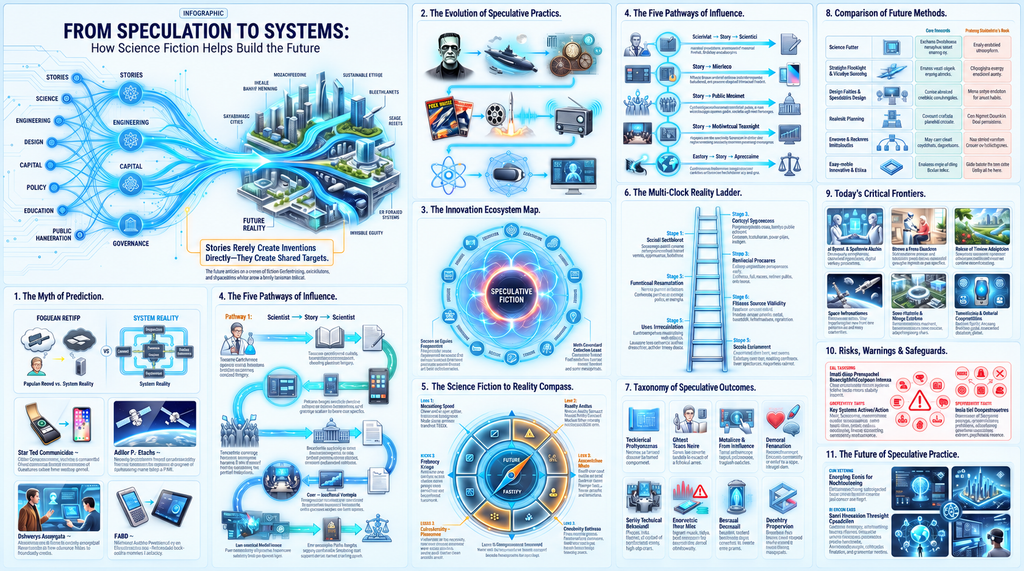
Science fiction is often asked to perform a party trick. Which inventions did it predict? The question is entertaining, but it misses the more consequential story. A fictional communicator, scanner, satellite relay or conversational computer does not become real because it appeared first in a novel or on a screen. It becomes real when science, engineering, manufacturing, capital, policy, culture and everyday need line up.
Fiction makes possibilities visible before all those conditions exist. It can give people a felt encounter with a future arrangement of life. It can make a device seem useful, frightening, desirable, awkward or unjust. That makes it a rehearsal space, not a crystal ball. For supporting documents see: Science fiction to reality (Description in Appendices) For futher exposition see YouTube: https://youtu.be/z2W0bWK6l-I
A better question than did it predict it
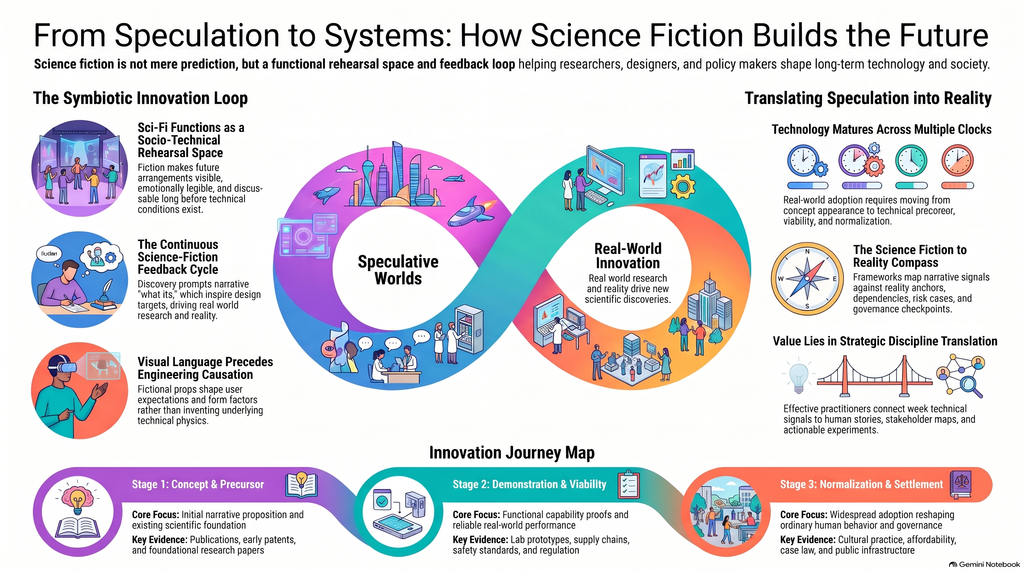
The useful question is not whether a story correctly foretold a finished product. It is how an imagined world affects the choices through which a technical future is researched, designed, accepted, resisted and governed. The answer is usually indirect, distributed and cumulative.
A fictional medical scanner can carry a proposition that diagnosis should be immediate, portable, non-invasive and understandable outside a laboratory. A communicator can suggest that connection should travel with the person. A space colony can expose assumptions about extraction, labour, family and political power. The visible object is often the smallest part of the idea.
Seven ways a story can matter
| Form of influence | What it contributes | What counts as evidence |
| Technical prefiguration | A mechanism or technical arrangement appears before practical deployment. | A stated mechanism, earlier research context and later engineering lineage. |
| Direct translation | A named team says a work informed a product or programme. | Design records, interviews, patents or correspondence. |
| Interface influence | A familiar way to use or recognise a new system. | A form factor, interaction pattern or shared visual grammar. |
| Demand formation | A capability becomes emotionally legible and socially desirable. | Public vocabulary, cultural expectation and institutional attention. |
| Consequences rehearsal | A future makes changes to daily life, work and power discussable. | Scenario work, public debate, education or policy discussion. |
| Negative prototype | A future operates as a warning rather than a product brief. | Safeguards, red-team scenarios, bans or redesign questions. |
| Dormant reservoir | An idea remains unbuilt but supplies a later generation with questions. | Reinterpretation when materials, science or social conditions change. |
These categories can overlap. The point is not to force every story into one box. It is to avoid the lazy claim that resemblance proves causation.
The loop between imagination and engineering
The relationship is not a conveyor belt from author to inventor. New discoveries give writers fresh material. Writers extend those discoveries into worlds. Those worlds give researchers, product teams and the public a shared picture. Prototypes test fragments of that picture. Reality then changes the next generation of stories. NASA producer Dan Curry describes the relationship as symbiotic: science gives rise to new what-if questions, while imagined possibilities can stimulate enquiry. [4]
Arthur C. Clarke offers a clear case because he moved across these worlds himself. In 1945 he proposed geostationary satellites as global communications relays. The European Space Agency identifies the relevant orbital region as the Clarke Belt. His proposal did not eliminate the need for launch systems, electronics, ground infrastructure, organisations and decades of engineering. It articulated a large-scale possibility that later systems could pursue. [1] [2]
The Star Trek communicator belongs in a different category. Long-distance wireless communication and portable radio already had independent technical histories. The programme made compact personal communication memorable. That is an interface and expectation effect, not proof that a television prop invented radio networks, cellular standards or batteries. [3]
The missing science behind the prop
Stories cannot carry every failed experiment, safety case, procurement route, manufacturing compromise or maintenance plan. They need room for character, pace and meaning. The risk is that audiences remember the device but lose the hypothesis, assumptions and constraints behind it.
A useful answer is companion material, not turning novels into textbooks. An assumption map can show the science being extended, the constraints being bent, the unknowns, the stakeholder questions and the reasons a proposition might never be built. A silicon-based life form, for example, can be a serious chemistry thought experiment, a challenge to carbon-centred assumptions, or both. It should not be confused with settled science merely because it appears in a convincing story.

How long does fiction take to become reality
There is no universal science fiction lag. A concept has several clocks. One dates its narrative appearance. Another dates the technical precursor. Another marks a functional demonstration. Another begins only when people can obtain, trust, maintain and afford it. A final clock records social settlement: standards, law, skills, repair, insurance, accessibility and changed expectations.
| Stage | Question to ask | Typical evidence |
| Concept appearance | When did the recognisable proposition appear? | Novel, film, exhibition, illustration or public demonstration. |
| Technical precursor | What enabling science or component base already existed? | Papers, experiments, patents, instruments and standards. |
| Functional demonstration | When did a working version show the core capability? | Laboratory result, pilot, mission or public demonstration. |
| Viable use | When could people use it reliably outside the lab? | Service design, supply, support, regulation and infrastructure. |
| Mass normalisation | When did it reshape everyday behaviour? | Adoption, affordability, accessibility and cultural practice. |
| Second-order settlement | What rules, repairs and norms followed? | Law, institutions, education, rights and public accountability. |
Software can move from concept to prototype quickly. Energy, healthcare, housing, transport, biology and public infrastructure move at the pace of evidence, materials, safety, trust and governance. A compelling image of the future does not speed up every dependency.
The future is contested, not merely imagined
Speculative work can open a conversation. It cannot settle it. A worker, investor, disabled user, regulator, community organiser and product team may all read the same scenario differently because they carry different risks and responsibilities. Good speculative practice makes those disagreements visible early. It records who benefits, who bears costs, who can object and what conditions would justify pausing or redesigning a path.
This matters especially for surveillance, automated decision-making, synthetic media, biotechnology and systems that shape access to work, care or public services. Dystopian stories can function as negative prototypes. They are not forecasts or policy substitutes. They provide a shared language for asking what should never become normal.
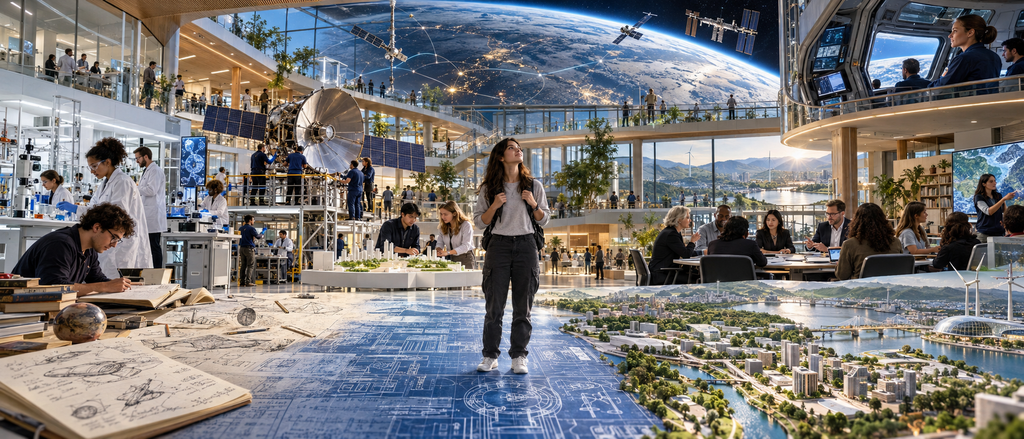
Who can use speculative practice and how
| Reader or team | Useful question | Practical use |
| Scientists and engineers | What human world would this capability create? | Write a short scenario, then map dependencies, failure modes and evidence gaps. |
| Designers and product teams | What does the service feel like in ordinary life? | Test a scene, artefact or prototype with people affected by it. |
| Public sector and policy teams | Which futures should policy remain robust against? | Use scenarios with horizon scanning, stress-testing and backcasting. |
| Community groups and educators | Whose future is absent from the brief? | Use accessible stories to surface local expertise, risks and aspirations. |
| Business and innovation leaders | What merits research, partnership, a small experiment or a deliberate no? | Separate narrative appeal from evidence, cost, capability and governance. |
| Writers and artists | What social system sits behind the familiar future object? | Make hidden infrastructure, labour and power visible in the worldbuilding. |
A practical compass from fiction to action
The Science Fiction to Reality Compass is a light framework for an existing story, research portfolio, innovation workshop or classroom. It does not score prophecy. It makes a route from imagined world to responsible action inspectable.
| Lens | Question | Output |
| Narrative signal | What need, fear or possibility is memorable? | Plain-language concept claim. |
| Reality anchor | What present science, trend or constraint is being extended? | Evidence map and confidence label. |
| Assumption audit | What must be true across energy, data, materials, institutions and behaviour? | Dependencies and unknowns. |
| Human world | How do routines, relationships, work and power change? | Stakeholder journeys and distributional effects. |
| Feasibility horizon | What is imaginable, researchable, demonstrable or deployable? | Maturity bands, not a false date. |
| Consequence rehearsal | What fails, who is excluded and what becomes hard to reverse? | Risks, abuse cases and safeguards. |
| Pathway design | What research, standards, partners and decisions are needed? | Experiments and roadmap. |
| Accountability loop | Who can challenge the case and halt harmful deployment? | Governance checkpoints and dissent record. |
How strongly should a claim be believed
A healthy speculative archive separates resemblance from lineage. A simple confidence scale helps. Grade A means documented direct evidence, such as testimony, correspondence or a design record. Grade B means strong contemporaneous evidence. Grade C means a plausible cultural or interface influence. Grade D means retrospective similarity only. Grade E means an unsupported prediction claim. The grades discipline the conversation. They do not reduce the cultural value of a story. See appendices
The disciplines and careers already doing this work
No single profession owns the relationship between speculation and reality. Strategic foresight explores possible, probable and preferable futures. The UK Government Office for Science uses horizon scanning, scenarios, futures wheels, policy stress-testing, backcasting and roadmapping. Its purpose is preparation for uncertainty, not prediction. [5]
| Discipline | What it does | Typical route |
| Strategic foresight and futures studies | Examines signals, scenarios, long-term change and strategic options. | Policy, research, strategy, social science, business analysis or specialist study. |
| Design fiction and speculative design | Uses artefacts and narratives to make future choices tangible. | Product, interaction, industrial or service design. |
| Science fiction prototyping | Uses story to explore a scientific inflection point and its human consequences. | Engineering, R and D, innovation and corporate futures roles. [6] |
| Systems and business architecture | Maps capabilities, dependencies, operating models, governance and change. | Business analysis, architecture, service design, operations or engineering. |
| Responsible innovation and technology ethics | Tests rights, public value, safety, accountability and distribution of benefits. | Law, policy, research, ethics, safety and technology governance. |
| Science communication and worldbuilding | Makes complex social and technical questions understandable. | Writing, journalism, games, film, museums, education and research communication. |
The opportunity is not simply to become a professional futurist. It is to become a translator who can connect a technical signal to a human story, stakeholder map, viable experiment and honest account of what must not be ignored.
Whose future is being used as the baseline
The familiar route from Shelley, Verne and Wells is useful, but incomplete. Afrofuturism, Indigenous futurisms, Asian speculative traditions and other globally rooted practices bring different histories, temporalities, relationships to land, collective responsibility and assumptions about technology. They do more than diversify a reading list. They challenge the default future a product team may unconsciously treat as universal. [10] [11]
What deserves attention now
The next important speculative questions will not be confined to one category of gadget. They sit at the collision of technical capacity, social demand and institutional uncertainty: AI agents and synthetic media, home and care robotics, climate adaptation, biotechnology, new materials, space infrastructure and culturally grounded computational systems. The task is not to identify one next big thing. It is to ask which futures are quietly being normalised, which are neglected and which should become more just before they become technically easy.
The point is not prophecy
Science fiction has not become obsolete because it has become entertainment, nor because professional foresight exists. It remains one of the few forms that can make a complicated future feel like a place where someone must wake up, work, care, travel, choose and bear consequences. Its gift is not clairvoyance. It is the ability to hold a possibility still long enough for people to inspect it, argue about it and decide whether they want to build toward it.
Appendices
Here is an example Speculative Archive Entry structured according to the evidence-linked method and protocol.
This case examines Arthur C. Clarke’s Geostationary Communications Satellite Relay, which stands out as an exceptionally clear, direct historical lineage.
📚 Speculative Archive Case Entry #001
- Concept: Geostationary Orbital Communications Satellite Relay.
- Primary Source Citation: Arthur C. Clarke, “Extra-Terrestrial Relays: Can Rocket Stations Give Worldwide Radio Coverage?”, Wireless World (October 1945).
1. Factual Lineage vs. Claimed Narrative Influence
- Factual History: While mathematical concepts of geostationary orbit had prior theoretical roots (such as Herman Potočnik’s 1928 work), Clarke—then a radar technician and later physics/mathematics graduate—formulated the explicit technical parameters for placing three equidistant satellite relays in a 24-hour equatorial orbit to achieve global radio and television coverage.
- Real-World Translation: In 1964, NASA launched Syncom 3, successfully placing the first satellite into geostationary orbit. The European Space Agency (ESA) officially designates this equatorial geostationary ring as the Clarke Belt.
2. Adoption Clock & Normalisation Sequence
- Concept Appearance (1945): Technical proposal and speculative essay published in Wireless World.
- Technical Precursor (1940s–1950s): Radar systems, multi-stage liquid-fuel rocketry, high-frequency transceivers, and early photovoltaic cells.
- Functional Demonstration (1963–1964): Syncom 2 and Syncom 3 missions proving equatorial geostationary alignment.
- Product / Service Viability (1965–1970s): Commercial satellite constellations (e.g., Intelsat I / “Early Bird”) enabling live intercontinental broadcasting.
- Mass Normalisation & Second-Order Settlement (1980s–Present): Ubiquitous GPS, satellite TV, weather monitoring, international orbital frequency allocation (ITU treaties), and orbital space debris governance.
3. Evidentiary Confidence Rating
Rating: GRADE A (Documented Direct Evidence)
- Justification: Supported by direct technical papers, authorial identity, engineering proposals, and formal institutional acknowledgment by the European Space Agency and the Arthur C. Clarke Foundation.
📋 Attached Concept Provenance Card (Appendix A Protocol)
Field
Provenance Record Details
Concept Name
Geostationary Orbital Communications Satellite Relays
Narrative Source
Arthur C. Clarke, “Extra-Terrestrial Relays” (1945) & associated speculative writing
Reality Anchor
Extrapolated 1940s radar technology, multi-stage rocketry physics, and equatorial orbital velocity equations
Assumptions
Development of space-capable launch vehicles, solar photovoltaic cells, high-frequency transceivers, radiation shielding, and international orbital frequency governance
Maturity View
Normalised / Deployable (historically evolved from Researchable in 1945 to global infrastructure today)
Stakeholders
Beneficiaries: Global telecommunications networks, broadcasters, maritime/aviation operators, defense agencies. Risk Bearers: Orbital slot regulators, debris management teams, astronomical research communities
Consequences
1st Order: Instantaneous global data and voice transmission. 2nd Order: Mass global media coverage, geopolitical competition for equatorial orbital slots. 3rd Order: Orbital space debris accumulation and reliance on vulnerable satellite infrastructure
Evidence & Uncertainty
Established: Equatorial orbital velocity equations and high-frequency wave propagation. Historical Unknowns in 1945: Electronics lifespan in high-radiation Van Allen belts and rocket launch reliability
Decision & Rationale
Research & Prototype (Validated): Direct mathematical rigor and clear physics justified immediate post-war space agency and telecommunications R&D
📚 Speculative Archive Case Entry #002
- Concept: Portable, Personal Handheld Wireless Communicator (Flip-Phone Form Factor).
- Primary Source Citation: Star Trek: The Original Series (Broadcast premiere: September 1966, Created by Gene Roddenberry).
1. Factual Lineage vs. Claimed Narrative Influence
- Factual History: Long-distance radio communication, portable two-way radios (”walkie-talkies”), and transistor miniaturization had independent technical histories long before 1966. In April 1973, Martin Cooper’s team at Motorola demonstrated the first handheld cellular phone prototype (DynaTAC). Later, in the 1990s, Motorola introduced flip-phone designs (such as the StarTAC) that mirrored the hinged opening mechanism of the television prop.
- Real-World Translation: The television show did not invent radio physics, cellular towers, or semiconductor manufacturing. Instead, it supplied an interface metaphor and a demand formation engine. Martin Cooper explicitly cited Dick Tracy’s wrist radio as an inspiration for freeing communication from fixed wires, while subsequent product teams drew directly on Star Trek’s visual language and flip-gesture interaction. Its primary legacy was establishing the cultural expectation that communication should follow the individual rather than tie a person to a location.
2. Adoption Clock & Normalisation Sequence
- Concept Appearance (1966): Broadcast appearance of the hinged handheld communicator prop on television.
- Technical Precursor (1940s–1960s): Military mobile radio transmitters, Bell Labs cellular network theories (1947), transistor miniaturization, and early microwave communications.
- Functional Demonstration (1973): Motorola’s first handheld cellular call by Martin Cooper in New York City.
- Product / Service Viability (1983–1989): First commercial cellular networks launched; release of the Motorola DynaTAC 8000X and MicroTAC.
- Mass Normalisation (1990s–2000s): Launch of the Motorola StarTAC (1996); universal consumer adoption of digital GSM networks, pocketable form factors, and affordable calling plans.
- Second-Order Settlement (2000s–Present): Ubiquitous mobile connectivity, public safety regulations (e.g., hands-free driving laws), emergency cell broadcasts, and social norms around constant availability.
3. Evidentiary Confidence Rating
Rating: GRADE B / C (Strong Contemporaneous / Plausible Cultural & Interface Influence)
- Justification: Unlike Arthur C. Clarke’s geostationary satellite relay (a Grade A case backed by a technical paper), the communicator was a prop created for visual storytelling. The underlying radio physics and network architectures developed independently. However, there is documented testimony from designers and engineers acknowledging that the prop provided a clear visual target and accelerated public demand for pocketable, personal wireless devices.
📋 Attached Concept Provenance Card (Appendix A Protocol)
Field
Provenance Record Details
Concept Name
Personal, Handheld Wireless Communicator (Flip-Phone Form Factor)
Narrative Source
Star Trek: The Original Series (1966) communicator prop designed by Wah Chang
Reality Anchor
Extrapolated 1960s transistor radios, walkie-talkies, and Bell Labs cellular network theories
Assumptions
Cellular tower networks, high-density batteries, semiconductor miniaturization, international spectrum allocation, and digital voice compression
Maturity View
Normalised (evolved from Imaginable in 1966 to global consumer ubiquity today)
Stakeholders
Beneficiaries: Global public, mobile network operators, emergency services. Risk / Cost Bearers: E-waste management teams, cobalt/lithium miners, workers subject to constant availability expectations
Consequences
1st Order: Instantaneous personal voice communication from anywhere. 2nd Order: Erosion of public payphones; creation of a multi-trillion-dollar mobile hardware industry. 3rd Order: Shifts in social etiquette, ambient reachability, and digital distraction
Evidence & Uncertainty
Established: Mobile radio physics and cellular network design. Historical Unknowns in 1966: Battery chemistry limits, network capacity constraints, and software encryption requirements
Decision & Rationale
Redesign & Expand (Validated): While the physical flip-phone form factor matured, its core promise (frictionless connection) evolved into modern smartphones and ambient AI wearables.
🔬 Comparative Analysis: Form-Factor Influence vs. Technical Prefiguration
Comparing this entry (Grade B/C) with the Arthur C. Clarke Satellite entry (Grade A) highlights how speculative influence travels along two distinct pathways:
[GRADE A: TECHNICAL PREFIGURATION]
Clarke’s 1945 Paper ──► Orbital Equations ──► Rocketry & Satellites ──► Clarke Belt (Syncom 3)
(Focuses on physical mechanisms, physics, and mathematical feasibility)
[GRADE B/C: INTERFACE & FORM INFLUENCE]
Star Trek Prop (1966) ──► Public Expectation ──► Form Factor / Flip Gesture ──► Motorola StarTAC
(Focuses on user interaction, emotional desire, and visual target images)
- Mechanism vs. Outcome: Direct technical prefiguration (Grade A) articulates how a system works mathematically or physically (e.g., Clarke calculating the 24-hour equatorial orbit). Interface influence (Grade B/C) shows what it feels like to use the device in daily life (e.g., flipping open a compact badge to speak) without providing the underlying engineering.
- Independent Technical Ancestry: A Grade B/C prop often sits atop pre-existing, fragmented lines of research. Radio networks, semiconductors, and lithium batteries evolved via their own corporate and military R&D pathways; Star Trek did not invent these components, but rather unified them into a memorable use-image.
- Prop as an Experience Prototype: Fictional props act as low-cost “experience prototypes”. They allow designers, investors, and consumers to encounter an interaction pattern—such as personal, mobile connection—decades before the physical infrastructure makes that pattern reliable and affordable.
📚 Speculative Archive Case Entry #003: Negative Prototype & Critical Warning
- Concept: Predictive Algorithmic Surveillance & Pre-Emptive Social Control (Negative Prototype).
- Primary Source Citations: Philip K. Dick, “The Minority Report” (1956) / George Orwell, 1984 (1949) / Mary Shelley, Frankenstein (1818).
1. Factual Lineage vs. Claimed Narrative Influence
- Factual History: Automated risk scoring, computer vision, data broker harvesting, and predictive policing algorithms evolved out of 20th-century statistics, database architectures, and military/intelligence pattern-recognition research.
- Real-World Translation: A negative prototype does not function as a product blueprint or a commercial goal. Instead, stories of panoptic surveillance and predictive control serve as red-team objects and socio-technical rehearsals. They expose second- and third-order harms—such as the erosion of civil liberties, algorithmic bias, systemic exclusion, and the dilution of due process—long before technical systems are deployed or socially normalised. Rather than motivating engineers to build the system, a negative prototype provides lawmakers, ethicists, and public advocates with a vivid shared vocabulary to establish prohibitions, regulatory safeguards, and explicit design limits.
2. Adoption Clock & Normalisation Sequence
- Concept Appearance (1949 / 1956): Publication of 1984 (telescreens, total surveillance) and “The Minority Report” (predictive pre-crime arrest).
- Technical Precursor (1970s–1990s): Mainframe databases, closed-circuit television (CCTV) networks, actuarial risk assessment models, and early facial-recognition research.
- Functional Demonstration (2000s–2010s): Deployment of predictive policing software (e.g., PredPol), automated license plate readers, and commercial data harvesting algorithms.
- Product / Service Viability & Normalisation (2010s–Present): Integration of algorithmic risk scoring in bail hearings, credit assessments, and automated public surveillance networks.
- Second-Order Settlement & Governance Response (Present): Enactment of legislative bans on real-time biometric mass surveillance (e.g., the EU AI Act), court challenges against predictive policing tools, and the establishment of algorithmic auditing standards.
3. Evidentiary Confidence Rating
Rating: GRADE A / B (Documented Direct Evidence & Strong Contemporaneous Influence)
- Justification: Supported by extensive public policy records, parliamentary debates, legal rulings, and technology ethics literature that explicitly reference Orwellian surveillance and “Minority Report-style” predictive policing as critical red-team warnings. Policymakers and civil rights groups directly cite these negative prototypes when drafting biometric bans, privacy legislation, and AI oversight frameworks.
📋 Attached Concept Provenance Card (Appendix A Protocol)
| Field | Provenance Record Details |
| Concept Name | Predictive Algorithmic Surveillance & Pre-Emptive Social Control |
| Narrative Source | Philip K. Dick, “The Minority Report” (1956) & George Orwell, 1984 (1949) |
| Reality Anchor | Extrapolated 20th-century database architectures, statistical risk modelling, facial recognition, and data harvesting |
| Assumptions | Ubiquitous sensor deployment, high-throughput data processing, centralized storage, algorithmic pattern matching, and public compliance |
| Maturity View | Deployable / Normalised (technically operational, but heavily contested under legal and regulatory settlement) |
| Stakeholders | Beneficiaries / Operators: State security agencies, commercial data brokers, private surveillance vendors. Risk Bearers: Marginalised communities, political dissidents, criminal justice defendants, and the general public facing privacy erosion. |
| Consequences | 1st Order: Automated tracking and risk scoring of individuals. 2nd Order: Chilling effect on public assembly, free speech, and personal autonomy. 3rd Order: Systemic bias lock-in, automated discrimination, and the degradation of due process. |
| Evidence & Uncertainty | Established: Statistical bias in historical training data and high error rates in biometric matching for minority populations. Contested / Unknown: Long-term psychological impact of living under continuous ambient algorithmic evaluation. |
| Decision & Rationale | STOP / REGULATE: Enforce explicit prohibitions on un-auditable predictive arrests and real-time biometric mass surveillance to protect fundamental human rights and civic freedoms. |
🛡️ How Negative Prototypes Establish Safety Stop Conditions
Negative prototypes contribute a crucial capability to the innovation ecosystem: they turn dystopian speculation into a civic tool for responsible governance. Fictional warnings establish safety stop conditions and red-team safeguards through several key mechanisms:
[NEGATIVE PROTOTYPE] [CONSEQUENCE REHEARSAL] [ACCOUNTABILITY LOOP]
Fictional Warning / Red-Team ──► Expose Failure Modes, Power ──► Establish Prohibitions,
Object (e.g. Orwell/Dick) Asymmetries & Social Harms Governance Checkpoints &
Explicit Stop Criteria
- Exposing Second- and Third-Order Failure Modes: While a commercial proposal highlights surface utility, a negative prototype reveals what happens when a system scales, fails, or gets exploited. It forces designers and policymakers to ask: What fails? Who is excluded? What gets exploited? What becomes hard to reverse?.
- Moving Beyond Mechanical Rules to Socio-Technical Systems: As Mary Shelley demonstrated in Frankenstein (1818), the central subject of speculative fiction is rarely the gadget itself, but the altered relationship between people, knowledge, and power. Similarly, while Isaac Asimov’s Laws of Robotics offered an early vocabulary for control, real-world negative prototypes show that rigid rules are inadequate as practical engineering safety frameworks. They push governance to focus on broader socio-technical systems—including data extraction, labour conditions, procurement, and public accountability.
- Framing “Stop Criteria” and Records of Dissent: In structured innovation frameworks like the Science Fiction to Reality Compass, Lens 6 (Consequence Rehearsal) generates risk registers and red-team scenarios, while Lens 8 (Accountability Loop) establishes formal governance checkpoints. Negative prototypes provide the rationale and vocabulary needed to define explicit stop criteria—the non-negotiable conditions under which a research or deployment path must be paused, redesigned, or terminated.
- Countering “Future-Washing” and Narrowed Imagination: Apocalyptic or cautionary narratives prevent society from uncritically accepting hype. They allow citizens, workers, and ethics boards to challenge unexamined assumptions before a harmful technology becomes technically easy or socially irreversible.
See: https://ideaswiz.com/pre-crime-by-convergence-ai-identity-data-fusion
References and further reading
For supporting documents see: Science fiction to reality
| No. | Document Title | Type | Summary |
| 1 | From Science Fiction to Tomorrow’s Creativity: How Stories Shape Innovation | Guide / Article | Explains how science fiction serves as a rehearsal space and experience prototype rather than a prediction tool. Covers methods, personas, careers, sub-genres, misuse risks, AI-assisted horizon scanning, practical toolkits, and supporting sources. |
| 2 | Speculative Practice Reference Guide: Books, Articles, People and Organisations | Reference Guide | Curated bibliography and resource collection covering futures studies, speculative design, systems thinking, responsible innovation, participatory methods, science fiction criticism, key organisations, journals, and recommended reading pathways. |
| 3 | Speculation to Delivery: Practice and Translation Companion | Methods Companion | Provides tools, templates, and sector-specific guidance for turning speculative ideas into evidence-based action. Includes governance processes, localisation, assessment frameworks, AI-use records, stop criteria, glossaries, and implementation guidance. |
| 4 | From Science Fiction to Deliverables: Speculation to Delivery Framework | Operating Framework | Defines a cyclical framework of imagine, explore, rehearse, anchor, test, deliver, adopt, govern, learn, and reimagine. Includes deliverable architecture, stakeholder ecosystems, maturity models, feedback loops, risk indicators, and a 90-day launch plan. |
| 5 | Imagineering Human Futures | Research Paper | Explores the emergence of Future Imagineering and Speculative Systems Architecture as disciplines. Covers history, professional roles, competencies, industry mapping, AI impacts, education ecosystems, futures traditions, maturity models, and long-term roadmaps. |
| 6 | Negative Prototypes and the Politics of Prediction Review | Case Review | Examines 1984, The Minority Report, and modern predictive systems as negative prototypes. Discusses surveillance, governance, prediction risks, due process, accountability, and practical review frameworks. |
| 7 | Science Fiction to Reality Compendium: Compass Audits and Provenance Cards | Case Compendium | Applies the Science Fiction to Reality Compass and Provenance Cards to technologies such as the universal translator, tricorder, and satellite communications. Includes evidence assessments, adoption pathways, consequence analysis, and accountability mechanisms. |
Corpus Structure
| Category | Documents | Purpose |
| Theory & Foundations | 1, 5 | Establish the conceptual basis for speculative practice, imagination, innovation, and emerging professional disciplines. |
| Methods & Frameworks | 3, 4 | Provide the operational models, templates, governance mechanisms, and delivery processes needed to translate speculation into action. |
| References & Case Studies | 2, 6, 7 | Supply supporting literature, examples, audits, critiques, and practical evidence for applying and evaluating speculative approaches. |
Overall Portfolio Narrative: The collection forms an integrated knowledge ecosystem that progresses from theory and conceptual foundations (Documents 1 & 5) through practical methods and operational frameworks (Documents 3 & 4) to reference materials, evidence, and applied case studies (Documents 2, 6 & 7), enabling a complete journey from imagination and foresight to governed implementation and evaluation.
References
[1] European Space Agency. “Designed for the high ground of space.” https://www.esa.int/Applications/Observing_the_Earth/Meteorological_missions/Meteosat/Designed_for_the_high_ground_of_space
[2] Arthur C. Clarke Foundation. “Arthur C. Clarke biography.” https://clarkefoundation.org/arthur-c-clarke-biography/
[3] Smithsonian Magazine. “From the Brick to the iPhone, the Cellphone Celebrates 50 Years.” 3 April 2023. https://www.smithsonianmag.com/innovation/from-the-brick-to-the-iphone-the-cellphone-celebrates-50-years-180981910/
[4] NASA. “Bonus: Dan Curry. NASA’s The Invisible Network Podcast.” https://www.nasa.gov/podcasts/invisible-network/bonus-dan-curry-nasas-the-invisible-network-podcast/
[5] UK Government Office for Science. The Futures Toolkit. https://www.gov.uk/government/publications/futures-toolkit-for-policy-makers-and-analysts/the-futures-toolkit-html
[6] Johnson, Brian David. Science Fiction Prototyping: Designing the Future with Science Fiction. Springer, 2011. https://link.springer.com/book/10.1007/978-3-031-01796-4
[7] Dunne, Anthony, and Fiona Raby. Speculative Everything: Design, Fiction, and Social Dreaming. MIT Press, 2013. https://mitpress.mit.edu/9780262019842/speculative-everything/
[8] Bleecker, Julian, et al. The Manual of Design Fiction. Near Future Laboratory, 2023. https://nearfuturelaboratory.com/
[9] Bowler, Peter J. A History of the Future: Prophets of Progress from H. G. Wells to Isaac Asimov. Cambridge University Press, 2017. https://www.cambridge.org/core/books/a-history-of-the-future/93019E58F7425A28BC86F3158E867B99
[10] Eshun, Ekow. In the Black Fantastic. MIT Press, 2022. https://mitpress.mit.edu/9780262047258/in-the-black-fantastic/
[11] Streeby, Shelley. Science Fiction Ecologies: Worldmaking with Butler, Le Guin, and Merril. NYU Press, 2026. https://nyupress.org/9781479833429/science-fiction-ecologies/
[12] Aronoff, Eric. Culture’s Futures: Science Fiction, Form and the Problem of Culture. Palgrave Macmillan, 2025. https://link.springer.com/book/10.1007/978-3-031-80431-2