How Ship-Based AI Infrastructure Turns Energy, Mobility, and Sovereignty into Strategic Advantage
Preamble
AI infrastructure is no longer constrained by silicon alone it is constrained by power, permitting timelines, geopolitics, and grid bottlenecks. As demand for sovereign, resilient, and rapidly deployable compute accelerates, conventional land-based data centres are proving too slow and inflexible. Ship-based (and ocean) AI compute emerges as a pragmatic alternative: not a novelty, but a logistics-driven response to energy abundance, jurisdictional complexity, and the need for faster time-to-compute. This article explores the technical, economic, and operational case for floating AI infrastructure.
Vision: Ship-Based Sovereign AI Compute (“Floating Compute Zones”)
Vision statement
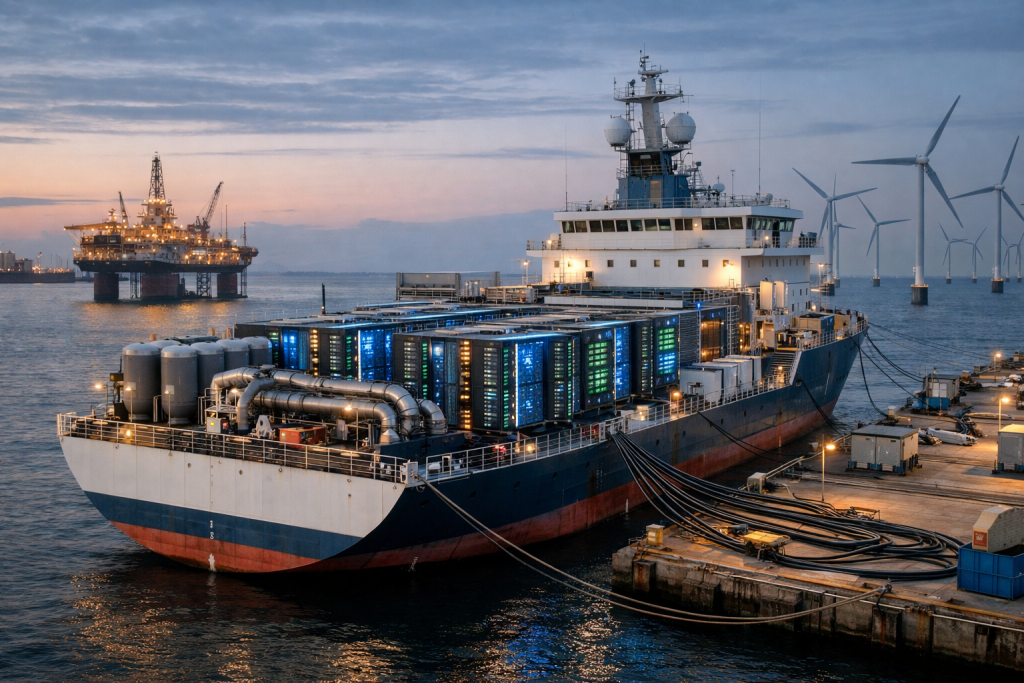
Create mobile, sovereign AI compute platforms using purpose-built or repurposed ships that convert coastal power, stranded energy, and jurisdictional arbitrage into secure, high-density AI compute deployable in months, relocatable as geopolitics or energy economics shift, and operated as modular “compute fleets.”
This is not a data center at sea for novelty. It is a logistics and sovereignty play, borrowing directly from Ideaswiz’s thesis: compute should move to power, not power to compute https://ideaswiz.com/sovereign-portable-ai-compute-infrastructure with ships acting as the mobility layer.#
As usual l supporting artefacts: Summary Table of Attached Documents
| Document Name | Short Description |
| AI Compute Solutions and Comparisons | Strategic analysis comparing land‑based sovereign compute pods, vessel‑based data centers, space‑based compute, and hyperscale facilities. Highlights cost–benefit, deployment difficulty, sovereignty issues, and practical viability. |
| Sea AI Compute Ship — Hardware Requirements & Technology Stack | Detailed hardware and physical‑infrastructure specification for a ship‑based AI compute vessel (10–50 MW). Covers power, cooling, marine hardening, networking, safety, and the onboard technology stack. |
| Sea AI Compute Ship — Software Requirements Specification (SRS) | Full software requirements for operating a multi‑tenant AI compute ship. Defines functional and non‑functional requirements, orchestration, security, observability, metering, DR, and compliance. |
Core Business Case (Why ships at all?)
Problem Ideaswiz identifies
- Grid congestion, slow permitting, geopolitical risk, and hyperscaler lock-in
- Power-rich regions lack fast paths to monetize energy via compute
Why ships solve a specific subset
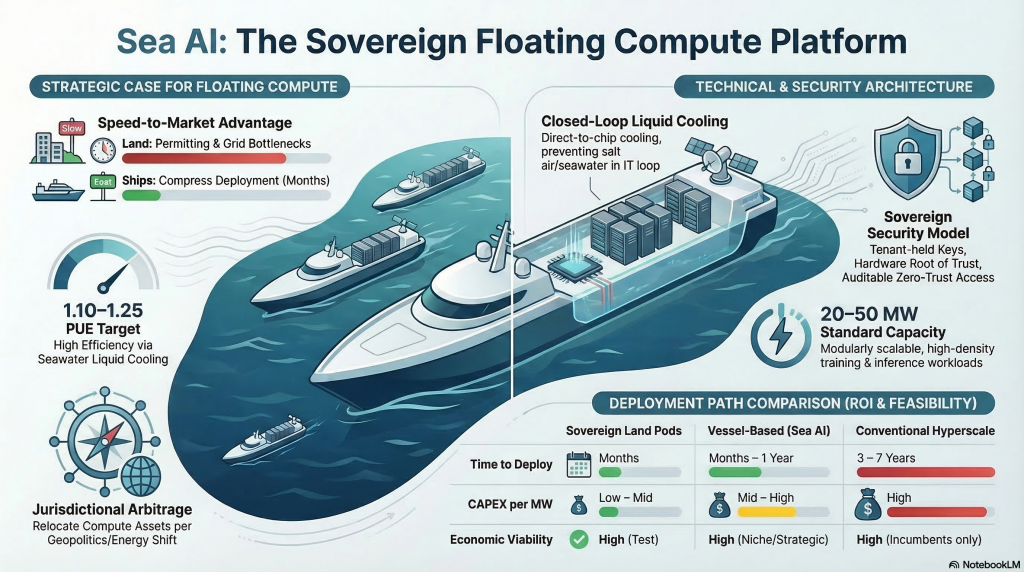
- Ships compress time-to-deploy where land permitting is slow
- They allow jurisdictional flexibility (flag state vs port state)
- They enable power arbitrage between ports, grids, and floating generation
- They act as temporary or transitional compute while land sites mature
Ships are not cheaper than land—they are faster and more flexible.
Technical Architecture (People · Process · Technology)
1. Compute & Cooling (hard engineering first)
Cooling strategy
- Primary: Closed-loop liquid cooling (direct-to-chip) inside sealed racks
- Heat rejection: Plate heat exchangers using seawater as a secondary sink
- Design rule: No seawater enters the IT loop
Why this works:
- Mirrors offshore oil & gas thermal systems (KK)
- Avoids humidity and salt ingress into electronics
- Supports high rack densities (60–100kW/rack)
Saltwater corrosion mitigation
- Marine-grade alloys + epoxy coatings
- Positive-pressure IT zones with filtered dry air
- Sacrificial anodes for hull protection
- Aggressive humidity control (sub-45%)
This is solved maritime engineering, not experimental.
2. Power Connectivity (the economic lever)
Primary power models
- Shore power (preferred): high-voltage grid tie at port
- Dedicated floating power: gas, LNG, or floating renewables
- Hybrid: grid + onboard generation for resilience
Selection criteria
- Power cost < $0.04–0.06/kWh
- Minimum 10–50MW expandable
- Stable baseload (AI hates intermittency)
- Long-term power purchase agreement (5–10 yrs)
Ships allow you to dock where power is cheapest today, and move if economics shift.
3. Connectivity & Bandwidth (often underestimated)
Information bandwidth requirements
- Inference-heavy: 10–100 Gbps
- Training or federated training: 100–400+ Gbps
Connectivity stack
- Dual terrestrial fiber from port IXs
- Subsea cable landing proximity (critical)
- Satellite only for control plane / failover (not bulk data)
Location rule
If the port is not already a data hub, don’t force it.
Location & Port Selection Criteria (non-negotiable)
- Power
- Cheap, expandable, politically stable
- Fiber
- Multiple carriers, low latency to major IXs
- Port maturity
- Industrial ports (not tourist harbors)
- Climate
- Cooler water improves thermal efficiency
- Regulatory clarity
- Predictable maritime + customs + data rules
- Security environment
- Low piracy, strong port authority
Ideal regions: Nordics, Middle East industrial ports, parts of Asia-Pacific, select African energy hubs
Security Model (Physical · Digital · Jurisdictional)
Physical security
- Single gangway access
- Armed port security + ship security
- Compartmentalized zones (bridge ≠ compute ≠ power)
Digital security
- Sovereign control plane (customer-controlled keys)
- Air-gapped management networks
- Continuous attestation and audit logging
Jurisdictional sovereignty
- Flag state defines vessel law
- Port state governs docking and utilities
- Customer sovereignty enforced via:
- Hardware root of trust
- Customer-held encryption keys
- Contractual and operational isolation
Reality check: sovereignty is operational, not symbolic.
Operating Model (People & Process)
People
- Small onboard technical crew (power, cooling, safety)
- Remote NOC/SOC for IT operations
- Maritime crew outsourced to experienced operator
Process
- “Lights-out” compute operations
- Predictive maintenance (marine + IT)
- Planned GPU refresh cycles dockside
Ships are operated like offshore platforms, not offices.
Cost Structure (Ranges, not hype)
CAPEX
- Repurposed vessel + retrofit: mid
- New-build compute ship: high
- Modular compute payload: scalable
OPEX
- Higher than land (marine maintenance, insurance)
- Offset by:
- Faster revenue start
- Power arbitrage
- Mobility value
Ships win on time-to-cash, not absolute $/MW.
Primary Use Cases (where this actually works)
- Sovereign AI inference
- Defense & government workloads
- Disaster recovery / surge compute
- Edge AI near coastal megacities
- Transitional capacity while land DCs are built
Not ideal for
- Frontier model training at hyperscale
- Ultra-low-latency financial trading
Key Risks (RDC Gap Types)
- Capability: Marine + DC integration expertise required (KK)
- Dependency: Port power and fiber availability (KU)
- Economic: Insurance and financing premiums (KU)
- Regulatory: Multi-jurisdiction compliance (KU)
- Behavioral: Customer trust in “floating” compute (UU)
Location location location
Below is a practical, non-hype list of ports where ship-based AI compute can realistically access rig power, offshore wind, solar, and hybrid systems, with onboard batteries used for smoothing, backup, and peak shaving (not primary baseload).
I’ve grouped by energy type and only included ports with real infrastructure adjacency, not theoretical potential.
Offshore Oil & Gas / Rig-Adjacent Power (Gas → Power)
Best for: Baseload, 24/7 compute, lowest intermittency
Pattern: Shore power + direct contracts with gas operators or floating power barges
- Stavanger – North Sea rigs, strong grid, mature offshore services
- Aberdeen – Oil & gas + wind convergence
- Port Fourchon – Gulf of Mexico rig logistics hub
- Doha – Gas-rich, industrial ports, sovereign-friendly
- Abu Dhabi – ADNOC infrastructure + ports
- Luanda – Offshore production + growing power access
Onboard batteries:
- Used for ride-through, black start, and load balancing (minutes–hours, not days)
Offshore Wind + Port Grid Interconnects
Best for: Sovereign / green compute, inference-heavy workloads
Pattern: Wind → grid → port substation → ship, batteries smooth variability
- Esbjerg – Europe’s offshore wind logistics capital
- Rotterdam – Offshore wind, massive grid + fiber
- Hamburg – Wind-heavy grid, strong IXs
- Grimsby – Direct wind farm adjacency
- Busan – Offshore wind expansion + fiber density
Onboard batteries:
- Critical for frequency smoothing, grid compliance, and short wind drops
Solar + Industrial Port Power (High Insolation Regions)
Best for: Hybrid setups (solar + grid or gas)
Pattern: Daytime solar + grid/gas + batteries
- Jebel Ali – Massive solar + grid redundancy
- NEOM Port – Solar + wind + sovereign mandate
- Port Said – Solar + gas + transit fiber routes
- Walvis Bay – Solar-rich, emerging energy hub
- Perth – Solar + gas + subsea connectivity
Onboard batteries:
- Used for solar firming and evening peak smoothing
Floating Power + Hybrid Energy Ports (Most Flexible)
Best for: Rapid deployment, weak grids, transitional compute
Pattern: Floating gas power + renewables + batteries → ship DC
- Singapore – Floating power, LNG, unmatched fiber
- Durban – Power barges + grid + undersea cables
- Colombo – Floating power experience + IX growth
- Maputo – Gas + ports + emerging infra
Onboard batteries:
- Enable islanding, resilience, and grid instability buffering
Battery Role on AI Compute Ships (Reality Check)
What batteries do well
- UPS replacement
- Frequency regulation
- Load ramping
- Black start capability
What they do NOT do
- Replace baseload power for AI (energy density too low)
Typical sizing
- 30–120 minutes of full load
- Longer duration only for resilience, not economics
Selection Criteria Summary (Ship-Based AI Compute)
Must-have
- ≥10–50MW expandable power
- Multiple fiber paths / IX proximity
- Industrial port zoning
- Political and regulatory predictability
Nice-to-have
- Cool water temperatures
- Existing offshore energy ecosystem
- Willing port authority (often decisive)
RDC Decision
Proceed → Test locations first, ships second
Ports + power contracts are the real bottleneck, not ships or GPUs.
Conclusion
Ship-based AI compute is not a replacement for hyperscale data centers, nor a futuristic experiment detached from reality. It is a transitional and strategic infrastructure layer—well-suited for inference-heavy, sovereign, edge, and surge workloads where speed, mobility, and energy proximity matter more than lowest long-term $/MW. The success of this model depends less on ships or GPUs, and more on disciplined site selection, credible governance, power contracts, and customer trust. Done correctly, floating compute fleets can unlock stranded energy, hedge geopolitical risk, and accelerate AI deployment where land-based options fall short.
Final RDC Decision
Proceed / Test / Pause → TEST
Why
Ship-based AI compute is not a replacement for land-based sovereign pods. It is a strategic accelerator and hedge—valuable when speed, flexibility, or jurisdictional optionality matters more than lowest long-term cost.
Winning strategy
- Start with 1–2 ships, inference-heavy workloads
- Anchor customers secured before retrofit
- Use ships as bridge infrastructure, not permanent hyperscale
Abbreviations & Uncertainty Tags
- KK = Known Known
- KU = Known Unknown
- UU = Unknown Unknown
- CAPEX/OPEX = Capital / Operating Expenditure
- MW = Megawatt
- IX = internet exchange
Appendices
Solution Comparison
Side-by-side decision table
| Dimension | Space-based | Sovereign Portable (Land) | Vessel-based | Conventional Hyperscale |
| CAPEX per MW | Extreme | Low–Mid | Mid–High | High |
| Time to Deploy | Years | Months | Months–1 yr | Years |
| Cooling Efficiency | High | High | High | High |
| Maintenance | Near-impossible | Standard | Complex | Standard |
| GPU Upgrade Cycle | Poor | Good | Good | Best |
| Latency | High | Low | Low–Mid | Lowest |
| Sovereignty Control | Theoretical | Practical (if governed) | Mixed | Operator-dependent |
| Commercial Viability | ❌ | ✅ | ⚠️ | ✅ (incumbents) |