
Preamble
There is a moment many experienced Business Analysts recognise, even if they struggle to name it.
You are sitting in a workshop, listening to stakeholders argue about scope for the third project in a row. The details are different, but the pattern is the same. The same capabilities appear in different guises. The same pain points repeat. The same decisions are made without any memory of what happened last time.
You look at the whiteboard and realise you are not just gathering requirements. You are holding a mental map of how the organisation actually works.
That is the beginning of the shift from Analyst to Architect.
This is not a career pivot. It is a change in altitude. You move from documenting features to shaping capabilities. From fixing local problems to designing how the whole business delivers value. From owning a project backlog to owning a business blueprint.
This piece is about that journey. What holds Business Analysts back. What transfers into Business Architecture. And how to start building the bridge, wherever you are on the path today.
The underused asset in the organisation
Most organisations underuse their Business Analysts.
On paper, BAs gather requirements, document processes, manage stakeholders, and support delivery. In practice, good analysts see across departments, programmes, tools, and teams. They become the unofficial memory of how change actually happens.
Then the project ends. Contracts roll off. Documentation is filed away. The human mind that connected all those threads is reassigned or exits. The next initiative starts almost from zero.
Common patterns appear:
- Short term, project-by-project thinking.
- Tool sprawl and duplicated solutions.
- Little reuse of previous analysis or models.
- No clear path for senior BAs beyond “more of the same”.
The result is a quiet but costly waste. Analysts accumulate strategic insight, but the organisation treats them as tactical resources. The gap between strategy decks and delivery teams stays wide. Business Analyst career patheway are described here :How to Build a Future-Proof IT Business Analyst Career in 2025 (and Beyond)
Business Architecture, done well, is one answer to that gap.
The Business Architect Defined
“For a Business Analyst, the path to ‘Architect’ isn’t a single lane. Understanding the distinct destinations is key to navigating your journey. While all architects share a systems-thinking mindset, they operate at different altitudes and with different primary materials.
A business architect is a professional who creates a “blueprint” for an organization to align its strategy with its operations. The Business Architecture Guild, a professional association for these individuals that provides resources, training, and certification. The Guild promotes and expands the business architecture discipline through its members, resources like the BIZBOK (Business Architecture Body of Knowledge), and professional certification programs.
Role of a business architect
- Acts as a strategic role responsible for business transformation.
- Provides an organizational blueprint to bridge the gap between strategic goals and operational realities.
- Oversees key deliverables, such as business capability models, and identifies opportunities, threats, and limitations.
- Works to ensure the organization’s structure, processes, and information flows support its vision.
In summary
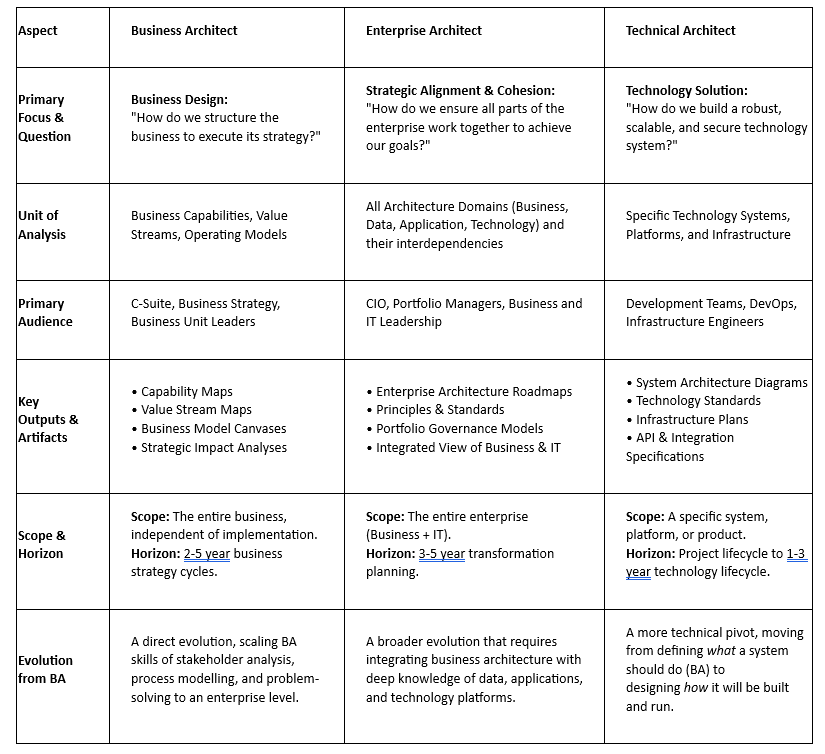
- The Business Architect focuses on the business itself as the system to be designed, using capabilities and value streams as some of their primary components.
- The Enterprise Architect takes a holistic view, ensuring the entire organization its business, data, applications, and technology works in strategic harmony.
- The Technical Architect zooms in to design the technology solutions that support the business capabilities, focusing on systems, code, and infrastructure.
Clarifying the Architecture Roles: Business, Enterprise, and Technical
For a Business Analyst looking toward architecture, understanding the landscape is key. These roles are often confused but have distinct missions, scopes, and artifacts. Think of them as different lenses for viewing the organization. This table clarifies the focus, scope, and outputs that define each role:”
Reframing the Business Analyst
If you strip away job titles and look at actual behaviour, many modern BAs already work at the edge of strategy.
They:
- Frame problems so they connect to business outcomes, not just features.
- Challenge stakeholders on “why” before locking into “what”.
- Notice patterns across projects, not just within one.
- Translate between business, technology, and operations.
- Make complex things understandable through clear visuals and narratives.
The more an analyst leans into these habits, the closer they move to architectural thinking.
Instead of “What does this system need to do for this team”, the questions start to sound like:
- “What capability are we really trying to build or improve”
- “Where else in the organisation does this already exist”
- “How does this change affect the wider value stream”
- “How does this tie into the strategy we keep talking about”
Once you consistently think like this, the distance between Analyst and Business Architect becomes smaller than the job descriptions suggest.
A simple career ladder: from delivery to design
You can think of the journey in three broad layers.
1. Foundation: Analyst as delivery partner
Typical roles: Junior BA, Business Analyst, Senior BA.
Focus:
- Requirements elicitation and documentation.
- Process mapping and improvement.
- Data analysis to support decisions.
- Facilitating workshops and managing stakeholders.
- Supporting change, training, testing, and rollout.
Time horizon: From sprint cycles up to the life of a project.
At this stage you are building core craft. You learn how to ask good questions, structure messy information, collaborate across disciplines, and deliver reliably.
2. Transition: Analyst as strategist-in-training
Typical labels: Senior BA, Strategic BA, Lead BA, Consultant, Domain Specialist.
Focus:
- Aligning initiatives to strategic goals, not just local needs.
- Looking across programmes and portfolios, not just single projects.
- Introducing value stream thinking and basic capability concepts.
- Identifying duplication and gaps across teams and systems.
- Influencing priorities, not just documenting them.
Time horizon: From programmes and roadmaps to 1-3 year horizons.
This is the critical stretch zone. You are still close to delivery, but your vantage point shifts. You start to see the organisation as an ecosystem instead of a collection of projects.
Many people sit here for years without the language of “architecture”. They are already behaving like junior architects without the title.
3. Architecture: designing the business
Typical roles: Business Architect, Senior Business Architect, or Enterprise Architect with a business focus.
Focus:
- Designing and maintaining capability maps, value streams, and operating models.
- Connecting strategy to execution through structured roadmaps.
- Providing impact analysis for major decisions, such as new markets, mergers, or regulatory shifts.
- Governing change so investments align with the business blueprint.
- Supporting leadership decisions with clear, visual models of complex reality.
Time horizon: Multi year strategy and transformation.
Here the unit of work is no longer a project or programme. It is the whole organisation, seen through capabilities, value flows, information, and people.
Eight BA skills that transfer directly into Business Architecture
The good news is that you do not start from zero. Most of what you need as a Business Architect has roots in BA craft. The difference is scope, abstraction, and time horizon.
Here are eight skills that translate almost one to one.
1. Stakeholder analysis becomes ecosystem mapping
As a BA you map who cares about a project, what they need, and how decisions flow.
As an architect you widen the lens. You map how business units, functions, partners, regulators, and customers interact around a capability or value stream. You design models that show influence, dependency, and tension at enterprise scale.
2. Process modelling becomes value stream design
As a BA you create process diagrams for “how work gets done” in a team or department.
As an architect you trace how value moves from trigger to outcome across the whole organisation. You care about the end to end journey, across channels, product lines, and internal silos. Processes become building blocks inside larger value streams.
3. Requirements elicitation becomes capability based planning
As a BA you gather and refine detailed requirements.
As an architect you step back and ask “What must this business be able to do”. You work with capabilities such as “Manage Customer”, “Deliver Product”, or “Manage Risk” as stable building blocks. Projects then become ways to change the maturity or shape of those capabilities.
4. Problem solving becomes scenario and impact analysis
As a BA you fix issues in specific journeys, systems, or teams.
As an architect you model what happens when strategy changes. What happens to capabilities if the company enters a new market, changes a business model, or acquires a competitor. You map upstream and downstream consequences before big decisions are made.
5. Domain knowledge becomes institutional intelligence
As a BA you often become the person who “just knows how things work” in a specific domain.
As an architect you use that knowledge consciously. You help shape operating models and blueprints that respect regulatory constraints, customer expectations, and local realities, while still pushing for simplification and coherence.
6. Visual storytelling becomes enterprise communication
As a BA you use flowcharts, journeys, and diagrams to help teams align.
As an architect you use capability maps, heatmaps, and value stream diagrams to help executives and delivery teams see the same picture. You do not just make models. You make decisions easier.
7. Systems thinking becomes enterprise architecture
As a BA you map system dependencies for a project and understand upstream/downstream impacts.
As an architect you hold a much bigger network in mind. You see how capabilities, processes, information, systems, and structures intersect. You spot where a local optimisation will undermine a strategic shift, and you have the models to show it.
8. Facilitation becomes architectural governance
As a BA you run workshops and help stakeholders reach agreement.
As an architect you facilitate prioritisation across portfolios, chair or support architecture forums, and influence investment choices. You do not sign the cheques, but your models and guidance shape where the money goes.
Across all eight, the core shift is simple:
- From project to enterprise.
- From detail to pattern.
- From features to capabilities.
- From local fixes to system design.
A story from the middle of the ladder
To make this more concrete, imagine someone at the transition layer.
For a few years, they have worked as a BA across digital programmes in a large financial institution. They know the products, the regulatory landscape, and the many workarounds that keep the business running.
On one transformation programme, they notice something familiar. Three projects in different parts of the bank are all trying to “tighten risk controls”, each with its own budget, tools, and stakeholders.
Instead of just capturing separate requirements, they sketch a simple map of the “Manage Risk” capability across the organisation. They show where responsibilities overlap, where there are gaps, and which processes and systems sit under each part.
In a review session, that one page shifts the conversation. Leaders see, for the first time, how fragmented their risk capability has become. The map becomes a reference point for future decisions. Some projects are combined. Others are stopped. Investment is redirected.
The BA did not call it Business Architecture. They simply used their existing skills at a larger scale. But the effect is unmistakably architectural.
That kind of moment is often the pivot from Senior BA into a more strategic role. The work looks less like documenting what others ask for, and more like shaping the options that leaders can see.
Qualifications and the Business Architect’s Guild
If you want to move into Business Architecture, you do not need a long list of certificates before you begin. Most architects grow from experience and pattern recognition. Formal pathways still help because they give you structure, shared language, and credibility inside large organisations.
There are three areas to focus on.
1. Foundational knowledge
You need a working understanding of capability models, value streams, operating model design, portfolio alignment, and enterprise level impact analysis. You can build this through books, mentorship, hands on mapping, and structured practice inside your current role. The goal is familiarity with the discipline, not mastery on day one.
2. The Business Architecture Guild
The Business Architect’s Guild is the most established professional body in this field. It maintains a global community of architects, publishes reference models, and runs working groups that focus on industry specific patterns.
Its Business Architecture Body of Knowledge (BIZBOK Guide) sets the standard vocabulary and methods used by many organisations. It covers capability mapping, value stream design, information mapping, cross domain alignment, and governance approaches. You do not need to follow every technique exactly. The guide is still useful because it gives you a consistent mental framework that helps you work with architects, strategists, and delivery teams from different backgrounds.
3. Certification pathways
The Guild runs the Certified Business Architect (CBA) examination. It validates your understanding of the BIZBOK Guide and your ability to apply Business Architecture principles. The exam does not replace experience, but it signals that you have reached an accepted baseline in the profession. Some organisations list it as a requirement for senior roles, especially in regulated industries.
You can also combine the CBA with adjacent qualifications in enterprise architecture or portfolio management. These create a broader foundation when you are working on large transformations or strategy execution.
Why this matters
Many senior Business Analysts already perform architectural tasks, but they cannot always communicate the value of that work. Qualification pathways and the Business Architecture Guild give you a platform to show that your skills fit a recognised discipline. They also plug you into a community that shares models, tools, and patterns that would take years to build alone.
Formal development will never replace the practical insight you gain from years of analysis, facilitation, and cross functional work. It helps you convert that insight into a structured career path and gives you the language that decision makers recognise.
Where Business Architecture is heading
The context for all of this is changing fast.
Digital transformation, automation, AI, and sustainability pressures are forcing organisations to redesign themselves, not just digitise existing workflows. That increases the need for people who can:
- Hold a holistic map of how the organisation creates value.
- Connect technology choices to business outcomes.
- Balance innovation with risk, regulation, and operational reality.
- Speak credibly to both senior leaders and delivery teams.
The modern Business Architect often operates as part strategist, part designer, part translator. In smaller organisations they may be the first person to create any formal view of capabilities and value streams. In larger ones they help coordinate transformation portfolios worth hundreds of millions.
There is also a growing family of adjacent roles: Enterprise Architect with a business flavour, Transformation Lead, Product Strategy Lead, or Innovation Architect. All of them benefit from the same underlying capabilities.
For Business Analysts, this makes the career path more open and more interesting than a simple ladder inside “Business Analysis”.
Building your own bridge
If you are a BA who feels the pull of architecture, you do not have to wait for a perfect job title to start moving.
Some practical steps:
- Change the questions you ask.
Start framing conversations around capabilities, value streams, and outcomes, not just features and requirements. - Map beyond your project.
For each piece of work, sketch where it sits in a larger journey or capability. Treat every project as a chance to see one more piece of the enterprise puzzle. - Learn the language of Business Architecture.
Explore concepts like capability mapping, value streams, operating models, and basic enterprise architecture frameworks. You do not need to be an expert overnight, but you should be conversant. - Volunteer for cross cutting work.
Offer to help with portfolio reviews, strategy workshops, or operating model conversations. These are natural places to practice architectural thinking. - Look for mentors and communities.
Connect with people already working as Business Architects or Enterprise Architects. Ask how they got there. Notice the mix of experience, not just the certificates. - Curate your own “enterprise memory”.
Keep a private, de-identified library of patterns, models, and lessons that show how your organisation actually behaves. Over time, that becomes your raw material as an architect. - Plan your formal step up.
When you are ready, align your CV, portfolio, and certifications with the roles you want. Show examples where you operated at architectural altitude, even if your title did not say “Architect”.
A final thought
The move from Business Analyst to Business Architect is not about leaving analysis behind. It is about using the same analytical instincts at a higher level.
Where analysts help teams ship better solutions, architects help organisations design better futures.
If you already find yourself thinking beyond your project, seeing patterns that others miss, and caring about how the whole system hangs together, you are probably closer to architecture than you think.
The next step is not to wait for permission. It is to start working, thinking, and communicating at the level of the architect you intend to become.
Appendices
Essay : From Analyst to Architect: Why Your Next Career Pivot Is Actually an Evolution
The air in the windowless war room is thick with the scent of stale whiteboard markers and the mounting friction of misaligned KPIs. You are sitting in yet another workshop, watching stakeholders haggle over the scope of a system upgrade. To them, these are fresh problems; to you, it is systemic rot. You recognize the redundant capabilities, the fragmented data, and the same friction points you diagnosed three projects ago. While the room obsesses over the immediate “what,” you realize you are the only one holding the “how”—a mental map of the entire organization’s functional reality. This is the inflection point. It is the moment a Senior Business Analyst realizes their value is no longer in documenting features, but in diagnosing the enterprise. This is not a career pivot; it is an “evolution in altitude.” Moving from Business Analyst (BA) to Business Architect is the transition from delivery-level documentation to designing the business itself.
The “Walking Mind Map” Problem
Organizations systematically haemorrhage their most valuable asset: institutional intelligence. While BAs are often confined to narrow delivery roles, they are the ones who truly see across departments, programs, and tools. They accumulate a wealth of strategic insight that rarely gets institutionalized. The problem is systemic. Most organizations operate at a “Level 1 Ad hoc” maturity—siloed delivery where choice is reactive. When a project ends or a contractor rolls off, the memory of how change actually happens evaporates. The documentation is filed away, and the next initiative starts from zero. This project-by-project thinking is a quiet but costly waste, leading to tool sprawl and the constant “reinvention of the wheel. “BAs… become the unofficial memory of how change actually happens. “Without a transition to an architectural framework, you remain a “walking mind map”—a tactical resource whose value is buried in a backlog rather than a strategic asset utilized at the C-suite table.
Requirements Gatherers Deliver Insights; Architects Deliver Blueprints
The shift from Analyst to Architect is defined by a change in scope and time horizon. While a BA focuses on the success of a specific product or project, the Architect is obsessed with enterprise value creation. This distinction is critical because 70% of transformation failures are linked to poor communication and misalignment. Requirements gatherers address the “what,” but Architects solve for the “why” and the “where next,” bridging the gap between high-level strategy decks and the reality of delivery. Moving from owning a backlog to owning a business blueprint is your only path to genuine strategic influence.| BA Dimension | Business Architect Dimension || —— | —— || Primary Lens: Product or project outcomes | Primary Lens: Enterprise value creation || Core Artifacts: Requirements, user stories, process models | Core Artifacts: Capability maps, value streams, operating models || Time Horizon: Near to mid-term (sprint/project) | Time Horizon: Mid to long-term (3-5 year cycles) |
The $2.3M Lesson in Capability Thinking
The power of architectural thinking is best seen in the journey of Sarah, a Senior BA who hit a ceiling in tactical delivery. During a large-scale regulatory transformation spanning a bank’s wealth management, retail, and trading divisions, Sarah stopped focusing solely on project-specific requirements. Instead, she mapped the “Manage Risk” capability across all three divisions. By zooming out to the enterprise level, Sarah revealed that three separate departments were building redundant controls and paying for overlapping tools. Her capability map didn’t just document needs; it exposed $2.3M in annual tooling costs that could be liquidated through consolidation. “Where I once delivered insights, I now deliver blueprints. The journey wasn’t a career pivot—it was an evolution from tactical problem-solving to strategic enterprise design. “Capability mapping is the most potent tool an analyst can adopt. It shifts you from being a “taker of orders” to a “shaper of investments.”
The Skillset Upgrade (Ecosystems Over Stakeholders)
Your BA craft is the raw material, but it requires “bilingual fluency”—the ability to translate between business strategy and technical execution—at an expanded scale.
- Stakeholder Analysis → Ecosystem Mapping: A BA manages project stakeholders. An Architect maps how business units, partners, and regulators interact. Example: Instead of mapping 15 project stakeholders, you design influence models for an M&A integration affecting 5,000+ employees across 12 business units.
- Process Modelling → Value Stream Mapping: A BA documents a departmental workflow, like a mortgage application. An Architect traces the end-to-end “Deliver Financial Product” value stream, cutting across silos to identify where value is lost before a single line of code is written.
- Requirements Elicitation → Capability-Based Planning: Instead of gathering 150 functional requirements for a portal, the Architect defines what the business must be able to do (e.g., “Manage Customer Experience”) to achieve its 5-year vision.
The 50/50 Hybrid—The Future of the Discipline
By 2025, the Business Architect will be a “50% technologist / 50% strategist” hybrid. This role is moving from intuition-driven to data-guided. We are seeing the rise of Digital Twins of Organizations (DTO) —tools that use real-time data to visualize organizational interdependencies. AI is no longer a buzzword; it is a primary tool for conducting dynamic risk assessments and streamlining discovery. Furthermore, the modern Architect must master ESG integration , weaving sustainability-focused design directly into the business blueprint to meet shifting regulatory mandates. The future belongs to those who can design for resilience, not just efficiency.
Stop Waiting for Permission (The 90-Day Bridge)
You do not need a title change to begin this disciplined transformation. You can bridge the gap immediately:
- Phase 1 (Days 1-30): Draft a Level 1 capability map for your current domain. Validate it with three senior stakeholders. Build an influence map to identify who actually drives enterprise-level change.
- Phase 2 (Days 31-60): Link two active strategic initiatives to your map. Use this visual to highlight gaps or redundant spend. Pilot an AI-assisted workflow to summarize discovery findings.
- Phase 3 (Days 61-90): Propose a “strategy-to-execution” review using your maps to guide portfolio decisions. Select a certification pathway—either the Certified Business Architect (CBA) or TOGAF—to codify your expertise.
Conclusion: The Architecture of Your Future
The transition from Business Analyst to Business Architect is a journey of increasing abstraction and deepening influence. The future belongs to those who “architect the possibilities” rather than just document requirements. By moving from tactical excellence to strategic mastery, you ensure that the enterprise doesn’t just change, but evolves with purpose. If you are already seeing the patterns that others miss, why are you still waiting for the title of “Architect” to start designing the solution?