How AI, Robotics, and Digital Twins Are Redrawing the Map of Global Manufacturing
A Strategic Field Guide for Executives, Investors, and Technologists
Preamble: Why This Moment Is Different
Enterprise AI has had a difficult few years. The promise was enormous. ERP integrations, SaaS overlays, RPA pipelines, and agentic workflows were meant to transform how companies operated at scale. Instead, most organisations found themselves in a familiar place: expensive pilots, fragmented implementations, and a widening gap between the sophistication of the technology and the demonstrable returns it delivered.
That gap has shifted the centre of gravity. Investors, engineers, and platform builders are all looking at the same question from different angles: where does AI actually generate returns that scale proportionally with investment? The answer that keeps surfacing is not in software alone. It is in the physical economy.
Manufacturing sits at the intersection of every force driving that answer. It has measurable processes, real capital assets, chronic labour constraints, geopolitical urgency, and decades of fragmented automation waiting to be unified under a coherent intelligence layer. The AI opportunity in manufacturing is not theoretical. It is operational, spatial, and increasingly well-funded.
In March 2026, Jeff Bezos was reported to be raising $100 billion to acquire and modernise manufacturing companies using AI. That move did not come from nowhere. It came from a convergence of signals that have been building for years: falling compute costs, maturing simulation tooling, accelerating robotics capability, and the political imperative to reshore strategic industries outside China.
| The strategic premise is not that AI will replace manufacturing workers. It is that the entire industrial cycle, from design to simulation to production to maintenance, is about to be compressed, unified, and made continuously adaptive. The companies that own that intelligence layer will own a structural advantage that compounds over time. |
This article sets out to survey that landscape. It covers the scale of the market, the technology stack, the stakeholders, the competitive dynamics, the economics, the risks, and a prediction of how the field is likely to develop over the next three to seven years. It draws on vision documents, architecture blueprints, business requirements, and strategic analysis developed at the intersection of industrial AI, simulation, and manufacturing transformation.
Part One covers the market context, the technology architecture, the stakeholder map, and the economics. Part Two covers competitive positioning, implementation sequencing, governance, and the long-term market prediction.
As usual supporting documents Manufacturing AI
| Document Name | Short Description |
| Industrial Intelligence Platform Vision Document v2 | Strategic overview of the industrial AI platform, covering market context, PESTLE, stakeholders, financial logic, risks, and the long-term vision of software-defined manufacturing systems. |
| Industrial Intelligence BRD v2 | Business Requirements Document defining objectives, stakeholder needs, functional and non-functional requirements, constraints, risks, and prioritized features for phased deployment. |
| Industrial Intelligence Architecture Blueprint v2 | Technical reference architecture outlining layered system design, data flows, hardware and software stack, security, and progressive autonomy model for industrial AI deployment. |
| Industrial Intelligence Layer (Analysis Document) | Strategic synthesis of the industrial AI opportunity, including market drivers, SWOT, competitive landscape, technology stack, and investment thesis behind manufacturing AI platforms. |
| Success Criteria and Checklists v2 | Detailed KPI framework and stage-gate checklists for financial ROI, technology adoption, workforce transformation, and governance to ensure measurable and scalable implementation success. |
PART ONE: THE MARKET, THE STACK, AND THE STAKEHOLDERS
1. The Scale of the Market
1.1 Global Manufacturing AI: Size and Trajectory
The AI-in-manufacturing market was valued at approximately $5.3 billion in 2024. Grand View Research projects that figure reaching $47.9 billion by 2030, a compound annual growth rate that reflects not incremental adoption but a structural shift in how manufacturers think about intelligent systems. That growth is distributed unevenly: it concentrates in sectors where the cost of inefficiency is highest and where the economic case for automation closes fastest.
Industrial robotics compounds that picture. The global industrial robotics market, already valued in the tens of billions, continues to expand on the back of reshoring programmes, chronic skilled-labour shortages, and the transition to software-defined automation. IFR data from 2025 shows that the top five countries account for 80 percent of global robot installations, with China alone representing 54 percent. That concentration is itself a strategic signal: outside China, the market is large, fragmented, and largely without a dominant operating system.
1.2 The Non-China Opportunity
China has built an end-to-end manufacturing AI ecosystem that is faster, more vertically integrated, and more heavily state-backed than anything currently available in Western markets. It runs on its own software frameworks, its own robotics companies, and its own AI infrastructure. For any non-Chinese platform builder, China is neither a target market nor an easy benchmark. It is a structural forcing function.
The opportunity outside China is substantial precisely because it lacks that integration. Western and allied manufacturers in semiconductors, aerospace, defence, automotive, advanced materials, and consumer goods are operating on heterogeneous, partially automated, often poorly documented plant infrastructure. They have high AI intent and low AI maturity. McKinsey’s late-2025 COO survey found 93 percent of manufacturers planned to increase digital and AI spending over the next five years, yet only 2 percent said AI was fully embedded across their operations.
That gap between intent and deployment is the commercial opening. The company that builds the connective intelligence layer across this fragmented estate, and proves it with measurable outcomes, owns a compounding position.
1.3 Strategic Sectors Driving Urgency
| Sector | Key Driver | AI Entry Point | Urgency |
| Semiconductors | Reshoring + yield sensitivity | Process control, defect inspection, simulation | Critical |
| Aerospace and Defence | Long design cycles, sovereign supply | Engineering AI, digital twins, quality | High |
| Automotive and Mobility | EV transition, flexible assembly | Robot orchestration, scheduling, maintenance | High |
| Advanced Materials | Materials science acceleration | Simulation, process optimisation | Growing |
| FMCG and Consumer | Line changeover, quality, waste | Vision, predictive maintenance, planning | Medium |
2. What Manufacturing AI Actually Is
Manufacturing AI is not a single product. It is a stack, and the failure to understand that distinction has caused most of the pilot overload that plagues enterprise implementations. There is no unified ‘manufacturing AI system’ you can buy and deploy. There is a layered architecture of capabilities that must be built, integrated, and governed together.
2.1 The Seven-Layer Intelligence Stack
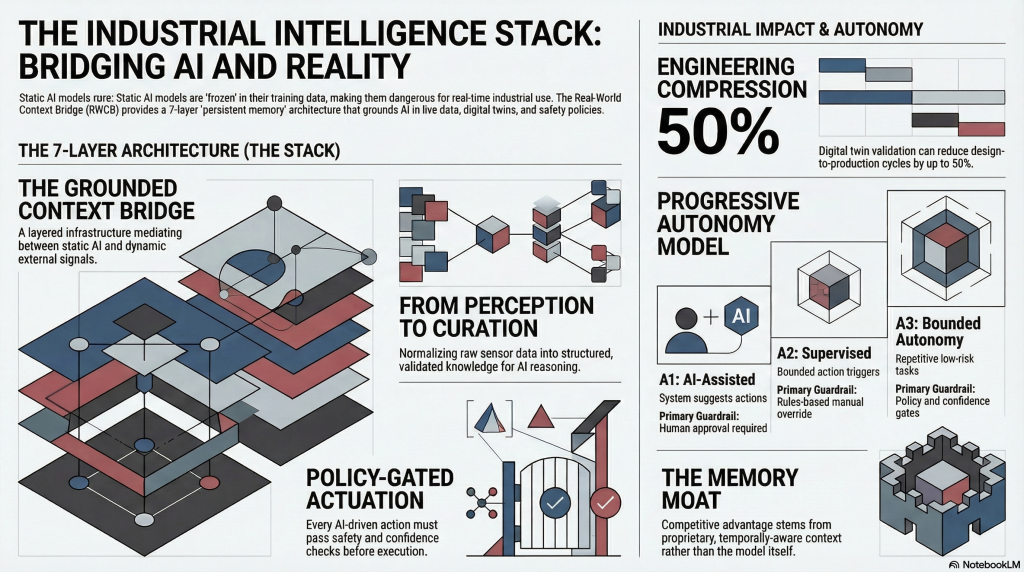
The architecture that best serves an advanced manufacturing platform has seven functional layers. Each layer depends on the one below it. Skipping layers is the most common reason AI programmes fail.
| Layer | Purpose | Core Components | Deployment |
| L1 Physical | Observe real processes | Machines, PLCs, robots, sensors, cameras, gateways | Plant edge |
| L2 Data | Create trustworthy industrial data | OPC UA, MQTT, historians, event bus | Plant edge and hybrid |
| L3 Context | Unify meaning and lineage | Asset graph, metadata, master data, versioning | Hybrid |
| L4 Twin | Model assets and scenarios | Process twins, line twins, physics simulation | Hybrid and cloud |
| L5 AI and Analytics | Predict, classify, optimise | Vision, anomaly, predictive maintenance, scheduling | Hybrid |
| L6 Application | Deliver decisions to users | Planner cockpit, quality app, operator copilots | Hybrid |
| L7 Governance | Control real-world change | Policy engine, approval workflow, rollback, audit log | Plant-local safeguards |
| The key technical challenge is not any single model. It is orchestration across noisy plant reality, safety constraints, and cross-functional workflows. Many programmes fail because they treat AI as a thin analytics add-on instead of building a robust context, verification, and change-management layer. |
2.2 Engineering AI
Engineering AI sits at the design end of the production cycle. It applies machine learning and physics-based simulation to product development, tolerance analysis, materials prediction, and virtual validation. The economic case is compelling: if you can test thousands of design variants digitally before cutting metal, you shorten time to market, reduce tooling risk, and compress the traditional build-test-fix loop by an order of magnitude.
Project Prometheus, the Bezos-backed startup reported in early 2026, is focused on exactly this layer. It reportedly builds systems that simulate and predict physical-world behaviour so engineers can test designs digitally before committing to costly physical trials. That is not a marginal improvement. It is a capital weapon. Every week saved in a defence aerospace programme or a semiconductor tool qualification has measurable six-figure value.
2.3 Factory AI
Factory AI operates on the production floor. It covers scheduling and optimisation, predictive maintenance, quality inspection, process control, anomaly detection, and operational copilots. NVIDIA’s 2026 manufacturing stack description maps this layer explicitly: AI tied to factory digital twins, robotics, quality inspection, predictive maintenance, and operational agents that surface context to planners, engineers, and technicians.
The economic wins here are the fastest to prove. Predictive maintenance delivers measurable reductions in unplanned downtime. Vision-based inspection reduces defect escape rates. AI-assisted scheduling reduces changeover waste and improves throughput. PepsiCo’s early digital twin deployments reportedly achieved a 20 percent throughput increase and 10 to 15 percent capital expenditure reduction. These are not speculative numbers. They are the kind of payback figures that close a CFO’s approval in a single meeting.
2.4 Digital Twin AI
Digital twins are the connective tissue between engineering and operations. A process twin continuously absorbs sensor data, maintenance records, quality outcomes, and planning inputs, and makes that context available for scenario modelling, change validation, and decision support. McKinsey describes them as the next frontier of factory optimisation.
The practical value is in two directions. Forwards, a twin lets you test a production change, a parameter adjustment, or a new robot cell configuration before touching the real plant. Backwards, it gives you a correlated record of what happened, when, under what conditions, and why. That second capability is undervalued by most organisations, but it is the foundation of reliable root-cause analysis and regulatory auditability.
Siemens and NVIDIA now describe their partnership explicitly as building an industrial AI operating system, combining digital twins, simulation, industrial software, and AI infrastructure. That is not a product announcement. It is a positioning statement. They are describing ownership of this layer as the strategic prize.
2.5 Physical AI and Robotics
Physical AI refers to robot control systems that can perceive, adapt, and act in changing environments. The distinction from traditional robotics is important. Traditional industrial robots execute programmed sequences in controlled conditions. Physical AI robots adapt to variation, recover from exceptions, and learn from experience.
The capital flowing into this space is large and accelerating. Robotics companies globally raised $2.26 billion in Q1 2025 alone, with more than 70 percent going to task-focused machines. Since then, funding has continued into robot-brain and deployment companies including Skild AI, Figure, Apptronik, Mind Robotics, and Physical Intelligence. Apptronik raised $520 million in February 2026 with backing from Google and Mercedes-Benz. Mind Robotics, a Rivian spinout, was valued at $2 billion in a Series A in March 2026.
Two strategic camps are emerging. Humanoid-first players like Apptronik and Figure argue that human-compatible form factors unlock the broadest deployment surface. Task-optimised players like Mind Robotics argue that traditional factory robot designs, optimised for dexterous variable work, are more practical near-term. Both camps agree on the underlying logic: the robot that wins is the one with the best AI brain, not the best mechanical design.
2.6 Operational Copilots and Agents
The final AI layer in the manufacturing stack is the human-facing intelligence surface. Operator copilots, engineer workbenches, maintenance agents, and procurement risk monitors are all versions of the same capability: an AI system grounded in plant context that surfaces relevant knowledge, coordinates actions, and supports decision-making in real time.
The critical word is grounded. Industrial copilots are not general-purpose chat interfaces. They draw on approved engineering documentation, maintenance history, quality records, and live sensor context. A maintenance technician asking why a motor is showing abnormal vibration should receive an answer that references the specific asset, its maintenance history, and the statistical pattern that matches the current reading, not a generic answer about vibration diagnostics.
That grounding requirement is why the asset graph layer matters so much. Without a maintained semantic model of what every asset is, what state it is in, what it is connected to, and what has happened to it, the copilot degrades into a hallucination risk rather than a decision aid.
3. The Stakeholder Map
Manufacturing AI affects every function in the plant and several functions well outside it. Understanding who is affected, what they need, and where resistance is likely to come from is as important as understanding the technology. Failed AI programmes almost always trace back to misalignment between what was built and what the people closest to the process actually needed.
| Stakeholder | Pain Point | What They Need | Value Created | Priority |
| Board and investors | Unclear AI payback and capital risk | Evidence-backed rollout and portfolio view | Margin improvement and asset resilience | High |
| COO and plant leadership | Low visibility and reactive issues | Plant-level control tower and KPI uplift | Operational confidence and throughput | High |
| Engineering | Slow iterations and disconnected tools | Integrated design, validation, and constraints | Shorter cycles and better first-time-right | High |
| Maintenance | Reactive work and weak root cause | Asset health models and work prioritisation | Higher uptime and planned interventions | High |
| Quality | Late defect detection | Real-time inspection and cause correlation | Lower scrap and reduced escapes | High |
| Operators | Alarm overload and unclear guidance | Simple, safe, contextual next-best-action | Less firefighting and greater safety | Medium |
| IT, OT, and security | Complex interoperability and cyber exposure | Secure integration and policy controls | Platform integrity and audit capability | High |
| HR and workforce | Skills mismatch and adoption risk | Training pathways and role redesign | Workforce capability and retention | Medium |
| Regulators and customers | Safety, provenance, resilience concerns | Auditability and controlled autonomy | Trust in output quality and compliance | High |
3.1 The Workforce Question
No stakeholder analysis of manufacturing AI is complete without an honest treatment of the workforce. The popular framing of robot-driven labour displacement is both politically charged and strategically counterproductive as a starting position. The more accurate framing, and the one that tends to unlock adoption, is job redesign.
The tasks most amenable to near-term automation are the ones workers typically find least rewarding: repetitive visual inspection, manual data transcription, reactive alarm response, and physically demanding material handling. Automating those tasks creates space for operators to move into supervision, exception handling, systems tuning, and field service roles that require judgement and contextual knowledge.
Human-in-the-loop design, retraining pathways, and transparent productivity sharing are not optional features for a responsible deployment. They are the conditions under which adoption actually happens. Every implementation that has failed because plant teams bypassed the platform or reverted to spreadsheets shares a common cause: the people closest to the process were not part of designing it.
4. The Economics: Where the Money Is, and Where It Is Not
4.1 The Revenue Pools
A well-structured industrial intelligence platform has multiple revenue streams that mature at different rates. Understanding the sequence matters as much as understanding the total addressable market.
- Modernisation programs: one-time or multi-year engagement revenue for platform deployment, integration, and change management. High margin when the capability is proprietary.
- Annual platform licensing: recurring subscription revenue from operating the intelligence layer across plant assets. Scales with site count and active users.
- Managed optimisation services: ongoing value-sharing or service contracts tied to measurable outcomes such as throughput improvement or downtime reduction.
- Robot-cell deployment: hardware and integration revenue from deploying bounded automation cells. Lower margin but creates sticky data relationships.
- AI-native contract manufacturing: using modernised plants to offer faster-turn production in strategic sectors. High capital requirement, but creates a structural moat once operational.
- Premium engineering simulation services: selling digital twin capacity, surrogate model access, and physics simulation as a service to engineering teams who cannot justify the infrastructure internally.
4.2 The Highest-Confidence Financial Wins
Not all AI use cases in manufacturing carry the same financial confidence. The clearest near-term returns come from a specific subset of applications where the output is directly measurable and the causal link between AI action and operational outcome is short.
| Use Case | Typical Payback | Confidence | Notes |
| Predictive maintenance on critical assets | 6 to 18 months | High | Direct uptime and maintenance cost impact |
| Vision-based defect detection | 6 to 24 months | High | Reduces scrap, rework, and customer escapes |
| AI-assisted scheduling and planning | 12 to 24 months | Medium-high | Throughput and changeover gains |
| Simulation-first engineering validation | 12 to 36 months | High for complex products | Capex avoidance and cycle compression |
| Operator copilots and guidance | 18 to 36 months | Medium | Adoption-dependent; UX quality critical |
| Bounded robot cell autonomy | 18 to 48 months | Medium-high for narrow tasks | Depends on task definition and safety validation |
| AI-native contract manufacturing | 3 to 7 years | Lower near-term | Long build time, but strongest long-term moat |
4.3 Where Profitability Is Weaker
Several AI applications in manufacturing attract disproportionate attention relative to their near-term financial return. Recognising these is as important for capital allocation as identifying the high-confidence wins.
General-purpose humanoid robots in messy real-world factory settings remain further from financial viability than the funding rounds suggest. The gap between laboratory demonstrations and reliable production deployment is still large for tasks with high exception rates, poor sensor coverage, or weak training data. Full lights-out factory visions, sold aggressively in vendor pitches, are technically achievable in narrow conditions but commercially premature as a first-wave business case for most manufacturers.
Retrofitting very low-margin manufacturers with expensive AI stacks often fails the basic economics test. The platform cost, including integration labour, sensor instrumentation, edge compute, and change management, must be justified against a margin structure that leaves little room for error. The initial portfolio should select for plants where the value-at-stake from improvement is large enough to absorb deployment cost in a reasonable timeframe.
| The first durable profits will come less from robot labour replacement and more from engineering compression and factory adaptability. That is where the economics are easiest to prove, fastest to demonstrate, and most defensible against competitive imitation. |
5. The Competitive Landscape
5.1 Four Layers of Competition
Competition in manufacturing AI operates across four distinct layers, and the strategic positioning differs meaningfully between them. A credible industrial intelligence platform must have a view on all four.
Industrial Software Incumbents
Siemens, Dassault Systemes, Rockwell Automation, Schneider Electric, and PTC own the deepest plant relationships, the broadest systems integration capability, and the most mature engineering workflow software. They are not standing still. The Siemens-NVIDIA partnership, announced in January 2026, is the clearest signal that incumbents understand what the next layer of competition looks like: an industrial AI operating system that unifies digital twins, simulation, software, and AI infrastructure.
These companies are hard to displace on integration depth and customer trust. The entry angle for a new platform is not to compete on systems integration but to build the intelligence layer that sits above it, across it, and between it.
Hardware and Compute Infrastructure
NVIDIA occupies a structural position in this layer that is difficult to overstate. Its DGX infrastructure, Omniverse simulation platform, and Isaac robotics stack collectively define the AI substrate for an increasing fraction of industrial applications. That position gives NVIDIA leverage across the entire stack without requiring it to own plant operations or customer relationships.
For a new platform builder, NVIDIA is more likely to be a foundational partner than a direct competitor, unless the platform attempts to build proprietary compute infrastructure from scratch, which is neither necessary nor advisable given the capital requirements.
Robotics and Physical AI
The robotics layer is the most competitive and the most fragmented. It includes humanoid-first players, task-optimised industrial robot developers, mobile manipulation specialists, and AI-brain companies that abstract across hardware platforms. Skild AI’s pitch as a foundation model for robot control, trained on human video and physics simulation, illustrates the direction: the value shifts from the mechanism to the intelligence.
Machina Labs represents a different but related model: AI-native manufacturing infrastructure built around robotic cells for complex metal structures. Their 200,000-square-foot intelligent factory, announced in February 2026 after a $124 million raise, is a working demonstration of what software-defined manufacturing looks like at scale. It is not a robot company. It is a manufacturing operating model.
Traditional Manufacturers and System Integrators
Legacy manufacturers and their integration partners still control the most valuable assets in the system: customer relationships, installed equipment, decades of production data, and plant knowledge that often exists nowhere outside the heads of experienced engineers. That tacit knowledge is both the hardest thing to replicate and the hardest thing to digitise without the right data infrastructure.
System integrators occupy an interesting middle position. They execute the deployments, hold the vendor relationships, and understand the plant environment. But they typically do not own the intellectual property in the platforms they deploy. As AI intelligence layers become more standardised, system integrators face a margin compression risk that makes some of them natural acquisition targets for platform builders.
5.2 SWOT of the New Entrant Position
| Strengths Patient capital for long industrial sales cycles No installed base to protect, so architecture can be purpose-built Access to real plant data from acquired or partner plants Simulation-first approach as a differentiating engineering capability | Weaknesses Manufacturing is operationally brutal and low-margin in many categories Brownfield plant heterogeneity is an enormous integration burden Most manufacturers remain at early AI maturity, extending deployment timelines Workforce resistance if change management is underinvested |
| Opportunities No dominant non-Chinese industrial AI operating system yet exists Reshoring and defence urgency creates politically supported demand Portfolio flywheel: acquire, instrument, model, optimise, replicate Engineering compression creates fast, credible ROI narrative | Threats Siemens-NVIDIA partnership building the same operating system from the inside China’s scale, supply chain depth, and state backing as structural advantage Safety incidents from premature autonomy deployment damage the entire field Cyber compromise of connected plant infrastructure as existential risk |
6. Implementation Sequencing and the Progressive Autonomy Model
6.1 Why Sequencing Matters More Than Ambition
The primary gap in manufacturing AI adoption is not ambition. It is delivery readiness. The manufacturers with the most enthusiasm for AI are often the ones with the weakest data infrastructure, the least mature governance frameworks, and the least experience of deploying governed workflows at scale. Jumping to autonomous robot cells or closed-loop process control without building the underlying context and verification layers is the most reliable way to produce an expensive failure.
The right sequence is not about moving slowly. It is about building each layer before depending on it. A platform that attempts to run predictive maintenance models without a clean, versioned asset graph and reliable sensor data will produce confident-looking predictions with unreliable accuracy. The plant team will stop trusting them within weeks, and the programme will stall.
6.2 The Five Levels of Autonomy
| Level | Description | Example | Guardrail | Timeline |
| A0 Human-led | System only observes and reports | KPI dashboards, performance tracking | No recommendations executed | Months 0-6 |
| A1 AI-assisted | System suggests actions to humans | Maintenance recommendations, scheduling proposals | Human approval required for all actions | Months 6-18 |
| A2 Supervised | Approved workflows trigger bounded actions | Work-order creation, job sequencing | Rules-based gating and manual override | Months 12-24 |
| A3 Bounded autonomy | System performs repetitive low-risk tasks | Robot cell handling, parameter updates in validated range | Policy and confidence threshold | Months 24-42 |
| A4 Validated autonomy | Broader autonomous behaviour in proven contexts | Closed-loop optimisation in stable cells | Formal safety case and rollback | 36 months plus |
This framework is not merely cautious. It is commercially rational. Moving through these levels builds the operational evidence base, the safety record, and the workforce trust that justify each subsequent expansion. It also creates a natural portfolio sequencing: prove A1 on one line, establish the playbook, then replicate across the portfolio before advancing the maturity level.
6.3 The Six-Phase Implementation Roadmap
| Phase | Focus | Key Deliverables | Decision Gate | Indicative Timing |
| 1 | Plant and data assessment | Architecture fit-gap, source inventory, KPI baseline | Target lines confirmed | 0 to 3 months |
| 2 | MVP data foundation | Connectors, asset graph, security baseline, dashboards | Data and UX stable | 3 to 9 months |
| 3 | Pilot intelligence | Predictive maintenance and quality analytics live | ROI evidence achieved | 9 to 18 months |
| 4 | Twin and scenario expansion | Digital twin models and planning workflow tools | Change validation trusted | 18 to 30 months |
| 5 | Robot and action orchestration | Bounded autonomy in selected cells | Safety and productivity validated | 30 to 48 months |
| 6 | Portfolio scale | Multi-plant model management and benchmarking | Platform economics confirmed | 42 months plus |
7. Governance: The Layer Everyone Skips
Governance is the most underinvested layer in manufacturing AI and the one most directly responsible for programme failures and safety incidents. It is also the layer that most clearly distinguishes a credible industrial platform from a capable but dangerous one.
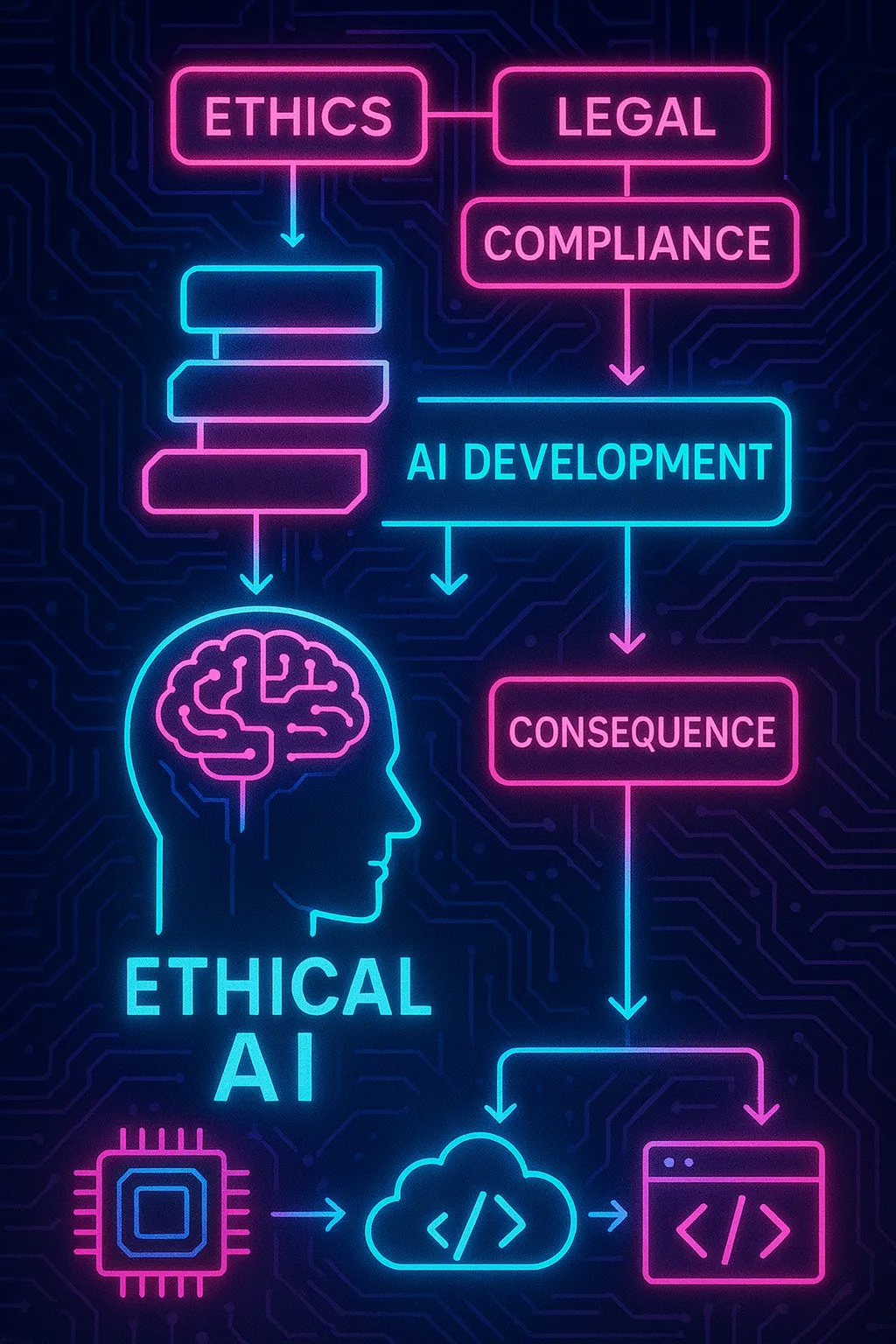
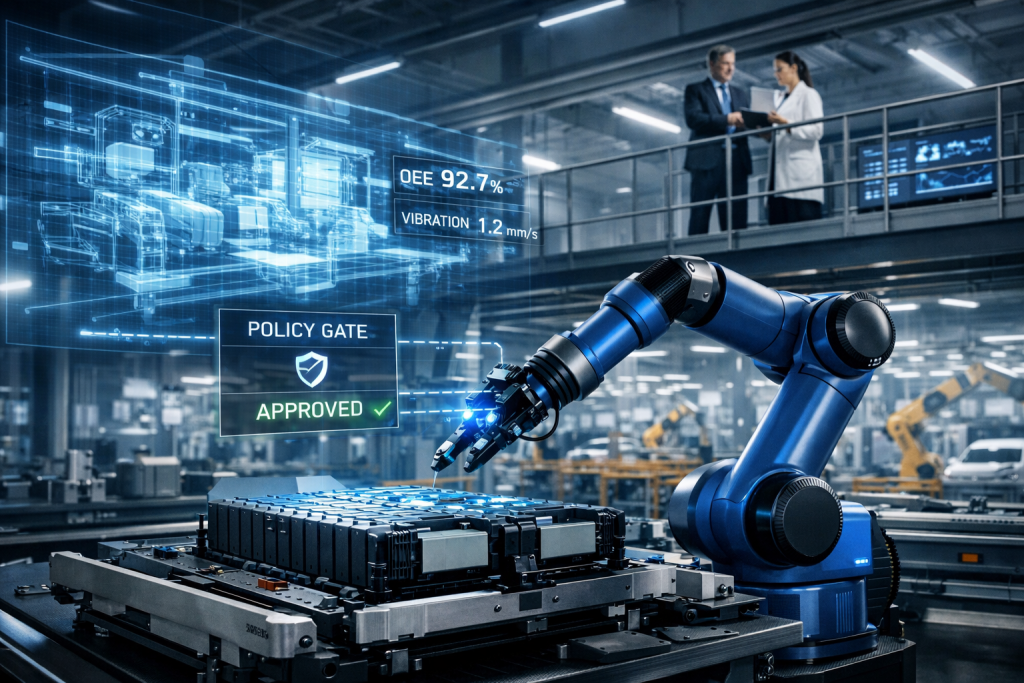
The core principle is straightforward. Every model-driven recommendation that could affect a physical process must pass through a policy and safety verification gate before it changes anything in the real factory. Separating the act of proposing from the act of executing is not bureaucratic caution. It is the engineering discipline that makes autonomous systems safe to operate at scale.
7.1 The Action Verification Layer
The action verification layer sits between the AI model outputs and any plant execution system. It enforces five checks before passing a recommendation downstream: policy compliance, safety boundary validation, confidence threshold check, human approval where required, and rollback availability. Only recommendations that pass all five gates proceed. Everything else is returned to the application layer with an explanation.
This architecture has a counterintuitive effect on adoption. Plant teams and safety officers are far more willing to allow AI systems into their workflows when they can see the gate and understand the rules it enforces. The psychological barrier to adoption is almost always about trust and accountability. A visible governance layer provides both.
7.2 Auditability and Traceability
Every action with a real-world effect must generate an immutable audit record. That record should capture the data sources that informed the recommendation, the model version that produced it, the confidence score, the approval decision and who made it, the action taken, and the outcome observed. That chain of provenance is not optional for regulated industries or for any deployment where the platform’s recommendations could affect safety, quality, or compliance.
It is also the commercial foundation for the platform’s own credibility. A platform that can demonstrate not just what it recommended but why, based on what data, validated against what simulation, approved by whom, and resulting in what outcome, is a platform that earns the trust required for expansion to A3 and A4 autonomy levels.
8. PESTLE Analysis: Forces Shaping the Field
| Factor | What Is Changing | Strategic Implication |
| Political | Industrial policy, defence spending, reshoring mandates, semiconductor sovereignty | Favours domestic manufacturing platforms with auditable AI and local capacity. Government procurement and defence contracts are a credible early revenue source. |
| Economic | Higher skilled-labour costs, margin pressure, capital intensity, interest-rate sensitivity | AI must prove faster payback through yield, uptime, and engineering compression rather than generic automation promises. ROI discipline is non-negotiable. |
| Social | Workforce anxiety, skills shortages, demand for safer and better-quality jobs | Human-in-the-loop design, transparent productivity sharing, and retraining pathways are conditions for adoption, not optional features. |
| Technological | Rapid progress in simulation, edge compute, vision, robot control, and digital twin platforms | Creates the basis for layered autonomy and factory operating systems. The technology convergence window is open now and will narrow as standards consolidate. |
| Legal | Safety, product liability, export controls, cyber rules, sector-specific compliance | Requires action verification, traceability, and clear responsibility boundaries. Legal exposure is highest in A3 and A4 autonomy without a robust safety case. |
| Environmental | Energy intensity, emissions reporting, waste reduction, circularity pressure | Digital twins and process AI can improve scrap rates, energy efficiency, and maintenance-driven waste. ESG metrics become a secondary value narrative. |
PART TWO: INVESTMENT HORIZONS, MARKET PREDICTION, AND THE SHAPE OF WHAT COMES NEXT
9. Investment Structure and Return Timelines
9.1 Three Investment Horizons
Manufacturing AI investment does not follow a single timeline. Returns are distributed across three horizons that require different capital types, risk tolerances, and value-realisation mechanisms.
Horizon One: Six to Eighteen Months
The near-term horizon is about proving the data foundation and the first intelligence use cases. Capital in this horizon funds sensor instrumentation, connectivity infrastructure, data normalisation, asset graph development, and the first analytical applications: predictive maintenance cockpits, quality dashboards, and engineering KPI tracking.
Returns in this horizon are primarily cost-reduction. Reduced unplanned downtime, lower defect escape rates, and faster identification of process drift. These returns are measurable, attributable, and sufficient to justify the next horizon of investment if the programme is disciplined. Stage gates at this horizon should require demonstrated pilot line improvements before authorising Phase 3 capital.
Horizon Two: Eighteen to Forty-Two Months
The medium-term horizon is about deploying the intelligence capabilities that depend on the foundation built in Horizon One. Digital twin scenario planning, engineer and operator copilots, robot-cell orchestration, and the first bounded autonomy deployments all belong here. Capital requirements increase, integration complexity increases, and the change management burden intensifies as AI systems begin affecting workflows rather than just informing them.
Returns in this horizon shift from pure cost reduction to a mix of cost and revenue. Faster time to market from simulation-first engineering, higher throughput from AI-assisted scheduling, and capacity expansion from bounded robot automation all contribute to the top line. The economic case becomes easier to construct and harder to challenge with each use case that delivers.
Horizon Three: Thirty-Six Months and Beyond
The long-term horizon is where the structural moat is built. Multi-plant portfolio benchmarking, AI-native contract manufacturing capacity, deeper engineering simulation services, and the transition to validated autonomy at A4 levels all sit here. Capital in this horizon is platform capital: it funds the infrastructure that makes everything else more defensible and more scalable.
Returns in this horizon are primarily strategic. The company that owns the intelligence operating system for a portfolio of modernised plants in strategic sectors does not compete on individual use cases. It competes on accumulated data, model libraries, process knowledge, and the speed at which it can replicate proven interventions across new assets.
9.2 What to Measure at Each Stage
Investment discipline in manufacturing AI requires stage-gated KPIs that are operational, not aspirational. The following metrics provide a practical framework for evaluating programme health at each horizon.
- Horizon One gates: data latency below defined threshold on critical assets, dashboard adoption among plant leadership and operators, first pilot line throughput improvement sustained for ninety days.
- Horizon Two gates: measurable reduction in unplanned downtime on targeted assets, reduction in defect escape rate on selected quality workflows, positive stage-gate evidence for second-plant expansion.
- Horizon Three gates: confirmed portfolio economics with multi-plant ROI model, external product revenue from platform licensing or simulation services, safety case approved for first A3 autonomy deployment.
| The highest-confidence financial wins come from better uptime, higher yield, faster engineering, and better asset utilisation. Target 10 to 20 percent throughput improvement on pilot lines, 5 to 15 percent capex avoidance through simulation-first validation, and 20 to 40 percent reduction in unplanned downtime as the economic proof points for expansion. |
10. The Technology Ownership Question
10.1 Who Owns the Operating System
The most consequential competitive question in manufacturing AI is not which algorithm wins or which robot is most dexterous. It is who owns the operating system. In the consumer technology paradigm, operating system ownership created platform lock-in that proved extraordinarily durable. In industrial AI, the equivalent question is which layer, once established, becomes structurally difficult to displace.
The most defensible ownership positions are not in the AI models themselves, which commoditise faster than any vendor would like, but in the data and context infrastructure that makes those models work in a specific plant environment. The asset graph, the versioned engineering knowledge base, the simulation twin calibrated to a specific production process, and the audit trail that documents every model decision and physical outcome are all deeply plant-specific. Replicating them for a competing platform requires reconstructing months or years of integration and contextualisation work.
10.2 Three Ownership Theses
The Infrastructure Thesis
Own the compute and simulation substrate. NVIDIA’s position in this space is the clearest example. By controlling the GPU infrastructure, the simulation platform, and the robot AI stack, NVIDIA sits underneath every other player in the ecosystem. This position is extraordinarily powerful but requires enormous capital to establish and maintain, and it does not require direct plant operations.
The Platform Thesis
Own the intelligence software layer: the connectors, the asset graph, the model registry, the digital twin orchestration, and the governance engine. Siemens and its industrial software peers are pursuing this thesis. The risk is that software ownership without plant data access creates a layer that is theoretically rich but practically shallow without real deployment experience.
The Operational Thesis
Own the plants, the data, and the operating model. The reported Bezos strategy is the clearest articulation of this thesis. By acquiring manufacturers and modernising them with a proprietary intelligence stack, the platform builder accumulates the most defensible asset in the field: actual production data, calibrated simulation models, and proven deployment patterns. The risk is execution complexity and capital intensity. The reward is a flywheel that accelerates with each plant added.
The highest-value long-term position is likely a hybrid of the platform and operational theses: a software-defined industrial holding company that operates modernised plants as living proof cases while licensing the platform stack externally. That structure aligns with the Bezos reports, the Siemens-NVIDIA direction, and the Machina Labs model.
11. Technologies Beyond Robotics: The Stacked Production Architecture
The public narrative around manufacturing AI concentrates heavily on robotics, particularly humanoids. That concentration is understandable but incomplete. The future of industrial production is a stacked architecture in which robotics is one execution layer among several, each with its own AI integration logic and its own economic profile.
11.1 Additive Manufacturing
Three-dimensional printing is strongest where geometry complexity, lightweighting, tooling avoidance, and small-batch customisation justify the process economics. AI improves design optimisation, build parameter tuning, defect prediction, and energy management. The combination of generative design AI with additive manufacturing is particularly powerful for aerospace and defence applications where part consolidation, weight reduction, and lead time compression have direct operational and financial value. Additive is not a universal manufacturing solution. It is a high-value tool for specific geometry and volume profiles, and its role in an intelligent factory is as one node in a multi-process production graph.
11.2 AI Metal Forming
Machina Labs represents the clearest working example of what AI-native metal forming looks like in practice: robotic cells combined with AI, closed-loop sensing, and software-defined forming, welding, and assembly. Their model shortens timelines from months to days for complex metal structures and operates in the space between traditional stamping and additive manufacturing. This is not a robot company. It is a manufacturing operating model that uses robots, AI, and software as coordinated components of a system designed for speed, flexibility, and quality.
11.3 Gigacasting
Gigacasting illustrates both the potential and the risk of extreme process consolidation. Tesla’s pioneering use of massive die-casting presses to produce large underbody sections from hundreds of previously separate parts demonstrated real cost and assembly time advantages. The subsequent reported retreat from a more ambitious next-generation variant is equally instructive: manufacturing AI can help optimise bold process bets, but it does not remove the materials science, tooling, and organisational risks that come with radical process redesign.
11.4 Drones in the Industrial Context
Drones extend the factory AI stack beyond the production floor into yards, warehouses, supply chain logistics, perimeter security, infrastructure inspection, and large industrial estates. They operate on the same control logic as factory robotics: perception, digital twin integration, mission scheduling, and human supervision. For large industrial sites, energy infrastructure, mining operations, and construction environments, drone-based inspection and logistics represent a near-term, deployable AI application with clear safety and cost benefits that does not require the same maturity threshold as full factory autonomy.
12. Market Prediction: How the Field Plays Out
12.1 The Near Term (2026 to 2028)
The near-term period will be defined by consolidation around a small number of credible industrial AI platform approaches and the first wave of genuine at-scale deployments in strategic sectors. The current funding environment will produce several companies with ambition that exceeds their delivery readiness. The field will separate into programmes that prove measurable value on real lines and programmes that are still running pilots three years after launch.
The winners in this period will be distinguished not by their AI sophistication but by their data infrastructure quality, their governance discipline, and their ability to manage change in brownfield environments. The losers will be distinguished by premature autonomy claims, inadequate asset graph investment, and implementation teams that were technically strong but operationally naive.
12.2 The Medium Term (2028 to 2032)
The medium-term period will see the emergence of platform economics in manufacturing AI. The companies that built defensible data and simulation infrastructure in the near term will begin compressing the time to deploy at new sites. Portfolio playbooks will replace bespoke deployments. Multi-plant benchmarking will become a standard commercial tool for acquisition due diligence and modernisation planning.
Robotics will mature from point solutions into coordinated fleet management, and the boundary between A2 and A3 autonomy will shift in well-instrumented environments. Engineering AI will begin delivering on its most ambitious promise: dramatically shorter design-to-certified-production cycles in aerospace and defence applications.
12.3 The Long Term (2032 and Beyond)
The long-term picture is a manufacturing landscape in which the dominant platforms are software-defined industrial operating companies that combine owned or deeply partnered production assets, a reusable intelligence stack, and a data flywheel that compounds with each deployment. These companies will not look like software firms, manufacturing conglomerates, or robotics OEMs. They will be a new category.
The most likely concentration of value will occur in four areas: strategic defence and aerospace production, semiconductor and advanced electronics manufacturing, high-complexity mobility and energy systems, and AI-native contract manufacturing services for industries that cannot justify internal platform investment. In each area, the platform company that establishes data depth, simulation accuracy, and governance credibility first will be structurally difficult to displace.
| The next major AI value pool sits not in chat interfaces, but in the physical economy, especially where simulation, production, and automation meet. The expected products are not a single robot or a single model. They are an integrated stack of industrial simulation, adaptive factory software, robot orchestration, and AI-enabled manufacturing services. The profitable future is not replacing all workers. It is turning factories into programmable, continuously improving systems. |
12.4 What Will Not Work
Balanced prediction requires identifying the theses that are most likely to disappoint as clearly as the ones most likely to succeed. Several narratives currently circulating in the investment community carry risk of significant underperformance.
The lights-out factory as a near-term commercial offer is one of them. The operational, safety, and data infrastructure required to run fully autonomous production at scale in a real brownfield plant is not available at the required cost and reliability for the vast majority of manufacturing environments. Selling it as a near-term deliverable creates contractual and reputational risk that will damage the broader field.
The humanoid-as-universal-solution narrative is another. Humanoid robots are a genuine long-term capability, and the investments being made today in dexterous manipulation, adaptive locomotion, and general robot intelligence are real and consequential. But the path from current capability to reliable deployment in the full range of unstructured factory tasks is longer than the funding rounds suggest. The near-term value in robotics comes from task-specific, well-defined applications with clear exception handling paths, not from general-purpose physical AI in complex environments.
Conclusion: The Architecture of the Opportunity
The industrial intelligence opportunity is real, large, and maturing. The market is moving, the capital is moving, and the technology is converging in ways that make meaningful deployment both possible and necessary. But the opportunity is also harder, more operationally complex, and more dependent on unglamorous foundational work than its most prominent advocates acknowledge.
The companies that will build durable positions in this field share a common architecture, regardless of whether they approach it from the software side, the hardware side, the plant ownership side, or the robotics side.
- They build the data and context layer first, before the AI layer. The asset graph, the sensor infrastructure, and the data contracts are not prerequisites you can skip. They are the foundation on which every other capability depends.
- They sequence autonomy carefully, earning trust at each level before advancing to the next. Progressive autonomy is not a slow path. It is the path that actually reaches the destination.
- They design for the humans in the system, not just the algorithms. Operator copilots, role-specific workflows, transparent governance, and visible audit trails are not feature requests. They are the mechanisms by which adoption happens and trust is maintained.
- They maintain rigorous economic discipline. Stage-gated ROI, measurable KPIs, and a portfolio playbook that replicates proven patterns before attempting novel ones are the commercial foundations that convert a compelling demonstration into a durable business.
- They treat governance as a competitive advantage, not a compliance burden. The platform that earns regulatory trust, workforce trust, and operational trust will expand into high-value, safety-critical applications that its less disciplined competitors cannot reach.
The winning firm will not be a pure software vendor or a pure robot maker. It will combine plant ownership or deep operating access with a reusable industrial intelligence stack. It will own the context layer, the simulation capability, the governance framework, and the portfolio playbook. And it will have the patience, the operational credibility, and the capital discipline to build all of it in the right sequence.
That is not a small task. But it is a clearly defined one. The field has reached the point where the architecture of the opportunity is visible, the technology is capable enough to deliver the first layers of value, and the market urgency is real enough to justify the investment. What remains is the hard work of execution.
| The future belongs not to the company with the most ambitious AI claims, but to the one with the most grounded data layer, the most disciplined governance, and the most replicable deployment playbook. In manufacturing AI, execution is the strategy. |
Success Criteria, ROI Framework, Technology Adoption, and Job Redefinition
This document defines the measurable success criteria for an industrial intelligence programme across four dimensions: financial implementation and ROI, new technology adoption, and job redefinition. Each section closes with a structured checklist that programme teams, sponsors, and reviewers can use at stage gates to assess readiness, track progress, and verify outcomes. See:
Selected Sources
Reuters, March 2026. Jeff Bezos aims to raise $100 billion to buy and revamp manufacturing firms with AI.
Los Angeles Times, March 2026. Why is Jeff Bezos raising $100 billion to bring AI to factories.
Siemens, January 2026. Siemens and NVIDIA expand partnership to build the industrial AI operating system.
McKinsey, December 2025. From pilots to performance: How COOs can scale AI in manufacturing.
McKinsey, January 2024. Digital twins: The next frontier of factory optimisation.
IFR, World Robotics 2025. Executive Summary, Industrial Robots.
Grand View Research, March 2026. Artificial Intelligence in Manufacturing Market Report, 2030.
Grand View Research, March 2026. Industrial Robotics Market Size, Share and Industry Report, 2030.
NVIDIA, March 2026. State of AI Report 2026.
Reuters, March 2026. Rivian spinout Mind Robotics valued at $2 billion in Series A funding round.
Reuters, February 2026. Humanoid startup Apptronik raises $520 million with backing from Google and Mercedes-Benz.
Machina Labs, February 2026. Machina Labs raises $124 million to scale manufacturing infrastructure for defence and advanced mobility.
UNCTAD, April 2025. Technology and Innovation Report 2025: Inclusive Artificial Intelligence for Development.