Preamble: How AI, Metamaterials, and Acoustic Zoning Are Transforming Noise Control for Cities, Events, and Public Spaces
Urban sound is becoming one of the defining design problems of the 21st century. As cities grow denser, festivals move closer to residential districts, airports face tighter community scrutiny, and people become more sensitive to environmental noise, the old model of “build a bigger wall” is reaching its limits.
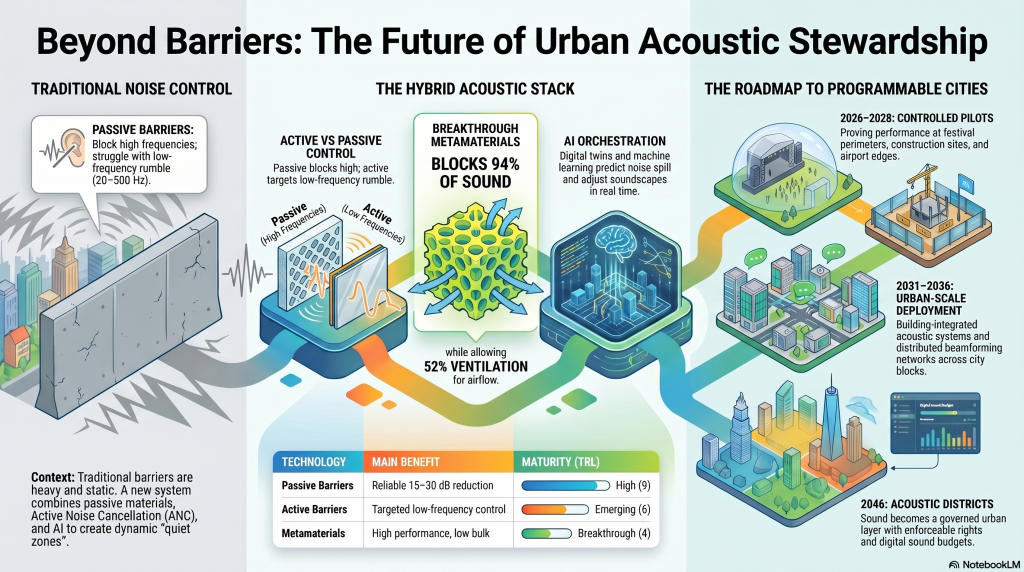
For decades, the dominant answer to unwanted outdoor noise has been passive infrastructure: concrete barriers, earth berms, timber fencing, absorptive panels, double façades, and acoustic shielding. These systems work. Passive barriers can achieve roughly 15–30 dB reduction for mid-to-high frequencies above 500 Hz, especially when they have sufficient mass, height, and width. But they are static. They cannot adapt to wind. They cannot respond to a shifting crowd. They cannot target only the bass from a stage, the rumble from aircraft, or the low-frequency vibration from construction equipment. They are also bulky, material-intensive, and often visually intrusive.
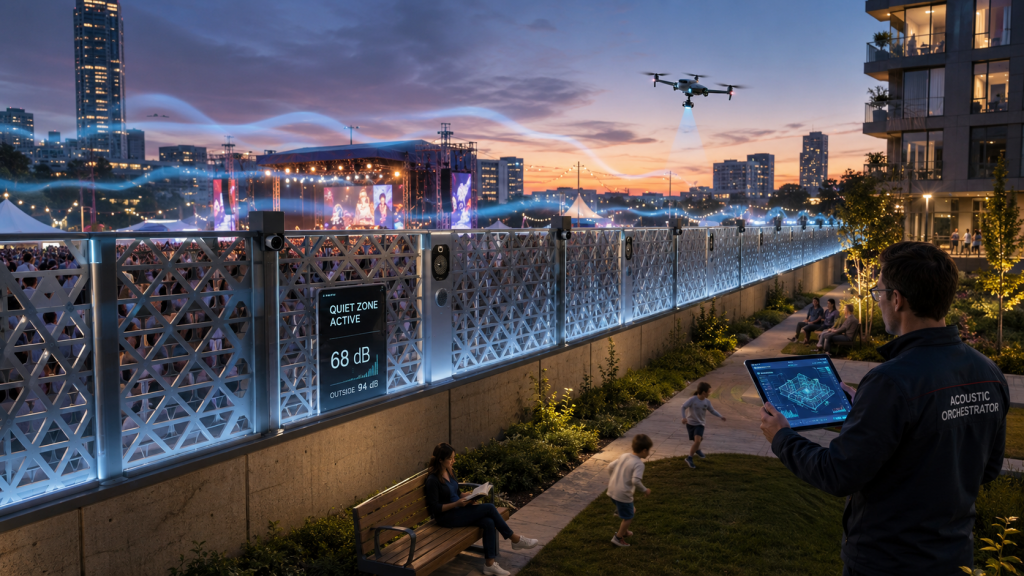
A new acoustic frontier is emerging: outdoor active noise cancellation, acoustic metamaterials, AI-driven spatial audio, and hybrid active-passive sound zoning. Together, these technologies point toward a future in which sound is not merely blocked, but shaped, steered, negotiated, monitored, and programmed.
This does not mean cities are about to receive giant noise-cancelling headphones. The physics are harder than that. But the trajectory is unmistakable: sound is becoming a managed urban layer, much like lighting, traffic, air quality, or energy.
As Usual References and research: ANC . YouTube Version: https://www.youtube.com/watch?v=FV_GFXq8kF0
What Is Outdoor Active Noise Cancellation?
Outdoor active noise cancellation, or outdoor ANC, uses microphones, signal processing, and loudspeakers to generate anti-noise waves that interfere destructively with unwanted sound.
In headphones, ANC works because the system only needs to control a tiny, predictable space: the small acoustic cavity between the headphone speaker and the listener’s ear. Outdoors, the problem becomes much harder. Sound waves reflect off buildings, bend with temperature gradients, scatter through crowds, and shift with wind. Multiple sources may arrive from different directions. A listener may move. The air itself becomes part of the system.
Current active noise barriers can achieve roughly 5–15 dB reduction in controlled outdoor zones, particularly for low-frequency noise in the 20–500 Hz range. Some analyses cite more ambitious results in constrained conditions, including platforms claiming up to 92% perceived reduction over 500+ meter zones, but these should be understood as targeted, context-dependent results rather than universal outdoor silence.
The important point is this: outdoor ANC is not a replacement for all passive barriers. It is a precision tool for problems that passive barriers handle poorly—especially low-frequency, persistent, spatially predictable noise.
Why Outdoor Noise Is Becoming a Strategic Problem
Noise is no longer just a nuisance. It is increasingly treated as a public health, planning, regulatory, and reputational issue.
For municipalities, noise complaints can derail event licensing, construction schedules, transport expansion, airport operations, and housing densification. For event organizers, uncontrolled sound spill can threaten permits and community relationships. For developers, acoustic performance can influence planning approval and asset value. For residents, noise exposure affects sleep, stress, concentration, and perceived quality of life.
The attached research frames the opportunity clearly: as urban density increases and public sensitivity rises, society needs systems that can programmatically control sound in open environments rather than merely block it. The long-term vision is a world where sound is zoned like traffic or light: loud here, quiet there, buffered at the edge, measured continuously, and negotiated with affected communities.
1. Market size by category
| Market | Current / forecast size | Growth | Relevance to ANC opportunity |
| ANC headphones | USD 23.24bn in 2026, forecast to USD 44.76bn by 2031 | 14.01% CAGR | Mature consumer proof of ANC demand, but crowded and not the best entry point. (Mordor Intelligence) |
| Smart headphones | USD 12.49bn in 2024, forecast to USD 36.32bn by 2030 | 20.5% CAGR | Shows growth in AI/audio/wearable comfort features. (Grand View Research) |
| Noise control systems | USD 7bn in 2026, forecast to USD 10bn by 2033 | 5% CAGR | Relevant umbrella market for panels, barriers, and commercial noise control. (Coherent Market Insights) |
| Active noise & vibration control systems | USD 3.59bn in 2025, forecast to USD 6.27bn by 2034 | 6.4% CAGR | Strong fit for aviation, automotive, industrial, machinery, and infrastructure. (Precedence Research) |
| Industrial noise control | USD 3.81bn in 2024, forecast to USD 5.84bn by 2035 | 3.95% CAGR | Good fit for data centres, BESS, factories, construction, ports, and utilities. (Market Research Future) |
| Sound barriers | USD 6.1bn in 2025, forecast to USD 11.2bn by 2035 | 6.3% CAGR | Directly relevant to hybrid active/passive barriers. (Future Market Insights) |
| Acoustic panels | USD 12.8bn in 2024, forecast to USD 20.1bn by 2030 | 7.8% CAGR | Strong adjacency for indoor quiet zones, gyms, healthcare, hospitality, and retrofit. (strategicmarketresearch.com) |
| Aerospace vibration/noise control | USD 4.85bn in 2024, forecast to USD 7.45bn by 2030 | 7.42% CAGR | Useful for cabin comfort, aircraft systems, eVTOL, and aviation-adjacent innovation. (TechSci Research) |
| Noise control services | USD 0.39bn in 2026, forecast to USD 0.69bn by 2035 | Steady growth | Relevant for consulting, surveys, acoustic compliance, and installation services. (Business Research Insights) |
Interpretation
The largest proven ANC-adjacent markets are headphones, acoustic panels, sound barriers, and general noise control systems. The highest-opportunity gap is not in headphones; it is in measurable quiet-zone systems for places where existing passive treatment is too bulky, too static, or lacks live compliance evidence.
Your attached research estimates the broader noise control systems market at about USD 7bn in 2026 to USD 10bn by 2033, and notes that outdoor ANC will probably emerge through multiple business models rather than one standalone category.
PESTLE Analysis: Outdoor ANC and Acoustic Zoning
| Factor | Implication |
| Political | Cities, airports, and transport authorities face growing pressure to control environmental noise. Municipalities increasingly need noise-compliant festivals, construction sites, and public events. |
| Economic | Active systems are typically more expensive upfront than passive barriers, but they can outperform passive approaches for low-frequency noise and constrained sites. Hybrid systems may offer the strongest cost-performance balance. |
| Social | Public tolerance for uncontrolled noise is falling. Residents expect transparency, predictability, and meaningful mitigation rather than after-the-fact complaint handling. |
| Technological | AI, microphone arrays, spatial audio, metamaterials, edge processors, and acoustic digital twins are converging into a new generation of adaptive sound-control systems. |
| Legal | Noise permitting, benefited-residence thresholds, environmental assessment, workplace exposure rules, and local nuisance law all shape adoption. In highway contexts, cost-per-benefited-residence thresholds are often central to reasonableness tests. |
| Environmental | Passive concrete and steel barriers carry embodied carbon; active systems consume power and require electronics. The best lifecycle outcome may come from hybrid designs using fewer heavy materials plus targeted active control. |
SWOT Analysis
| Strengths | Weaknesses |
| Stronger potential for low-frequency control than conventional passive barriers | Limited spatial coverage; works best in defined “quiet zones” |
| Adaptive response to changing sound sources and environments | Sensitive to wind, humidity, reflections, geometry, and calibration |
| Enables programmable acoustic zones, not just barriers | Higher capital cost, power demand, maintenance burden |
| Can reduce reliance on heavy, land-intensive infrastructure | Requires skilled acoustic design and real-time monitoring |
| Opportunities | Threats |
| Festivals, airports, highways, construction, smart cities, industrial facilities | Public skepticism about “sound manipulation” |
| Hybrid metamaterial-active panels | Regulatory fragmentation across jurisdictions |
| Acoustic digital twins for permits and event design | Competing solutions such as quiet pavement, urban design, scheduling limits |
| Resident transparency portals and acoustic stewardship services | Slow manufacturing scale-up for metamaterials |
Current State of Technology in 2026
1. Passive Barriers: Mature and Reliable
Passive barriers remain the default because they are simple, robust, and energy-free. They are particularly effective for mid-to-high-frequency noise. Their limitations appear at low frequencies, where wavelengths are long and effective passive control often requires impractical mass, depth, or distance.
2. Active Noise Barriers: Emerging but Useful in Targeted Zones
Active noise barriers use microphones, DSP processors, and loudspeakers to create controlled cancellation zones. They are best suited to steady, low-frequency noise such as engine rumble, HVAC noise, some industrial machinery, and certain traffic or aircraft components. They are less effective against sudden transient sounds such as horns, bangs, and door slams because the system has little time to detect, calculate, and counteract the event.
3. Acoustic Metamaterials: The Breakthrough Frontier
Acoustic metamaterials are engineered structures that manipulate sound through geometry rather than mass alone. They can trap, redirect, absorb, or block sound in ways conventional materials cannot.
The attached research highlights several promising directions: meta-rings that block large fractions of sound while allowing airflow, ventilated resonant structures, 3D-printed low-frequency panels, and bio-inspired designs. One cited research direction reports over 60 dB reduction in the 650–1410 Hz range while maintaining 52% ventilation, while another reports 94% sound blocking while allowing air passage. These results are highly promising, but many remain at prototype or early commercialization stages.
4. Spatial Audio and Beamforming: Mature in Venues, Expanding Outdoors
Spatial audio systems already shape sound in theatres, immersive venues, exhibitions, and large event environments. Systems such as L-ISA, Soundscape, immersive theatre platforms, and beamforming speaker arrays can steer sound toward desired zones and reduce spill into others. They do not create silence, but they change the geometry of listening.
5. AI-Driven Acoustic Control: The Accelerator
AI does not repeal physics. It does, however, make complex acoustic systems manageable.
AI can support predictive cancellation, adaptive beam steering, automated FOH mixing, real-time environmental modelling, acoustic digital twins, and live compliance dashboards. The research describes AI as the biggest shift since digital signal processing because it can coordinate many interacting components that would be too complex to tune manually in real time.
Technology and Solution Exploration Matrix
| Solution Type | Best Use Case | Maturity | Main Benefit | Main Constraint | Strategic Role |
| Passive barriers | Roads, rail, industrial perimeters | High | Reliable 15–30 dB mid/high-frequency reduction | Bulky; weak at low frequencies | Baseline layer |
| Quiet pavement | Road traffic | Medium/high | Low-cost 3–5 dB reduction | Frequent replacement; limited spectrum | Complementary measure |
| Active noise barriers | Low-frequency persistent noise | Emerging/applied | 5–15 dB targeted low-frequency reduction | Power, calibration, limited zones | Precision low-frequency layer |
| Acoustic metamaterials | Ventilated barriers, lightweight panels, façades | Breakthrough/emerging | High performance with less bulk | Manufacturing scale and cost | Future material layer |
| Beamforming/spatial audio | Events, theatres, exhibitions, stadiums | Medium/high | Keeps wanted sound inside zones | Requires careful design and tuning | Sound-containment layer |
| Acoustic digital twins | Permitting, planning, pre-event simulation | Emerging | Predicts spill before deployment | Data quality and model validation | Planning and compliance layer |
| AI orchestration | Complex multi-zone environments | Emerging | Dynamic optimization across sensors and speakers | Safety, explainability, latency | Control layer |
| Hybrid systems | Festivals, airports, construction, urban districts | Emerging | Broadest performance across frequencies | Integration complexity | Most realistic near-term path |
Stakeholder Analysis
| Stakeholder | Core Need | Pain Point | What Success Looks Like | Engagement Strategy |
| Residents | Sleep, comfort, predictability | Late-night noise, bass leakage, lack of transparency | Lower boundary noise, clear schedules, complaint response | Resident portal, sound budgets, pre-event communication |
| Event organizers | Permit security, audience experience | Noise complaints, curfews, reputational risk | High-quality sound inside, lower spill outside | Acoustic design package, real-time dashboard |
| Municipalities | Compliance, public trust, economic activity | Balancing nightlife/events with residents | Fewer complaints, measurable compliance | Licensing integration, acoustic charters |
| Acoustic engineers | Reliable tools and validated models | Complex outdoor propagation | Predictable performance and calibration workflows | Open standards, test data, simulation tools |
| Audio production teams | Artistic control | Fear that limits will damage experience | Compliance without ruining the show | AI recommendations, human override, FOH integration |
| Transport operators | Mitigation of road, rail, and airport noise | Low-frequency noise and community opposition | Targeted reductions near affected communities | Hybrid barriers, monitoring, retrofit planning |
| Developers and architects | Planning approval and asset value | Noise constraints on dense sites | Buildable acoustic strategies | Façade-integrated systems, planning evidence |
| Regulators | Enforceable standards | Fragmented data and inconsistent reporting | Auditable noise performance | Certified monitoring and reporting systems |
| Hardware manufacturers | Scalable product demand | Immature market and uncertain standards | Repeatable modular products | Partnerships with events, cities, and consultants |
| Investors | Defensible growth market | Long sales cycles and technical risk | Validated pilots and recurring software revenue | Start with systems integration and SaaS tools |
Market Forces and Business Opportunity
The commercial opportunity sits at the intersection of noise control, live events, transport infrastructure, smart cities, construction, aviation, and environmental compliance.
The attached analyses cite a noise control systems market growing from roughly $7 billion in 2026 to about $10 billion by 2033, with related aviation active noise and vibration control systems valued at $2.66 billion in 2025 and projected to reach $3.64 billion by 2035.
Outdoor ANC is unlikely to become a single standalone market at first. It is more likely to emerge through several business models:
| Business Model | Description | Near-Term Viability |
| Acoustic simulation SaaS | Digital twins and permitting tools for events, venues, and planners | High |
| Systems integration | Combining barriers, sensors, beamforming, AI, and monitoring | High |
| Modular hardware | Active-metapanel products for events, roads, and construction | Medium |
| Acoustic stewardship certification | Compliance and resident-trust programs | Medium/high |
| IP licensing | Algorithms, metamaterial geometries, control architectures | Medium |
| Consumer garden/small venue systems | Portable acoustic fencing and AI-guided setup | Medium/long-term |
The most realistic near-term wedge is not “city-scale ANC.” It is premium, high-pressure acoustic environments: festivals near residential areas, construction sites with strict limits, airports under community pressure, and venues that need measurable sound containment.
Gap Analysis: Today vs. the Programmable Soundscape Future
| Gap Type | Today | Future Target | Uncertainty |
| Capability | Small controlled zones; limited outdoor cancellation | Multi-zone adaptive quiet corridors and sound corridors | KU |
| Dependency | Requires expert calibration and site-specific design | Self-calibrating modular systems | KU |
| Economic | Active systems cost 2–4× passive equivalents, sometimes more at infrastructure scale | Mass-manufactured panels and SaaS-style optimization reduce deployment cost | KU |
| Regulatory | Fragmented local rules and permitting standards | Acoustic budgets, certified monitoring, enforceable sound rights | UU |
| Behavioral | Public may distrust sound manipulation or invisible control systems | Acoustic transparency becomes part of civic trust | UU |
The Pathway to Scale
Phase 1: 2026–2028 — Controlled Pilots
The first phase is about proving performance in specific settings: festival boundaries, construction perimeters, industrial yards, and small transport corridors. The target should not be universal silence, but measurable improvement: reduced bass spill, fewer complaints, better compliance, and improved perceived quiet.
Phase 2: 2028–2031 — Modular Integration
This phase brings together acoustic digital twins, edge AI, microphone networks, active panels, and metamaterial-enhanced barriers. Systems become faster to deploy, easier to calibrate, and more repeatable.
The research identifies a plausible consumer or small-venue pathway in this window: smart acoustic fence panels, mesh coordination, solar-powered elements, and rental or subscription models for gardens, community spaces, and small events.
Phase 3: 2031–2036 — Urban-Scale Deployment
By this stage, acoustic zoning could become part of urban design. Buildings may integrate acoustic façades. Event districts may operate with live sound budgets. Transport corridors may combine quiet pavement, passive shielding, active low-frequency control, and real-time monitoring.
Phase 4: 2036–2046 — Programmable Acoustic Districts
The long-term vision is not simply noise reduction. It is programmable acoustic governance: districts where sound is dynamically managed, where therapeutic soundscapes support wellbeing, and where acoustic rights are negotiated like environmental limits.
Conclusion: From Noise Barriers to Acoustic Stewardship
The future of outdoor noise control will not be built from one technology. Passive barriers will remain essential. Active cancellation will handle targeted low-frequency problems. Metamaterials will reduce bulk and open new design possibilities. Beamforming will keep wanted sound where it belongs. AI will coordinate the system. Digital twins will make acoustic outcomes predictable before a site is built or an event begins.
The real shift is conceptual.
We are moving from noise blocking to acoustic stewardship.
That means cities, venues, transport operators, and developers will increasingly be judged not only by how loud they are, but by how intelligently, transparently, and fairly they manage sound.
Outdoor ANC is not yet a universal “silence wall.” But as part of hybrid acoustic zoning, it is becoming one of the most important technologies in the next generation of urban environmental control.
Recommendation: Test. Start with controlled pilots in high-value use cases—festivals, construction sites, transport edges, and premium venues—before attempting city-scale deployment.