A Systemic Framework for Near-Expiry Food Utilisation,
Meal Conversion, and Last-Mile Delivery, Built upon the P³T&C Architecture of the Cultivating Abundance Framework
and informed by the China Case Study Systemic Blueprint
Preamble
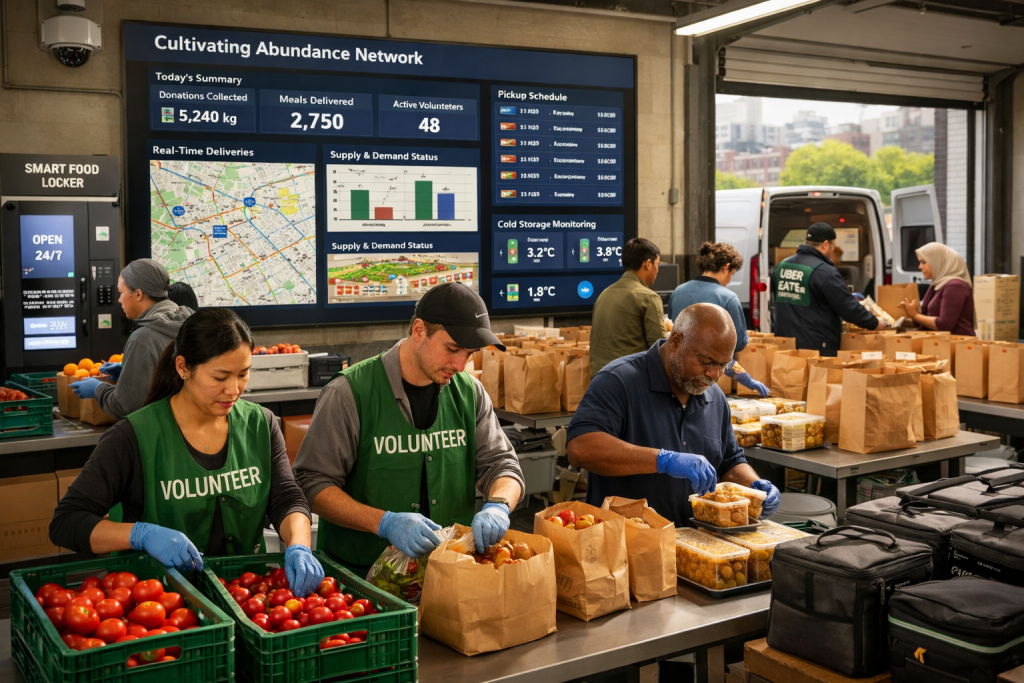
Cities throw away vast amounts of edible food every day while vulnerable people struggle to access consistent meals. Soup kitchens already sit at the intersection of this contradiction. They have kitchens, volunteers, and trust within communities, yet they operate under extreme unpredictability and limited infrastructure. This document reframes soup kitchens as intelligent conversion hubs that transform near-expiry surplus into safe, frozen meals and structured home delivery. It treats freezing, logistics, and AI coordination as public infrastructure tools, not charity add-ons. The aim is to turn time-sensitive waste into a stable food pipeline that reaches both walk-in diners and people who cannot leave their homes.
As usual some artifacts :Related Artifacts Part 2
| Document Name | Short Description |
| AI Risk Assessment Profile and Mitigation Plan | Defines the AI boundaries, risk taxonomy, safety controls, governance, monitoring metrics, and phased safe‑deployment plan for the soup‑kitchen + homebound delivery AI system. |
| Outline Software Requirements Specification | SRS for the soup‑kitchen conversion and delivery platform: functional requirements, non‑functional requirements, AI features, safety constraints, and acceptance tests. |
| Outline Hardware Requirements and Technology Stack | Hardware and site‑infrastructure specification for intake, cooking, cooling, freezing, packaging, storage, dispatch, IoT monitoring, and the supporting technology stack. |
| Soup Kitchen & Homebound Delivery Synthesis (CA Framework) | A systemic blueprint integrating soup kitchens into the Cultivating Abundance model: operational characteristics, safety, freezing workflows, AI logistics, delivery channels, and ecosystem scale. |
| Generic Implementation and Business Plan | End‑to‑end implementation and governance plan for a city‑scale surplus‑to‑meal system: selection criteria, staffing, funding architecture, policy integration, rollout playbook, risk simulation, and governance structures. |
| In‑Depth Stakeholder and Ecosystem Analysis | A systems‑level stakeholder map detailing power, dependencies, risks, incentives, failure modes, required features, RACI governance, and ecosystem influence flows. |
| General Food Handling Risk and Health & Safety Document | Baseline food‑safety and health‑and‑safety standards for intake, cooking, cooling, freezing, storage, delivery, hygiene, equipment use, incident response, and training in mixed volunteer/professional kitchens. |
I. Executive Summary
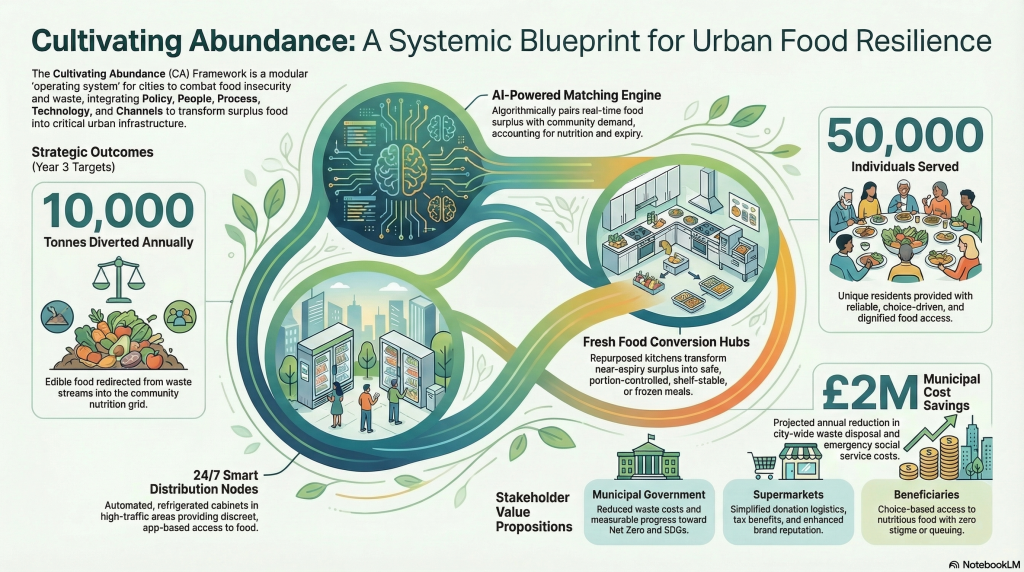
This document extends the Cultivating Abundance (CA) Framework Cultivating Abundance, A Blueprint for City Scale Urban Food Resilience originally architected around the China case study’s systemic blueprint for urban food resilience into the specific operational context of soup kitchens and food delivery services for homebound individuals. The core thesis is unchanged: near-expiry surplus food represents both the most urgent waste stream and the greatest untapped resource for feeding vulnerable populations. What changes is the conversion pathway, the last-mile channel, and the AI-assisted logistics model required to make it work reliably at scale.
Soup kitchens occupy a unique position in the food-redistribution ecosystem. Unlike static smart cabinets or staffed pantries, they already possess commercial kitchen infrastructure, trained food-handlers, and established community trust. The framework reframes them not merely as end-point distributors but as active Conversion Hubs: facilities that receive near-expiry surplus, triage it for safety and nutritional value, convert it into frozen or microwavable meals, and feed two parallel channels — walk-in service for immediate consumption and a structured delivery pipeline for homebound individuals who cannot access in-person services.
Key Principle: The soup kitchen is not the end of the supply chain. It is the intelligent midpoint — where raw surplus becomes a finished, safe, labelled, portion-controlled product that can be distributed through food-delivery-style logistics at a fraction of the cost of bespoke meal services.
This synthesis addresses all seven domains requested: operational characteristics and constraints; health, safety, and regulatory considerations; logistical integration with freezing and microwavable meal production; differentiation from homebound and general delivery programmes; pipeline interface with existing infrastructure; hardware and software requirements; stakeholder mapping; and a detailed risk profile. Each section is grounded in the P³T&C (Policy, People, Process, Technology, Channels) architecture established by the CA Framework, enriched by lessons drawn from China’s Shanghai and Shenzhen models.
II. Operational Characteristics & Constraints of Soup Kitchens
A. What Makes Soup Kitchens Operationally Distinct
Soup kitchens differ fundamentally from food banks, smart cabinets, and dark kitchens in ways that shape every design decision in this framework. Understanding these distinctions is prerequisite to integration.
| Characteristic | Soup Kitchen Reality | Implication for Near-Expiry Integration |
| Kitchen Infrastructure | Most operate commercial or semi-commercial kitchens with stoves, ovens, prep surfaces, and some form of cold storage — but rarely industrial-grade freezers or vacuum sealers. | Freezing and microwavable meal production require a targeted capital upgrade, not a ground-up build. The existing kitchen is the anchor asset. |
| Volunteer Workforce | Operations are heavily volunteer-driven. Skill levels vary enormously — from untrained to professionally qualified. Shifts are irregular and retention is a chronic challenge. | Food-safety protocols must be simple, visual, and enforceable by non-professionals. AI-assisted checklists and real-time dashboards replace reliance on individual judgement. |
| Throughput & Capacity | A typical urban soup kitchen serves 50–300 meals per day during a single service window (usually lunch, sometimes dinner). Weekly throughput ranges from 300–2,000 meals. | Near-expiry conversion must be batched to fit existing service rhythms. Freezing production for delivery is an additive activity, not a replacement — it runs alongside or immediately after the daily service. |
| Supply Unpredictability | Donations arrive ad hoc. Quantity, type, and quality are largely uncontrolled. Staff frequently discover what they are cooking on the morning of service. | The AI routing engine must be designed for maximum input variability. Recipe libraries must support dynamic substitution, not fixed menus. |
| Trust & Dignity Norms | Soup kitchens carry significant stigma in many communities. Beneficiaries often feel exposed or surveilled. Some refuse to return after a negative experience. | Any delivery service branching from the soup kitchen must be branded and operated independently — the connection to the kitchen should be invisible to the end recipient. |
| Regulatory Position | Many operate under charity or faith-based exemptions that reduce their food-safety obligations compared to commercial kitchens. This is both an advantage (flexibility) and a risk (gaps). | The framework must map each kitchen’s actual regulatory status and layer in voluntary HACCP-equivalent protocols where statutory requirements are absent. |
| Hours of Operation | Typically open 4–8 hours per day, 5–7 days per week. Refrigeration and security outside these hours are inconsistent. | Freezer storage and IoT monitoring must function 24/7 regardless of kitchen operating hours. Remote temperature alerting is non-negotiable. |
B. The Dual-Channel Model
The framework proposes that soup kitchens operate two parallel output channels, each serving a different population with a different product:
| Channel | Product | Consumer | Distribution Method | Volume Priority |
| Channel 1: Walk-In Service | Hot meal, freshly prepared | Individuals who can attend in person | On-site consumption | High — maintains the kitchen’s core social function and community presence |
| Channel 2: Freeze-to-Deliver | Portioned, labelled, frozen or chilled microwavable meals | Homebound individuals (elderly, disabled, post-surgery, carer-isolated) | Food-delivery-style logistics (driver network, route optimisation) | Growing — this is the primary scaling lever for near-expiry utilisation |
The freeze-to-deliver channel is where the near-expiry food problem is solved at scale. Fresh surplus that would spoil within 24–48 hours is converted into meals with a 3–6 month frozen shelf life, transforming a perishability crisis into a logistics opportunity.
III. Health, Safety & Regulatory Considerations for Near-Expiry Food
A. The Near-Expiry Triage Framework
Not all near-expiry food is equal. The framework introduces a four-tier classification system that determines the fate of every item entering the soup kitchen pipeline. This replaces the binary accept/reject decision that most kitchens currently apply with a nuanced, safety-first routing logic.
| Tier | Definition | Permitted Use | Safety Protocol | Example Items |
| Tier 1: Fresh-Use Window | Expires within 24 hours. Still safe for immediate cooking and consumption. | Walk-in service only (Channel 1). Must be cooked and served same day. | Visual inspection + temperature check. No freezing permitted at this stage unless cooked first. | Fresh vegetables, bread, dairy approaching best-before. |
| Tier 2: Cook-and-Freeze Ready | Expires within 2–5 days. Safe to cook and then freeze immediately. | Conversion to frozen microwavable meals (Channel 2). Must enter production within 12 hours of intake. | Full intake triage: visual, temperature, packaging integrity, allergen check. Batch QR code assigned. | Meat, fish, prepared sauces, soft produce, fresh pasta. |
| Tier 3: Packaged Shelf-Stable Near-Expiry | Packaged goods within 1–3 weeks of best-before. Remain safe but commercially unsaleable. | Direct distribution via walk-in pantry or smart cabinet. Can supplement frozen meals as sides. | Packaging integrity check only. Batch logged in platform. | Canned goods, dry pasta, cereal, sauces, condiments. |
| Tier 4: Rejected | Visually compromised, temperature-breached, packaging damaged, or past expiry date. | Full rejection. Disposed of via composting or general waste. | Photographed and logged for donor feedback. No exceptions. | Mouldy produce, burst packaging, items found past expiry. |
B. HACCP-Aligned Protocols for Near-Expiry Conversion
Drawing on the CA Framework’s Conversion Hub Operations and China’s food redistribution safety model, the following critical control points apply specifically to near-expiry food handled in soup kitchen environments:
- Critical Control Point 1 — Intake Temperature Verification: All cold-chain items must be at or below 8°C at the point of acceptance. Items above this threshold are rejected regardless of stated expiry. IoT-enabled temperature loggers on incoming delivery containers provide automated verification.
- Critical Control Point 2 — Time-Temperature Abuse Window: From intake to cooking, no more than 4 hours may elapse for items in the 8–60°C danger zone. The platform flags any batch approaching this limit and alerts the kitchen manager.
- Critical Control Point 3 — Cooking to Safe Core Temperature: All Tier 1 and Tier 2 items must reach 75°C core temperature (or equivalent time-temperature combination) before serving or freezing. Temperature probes are mandatory at this stage.
- Critical Control Point 4 — Rapid Cooling for Freezing: Cooked meals destined for freezing must cool from 60°C to 21°C within 2 hours, and from 21°C to 5°C within a further 4 hours. Industrial blast chillers are the required equipment upgrade for this protocol.
- Critical Control Point 5 — Frozen Storage Integrity: Frozen meals must be stored at -18°C or below. IoT sensors monitor temperature continuously. Any excursion above -15°C for more than 30 minutes triggers an automatic quarantine flag on the affected batch.
- Critical Control Point 6 — Delivery Cold Chain: Meals delivered to homebound individuals must remain below 5°C (chilled) or -18°C (frozen) throughout transit. Insulated delivery bags with cold packs are the minimum standard; refrigerated vehicles are required for volumes exceeding 20 meals per route.
C. Regulatory Landscape & Compliance Mapping
Soup kitchens exist in a patchwork of regulatory statuses. Some operate under charity food-safety exemptions; others hold full food business licences. The framework does not assume a single status but provides a compliance mapping tool that identifies the gap between each kitchen’s current obligations and the additional standards required by near-expiry conversion and delivery.
| Regulatory Dimension | Requirement for Near-Expiry Conversion | Enforcement Body (UK Example) | CA Framework Action |
| Food Hygiene Rating | Any kitchen producing frozen meals for off-site delivery must hold a minimum rating of 3 (Good Hygiene Practice). Rating 5 (Excellent) is the target. | Local Authority Environmental Health | Baseline rating assessment at onboarding. Remediation plan if below 3. |
| Food Handler Certification | All staff and volunteers handling Tier 1 and Tier 2 food must hold a Level 2 Food Safety in Catering certificate. | Accredited training providers | Mandatory training funded by the framework. Tracked in the volunteer management module. |
| Allergen Management | All frozen meals must carry full 14-allergen labelling. Cross-contamination protocols must be documented and auditable. | Food Standards Agency | Labelling machine integrated into production line. AI-generated nutritional and allergen data per batch. |
| Good Samaritan / Liability | Donors of near-expiry food must be protected from liability if the food is handled correctly downstream. Standardised liability waivers required. | Varies by jurisdiction; proposed UK Food Waste Reduction Bill | Waiver templates co-drafted with municipal legal teams. Insurance coverage extended to cover conversion activities. |
| Data Protection (Delivery) | Homebound beneficiaries’ addresses and dietary data constitute personal data. GDPR-compliant handling is mandatory. | Information Commissioner’s Office (ICO) | Privacy-preserving registration. Address data encrypted at rest. Delivery drivers see route only, not beneficiary identity. |
IV. Logistical Integration: Freezing, Microwavable Meals, AI & Delivery
A. Meal Type Priority Framework
Not all meals are equally suitable for freeze-to-deliver conversion. The framework establishes a priority matrix based on three factors: how well the dish survives freezing and reheating (freeze-reheat fidelity), how nutritionally complete the meal is as a standalone portion, and how readily the ingredients map to common near-expiry surplus streams.
| Meal Category | Priority | Freeze-Reheat Fidelity | Nutritional Completeness | Surplus Alignment | Examples |
| Soups & Broths | ★★★★★ (Highest) | Excellent — liquids freeze and reheat with minimal quality loss. | High when paired with bread or crackers (distributed alongside). | Very high — vegetable trimmings, near-expiry stock, leftover meat all convert well. | Vegetable soup, chicken broth, minestrone, lentil dal. |
| Stews & One-Pot Meals | ★★★★★ (Highest) | Excellent — sauces and chunky components retain texture. | Self-contained protein + carb + vegetable in one container. | High — root vegetables, legumes, and meat scraps are core surplus items. | Beef stew, chickpea curry, ratatouille with rice. |
| Rice & Grain Dishes | ★★★★☆ (High) | Very good — rice freezes well if cooled rapidly. | Good when combined with a protein or sauce portion. | High — rice and grains are common Tier 3 surplus items. | Fried rice, pilaf, grain bowls with sauce. |
| Pasta Dishes | ★★★☆☆ (Medium) | Moderate — pasta can become mushy if overcooked before freezing. Al dente + rapid cool is critical. | Good when sauce is protein-rich. | Medium — pasta itself is rarely surplus; sauces often are. | Pasta bake, mac & cheese, pasta with meat sauce. |
| Sandwiches & Wraps | ★★☆☆☆ (Low) | Poor — bread and fillings do not survive freezing well. | Moderate. | Low — these are better suited to same-day distribution. | Not recommended for freeze-to-deliver channel. |
| Baked Goods (Standalone) | ★☆☆☆☆ (Lowest) | Very poor as a main meal. Acceptable as a supplement. | Low as a standalone item. | Moderate — bakery surplus is common but better used as a complement. | Muffins, rolls (as accompaniment only). |
B. The Freezing & Packaging Production Line
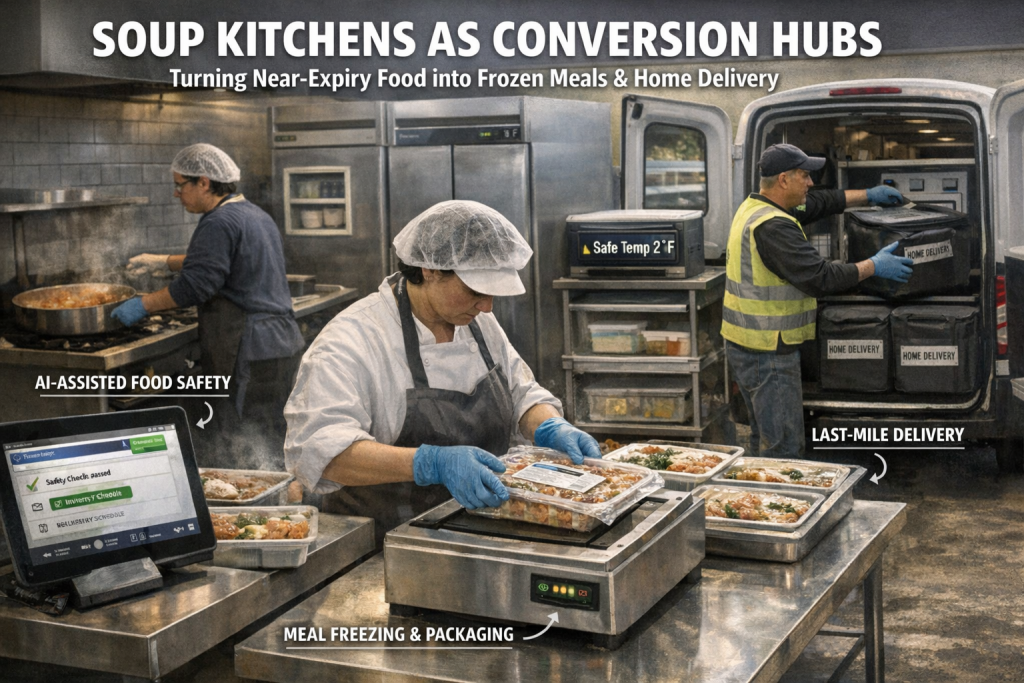
Converting a soup kitchen’s cooking area into a dual-purpose facility — serving walk-in meals and producing frozen portions simultaneously — requires a defined production sequence and dedicated equipment. The following production line model is designed to integrate with an existing kitchen using minimal footprint additions.
- Stage 1 — Surplus Intake & Triage: Incoming near-expiry food is received, scanned (QR code generated), classified into Tiers 1–4, and stored in designated zones. Tier 2 items are flagged for same-day production. The platform notifies the kitchen manager of available ingredients and suggests recipes from the AI-powered recipe engine.
- Stage 2 — Cooking & Portioning: Meals are cooked in commercial batches using the existing kitchen equipment. Portion sizes are standardised (250ml soup, 350g stew, 400g rice dish) using pre-measured ladles and containers. Each portion is labelled at this stage with a batch ID, cooking date, and allergen information.
- Stage 3 — Rapid Cooling: Cooked portions are transferred to a blast chiller (the key equipment upgrade). Cooling times are monitored by IoT sensors and logged automatically. No portion may proceed to freezing until the cooling protocol is verified as complete by the system.
- Stage 4 — Freezing & Packaging: Cooled portions are vacuum-sealed (industrial vacuum sealer) or placed in freezer-safe microwavable containers. Labels are printed by an automated labelling machine showing: meal name, portion size, date of production, use-by date (calculated by the system based on meal type), reheating instructions, allergen information, and a QR code linking to full nutritional data.
- Stage 5 — Frozen Storage & Inventory Update: Sealed meals are placed in the chest freezer or walk-in freezer, organised by production date (FIFO enforced by the platform). Inventory is updated in real time. The system calculates available stock for delivery scheduling.
- Stage 6 — Delivery Staging: On the day of delivery, meals are moved from freezer to insulated delivery bags or refrigerated transport containers. The platform generates optimised delivery routes and assigns drivers.
C. AI & Technology Role in Management and Logistics
AI is not an add-on to this system — it is the coordination layer that makes near-expiry utilisation feasible at scale. The following AI functions are specifically tailored to the soup kitchen and delivery context:
| AI Function | What It Does | Data Inputs | Impact on Operations |
| Surplus Prediction Engine | Forecasts what near-expiry food will arrive at the kitchen in the next 24–72 hours, based on historical donation patterns, donor schedules, and seasonal trends. | Donor history, calendar events, season, day of week, weather (affects produce waste patterns). | Kitchen managers can plan recipes and volunteer shifts in advance rather than reacting on the morning of service. |
| Dynamic Recipe Matching | Given a set of available ingredients (post-triage), suggests the optimal combination of recipes that maximises nutritional balance, minimises waste within the kitchen, and aligns with the day’s delivery demand. | Ingredient inventory, nutritional database, recipe library, delivery orders, dietary restrictions of registered beneficiaries. | Reduces in-kitchen waste to below 5%. Ensures meals are nutritionally complete, not just calorie-dense. |
| Expiry & Safety Monitoring | Continuously tracks the age and temperature of every batch in the system. Automatically quarantines any item approaching or exceeding safe thresholds. | IoT temperature sensors, batch intake timestamps, Tier classification, cold-chain logs. | Prevents food safety incidents. Replaces manual expiry checking with automated, real-time surveillance. |
| Delivery Route Optimisation | Calculates the most efficient multi-stop delivery route for homebound recipients, integrating with food-delivery platform APIs to use existing driver networks where cost-effective. | Recipient locations (anonymised to route level), real-time traffic data, driver availability, vehicle type (refrigerated vs. insulated bag), number of meals per stop. | Reduces cost per delivery by 25–40% compared to bespoke meal-delivery services. Enables same-day and next-day delivery windows. |
| Demand Forecasting | Predicts how many homebound recipients will need deliveries in a given week, based on registration patterns, seasonal illness trends, and historical consumption data. | Beneficiary registration data, delivery history, local health data (anonymised), weather. | Allows production planning 3–5 days ahead. Prevents over-production (which wastes frozen meals) and under-production (which leaves surplus unused). |
| Driver & Volunteer Coordination | Assigns and schedules drivers for delivery routes, matching driver capability (vehicle type, geography, availability) to route requirements. | Driver profiles, vehicle specs, GPS availability, route requirements, historical performance. | Fills delivery slots within hours, not days. Integrates volunteer drivers and third-party gig drivers in a single scheduling system. |
D. Borrowing from Food-Delivery Platforms: What Works and What Doesn’t
Food-delivery platforms (Uber Eats, Deliveroo, Just Eat) have solved several problems that are directly relevant to this framework: real-time driver dispatch, route optimisation, customer-facing ordering interfaces, and proof-of-delivery systems. The CA framework proposes borrowing these capabilities rather than rebuilding them. However, the borrowing is selective — the commercial incentives of these platforms (speed, minimum spend, upselling) are misaligned with the needs of a surplus-to-homebound pipeline.
| Capability | Borrow? | How | Adaptation Required |
| Driver dispatch & routing | Yes — core function | API integration with platform’s logistics layer (not the consumer-facing ordering system). | Drivers must be briefed that deliveries are temperature-sensitive and time-constrained differently than restaurant food. Insulated bag standards must be enforced. |
| Real-time GPS tracking | Yes | Use platform’s driver tracking API to provide live delivery status to the dispatch dashboard. | No adaptation needed — direct reuse. |
| Proof of delivery | Yes | Photo + timestamp at delivery point. Signature optional (many homebound users may not be able to sign). | Alternative verification: delivery confirmed by platform + follow-up SMS to a nominated contact (carer, family member). |
| Consumer ordering interface | No — redesign | Homebound beneficiaries do not ‘order’ in the commercial sense. They register preferences and receive scheduled deliveries. | A simpler, accessible interface (large text, voice-enabled, SMS-compatible) replaces the app-based ordering flow. Deliveries are scheduled, not on-demand. |
| Minimum spend / upsell mechanics | No — remove entirely | These mechanics drive waste, not efficiency. They are structurally incompatible with the surplus-utilisation goal. | The platform charges zero to beneficiaries. Cost is borne by the framework (funded via municipal contracts, CSR, and philanthropic grants). |
| Rating & review system | Partial | Beneficiaries can rate meal quality (1–5 stars) via SMS or app. This feeds back into the recipe engine. | Ratings must be anonymous and voluntary. No penalty to drivers for low ratings caused by meal quality issues. |
V. Scale, Channels of Delivery & Differentiation from Existing Programmes
A. Scale of Soup Kitchens
Understanding the scale of the soup kitchen sector is essential for sizing the framework’s ambitions and logistics requirements.
| Metric | Estimated Scale (UK) | Estimated Scale (US) | Implication for Framework |
| Number of Soup Kitchens / Meal Programmes | Approximately 1,500–2,500 organisations providing regular hot meal services across the UK. | Approximately 35,000+ soup kitchens and hot meal programmes (USDA Food Programmes data). | A city-scale pilot targeting even 2–3% of local soup kitchens provides a meaningful volume of conversion capacity. |
| Meals Served Per Day (National) | Estimated 200,000–400,000 hot meals per day across all UK soup kitchens combined. | Estimated 2–3 million meals per day via soup kitchens and similar programmes nationally. | The freeze-to-deliver channel could realistically add 10–20% to these volumes if near-expiry surplus is captured and converted at scale. |
| Typical Kitchen Size | Small: 1–2 burners, serves 30–80 meals. Medium: 4–6 burners, serves 80–200 meals. Large: full commercial kitchen, serves 200–500+ meals. | Similar distribution; urban kitchens tend to be larger. | The framework is designed to be modular — even a small kitchen can participate in the freeze-to-deliver channel with targeted equipment upgrades. |
| Volunteer vs. Paid Staff Ratio | Typically 3:1 to 5:1 volunteer-to-paid-staff ratio. Some kitchens are entirely volunteer-run. | Similar patterns; faith-based kitchens often fully volunteer. | AI-assisted scheduling and simplified protocols are critical — the system cannot assume professional kitchen expertise. |
B. Scale of Food Delivery Services & Channels
| Delivery Channel | Scale & Reach | Suitability for Homebound Delivery | Integration Model |
| Commercial Food Delivery Platforms (Uber Eats, Deliveroo, etc.) | Uber Eats: 50M+ orders/month (UK). Deliveroo: 10M+ orders/month (UK). Dense urban coverage; sparse rural coverage. | High potential for urban areas. Drivers already trained in time-sensitive delivery. Coverage gaps in rural and suburban areas. | API-level integration for driver dispatch and routing. CA Framework pays a per-delivery fee to the platform, or negotiates a CSR-rate discount. |
| Volunteer Driver Networks | Existing networks (e.g., Royal Voluntary Service, neighbourhood apps like Nextdoor) cover 5–15% of homebound population in a given area. | Moderate. Volunteers are motivated but unreliable in volume. Best suited for rural and suburban gaps. | Integrated into the same scheduling platform as commercial drivers. Volunteer routes are shorter and less time-pressured. |
| Municipal / Social Care Delivery | Some councils already operate meal-delivery services for homebound individuals (Meals on Wheels equivalents). Coverage is declining in many areas due to budget cuts. | High suitability — these services already have the beneficiary relationships and safeguarding protocols. | The framework does not compete with these services. It supplements them by providing a lower-cost frozen-meal option that extends the reach of existing programmes. |
| Pharmacy & GP Delivery Networks | Pharmacies deliver to homebound patients regularly. Some GP practices have established delivery infrastructure during and after the pandemic. | Moderate. The relationship of trust already exists. Cold-chain capability is often present. | Partnership model: frozen meals are added to existing pharmacy delivery runs at marginal cost. Requires a cold-storage compartment at the pharmacy. |
C. How This Model Differs from Homebound & General Food-Delivery Programmes
| Dimension | CA Soup Kitchen Framework | Traditional Meals on Wheels | Commercial Meal-Delivery Services (e.g., Wicked Kitchen, Gousto) | General Food Bank Home Delivery |
| Food Source | Near-expiry surplus, converted in-house. | Commercially produced, purpose-cooked. | Commercially produced, subscription-based. | Donated packaged goods; occasionally fresh produce. |
| Cost Per Meal to System | £1.50–£3.00 (including conversion and delivery) | £8–£15 (fully funded by social care budgets) | £10–£25 (paid by consumer) | £2–£5 (but nutritional completeness is inconsistent) |
| Nutritional Completeness | High — AI-optimised recipe matching ensures balanced macros and micronutrients. | High — professionally planned menus. | Variable — depends on plan and customisation. | Low to moderate — recipients receive ingredients, not meals. |
| Flexibility & Choice | Moderate — meals are produced based on available surplus, but dietary preferences are accommodated via the matching engine. | Low — fixed menu rotation. | High — full consumer choice. | Very low — recipients receive what is available. |
| Freshness vs. Convenience Trade-off | Frozen meals (3–6 month shelf life) with clear reheating instructions. Some chilled options for next-day delivery. | Hot, freshly cooked, delivered same day. | Mix of fresh and chilled; delivered within days. | Shelf-stable goods only in most cases. |
| Beneficiary Experience | Discreet delivery. No requirement to attend a charity. Branded independently of the soup kitchen. | Regular scheduled visits. Often combined with welfare check. | Consumer-grade experience — online ordering, tracking. | Stigma risk if visibly charity-branded. Often requires collection. |
| Scalability | High — frozen production can scale independently of walk-in service capacity. AI logistics optimise for volume. | Low — limited by social care budgets and staffing. | High — but cost prohibitive for food-insecure populations. | Moderate — limited by donation volumes and volunteer capacity. |
VI. Surplus-to-Soup-Kitchen Pipeline & Infrastructure Interface
A. The Supply Pipeline: From Surplus Source to Kitchen Door
The pipeline that moves near-expiry food from its source (supermarket, restaurant, wholesaler, food manufacturer) to the soup kitchen’s intake dock must be fast, cold-chain-secure, and digitally tracked. This section maps the interface points with existing infrastructure.
| Pipeline Stage | Existing Infrastructure to Leverage | Required Upgrade or Addition | AI/Tech Role |
| Surplus Identification | Supermarket inventory management systems (SAP, Oracle) already flag items approaching best-before dates internally. | API connection from retailer inventory to CA Platform’s Surplus Prediction Engine. One-click donation scheduling interface. | Predictive model forecasts which donors will have surplus on which days, allowing pre-positioning of collection logistics. |
| First-Mile Collection | Delivery platforms already have driver networks available for short-notice urban pickups. Corporate logistics vehicles (e.g., supermarket delivery vans on return trips) have spare capacity. | Designated ‘surplus pickup’ slots added to existing commercial delivery schedules. Temperature-monitored collection containers provided to donors. | Route optimisation assigns the nearest available driver or vehicle to each pickup. Temperature logging begins at collection. |
| Sorting & Triage Hub | Some food banks and redistribution charities already operate sorting facilities. Dark kitchens and food-waste-reduction organisations have relevant expertise. | If no sorting hub exists within 10 miles, the soup kitchen itself performs triage at intake. Triage stations (scales, scanner, temperature probe, photo station) are installed at the kitchen. | The platform generates a triage report for each incoming batch within minutes of scanning. Tier classification is AI-assisted but human-verified. |
| Transport to Kitchen | Municipal waste-management vehicles, charity vans, and volunteer cars currently move food between points. Many are unrefrigerated. | Insulated containers with cold packs are the minimum standard for transport exceeding 30 minutes. Refrigerated vehicles are required for Tier 1 and Tier 2 items in warm weather. | Real-time temperature monitoring during transit. If a temperature breach is detected, the driver is alerted and the batch is quarantined on arrival. |
B. The Delivery Pipeline: From Frozen Meal to Homebound Door
| Delivery Stage | Infrastructure Interface | Operational Standard | Technology Integration |
| Order Generation | Beneficiary registers preferences via app, SMS, or phone call. A nominated carer or family member can register on their behalf. | Weekly delivery schedule is set by the platform based on beneficiary needs, meal availability, and route efficiency. Recipients are notified 24 hours in advance. | Multi-modal registration (app, SMS, voice). Privacy-preserving — driver sees only the delivery address and meal contents, not the beneficiary’s name or medical history. |
| Meal Staging | Meals are retrieved from the kitchen’s freezer and packed into insulated delivery bags or refrigerated containers at the kitchen. | Meals are packed in FIFO order. Each bag is labelled with the route number, number of meals, and a temperature indicator strip. | Inventory system confirms stock availability and generates the pick list. Temperature indicator strips are scanned to confirm cold-chain integrity before dispatch. |
| Driver Dispatch | Commercial platform drivers (Uber Eats, Deliveroo) or volunteer drivers are assigned via the CA Platform. | Drivers receive route instructions via mobile app. Instructions include: number of stops, estimated time per stop, and any access codes or notes (provided by the beneficiary, not visible to other drivers). | Route optimisation algorithm calculates the most efficient multi-stop route. Real-time traffic integration allows dynamic re-routing. |
| Last-Mile Delivery | Drivers deliver to the beneficiary’s door. For homebound individuals, this may require a carer or family member to receive. | Proof of delivery: photo of meal at the door + GPS timestamp. No signature required (accessibility). Follow-up SMS sent to confirm receipt. | Delivery completion logged in platform. If no receipt is confirmed within 30 minutes, an alert is sent to the beneficiary’s nominated contact. |
| Post-Delivery Feedback | Beneficiaries can rate the meal via SMS (1–5 stars) or through the app. | Feedback is aggregated and fed back to the recipe engine. Consistently low-rated meals are flagged for review. | AI analyses feedback patterns to identify which meal types, portion sizes, or preparation methods need adjustment. |
VII. Required Hardware & Software Stack
A. Kitchen-Level Hardware Upgrades
The following equipment additions are required per soup kitchen to enable the freeze-to-deliver channel. Costs are indicative and based on commercial kitchen-supply pricing (UK, 2026). Each item is categorised as Essential (must-have for safe operation) or Enhanced (improves efficiency but not strictly required at launch).
| Equipment | Specification | Purpose | Unit Cost (Est.) | Priority |
| Blast Chiller | 4-tray or 10-tray model. Chills from 90°C to 3°C in 90 minutes (4-tray) or 40 minutes (10-tray). | Rapid cooling of cooked meals before freezing. Critical for food safety (prevents bacterial growth in the danger zone). | £3,500–£8,000 | Essential |
| Chest Freezer or Walk-In Freezer | Chest: 400–800 litres at -18°C. Walk-in: 6–10 m² at -18°C. Alarm and IoT sensor included. | Frozen meal storage. Must maintain -18°C continuously. | £1,200 (chest) – £15,000 (walk-in) | Essential |
| Vacuum Sealer (Industrial) | Chamber-type, handles up to 10 litres per cycle. Seals microwavable-safe pouches. | Extends frozen shelf life to 3–6 months. Prevents freezer burn. | £2,000–£4,500 | Essential |
| Automated Labelling Machine | Thermal transfer printer. Prints batch ID, allergens, dates, reheating instructions, QR code. | Ensures every meal is correctly and consistently labelled. Reduces manual labelling errors. | £1,500–£3,000 | Essential |
| IoT Temperature Sensors | Wireless sensors for freezer, chiller, and refrigerator. Transmit data to cloud platform every 5 minutes. | Continuous temperature monitoring. Alerts on breach. | £200–£500 (pack of 5) | Essential |
| Industrial Scales (Networked) | 200 kg capacity, Bluetooth or WiFi connected. Logs weight data to the platform. | Accurate portion control and inventory tracking. | £500–£1,000 | Essential |
| Rugged Tablet (Kitchen) | Waterproof, 10-inch screen. Mounted at prep station. Displays recipe instructions, checklists, and alerts. | Staff interface for the CA Platform within the kitchen. | £400–£600 | Essential |
| QR Code / Barcode Printer | Thermal printer. Generates batch QR codes for incoming surplus items. | Traceability from intake through to delivery. | £200–£400 | Essential |
| Microwavable Meal Containers | BPA-free, freezer-safe, microwavable. Portion sizes: 250 ml (soup), 350 g (stew), 400 g (rice dish). Stackable. | The physical product that reaches the beneficiary’s door. | £0.40–£0.80 per container (bulk) | Essential |
| Insulated Delivery Bags | Rated to maintain <5°C for 4 hours. Holds 10–20 meals. Branded with framework identity (not soup kitchen name). | Last-mile cold chain for chilled deliveries. Frozen deliveries use dry ice or phase-change materials. | £80–£150 per bag | Enhanced |
B. Software & Platform Stack
The software architecture follows the CA Framework’s microservices model but is scoped for the soup-kitchen and homebound-delivery use case. The platform is modular — kitchens can onboard with a minimal feature set and expand as their operations grow.
| Software Module | Function | Technology Approach | Integration Points |
| Surplus Management & Triage | Receives surplus notifications from donors, generates QR codes, manages intake triage workflow. | Web portal + mobile app. API connections to retailer inventory systems. | Donor ERP systems (SAP, Oracle). Logistics dispatch platforms. |
| Recipe & Meal Planning Engine (AI) | Suggests recipes based on available ingredients, nutritional targets, and delivery demand. Supports dynamic substitution. | ML model trained on recipe database + nutritional data + historical surplus patterns. Python backend (FastAPI). | Ingredient inventory system. Nutritional database. Delivery demand forecasts. |
| Kitchen Operations Dashboard | Displays daily production schedule, volunteer assignments, HACCP checklists, and real-time alerts on tablets in the kitchen. | React-based web app. Real-time updates via WebSocket. | IoT sensor network. Volunteer scheduling module. Labelling machine. |
| Beneficiary Registration & Preferences | Privacy-preserving registration for homebound delivery recipients. Captures dietary needs, delivery address, contact preferences. | Mobile app (React Native) + SMS interface + voice hotline (IVR). Encrypted data storage. | Delivery scheduling module. Feedback collection. Social care referral systems (with consent). |
| Delivery Scheduling & Route Optimisation | Calculates optimal multi-stop delivery routes. Assigns drivers (commercial or volunteer). Generates driver instructions. | Route optimisation algorithm (Google OR-Tools or equivalent). Integration with Uber Eats / Deliveroo logistics APIs. | Food delivery platform APIs. GPS/traffic data (Google Maps). Driver management system. |
| IoT & Cold-Chain Monitoring | Continuous temperature monitoring of freezers, chillers, and delivery containers. Automated alerts and quarantine flags. | MQTT protocol for sensor communication. Cloud-based alert engine. | Kitchen IoT sensors. Delivery container sensors (optional). Platform alert system. |
| Analytics & Impact Reporting | Tracks meals produced, meals delivered, surplus diverted, CO2 avoided, beneficiary satisfaction, and cost per meal. | Data warehouse (BigQuery or equivalent). Dashboard (Metabase or custom). | All operational modules. Funder reporting requirements. |
| Volunteer & Driver Coordination | Schedules volunteers for kitchen shifts and drivers for delivery routes. Sends reminders. Tracks check-in/check-out. | Shared scheduling platform with SMS/push notifications. | Kitchen operations dashboard. Delivery scheduling module. |
C. Implementation Profile
| Phase | Timeline | What Is Deployed | Capital Cost (Est.) | Operational Cost (Est. / month) |
| Phase 0: Assessment & Setup | Months 1–3 | Kitchen assessment. Equipment procurement. Platform configuration. Staff and volunteer training. Beneficiary registration campaign. | £25,000–£50,000 (equipment + setup per kitchen) | £2,000–£4,000 (staffing, training, marketing) |
| Phase 1: Pilot (Single Kitchen) | Months 4–9 | One soup kitchen fully equipped. Freeze-to-deliver channel active with 20–50 homebound recipients. AI recipe engine in rule-based mode. Volunteer driver network. Manual QR tracking. | £15,000–£30,000 (additional equipment if needed) | £3,000–£5,000 |
| Phase 2: AI & Logistics Scale-Up | Months 10–18 | AI recipe matching and demand forecasting activated. Commercial delivery platform API integrated. Second kitchen onboarded. 100–300 homebound recipients served. | £10,000–£20,000 (second kitchen setup) | £5,000–£8,000 |
| Phase 3: Network & Optimisation | Months 19–36 | 3–5 kitchens networked. Shared frozen-meal inventory across kitchens (a kitchen with surplus stock can fulfil delivery orders for another kitchen’s catchment area). Full IoT cold-chain monitoring. Policy advocacy for municipal procurement of frozen meals. | £20,000–£40,000 (network infrastructure) | £8,000–£15,000 |
VIII. Stakeholders, Roles, Incentives & Interdependencies
A. Stakeholder Map
| Stakeholder | Role in the System | Primary Incentive | Key Dependency | Risk of Disengagement |
| Soup Kitchen (Operator) | Conversion Hub — receives surplus, produces frozen meals, operates walk-in service. | Extended impact beyond walk-in capacity. Demonstrated value to funders. Reduced food waste within the kitchen. | Reliable surplus supply. Equipment upgrades funded. Volunteer retention. | Medium — if conversion adds too much burden to volunteers or managers, participation declines. |
| Homebound Beneficiaries | End recipients of frozen meal deliveries. | Nutritious, dignified, convenient food access without leaving home. | Regular delivery schedule. Meal quality consistency. Easy feedback mechanism. | High — if meals are poor quality or deliveries are unreliable, trust collapses and uptake falls. |
| Supermarkets & Retailers | Primary surplus donors. Near-expiry food is the raw material. | Reduced waste disposal costs. CSR reporting value. Tax benefits (where applicable). Brand reputation. | Streamlined donation process. Liability protection. Impact reporting. | Medium — if donation logistics are burdensome or liability concerns are unresolved, participation stalls. |
| Restaurants & Cafes | Secondary surplus donors. Often have prepared food or ingredient waste. | Daily waste management simplified. Community reputation. Regulatory compliance (pre-emptive). | Same-day or next-day collection. Standardised safety protocols. | High — restaurants are time-pressured. If collection is not fast and frictionless, they revert to disposal. |
| Food Delivery Platforms | Logistics infrastructure provider. Driver networks and route optimisation. | Per-delivery revenue. CSR narrative (feeding vulnerable communities). Data on new delivery patterns. | Volume of delivery orders must justify integration effort. Clear API and operational protocols. | Medium — platforms will disengage if volumes are too low to justify the integration overhead. |
| Volunteer Drivers | Last-mile delivery for routes not covered by commercial platforms. | Meaningful contribution. Flexibility. Recognition and impact tracking. | Clear scheduling. Simple app interface. Safety assurance. | High — volunteers are the most fragile logistics resource. Burnout and scheduling conflicts are the primary risks. |
| Municipal Government | Policy enabler. Potential funder (social care budget savings). Regulatory oversight. | Waste diversion targets met. Social care cost reduction. Innovation reputation. | Political will sustained across election cycles. Cross-departmental coordination. | Medium — political turnover is a structural risk, mitigated by embedding the framework in long-term municipal plans. |
| Funders & Philanthropists | Capital providers for equipment, platform development, and operational costs. | Measurable impact per pound invested. Scalability and replicability of the model. | Transparent reporting. Evidence of impact. Path to financial sustainability. | Medium — funders lose confidence if impact metrics plateau or costs escalate unexpectedly. |
| Social Care / Health Services | Referral source for homebound beneficiaries. Potential integration partner for welfare checks. | Supplementary nutrition for their clients at no additional cost. Reduced pressure on meals-on-wheels budgets. | Formal referral protocol. Data-sharing agreement (with consent). | Low — these services have an institutional interest in any additional resource for homebound individuals. |
| Food Safety Authority | Regulatory oversight. Inspection and certification. | Public health protection. Compliance with food-safety standards. | Clear communication of the framework’s protocols and the kitchen’s regulatory status. | N/A — not a voluntary participant. Engagement is mandatory. |
B. Interdependency Map (Narrative)
The system functions as a closed loop with five critical interdependencies. First, the surplus supply from retailers depends on the framework providing a frictionless, liability-protected donation pathway — without this, food goes to landfill. Second, the kitchen’s conversion capacity depends on predictable surplus (provided by the AI prediction engine) and skilled volunteers (provided by the recruitment and training module). Third, the delivery pipeline depends on the kitchen producing a consistent volume of frozen meals — irregular production makes route optimisation impossible. Fourth, homebound beneficiary uptake depends on delivery reliability and meal quality — a single bad experience can permanently lose a recipient. Fifth, the entire system’s financial sustainability depends on demonstrating measurable impact to funders and municipal commissioners — without data, funding evaporates.
The weakest link is the volunteer workforce. Every other element of the system (technology, equipment, logistics) can be optimised and scaled. Volunteer retention and training are the single most important operational focus for the framework’s first 12 months.
IX. Detailed Risk Profile
A. Operational Risks
| Risk | Likelihood | Impact | Mitigation Strategy | Residual Risk |
| Inconsistent surplus supply volumes | High | High — kitchen cannot plan production or staffing without knowing what food is coming. | AI prediction engine reduces surprises. Agreements with 3+ anchor donors ensure baseline supply. Backup recipes using shelf-stable staples (Tier 3 items) fill gaps. | Medium — some variability is inherent. The system is designed to absorb it, not eliminate it. |
| Volunteer skill gaps leading to poor meal quality | High | Medium — meals that are nutritionally adequate but unappetising reduce beneficiary satisfaction and uptake. | Mandatory food-safety training. AI-generated step-by-step recipe cards on kitchen tablets. Supervisor oversight for all Tier 2 production. Quality sampling before dispatch. | Medium — addressed by process design, not just training. |
| Equipment failure (blast chiller or freezer) | Medium | High — if the freezer fails, all stored meals are at risk. If the chiller fails, production halts. | IoT temperature alerts with 24/7 monitoring. Backup cold storage identified within 5 miles (partner kitchen or commercial cold store). Emergency protocol: divert production to walk-in service only. | Low — redundancy is built into the design. |
| Delivery delays or failures (cold chain breach) | Medium | High — a meal delivered above safe temperature is a food-safety incident and a liability event. | Insulated bags rated for 4-hour cold retention. Temperature indicator strips on every delivery bag. Driver briefing on handling requirements. Real-time GPS monitoring with exception alerts. | Low — multiple barriers prevent a cold-chain breach from reaching the beneficiary. |
| Over-production of frozen meals (waste within the system) | Medium | Medium — frozen meals that are not delivered within their use-by date are wasted, undermining the framework’s waste-reduction mission. | Demand forecasting model calibrated weekly. Production volumes matched to confirmed delivery orders, not speculative demand. Unsold stock redistributed to other kitchens in the network. | Low — the AI demand model prevents systematic over-production. |
B. Health & Safety Risks
| Risk | Likelihood | Impact | Mitigation Strategy | Residual Risk |
| Foodborne illness from near-expiry ingredients | Low | Critical — a single case of food poisoning linked to the framework would damage public trust and potentially trigger legal action. | Rigorous four-tier triage system. HACCP-aligned critical control points at every stage. Batch traceability via QR codes. Comprehensive food-safety insurance. Incident response protocol (see Section IX.D). | Very Low — the system is designed with multiple redundant safety layers. |
| Allergen cross-contamination | Medium | Critical — severe allergic reactions can be life-threatening, especially for homebound individuals who may not have immediate access to medical help. | Dedicated allergen zones in the kitchen. AI-generated allergen labels on every meal. Beneficiary dietary restrictions checked against meal contents before dispatch. Color-coded equipment for allergen-free production. | Low — allergen management is a primary design constraint, not an afterthought. |
| Improper reheating by beneficiary | Medium | Medium — homebound individuals, particularly elderly users, may not reheat meals to safe temperatures. | Clear, large-print reheating instructions on every meal label. QR code linking to video instructions. Meals designed to be safe at any reheating duration above a minimum threshold (e.g., 2 minutes in a 850W microwave). | Medium — cannot fully control end-user behaviour. Meal design mitigates but does not eliminate the risk. |
| Volunteer handling of contaminated food | Medium | High — volunteers without professional training may not recognise signs of contamination (mould on produce, off-smell in meat). | Visual inspection checklist displayed at intake station. AI-assisted photo analysis flags suspicious items for human review. Training module on contamination signs. Any item flagged by the system is automatically quarantined. | Low — the combination of training, checklists, and AI-assisted inspection provides strong coverage. |
C. Legal & Reputational Risks
| Risk | Likelihood | Impact | Mitigation Strategy | Residual Risk |
| Donor liability for food poisoning from donated near-expiry food | Low | High — without liability protection, major retailers will not participate. | Standardised liability waivers co-drafted with municipal lawyers. Good Samaritan law advocacy (where not already in force). Comprehensive insurance covering the entire chain from donation to consumption. | Low — the waiver and insurance combination provides robust protection. |
| Data breach exposing homebound beneficiary addresses | Low | Critical — homebound individuals are among the most vulnerable populations. Exposure of their addresses could facilitate abuse or exploitation. | GDPR-compliant data handling. Beneficiary addresses encrypted at rest. Delivery drivers see only the route, not individual addresses. Regular penetration testing of the platform. | Very Low — multiple layers of data protection are in place. |
| Reputational damage if meal quality is consistently poor | Medium | High — the framework’s credibility depends on delivering meals that beneficiaries are proud to eat, not ashamed to receive. | Anonymous feedback system with weekly review. Quality sampling before dispatch. Rapid recipe adjustment based on feedback patterns. Independent quality audit quarterly. | Medium — reputation management is an ongoing process, not a one-time action. |
| Perception that the framework is ‘dumping’ unwanted food on vulnerable people | Medium | High — this narrative would undermine public support and political backing. | Dignity-first branding. Independent packaging (not charity-branded). Quality standards that exceed, not merely meet, safety requirements. Transparent communication about the framework’s mission and standards. | Medium — narrative risk requires continuous communication, not just good operations. |
D. Incident Response Protocol
In the event of a food-safety incident (reported illness, contamination discovery, or cold-chain breach), the following escalation protocol applies:
- Hour 0 — Detection: Incident is reported (by a beneficiary, driver, volunteer, or IoT sensor alert). The platform immediately flags the affected batch and all meals produced in the same session.
- Hour 1 — Containment: All distribution of meals from the affected batch is halted. The kitchen manager is notified. If the incident involves delivered meals, the delivery platform is alerted and any undelivered meals from the batch are recalled.
- Hour 2 — Investigation: The food-safety lead initiates a root-cause investigation. Batch traceability (QR codes) identifies the source ingredient, the production session, and all recipients who received meals from the batch.
- Day 1 — Communication: Affected beneficiaries are contacted (via their nominated contact if they are unable to receive calls). A public statement is prepared and approved by the Governance Council before release. The local food-safety authority is notified as required by law.
- Week 1 — Remediation: Corrective actions are identified and implemented. Staff and volunteers receive targeted retraining. Equipment is inspected and serviced.
- Month 1 — Review: An independent review of the incident is conducted. Findings are shared with all stakeholders. Protocol updates are made if required. The framework’s insurance provider is notified and any claims are processed.
X. Conclusion & Next Steps
This synthesis demonstrates that the systemic architecture developed through the China case study and the Cultivating Abundance Framework is not only transferable to the soup kitchen context — it is, in many respects, a more natural fit. Soup kitchens already possess the physical infrastructure, the community relationships, and the operational rhythm that the CA Framework’s Conversion Hub model requires. What they lack — predictive supply intelligence, AI-assisted recipe planning, industrial freezing capacity, and food-delivery-style logistics — are precisely the capabilities this framework adds.
The near-expiry food problem is not a shortage problem. It is a coordination and conversion problem. Food that is perfectly safe to eat today will be in a landfill tomorrow unless the system can move it, transform it, and deliver it faster than it spoils. Freezing is the key enabler: it breaks the time constraint. AI is the key coordinator: it makes the matching and routing decisions that no human team could make at scale. And the soup kitchen is the key facility: it is where the conversion happens, where the trust already exists, and where the community connection is strongest.
The framework’s ultimate ambition is not to serve soup kitchens. It is to use soup kitchens as the intelligent conversion layer in a city-wide food-resilience grid — one that feeds both the people who walk through the door and the people who cannot.
Recommended Next Steps
- Step 1: Conduct a baseline assessment of 10–15 soup kitchens in the target borough using the gap analysis methodology from the CA Framework. Score each kitchen on kitchen infrastructure, volunteer capacity, cold-storage availability, and community reach.
- Step 2: Select 2–3 pilot kitchens based on the assessment scores. Begin equipment procurement and platform configuration.
- Step 3: Launch a homebound beneficiary registration campaign in partnership with local social care services and GP practices. Target 50 registered recipients for the pilot.
- Step 4: Run a 3-month pilot with manual operations (rule-based recipe selection, volunteer drivers, paper-based triage). Collect baseline data on meal quality, delivery reliability, and beneficiary satisfaction.
- Step 5: Activate AI modules (recipe matching, demand forecasting, route optimisation) and integrate with a commercial delivery platform API. Measure the impact on cost per meal and delivery efficiency.
- Step 6: Present findings to the Governance Council and municipal commissioners. If KPIs are met, proceed to Phase 2 expansion.