Preamble
Nature has been conducting research and development for 3.8 billion years, perfecting solutions to challenges that humanity now faces from energy efficiency and water scarcity to materials science and adaptive systems. Biomimicry, the practice of learning from and emulating nature’s forms, processes, and ecosystems, has evolved from a captivating design principle into a profound methodology for systemic innovation. We have moved beyond simply admiring a lotus leaf’s self-cleaning properties to translating entire ecosystem dynamics into industrial processes, urban infrastructure, and computational algorithms.
Thanks for reading! Subscribe for free to receive new posts and support my work.
This article explores biomimicry’s maturation as it reshapes industries, economies, and urban planning across the globe. It is no longer just about what we can take from nature, but what we can learn from its deep patterns, circular economies, and regenerative strategies. The convergence of biomimicry with artificial intelligence, circular economy principles, and advanced manufacturing positions it not as a niche specialty but as a foundational framework for 21st-century innovation.
Introduction: Beyond Definitions
Biomimicry is the practice of emulating nature’s forms, processes, and ecosystems to solve human challenges. While the term has gained recognition, its practice is undergoing significant evolution across three interconnected levels of sophistication:
1. Form-Level Biomimicry: Copying structures to gain function such as mimicking a bird’s wing for aerodynamics or replicating shark skin textures for antimicrobial surfaces.
2. Process-Level Biomimicry: Emulating how nature builds, senses, repairs, and optimizes like replicating photosynthesis for energy production or mimicking blood clotting for self-healing materials.
3. Systems-Level Biomimicry: The most powerful approach, where entire networks, markets, and cities are designed to behave like healthy ecosystems, creating circular, zero-waste economies that mirror forest nutrient cycles or coral reef interdependencies.
This shift from object-focused to ecosystem-focused design matters profoundly because most contemporary challenges climate change, resource depletion, urban resilience—are systemic rather than isolated.
The Development Lifecycle for Biomimicry Innovation
The Biomimicry Institute champions a practical, iterative framework that guides innovation from observation to implementation:
1. Define Function: Start with clear functional requirements rather than prescribing solutions. What must the solution accomplish?
2. Find Biological Champions: Search broadly across diverse species and ecosystems for organisms that have solved similar challenges through evolutionary adaptation.
3. Abstract Principles: Translate biological strategies into design rules suitable for engineering translation, moving from “how does a lotus leaf repel water” to “create hierarchical micro- and nano-structures that minimize surface contact.”
4. Emulate: Prototype using available materials, fabrication methods, and computational tools.
5. Evaluate with Life’s Principles: Check prototypes against nature’s design criteria efficiency, resource optimization, adaptability, resilience, and circularity.
6. Iterate: Improve based on testing results and new biological insights.
This is not a linear path but a dynamic cycle deeply reliant on interdisciplinary collaboration between biologists, engineers, designers, material scientists, and domain experts.
The Translation Challenge: Limitations and Hybrid Approaches
A critical limitation exists in the “translation gap” converting biological strategies into viable technological applications. Nature assembles structures at ambient temperature using water as solvent and benign chemistry, building self-assembling, biodegradable polymers through elegant molecular processes. Industry, by contrast, traditionally relies on high heat, pressure, and toxic processes what practitioners call “heat, beat, and treat.”
Hybrid approaches bridge this gap by combining biomimetic principles with advanced engineering. For instance:
- A structure might be inspired by tree branching patterns (biomimicry) but optimized using generative AI and manufactured with novel composite materials (hybrid engineering)
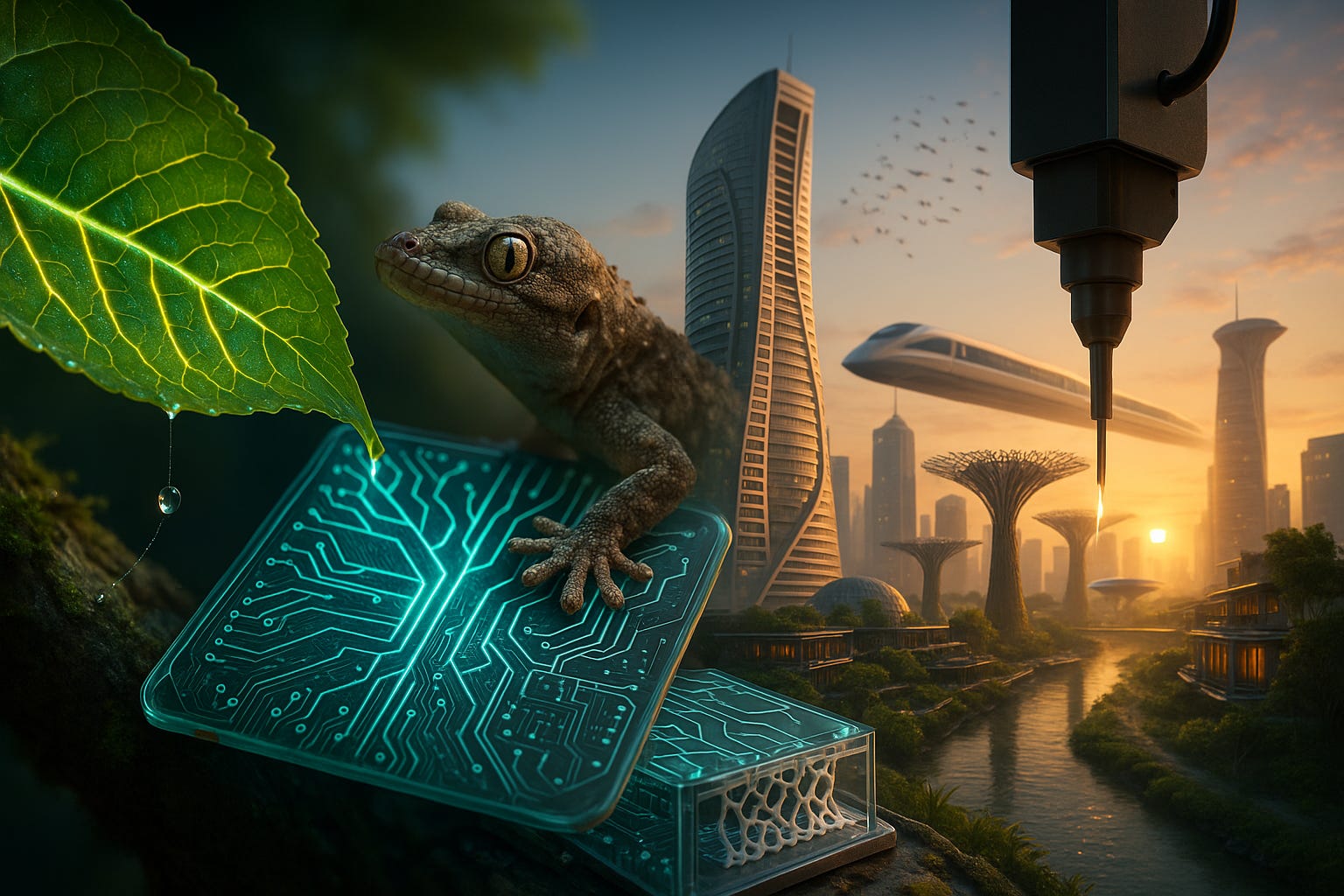
- Gecko-inspired adhesives adapted for medical applications through polymer chemistry
- Termite-inspired ventilation systems enhanced with smart sensors and adaptive controls
The key is treating nature as a library of proven strategies and engineering as the means to scale them, rather than expecting direct one-to-one translations.
Applications and Achievements: Proof Beyond Promise
Biomimicry has moved decisively from laboratory curiosity to marketplace transformation, delivering measurable value across multiple sectors.
Architecture and Construction
The Eastgate Centre in Harare, Zimbabwe, stands as a landmark achievement. Its termite mound-inspired passive ventilation system consumes 90% less energy than conventional buildings of comparable size, demonstrating that nature’s climate control strategies can dramatically outperform mechanical systems.
The Eden Project in Cornwall employs ETFE material that mimics plant cuticles, regulating internal temperature and preventing water loss while creating the world’s largest greenhouse biomes.
Singapore’s Gardens by the Bay features iconic Supertrees that go beyond aesthetics to replicate natural tree functions providing shade, collecting rainwater, improving air quality through vertical gardens, and incorporating solar photovoltaic cells for energy generation. These structures demonstrate systems-level thinking where form, process, and ecological function converge.
Transportation and Energy
Kingfisher beak-shaped noses on Japan’s Shinkansen bullet trains solved a critical problem: the sonic boom created when trains entered tunnels at high speed. The streamlined design reduced noise by 30% while improving energy efficiency by 15% a rare combination of passenger comfort and operational savings.
Humpback whale tubercles the bumps along their flippers inspired wind turbine blade designs that achieve 32% better lift at low speeds and delay stall angles, expanding the operational range of renewable energy systems.
Pax Scientific applied the logarithmic spiral patterns found in nautilus shells and natural vortices to design ultra-efficient fans, mixers, and turbines, demonstrating how fundamental biological geometry translates directly to engineering performance.
Materials Science
Gecko-inspired adhesives work in wet environments where traditional adhesives fail, enabling medical applications like surgical glue that bonds tissue during operations.
Nacre-inspired composites replicate the layered structure of abalone shells, achieving remarkable impact resistance the material can absorb energy like shell nacre while maintaining structural integrity.
Spider silk analogues synthesized through biotechnology demonstrate nature’s genius: strength exceeding steel by weight, toughness surpassing Kevlar, elasticity, and potential for self-repair all produced at ambient temperature without toxic chemistry.
Recent innovations include mycelium-based packaging grown from agricultural waste that naturally decomposes, offering a closed-loop alternative to petroleum-based plastics.
Robotics and Medicine
Boston Dynamics’ Spot robot leverages canine locomotion dynamics—the balanced, adaptive gait of quadrupeds—to traverse complex terrain that wheeled robots cannot navigate, from construction sites to disaster zones.
The 2025 Ray of Hope Accelerator cohort showcases cutting-edge medical biomimicry:
- Emboa Medical developed a catheter using boa constrictor fang-inspired tips for blood-clot removal, where the backward-facing serrations enable grip and extraction
- Limax Biosciences created bio-based surgical adhesives inspired by slug mucus, which naturally seals bleeding tissue in wet environments where conventional adhesives fail
Agriculture and Water Management
Mangrove root-inspired desalination systems mimic the selective filtration mechanisms that allow mangrove trees to extract freshwater from saltwater environments.
Namib beetle-inspired fog harvesting structures, like Warka Water Towers, feature textured surfaces that capture atmospheric moisture, providing drinking water in arid regions—combining beetle exoskeleton patterns with spider web condensation principles.
Mycorrhizal network thinking guides agricultural systems where fungi create underground networks connecting plant roots, enabling nutrient exchange and communication—a biological model for low-input, climate-resilient farming.
Novel Pathways for Global Impact: Context-Specific Innovation
Biomimicry’s true power lies in its adaptability to diverse economic and environmental contexts. The field is advancing along divergent but complementary pathways globally.
Emerging Economies: Foundational Sustainability
Innovation in developing regions emphasizes low-cost, locally-adapted solutions addressing fundamental needs:
Off-Grid Water Access:
- Fog and dew harvesting meshes patterned after desert beetle exoskeletons and spider web structures
- Warka Water Towers that extract 25-100 liters daily from atmospheric humidity in East African highlands
Passive Thermal Comfort:
- Building skins that channel air like termite mounds, reducing cooling loads by 60-90% without mechanical systems
- Textiles mimicking camel fur structure—hollow fibers that insulate against heat—cutting air conditioning demand in hot climates
Circular Micro-Manufacturing:
- Mycelium-based packaging and building panels grown from agricultural waste
- Production cycles following forest nutrient patterns where waste becomes feedstock
- Low-cost mobility solutions using tendon-like cable networks for strength with minimal material
Developed Economies: High-Tech Integration
Advanced economies integrate biomimicry with cutting-edge technology platforms:
AI and Aerospace:
- Feather-like morphing winglets that adapt in real-time to flight conditions
- Swarm-inspired flight control systems for autonomous drone fleets
- Airbus “Bird of Prey” concepts with individual wingtip feather control for drag reduction
Biotech and Medicine:
- Self-healing polymers modeled on blood clotting cascades
- Antimicrobial surfaces mimicking shark skin microtextures (riblets that prevent bacterial attachment)
- Mussel protein-inspired tissue adhesives that bond in wet surgical environments
Urban Design as Ecosystem:
- Watersheds as integrated masterplans where streets, parks, and green roofs function as catchments
- Systems that store, filter, and cool water while recharging aquifers
- Cities designed with redundancy, diversity, and feedback loops mirroring forest resource flows
Biomimetic Computing:
- Distributed scheduling and routing modeled on ant foraging algorithms
- Slime mold pathfinding for network optimization
- Data center energy reduction through natural cooling patterns and decentralized processing
- Mycelium-inspired data fabrics that route around congestion
Scientific and Practical Challenges: Barriers to Scale
Despite proven successes, scaling biomimicry requires overcoming significant interdisciplinary and technical hurdles.
The Interdisciplinary Translation Gap
Biologists describe function in terms of fitness, adaptation, and evolutionary pressures. Engineers specify requirements in stresses, tolerances, and performance metrics. This creates fundamental communication barriers where:
- Biological strategies are described qualitatively (”the structure is robust”)
- Engineering needs quantitative specifications (”yield strength of 400 MPa”)
Solutions require:
- Shared taxonomies and ontologies bridging biological and engineering language
- Joint design sprints where biologists and engineers co-locate during ideation
- Prototyping spaces equipped for both biological observation and engineering testing
- The 2025 Ray of Hope cohort demonstrates this integration, featuring innovations from university-licensed startups and research institutes spanning three continents
Manufacturing at Scale: Nature’s Ambient Chemistry
Nature’s genius lies in self-assembling, biodegradable polymers created at room temperature using water as solvent. Spider silk, bone, nacre, and cellulose all form through elegant molecular choreography at ambient conditions.
Industry struggles to replicate this because conventional manufacturing relies on:
- High temperatures (often exceeding 1000°C for metals and ceramics)
- Extreme pressures
- Toxic solvents and catalysts
- Energy-intensive processes
Emerging solutions:
- 3D and 4D printing technologies enabling complex geometries and responsive materials
- Bio-based polymer development using bacterial fermentation
- Room-temperature synthesis pathways inspired by biomineralization
- Additive manufacturing that builds structures layer by layer like biological growth
Complex Systems Modeling
Real ecosystems couple flows of energy, materials, water, and information in ways current modeling tools inadequately capture. A forest manages:
- Carbon cycling through photosynthesis and decomposition
- Water regulation via transpiration and soil infiltration
- Nutrient distribution through mycorrhizal networks
- Population dynamics across trophic levels
- Disturbance recovery and succession
We can model individual processes but struggle to capture emergent properties arising from their interaction. Better multiscale models and digital twins are needed to simulate these interconnected dynamics from molecular to landscape scales.
Data Access and Knowledge Infrastructure
Biological strategy data remains scattered across:
- Peer-reviewed journals behind paywalls
- Field observations in researcher notebooks
- Indigenous knowledge systems
- Natural history collections
The Biomimicry Institute’s AskNature platform addresses this gap by curating biological strategies in a searchable database organized by function. The platform recently unveiled an enhanced chat feature in 2025, using AI to help users query nature’s strategies in conversational language dramatically improving accessibility for non-specialists.
What’s still needed:
- Standardized ontologies for describing biological strategies
- Open-access protocols linking field observations to design applications
- Machine-readable formats enabling AI-assisted pattern recognition
- Global networks capturing strategies from diverse ecosystems before they disappear
Disciplinary Identity and Curriculum Design: Building Educational Infrastructure
Is biomimicry a discipline or a framework? The answer is both. Biomimicry is emerging as a meta-discipline—an integrative framework that informs design, biology, engineering, computing, business, and policy rather than replacing them.
Comprehensive Curriculum Architecture
K-12 Education:
- Nature journaling and observation skills
- Function spotting exercises (”How does this organism solve the problem of…”)
- Simple build challenges using local materials
- Habitat design projects connecting ecological principles to community needs
- Integration into biology, physics, art, and engineering curricula
Undergraduate Programs:
- Cross-listed studios bringing together engineering, design, and business students
- Core modules in:
- Functional morphology (how form relates to function in organisms)
- Bio-inspired materials science
- Systems ecology and network dynamics
- Responsible innovation and ethical frameworks
- Semester-long projects partnering with industry or community organizations
- Minors or concentrations accessible across majors
Graduate and Professional Training:
- Biomimicry specialist master’s programs
- Sector-specific residencies (healthcare biomimicry, architectural biomimicry, etc.)
- Industry-partnered capstone projects delivering tested pilots
- Research degrees advancing both biological understanding and engineering translation
Lifelong Learning and Executive Education:
- Short courses for executives and policymakers
- Focus on procurement criteria rewarding life-friendly solutions
- Building code workshops recognizing passive systems and living materials
- Incentive design that rewards circular, regenerative outcomes
- City planner training in ecosystem-grade urban design
Building a Professional Identity
Professional development requires:
- Certification programs establishing competency standards
- Professional associations connecting practitioners
- Journals publishing biomimetic research and case studies
- Annual conferences showcasing innovation and fostering collaboration
- Industry playbooks institutionalizing biomimetic thinking in R&D processes
Biomimicry in Science, Technology, and AI: Accelerating Discovery
The intersection of biomimicry with artificial intelligence represents one of the most promising frontiers for accelerating innovation.
Cross-Scientific Impacts
Biomimicry is enriching multiple scientific domains:
Chemistry: Self-assembly playbooks from biological systems, benign synthesis pathways, and molecular recognition principles
Systems Engineering: Resilient network patterns from mycelium, coral reefs, and neural systems offering redundancy without redundancy costs
Materials Science: Hierarchical structures spanning nano to macro scales, adaptive materials that respond to environmental cues, and self-repair mechanisms
Computing: Distributed algorithms, parallel processing inspired by brain architecture, and energy-efficient information processing
AI as Catalyst: Accelerating Discovery
Machine learning dramatically compresses biomimetic discovery timelines:
Pattern Recognition:
- Mining vast biological literature to cluster form-function relationships
- Identifying non-obvious analogies (”Show me biological strategies for adhesion in wet environments”)
- Extracting design principles from thousands of papers humans couldn’t synthesize
Simulation and Optimization:
- Virtual prototyping that evaluates candidate strategies before physical fabrication
- Multi-objective optimization balancing competing performance criteria
- Generative design creating thousands of variations for testing
Case Study: Leaf-mimicking solar cells developed through interdisciplinary collaboration between engineers and botanists achieved 47% more electricity generation than conventional flat panels by replicating the light-capturing microstructures of leaves—a breakthrough accelerated by AI-driven optimization of surface geometries.
AI Inspired by Nature: Learning from Life’s Intelligence
The most profound application reverses the relationship: using Life’s Principles as guardrails for AI development itself.
Nature demonstrates intelligence without centralized control:
- Ant colonies optimize foraging routes through simple individual rules and pheromone feedback
- Slime molds solve maze problems and find shortest paths without neurons
- Mycelial networks allocate resources efficiently across vast underground architectures
- Bird flocks navigate complex environments through local awareness and simple interaction rules
Biomimetic AI architectures offer:
- Decentralized processing avoiding single points of failure
- Locally-adaptive algorithms that respond to context
- Transparent decision-making unlike “black box” neural networks
- Robust performance that degrades gracefully rather than catastrophically
- Energy efficiency through sparse, event-driven computation
Distributed scheduling inspired by ant foraging already reduces data center energy consumption by 15-30%. Slime mold algorithms optimize logistics networks. These represent early glimpses of AI that learns from life rather than simply processing data.
Biomimicry and Circular Economy Convergence: Closing the Loop
The intersection of biomimicry and circular economy principles creates regenerative systems that eliminate the concept of waste.
Nature’s Circular Operating System
Ecosystems operate in closed-loop cycles where:
- One organism’s waste becomes another’s resource
- Nutrients circulate rather than accumulate
- Energy flows while materials cycle
- Diversity creates resilience through functional redundancy
- Local production minimizes transport energy
Translating Ecosystem Logic to Industrial Ecology
Biomimicry provides design principles while circular economy offers operational frameworks:
Bio-Inspired Water Systems:
- Filtration modeled after mangrove root selective permeability
- Treatment wetlands mimicking natural purification processes
- Closed-loop systems where “waste” water feeds agricultural or industrial uses
Materials That Return to Earth:
- Mycelium packaging that decomposes in 30 days
- Bio-based polymers designed for composting
- Adhesives and binders derived from plant proteins
- Textiles from agricultural waste following natural fiber assembly
Industrial Symbiosis:
- Industrial parks designed as ecosystems where companies exchange byproducts
- Heat from one process warming another’s feedstock
- CO2 from fermentation feeding algae cultivation
- Water circulating through multiple uses before purification and reuse
2025 Ray of Hope Accelerator: Convergence in Action
The latest cohort demonstrates practical convergence:
Ecotune: Pioneering 100% bio-based materials engineered at molecular level to mimic leather’s hierarchical structure—achieving both durability and biodegradability
New Dawn Bio: Growing premium pre-shaped wood components by leveraging cellular-level tree growth—addressing deforestation while preserving biodiversity-rich forests and eliminating sawmill waste
Pyri: Developing scalable wildfire detection devices inspired by heat-activated serotinous pine cones, using bio-based organic electronics that naturally degrade after use without toxic batteries
Mainstreaming Biomimicry: From Niche to Norm
Transitioning biomimicry from specialized practice to mainstream innovation pathway requires coordinated efforts across public, private, and civic sectors.
Public Engagement: Democratizing Access
Open Knowledge Platforms:
- AskNature.org enabling anyone to search biological strategies by function
- Enhanced chat features using AI to translate user needs into biological queries
- Export tools generating design briefs from biological strategies
- Case study libraries showcasing successful implementations
Education and Competitions:
- The Biomimicry Global Design Challenge spotting emerging talent
- Student competitions driving innovation while building awareness
- Public exhibitions making biomimicry tangible and inspiring
- Media partnerships creating “biomimicry moments” in popular culture
Policy Support: Creating Enabling Environments
Financial Incentives:
- Government R&D grants specifically for biomimetic research
- Tax credits for companies adopting biomimetic processes
- Green bonds financing biomimetic infrastructure
- Procurement policies scoring projects against Life’s Principles
Regulatory Evolution:
- Building codes recognizing passive systems and living materials
- Standards for bio-based materials and biodegradability
- Fast-track approval for biomimetic medical devices
- Zoning reforms enabling green infrastructure
Industry Integration: Institutionalizing Innovation
R&D Transformation:
- Playbooks starting with function framing and biology scanning
- Dedicated biomimicry specialists in innovation teams
- Partnerships with biologists and ecological consultants
- Budget allocation for biological research and field observation
Supply Chain Evolution:
- Supplier scorecards tracking benign chemistry
- Circularity metrics in vendor evaluation
- Material databases identifying bio-based alternatives
- Lifecycle assessment tools comparing biomimetic options with legacy solutions
Performance Measurement:
- Standardized metrics for energy savings and resource efficiency
- Durability testing protocols
- Recyclability and biodegradability certification
- Ecosystem services valuation (carbon sequestration, water filtration, habitat provision)
Sector-Specific Innovation Frontiers: Novel Applications by Domain
Biomimicry’s expanding reach across industries reveals domain-specific opportunities for breakthrough innovation.
Wildfire Management
Pyri’s serotinous pine cone-inspired detection devices exemplify targeted biomimicry. Certain pine species protect their seeds in cones sealed with resin that melts only at fire temperatures. This passive, heat-activated mechanism inspired scalable detection devices using bio-based organic electronics—no batteries, no electronic waste, natural degradation after use.
Energy Generation and Storage
Low-Speed Wind Energy:
- Amazonian seed-inspired turbine designs capture energy at wind speeds below conventional turbine thresholds
- Kelp blade-inspired tidal turbines optimize performance in variable ocean currents
- Expanding renewable energy viability in low-resource environments
Solar Innovation:
- Leaf vein-inspired microgrid architectures that reroute power around faults
- Photosynthetic efficiency principles applied to photoelectrochemical cells
- Radiative cooling surfaces inspired by Saharan silver ants
Healthcare Beyond Surgery
Tissue Adhesion:
- Mussel protein-inspired adhesives bonding in wet surgical environments
- Gecko-inspired materials for internal wound closure
- Barnacle-inspired microscale anchoring for medical sensors and drug delivery patches
Antimicrobial Surfaces:
- Shark skin riblet textures preventing bacterial attachment in hospitals
- Cicada wing nanostructures mechanically killing bacteria without chemicals
- Self-cleaning surfaces modeled on lotus leaf hierarchical structures
Agriculture and Food Security
Regenerative Farming:
- Reef patch farming applying coral stabilization principles to mixed-species crop beds preventing soil erosion
- Mycorrhizal network optimization for nutrient distribution
- Prairie root system-inspired perennial grain crops with 3-meter roots preventing erosion and sequestering carbon
Urban Food Systems:
- Bee-inspired pollination corridors integrated into city planning
- Vertical farms mimicking forest canopy light distribution
- Aquaponics systems modeled on wetland nutrient cycling
Microplastic Filtration and Water Purification
Novel Filtration:
- Aquatic plant root-inspired filters for ocean and freshwater plastic removal
- Baleen whale-inspired filtration mechanisms
- Oyster reef-inspired biofilters combining filtration with habitat creation
Digital Infrastructure and Computing
Bio-Inspired Algorithms:
- Ant colony optimization for logistics and routing
- Slime mold computation for network design
- Neural network pruning inspired by brain development
- Mycelium-inspired data fabrics routing around congestion
Energy-Efficient Computing:
- Neuromorphic chips mimicking brain energy efficiency
- Event-driven processing inspired by biological sensing
- Distributed computing modeled on collective intelligence
Future Outlook: The Next Decade of Bio-Digital Fusion
The convergence of biological principles with digital fabrication, artificial intelligence, and systems modeling will define biomimicry’s next phase.
Three Transformative Shifts
1. Design from Databases: AI-Accelerated Discovery
Biological strategy databases combined with machine learning will compress discovery timelines from years to weeks:
- Natural language queries returning ranked biological solutions
- Pattern recognition identifying non-obvious cross-domain analogies
- Generative design creating thousands of bio-inspired variations
- Broadening analogy sets beyond human intuition and disciplinary boundaries
2. Fabrication That Mimics Growth: Advanced Manufacturing
Manufacturing processes will increasingly replicate biological assembly:
- 3D and 4D printing creating complex geometries impossible with traditional methods
- Bio-based polymers replacing petroleum derivatives
- Room-temperature synthesis pathways inspired by biomineralization
- Self-assembling materials that organize through molecular recognition
- Grown products replacing manufactured ones (cultured leather, mycelium packaging, bacterial cellulose)
3. Ecosystem-Grade Planning: Cities as Living Systems
Urban and regional planning will adopt ecosystem management principles:
- Water systems designed like watersheds with redundancy and storage
- Heat management through vegetation networks and passive cooling
- Nutrient cycling in urban agriculture and waste streams
- Mobility networks modeled on circulation systems
- Infrastructure with diversity, feedback loops, and adaptive capacity
Required Research and Collaboration Infrastructure
Global Field-to-Lab Networks:
- Biodiversity observatories capturing strategies before species extinction
- Standardized formats for documenting biological mechanisms
- Open-access databases linking ecology, physiology, and materials
- Indigenous knowledge integration protocols
Shared Simulation Stacks:
- Multiscale modeling from molecular to ecosystem levels
- Digital twins of biological systems for virtual testing
- Open-source tools accessible to researchers and practitioners
- Validation datasets connecting simulations to physical performance
Challenge-Led Funding Models:
- Mission-driven programs tying biology, engineering, AI, and manufacturing
- Unified briefs requiring interdisciplinary collaboration
- Milestone-based funding through proof-of-concept, prototype, and pilot phases
- The 2025 Ray of Hope Accelerator cohort exemplifies this approach with ventures spanning three continents
Implementation Roadmap: Making Biomimicry Actionable
For organizations, communities, and individuals seeking to integrate biomimicry, a structured approach yields results.
The Six-Step Framework
1. Define Function Clearly
- Start with “what must this solution do” rather than “what should it look like”
- Frame challenges broadly to maximize biological analogies
- Identify constraints (cost, scale, materials, timeline)
2. Search Biological Champions Broadly
- Look across diverse taxa and ecosystems
- Consider extinct organisms and evolutionary transitions
- Examine extreme environments where organisms face similar challenges
- Use databases like AskNature.org for systematic searching
3. Abstract Design Principles
- Translate biological strategies into engineering-compatible rules
- Identify key mechanisms and structures
- Determine which aspects are essential vs. incidental
- Create design briefs connecting biology to application
4. Prototype with Available Tools
- Start with simple materials and fabrication methods
- Use computational modeling before physical building
- Iterate rapidly through multiple concept variations
- Test in relevant environmental conditions
5. Evaluate Against Life’s Principles
- Resource efficiency: Does it use materials and energy wisely?
- Adaptability: Can it respond to changing conditions?
- Integration: Does it fit into larger systems?
- Circularity: Can components return to biological or technical cycles?
- Local optimization: Does it use locally-available resources?
6. Iterate Based on Testing and New Insights
- Measure performance against conventional solutions
- Identify failure modes and limiting factors
- Return to biological models for additional strategies
- Refine based on user feedback and real-world conditions
Building Enabling Ecosystems
Interdisciplinary Teams:
- Link biologists, engineers, designers, and domain experts
- Create shared language and mutual understanding
- Co-locate during critical design phases
- Establish regular feedback loops
Policy and Incentive Alignment:
- Reward solutions aligned with Life’s Principles
- Create procurement criteria favoring biomimetic approaches
- Build codes recognizing passive and natural systems
- Tax structures incentivizing circularity and resource efficiency
Cultural Shift:
- Treat nature as mentor rather than mere resource
- Value long-term resilience over short-term optimization
- Celebrate elegant, efficient solutions over brute-force approaches
- Recognize 3.8 billion years of evolutionary R&D as humanity’s greatest asset
Conclusion
Biomimicry offers a disciplined pathway toward technology and infrastructure that perform more like living systems and less like machines fighting their environment. As the field matures from copying shapes to translating entire ecosystem dynamics, its potential to address sustainability, resilience, and efficiency challenges grows exponentially.
The convergence with circular economy principles, artificial intelligence capabilities, and advanced manufacturing positions biomimicry not as a niche specialty but as a foundational framework for 21st-century innovation. The journey ahead requires us to be not just takers, but students—humble, observant, and collaborative.
Nature has already solved the problems we face. The challenge is learning to read nature’s design strategies, translate them across disciplinary boundaries, and implement them at scales that matter. Organizations, educators, and policymakers embracing this approach will create solutions that align human activity with the proven strategies of 3.8 billion years of natural selection.
We stand at an inflection point. The tools exist—AI for discovery acceleration, advanced manufacturing for implementation, global collaboration networks for knowledge sharing, and growing awareness of sustainability imperatives. What remains is commitment: to fund interdisciplinary research, train the next generation of biomimetic practitioners, reform policies that reward life-friendly innovation, and fundamentally reimagine how humanity designs, builds, and lives on this planet.
The future belongs to those who learn from life. The question is not whether biomimicry will transform innovation, but how quickly we can accelerate its adoption and how broadly we can apply its principles. By treating nature as our mentor rather than merely our warehouse, we chart a course where humanity not only survives but thrives in harmony with the 3.8 billion years of wisdom surrounding us.
Reference Map: Anchors for Practice and Adoption
The Biomimicry Institute & AskNature.org: Primary open-source platform for biological strategies, Life’s Principles framework, and practitioner methodology. The 2025 enhanced chat feature democratizes access for non-specialists.
Biomimicry 3.8: Professional training, consulting, and the Biomimicry Design Lens for commercial application and corporate adoption.
Janine Benyus: Coined the term biomimicry and developed the concept of Life’s Principles—the foundational philosophy and design rules extracted from nature.
Ellen MacArthur Foundation: Circular economy principles showing strong alignment with systems-level biomimicry and sustainable framework convergence.
Pax Scientific / Pax Group: Landmark case study translating natural flow patterns (logarithmic spirals) into high-performance engineering systems.
MIT Media Lab, Mediated Matter Group: Material ecology and computational design exemplifying bio-digital fusion using advanced fabrication to emulate biological growth.
Biomimicry Global Design Challenge: Annual competition driving education, innovation, and emerging talent identification.
2025 Ray of Hope Accelerator Cohort: Showcases cutting-edge ventures from proof-of-concept through real-world pilots, demonstrating biomimicry’s practical implementation across healthcare, materials, energy, and environmental monitoring.