Transforming surplus, dignity, and infrastructure into an integrated urban food system
Preamble
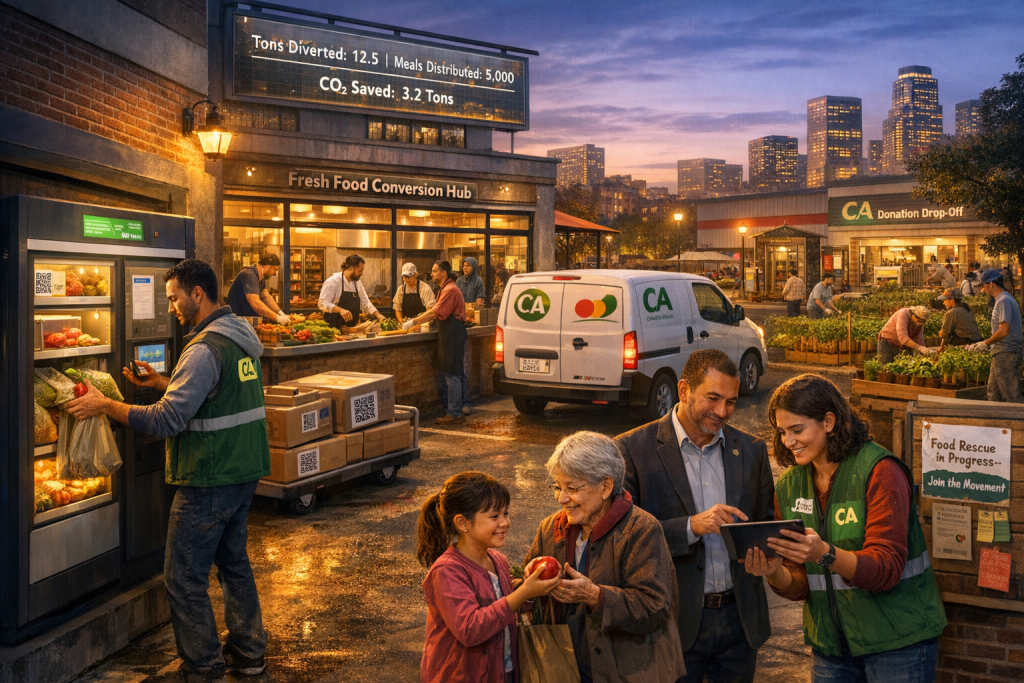
Cities produce more than enough food to feed everyone, yet waste and hunger continue to coexist block by block. This document introduces a practical framework for redesigning how food moves through an urban environment. It treats food access not as charity, but as infrastructure. By aligning policy, technology, logistics, and community networks, the framework shows how cities can convert fragmented emergency responses into a coordinated resilience grid. The goal is measurable impact. Less waste entering landfills. More people accessing food with dignity. Stronger partnerships between government, business, and civil society that reinforce a circular economy instead of a linear one. This document is inspired by a China case study Outline China study
As usual some artifacts : Artifacts abundance
| Document Name | Short Summary |
| A Systemic Blueprint for Urban Food Resilience | The core conceptual framework defining the Cultivating Abundance model. It explains the P³T&C structure, implementation logic, success metrics, and phased roadmap for building a city-scale food resilience operating system. It acts as the strategic foundation for all other documents. |
| Stakeholder Ecosystem Analysis | A deep mapping of all actors in the food redistribution ecosystem. It identifies power, needs, incentives, and friction points across beneficiaries, NGOs, donors, government, logistics, and funders. It translates stakeholder pain points into system features and partnership structures. |
| Risk Profile for the CA Framework | A comprehensive operational risk framework covering governance, safety, logistics, technology, and reputational risks. It integrates lessons from the China case study and defines mitigation protocols, safety standards, audit structures, and incident response models. |
| Gap Analysis & Research Framework | A diagnostic tool for assessing the current food support ecosystem versus the CA target state. It provides research methods, capability mapping, and decision rules to avoid duplication and guide pilot selection, scaling, and specialization. |
| Cultivating Abundance Framework Implementation Documentation | The technical and operational specification layer. It includes business requirements, hardware and software architecture, system modules, KPIs, compliance rules, and infrastructure planning. This document converts the strategy into buildable system |
Vision Document: The Cultivating Abundance (CA) Framework
1. Executive Summary
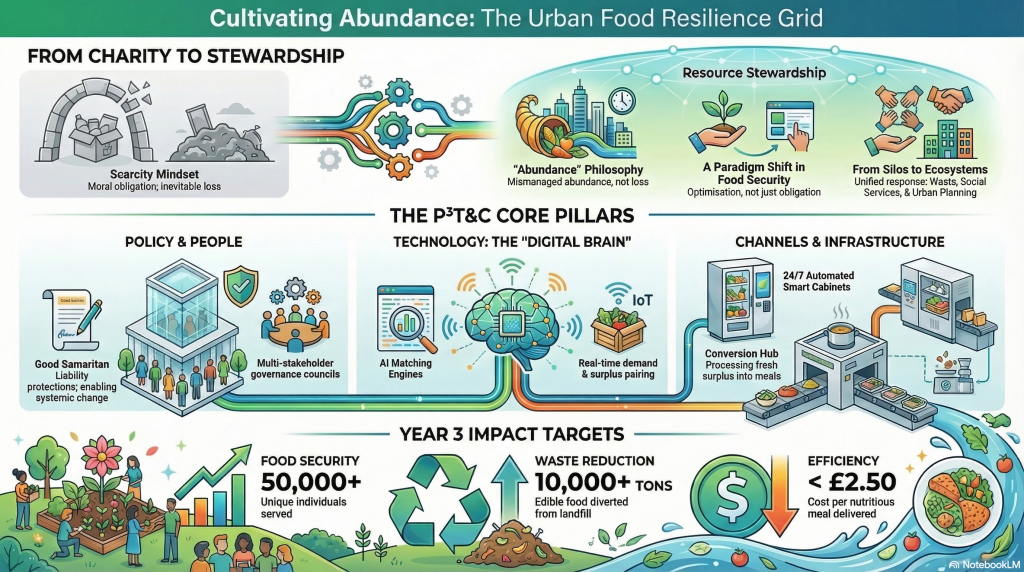
The Cultivating Abundance (CA) Framework is a holistic, scalable, and adaptive model for transforming urban food systems from fragmented charity into integrated infrastructure. It simultaneously addresses food insecurity and food waste by aligning Policy, People, Process, Technology, and Channels (P³T&C) into a resilient, data-driven ecosystem. Designed for phased implementation from borough to city-wide scale, CA delivers measurable social, economic, and environmental impact while restoring dignity and choice to food access.
2. Vision Statement
To create city-wide food resilience grids where no edible food goes to waste, no person goes hungry, and every stakeholder—from beneficiary to business—participates in a circular economy of abundance.
3. Core Business Objectives
- Divert 10,000+ tons of edible food from waste streams annually by Year 3.
- Serve 50,000+ unique individuals with dignified food access by Year 3.
- Achieve 90%+ beneficiary satisfaction on dignity and choice metrics.
- Reduce municipal waste disposal costs by £2M+ annually by Year 3.
- Create a replicable model adopted by 5+ cities by Year 4.
4. Stakeholder Ecosystem
| Stakeholder Group | Key Role | Needs & Value Proposition |
| Food-Insecure Individuals | End beneficiaries | Dignified, choice-driven access; nutritional security; privacy. |
| Volunteers & Community Champions | Human capital | Meaningful engagement; skill utilization; recognition. |
| Local NGOs & Charities | Trusted distributors | Increased capacity; reduced admin burden; shared resources. |
| Supermarkets & Grocery Chains | Surplus donors | CSR impact; waste cost reduction; tax benefits; brand equity. |
| Restaurants & Food Service | Perishable surplus donors | Daily waste management; community reputation; regulatory compliance. |
| Municipal Government | Policy enabler & funder | Social welfare outcomes; waste reduction; cost savings; SDG alignment. |
| Technology Partners | Platform builders | Scalable solutions; data insights; SaaS revenue; innovation showcase. |
| Logistics & Delivery Firms | Distribution network | Route optimization; CSR fulfillment; driver engagement. |
| Funders & Philanthropists | Catalytic investors | Measurable impact; leverage; systemic change; replicable models. |
5. Technology & AI Requirements
Core Platform Components:
- AI-Powered Matching Engine: Dynamically pairs surplus food with demand based on expiry, nutrition, dietary needs, and location.
- IoT & Smart Infrastructure: Temperature sensors, smart locks, RFID/QR tracking for real-time monitoring.
- Predictive Analytics Module: Forecasts surplus and demand using sales, weather, and event data.
- Multi-Modal User Interfaces: Mobile app, web portal, SMS, and voice systems for inclusive access.
- Real-Time Logistics Dashboard: Route optimization, fleet tracking, and driver coordination.
Key AI/ML Applications:
- Surplus Prediction: Time-series models to anticipate donor waste patterns.
- Demand Forecasting: Regression models to predict community need spikes.
- Nutritional Optimization: Algorithmic meal planning for conversion hubs.
- Anomaly Detection: Identify food safety risks or system inefficiencies.
6. Insights from the China Model
Adaptable Strategies:
- 24/7 Smart Cabinets: Automated, accessible distribution nodes in high-traffic areas (metros, community centers).
- Hybrid Governance: Strong public-private-community coordination with clear policy backing (e.g., Anti-Food Waste Law).
- Digital Tracking: QR codes and apps for traceability, safety, and transparency.
- Corporate Partnerships: Mandated retailer participation with streamlined donation protocols.
Lessons for CA Framework:
- Policy First: Start with municipal mandates and liability protections.
- Tech-Enabled Trust: Use traceability to build donor confidence.
- Community Embeddedness: Place food access points where people already are.
- Scalable Pilots: Begin with one borough, one supermarket chain, one NGO.
7. Implementation Roadmap
Phase 1: Pilot (Months 1–6)
- Deploy 10 smart cabinets and 1 conversion hub.
- Onboard 2 anchor donors + 1 NGO.
- Launch basic matching engine + volunteer coordination.
- Target: 100 tons diverted, 500 beneficiaries served.
Phase 2: Expansion (Months 7–18)
- Scale to 3 boroughs.
- Integrate AI matching and IoT monitoring.
- Develop corporate CSR portals.
- Target: 1,000 tons diverted, 5,000 beneficiaries served.
Phase 3: City-Wide (Months 19–36)
- Full city coverage with 100+ cabinets, 5+ hubs.
- Launch predictive analytics and policy simulation tools.
- Begin replication toolkit for other cities.
- Target: 10,000+ tons diverted, 50,000+ beneficiaries served.
8. Success Metrics & KPIs
| Category | KPI | Target (Year 3) |
| Impact | Food diverted (tons) | 10,000+ |
| Impact | Beneficiaries served | 50,000+ |
| Operational | Surplus capture rate | 70%+ |
| Financial | Cost per meal delivered | < £2.50 |
| Environmental | CO₂ avoided (tons) | 5,000+ |
| Satisfaction | Beneficiary dignity score | 90%+ |
9. Call to Action
The CA Framework is not a theoretical exercise—it is a ready-to-implement blueprint for urban food transformation. With existing technology, proven models from global cities, and growing political will, the time to act is now.
We invite city leaders, NGOs, corporations, and technologists to join us in building the first borough-scale pilot and demonstrating that a future of food abundance is within reach.
Food Bank Transformation Framework: Systems Analysis & Integration Blueprint
1. Strategic Outlook & Operational Models of Food Banks
Why Food Banks Exist:
- Emergency Response: Crisis-driven charity model for acute need.
- Social Safety Net: Fills gaps in government welfare systems.
- Community Solidarity: Volunteer-driven local support networks.
- Resource Redistribution: Channels surplus food to those in need.
Food Bank Typologies:
| Type | Description | Stakeholders |
| Traditional Charity Model | Fixed-location, pre-packed parcels, eligibility-based. | Donors, volunteers, beneficiaries, NGOs. |
| Community Food Bank | Localized, often faith-based, relationship-driven. | Local leaders, community members, small businesses. |
| Governmental/Public Model | State-funded, means-tested, integrated with social services. | Municipalities, social workers, public agencies. |
| Demand-Led Tech Model | App-based, choice-driven, real-time matching. | Tech providers, logistics partners, retail donors. |
2. SWOT Analysis of Existing Food Bank Systems
| Strengths | Weaknesses |
| • Established trust in communities • Volunteer networks • Immediate crisis response | • Supply-push (not demand-led) • Stigmatizing user experience • High administrative overhead • Limited fresh/perishable handling |
| Opportunities | Threats |
| • Tech enablement (AI, IoT) • Corporate CSR partnerships • Policy shifts (food waste laws) • Data-driven optimization | • Donor fatigue • Regulatory barriers • Funding instability • Digital divide |
3. PESTLE Analysis for Integration
| Factor | Implications for Integration |
| Political | Municipal mandates (e.g., Anti-Food Waste Law). Cross-departmental coordination (Social Services + Environment). |
| Economic | Waste disposal cost savings. CSR funding from retailers. Social impact bonds. |
| Social | Dignity-by-design requirement. Multi-language, multi-modal access. Cultural dietary preferences. |
| Technological | IoT for cold chain tracking. AI for matching. Mobile apps for beneficiaries. API integration with existing systems. |
| Legal | Liability waivers (“Good Samaritan” laws). Food safety compliance (HACCP). Data privacy (GDPR). |
| Environmental | Carbon footprint reduction. Circular economy alignment. Urban farming integration. |
4. Comparison with Existing Systems
| System Type | Key Features | Integration Points with CA Framework |
| Traditional Food Banks | Fixed schedules, pre-packed parcels. | Convert to “smart nodes” with digital inventory. Integrate volunteer pools. |
| Food Delivery Apps (Uber Eats, etc.) | Real-time routing, driver networks. | Donated delivery capacity. CSR-integrated dispatch. |
| Retail Inventory Systems (SAP, Oracle) | Surplus tracking, expiry management. | API for automatic surplus flagging. |
| Municipal 311 / Citizen Portals | Service requests, complaint logging. | Integrated food access reporting and routing. |
| NGO Case Management Systems | Beneficiary records, need assessment. | Privacy-preserving data sharing for holistic support. |
5. Orchestration & Coordination with Existing Systems
A. Technology Stack for Integration:
| Layer | Components | Purpose |
| Orchestration Engine | Central CA Platform (AI matching, routing) | Coordinates all subsystems, ensures real-time sync. |
| API Gateway | RESTful APIs, Webhooks, EDI connectors | Enables communication between legacy and modern systems. |
| Data Lake | PostgreSQL + Elasticsearch + BigQuery | Aggregates data from donors, NGOs, logistics, municipalities. |
| IoT Hub | MQTT brokers, sensor networks | Monitors smart cabinets, refrigerated transport, hub equipment. |
| Mobile & Web Clients | React Native apps, SMS gateway, voice IVR | Multi-modal access for beneficiaries, drivers, volunteers. |
B. Hardware Stack:
| Component | Purpose | Integration Example |
| Smart Cabinets | 24/7 automated food access | IoT sensors report inventory to central platform. |
| Conversion Hubs | Fresh food processing | Integrated with POS/ERP systems for surplus intake. |
| Mobile Pantries | Refrigerated vehicles | GPS tracking integrated with fleet management systems (Samsara). |
| Donor Kiosks | QR code printers, scales | Connected to retailer inventory systems for batch logging. |
6. Hybrid Model: Integrating Three Streams
Instead of separate systems, CA proposes a unified hybrid:
| Stream | Role in Hybrid Model | Tech Integration |
| Food Banks | Become “Smart Distribution Nodes” with digital inventory and choice-based access. | Mobile app + IoT cabinet integration. |
| Soup Kitchens / Dark Kitchens | Become “Fresh Conversion Hubs” transforming surplus into meals. | Recipe AI + inventory management software. |
| Food Waste Prevention | Becomes the supply engine via retailer/manufacturer integrations. | API connections to ERP/POS systems for surplus forecasting. |
7. Demand-Supply Coordination Model
Supply Side:
- Retailers flag surplus via API or mobile app.
- IoT sensors monitor temperature/expiry.
- AI predicts surplus based on sales/weather.
Demand Side:
- Beneficiaries indicate preferences via app/SMS.
- Household size, dietary needs, location logged (privacy-preserving).
- Priority algorithm (children, elderly, disabilities) applied.
Matching & Routing:
- AI engine matches supply to demand in real time.
- Route optimization integrates donated delivery capacity (Uber Eats, etc.).
- Dynamic adjustments for traffic, weather, emergencies.
8. Cost-Benefit & Value Demonstration
Tangible Benefits:
- Waste Reduction: £X saved in disposal fees.
- Social Services: £Y saved in emergency food aid.
- Volunteer Hours: £Z value of contributed time.
Intangible Benefits:
- Dignity Score: Measured via beneficiary surveys.
- Community Trust: Increased via transparent operations.
- Environmental Impact: Carbon/water savings calculated via LCA.
Open Source & AI Enablement:
- Open Source Core: Reduces licensing costs, enables replication.
- AI Modules: Predictive analytics, matching, routing—built on TensorFlow/PyTorch.
- Dashboards: Real-time impact visualization for stakeholders.
9. Case Study Approach: London Borough + NYC District
Selection Criteria:
- High food insecurity + high retail density.
- Willing municipal partner + anchor NGO.
- Existing digital infrastructure (broadband, mobile penetration).
Study Components:
- Baseline Mapping: Existing food banks, soup kitchens, surplus sources.
- Pilot Deployment: 10 smart cabinets + 1 conversion hub + 1 retailer.
- Integration Testing: API connections with local government + retail systems.
- Impact Measurement: Pre/post waste volumes, beneficiary satisfaction, cost savings.
10. Recommendations for Implementation
- Start Hybrid: Co-locate traditional food bank with smart cabinet/conversion hub.
- Leverage Existing Tech: Use proven delivery/logistics platforms (donated capacity).
- Build Open APIs: Ensure interoperability with municipal and retail systems.
- Measure Holistically: Track both tangible (tons diverted) and intangible (dignity) metrics.
- Scale Through Replication: Document learnings as open-source “city implementation kit.”
Conclusion
The framework demonstrates that food abundance is not a question of supply, but of coordination. When cities integrate surplus tracking, predictive analytics, smart distribution points, and community partnerships, they move from reactive aid to proactive system design. The result is a model that scales. It lowers municipal costs, strengthens social safety nets, and reduces environmental impact while preserving human dignity at the center of the system. The next step is execution. Pilot programs, open collaboration, and transparent measurement will determine how quickly this blueprint becomes everyday infrastructure in cities that choose to act.