A unified framework for traceability, explainability, governance, and change control across Agile and hybrid methodologies
1. Introduction — Why Requirements Management Has Become Mission‑Critical Again
For the last decade, Agile delivery practices have often treated requirements management as a lightweight activity: user stories, acceptance criteria, and a backlog were considered “good enough.” Heavyweight traceability matrices, change control boards, and structured requirement attributes were seen as relics of Waterfall.
AI changes this calculus completely.
As AI systems now generate user stories, acceptance criteria, test cases, architecture drafts, code, documentation, and even sprint plans, the delivery ecosystem has entered a new era — one where:
- requirements are no longer exclusively human‑authored,
- artefacts evolve faster than teams can manually track,
- explainability and provenance become essential for trust,
- AI‑generated outputs must be validated, governed, and traceable,
- technical debt now includes “AI‑generated debt”,
- version control must apply to requirements, not just code,
- change control must be redesigned for non‑deterministic tools,
- and teams must be able to explain why something was built, not just how.
This paper proposes a renewed, modernised requirements management framework that integrates:
- Agile and iterative delivery
- AI‑augmented practices
- traceability and explainability
- versioning and change control
- documentation and governance
- technical debt management
- Greenfield and Brownfield realities
- and the emerging need for AI‑specific oversight
The goal is simple:
to ensure that delivery remains accountable, explainable, and resilient in a world where AI participates in the creation of requirements and solution artefacts.
References Document Summary Table Supporting artefacts
| Name | Short Description |
| The Renewed Importance of Requirements Management in the Age of AI-Augmented Delivery | Core paper defining why requirements management becomes critical again with AI, introducing the AARMF framework and its six pillars: provenance, traceability, versioning, governance, documentation integrity, and AI debt. |
| Agile Philosophy vs AI-Driven Requirements Discipline | Explains the tension between Agile’s lightweight philosophy and the need for stronger governance in AI-driven environments, showing how AI enhances rather than contradicts Agile practices. |
| AI-Augmented Requirements Management Framework (AARMF) Support Documents | A comprehensive set of supporting artefacts including manifesto addendum, Scrum AI rules, governance model, simulation scenario, and policy paper for organisational adoption. |
| Naming Conventions | Defines structured naming, configuration management, metadata taxonomy, and tool selection principles to ensure traceability, versioning, and governance across all artefacts. |
| Support Requirements Management in the Age of AI-Augmented Delivery | Training and enablement pack including slide deck, workbook, BA-focused guidance, public sector adaptation, maturity model, and operational checklist. |
| Templates | A full suite of reusable templates such as RTM, AI provenance log, change control forms, version control records, and governance artefacts for practical implementation. |
| The AI-Aware Intersection: Requirements Management × Agile | Conceptual paper defining the new discipline at the intersection of Agile and requirements management, positioning the BA as the governance anchor in AI-augmented delivery. |
What this set represents (quick synthesis)
If you step back, this is not just a collection of documents. It is a full operating system:
- Core theory → why requirements management matters again
- Philosophy bridge → how it aligns with Agile
- Framework → AARMF + AIRL
- Governance model → rules, policy, and accountability
- Execution layer → templates, naming, tooling
- Capability building → training, maturity model
- Conceptual anchor → the AI-aware intersection
2. Why AI Forces a Rethink of Requirements Management
AI disrupts the traditional Agile assumption that:
“Requirements emerge through conversation.”
When AI generates requirements, the “conversation” is no longer purely human. This introduces new risks:
2.1 Loss of provenance
Teams cannot tell which requirements were human‑authored, AI‑generated, or hybrid.
2.2 Loss of explainability
Stakeholders cannot understand why a requirement exists or what inputs shaped it.
2.3 Velocity distortion
AI can inflate throughput metrics by generating large volumes of requirements or code.
2.4 Governance gaps
AI outputs may bypass review, leading to unvalidated or biased requirements.
2.5 Change‑tracking failures
AI can regenerate requirements in ways that break continuity or invalidate previous decisions.
2.6 Technical debt multiplication
AI can generate code or requirements that appear correct but embed hidden complexity.
2.7 Breakages in existing systems
AI‑generated changes may unintentionally conflict with legacy constraints, integrations, or business rules.
2.8 Tool‑driven fragmentation
Multiple AI tools (Copilot, Claude, Jira AI, Miro AI, etc.) create artefacts in different formats, with no unified traceability.
These risks make structured requirements management not optional but essential.
3. The Overarching Approach: The AI‑Augmented Requirements Management Framework (AARMF)
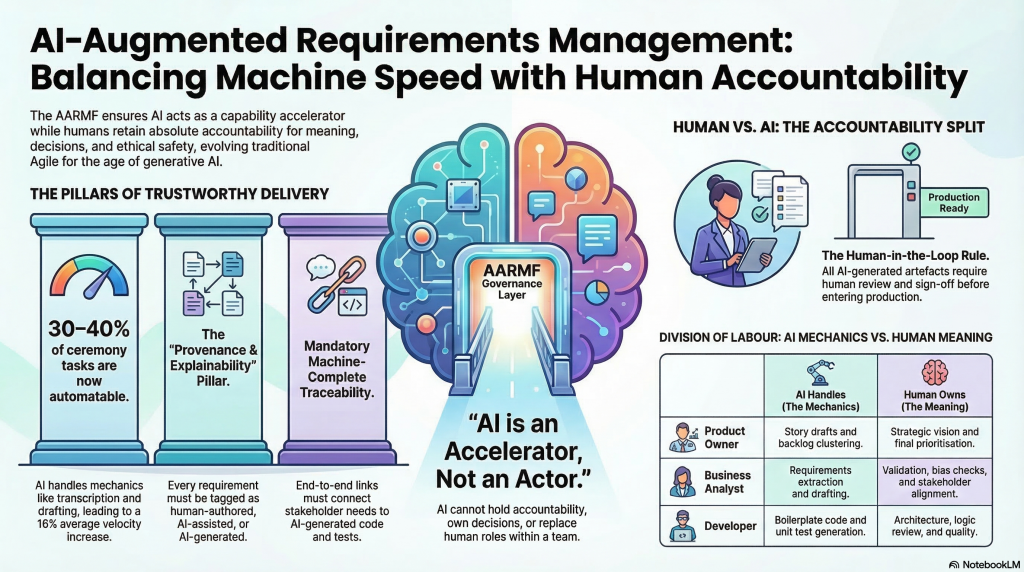
This paper proposes a unified methodology:
The AI‑Augmented Requirements Management Framework (AARMF)
It has six pillars:
- Provenance & Explainability
- Traceability & Dependency Mapping
- Version Control & Change History
- Governance & Change Control
- Documentation & Artefact Integrity
- Technical Debt & AI‑Generated Debt Management
Each pillar is described below.
4. Pillar 1 — Provenance & Explainability
AI‑generated requirements must be traceable to their origin:
- Human-authored
- AI-assisted (human reviewed)
- AI-generated (human approved)
Every requirement must include:
- source inputs (documents, interviews, prompts)
- AI tool used
- prompt or instruction
- human reviewer
- validation notes
- explainability statement (“Why this requirement exists”)
This ensures:
- auditability
- accountability
- transparency
- trustworthiness
Explainability becomes a first-class requirement attribute.
5. Pillar 2 — Traceability & Dependency Mapping
Traditional traceability matrices (RUP, IEEE, RequisitePro) become essential again — but modernised for Agile and AI.
Traceability must link:
- stakeholder needs
- business rules
- features
- user stories / use cases
- acceptance criteria
- design decisions
- architecture artefacts
- code modules
- test cases
- deployment units
- operational metrics
AI tools must not break traceability.
Instead, they must write into it.
AI‑specific traceability requirements
- AI-generated stories must link to the prompts and source materials.
- AI-generated test cases must link to the stories they validate.
- AI-generated code must link to the requirements it implements.
- AI-generated documentation must link to the code and requirements.
Traceability becomes the backbone of explainability.
6. Pillar 3 — Version Control & Change History
Requirements must be versioned with the same discipline as code.
Why?
AI tools regenerate content frequently.
Without versioning:
- teams lose continuity
- decisions become opaque
- regressions occur
- audit trails break
- compliance becomes impossible
Version control must include:
- requirement versions
- attribute changes
- status transitions
- AI-generated revisions
- human approvals
- rationale for changes
- links to change requests
Versioning applies to:
- requirements
- business rules
- models
- diagrams
- test cases
- architecture decisions
- AI prompts
- AI outputs
This creates a living history of the system.
7. Pillar 4 — Governance & Change Control
AI accelerates change — but change must remain controlled.
A modern change control process includes:
- a single channel for change requests
- AI-generated changes treated as formal change proposals
- impact analysis supported by AI but validated by humans
- cross-functional review (BA, Architect, QA, PO)
- approval gates for high-risk changes
- automated traceability updates
- versioning of all affected artefacts
AI-specific governance rules
- AI cannot approve its own outputs
- AI cannot bypass human review
- AI cannot modify baselined requirements without approval
- AI cannot generate production artefacts without traceability
Governance ensures that AI accelerates delivery without compromising safety.
8. Pillar 5 — Documentation & Artefact Integrity
AI can generate documentation rapidly — but this introduces risks:
- hallucinated content
- outdated content
- inconsistent terminology
- missing rationale
- broken traceability
- duplicated requirements
Documentation must be:
- structured
- versioned
- traceable
- explainable
- validated
- consistent
- aligned to business rules
AI can assist with:
- generating drafts
- summarising interviews
- creating diagrams
- updating glossaries
- producing traceability matrices
- generating test documentation
But humans must validate meaning and intent.
9. Pillar 6 — Technical Debt & AI‑Generated Debt
AI introduces new forms of debt:
9.1 Prompt debt
Poorly written prompts lead to inconsistent outputs.
9.2 Model drift debt
AI outputs change over time as models evolve.
9.3 Explainability debt
Teams cannot explain why a requirement exists.
9.4 Traceability debt
AI-generated artefacts lack links to upstream/downstream items.
9.5 Code debt
AI-generated code may be syntactically correct but architecturally harmful.
9.6 Documentation debt
AI-generated documentation may be outdated or incorrect.
9.7 Business rule debt
AI may generate requirements that violate business rules or policy constraints.
9.8 Integration debt
AI may propose changes that break legacy systems.
Debt management requires:
- debt registers
- AI-assisted debt detection
- human-led debt prioritisation
- governance for debt repayment
- architecture oversight
- BA oversight for requirement-level debt
10. Greenfield vs Brownfield: Different Challenges
Greenfield Projects
AI accelerates:
- discovery
- story generation
- modelling
- architecture exploration
But risks include:
- overgeneration of requirements
- premature solutioning
- lack of stakeholder grounding
- missing business rules
Brownfield Projects
AI accelerates:
- reverse engineering
- documentation recovery
- test generation
- code analysis
But risks include:
- breaking legacy constraints
- misinterpreting undocumented behaviour
- generating incompatible requirements
- creating integration conflicts
The framework must adapt to both contexts.
11. Tooling, Interactions, and Tracking
AI tools must be integrated into the requirements management ecosystem.
Tooling categories:
- AI assistants (Copilot, Claude, ChatGPT)
- ALM tools (Jira, Azure DevOps)
- modelling tools (Miro, Lucidchart)
- documentation tools (Confluence, Notion)
- traceability tools (ReqPro, Jama, Helix)
- version control (Git, SVN)
Tooling requirements:
- unified traceability
- prompt logging
- AI output tagging
- cross-tool integration
- audit trails
- access control
- change history
Interactions must be governed by:
- role-level AI augmentation agreements
- ceremony-level AI protocols
- artefact provenance standards
- metrics recalibration rules
12. Breakages: How to Detect, Prevent, and Recover
AI can introduce breakages in:
- requirements
- architecture
- code
- integrations
- business rules
- test coverage
- documentation
Breakage detection strategies:
- AI-assisted impact analysis
- automated traceability checks
- dependency graph analysis
- regression test generation
- architecture rule validation
- business rule compliance checks
Breakage recovery strategies:
- revert to previous requirement versions
- rebaseline requirements
- revalidate business rules
- regenerate test cases
- conduct human-led reviews
- update prompts and AI guardrails
13. The Overarching Methodology: The AI‑Augmented Requirements Lifecycle (AIRL)
AIRL is a unified lifecycle that integrates Agile, RUP, and AI‑augmented practices.
AIRL Stages
- Elicit
- Human-led discovery
- AI-assisted synthesis
- Business rule identification
- Define
- Requirements drafting (AI-assisted)
- Attribute configuration
- Traceability setup
- Validate
- Human review
- Explainability checks
- Business rule compliance
- Risk assessment
- Baseline
- Version control
- Change control activation
- Governance sign-off
- Implement
- AI-assisted development
- Traceability to code and tests
- Continuous documentation
- Monitor
- Change detection
- Drift analysis
- Debt tracking
- Evolve
- Controlled requirement changes
- AI-assisted impact analysis
- Re-baselining
AIRL is methodology-agnostic and works with:
- Scrum
- Kanban
- SAFe
- RUP
- Waterfall
- Hybrid models
14. Conclusion — Requirements Management Is Back, and More Important Than Ever
AI has not made requirements management obsolete.
It has made it indispensable.
In a world where AI generates requirements, code, tests, and documentation, teams must ensure:
- traceability
- explainability
- version control
- change governance
- documentation integrity
- technical debt management
- business rule compliance
- auditability
- accountability
The organisations that thrive will be those that treat requirements management not as bureaucracy, but as the foundation of trustworthy, safe, and effective AI‑augmented delivery.