Preamble
Most people do not hate printing. They hate printers.
They hate the cartridge that costs almost as much as the machine. They hate subscription prompts, blocked third-party ink, mysterious error messages, landfill-bound hardware, and the feeling that a useful device has been designed to become disposable.
That frustration is not accidental. For decades, much of the consumer printer industry has operated around the “razor-and-blade” model: sell the printer cheaply, then recover profit through high-margin consumables. The result is a category where users often feel less like owners and more like renters of a locked ecosystem.
As usual : Perpetual printer research
The Perpetual Printer proposes a different model.

Instead of planned obsolescence, it is built around planned permanence: a printer designed for a 20+ year lifespan, modular upgrades, repairable components, open-source firmware, refillable ink, third-party cartridge compatibility, and a software layer that helps users maintain rather than replace the machine.
The attached concept image captures the shift clearly: the old model is a chained, disposable printer with proprietary DRM, subscription economics, and a 3–5 year lifecycle. The new model is a durable platform: hot-swappable hardware, open ink, modular upgrades, community firmware, and revenue from upgrades, licensing, services, and ecosystem growth rather than forced replacement.
The current strategic feasibility score is 67%. That is promising, but not a green light for mass production. Under the development plan’s decision rule, this sits in the “test more” zone: strong enough to justify structured validation, not strong enough to skip technical, legal, and market-risk gates. The development plan recommends proceeding only at 75%+, testing further between 50–74%, and pivoting or parking below 50%.
That makes the Perpetual Printer a serious venture hypothesis: not hype, not fantasy, but a product-platform opportunity that deserves disciplined testing.
Visual placement note: Use the attached “razor-and-blade vs durable paradigm” infographic directly after this preamble. Caption: From planned obsolescence to planned permanence: the Perpetual Printer reframes the printer as an upgradeable platform, not a disposable appliance.
Market Analysis
The home and small-office printer market is mature, but not irrelevant. It is undergoing a structural transition.
The attached market analysis estimates the global home printer market at $42.5 billion in 2024, including hardware and consumables, with a projected 3.1% CAGR from 2024 to 2030. Home and small-office shipments are estimated at approximately 45–50 million units annually.
This is not a venture category built on explosive unit growth. It is a category built on frustration, replacement cycles, recurring consumables, hybrid work, homeschooling, mobile-first workflows, and cost-of-ownership pressure.
The market is shifting in three important ways.
First, the traditional cartridge model is weakening. The market document describes a transition away from loss-leader cartridge printers toward “smart home” printers, subscription models, and high-yield tank systems such as Epson EcoTank and Canon MegaTank.
Second, consumers are increasingly aware of total cost of ownership. The market analysis highlights a “mass exodus” from standard cartridges toward ink tank and super-tank systems because users now understand cost per page, not just purchase price.
Third, hybrid work remains a demand driver. The attached market data states that 58% of knowledge workers operate in a hybrid model, creating ongoing demand for reliable color printing at home for presentations, contracts, administration, education, and creative work.
The Perpetual Printer’s opportunity is not to prove that people still print. The opportunity is to prove that people want a printer they can trust.
The gap is clear. No major consumer printer manufacturer currently offers the full combination of:
Open hardware standards.
Open-source or community-maintained firmware.
Modular, repairable architecture.
DIY or third-party ink compatibility.
Transparent lifetime cost.
Long-term repairability.
A third-party upgrade ecosystem.
The Perpetual Printer enters where the market is already moving—toward lower running costs, better software, and sustainability—but pushes further into openness and permanence.
Stakeholder Analysis
| Stakeholder | Interest | Value Exchange |
| Home-office users | Low lifetime cost, reliability, freedom from lock-in | Repairable printer, refillable ink, transparent TCO |
| Makers and open-source contributors | Hackable hardware, public standards, contribution visibility | Firmware, modules, documentation, testing |
| Third-party builders | New module, cartridge, accessory, and service market | Revenue from certified upgrades and components |
| Repair hubs and makerspaces | Local repair revenue, skills development, community role | Service manuals, parts access, certification |
| Schools and sustainability groups | STEM education, repair culture, circular economy | Education kits, repair curricula, reuse programs |
| Investors and ecosystem partners | Platform economics, defensible niche, long-tail revenue | Licensing, certification, data-light services, partner network |
The stakeholder logic is intentionally decentralized. The Perpetual Printer becomes stronger when more people can repair it, extend it, document it, teach with it, and build around it.
This is different from a closed OEM model, where value is captured primarily through proprietary consumables. The brand concept positions the Perpetual Printer around open-source hardware, modular architecture, community-driven upgrades, third-party cartridge compatibility, and user-controlled ink systems.
SWOT Analysis
| Strengths | Weaknesses |
| Clear differentiation from locked printer ecosystems | Higher upfront price than disposable entry-level printers |
| Modular, repairable, upgradeable hardware | Printhead sourcing and reliability are difficult |
| Open-source firmware and public standards build trust | Requires user education around ink, maintenance, and repair |
| Low lifetime cost can appeal to home-office users | Certification and compliance add cost |
| Strong sustainability narrative with practical design logic | Community contributions may be uneven early |
| Opportunities | Threats |
| Right-to-repair momentum supports the concept | Incumbents may launch “open-ish” alternatives |
| Tank-printer adoption validates low-CPP demand | Patent risk around printhead control and ink systems |
| Maker, education, and repair communities can seed adoption | Supply chain delays may slow pilots |
| Third-party modules can create platform economics | Poor early reliability could damage trust |
| AI diagnostics can reduce support burden | DIY ink may be perceived as messy or risky |
The central SWOT takeaway is simple: the Perpetual Printer has strong differentiation, but differentiation alone is not enough. It must be more reliable, more understandable, and easier to maintain than users expect from open hardware.
PESTLE Analysis
| Factor | Impact on Perpetual Printer |
| Political | Right-to-repair policy momentum supports openness; tariffs and manufacturing geography may affect costs. |
| Economic | Inflation and cartridge fatigue strengthen demand for predictable lifetime cost. |
| Social | Hybrid work, homeschooling, creator workflows, and sustainability values support durable home-office hardware. |
| Technological | MEMS printheads, IoT sensors, AI diagnostics, mobile printing, and cloud dashboards shape user expectations. |
| Legal | WEEE, RoHS, REACH, wireless certification, privacy rules, and printhead IP must be handled early. |
| Environmental | E-waste, cartridge waste, plastic reduction, and repairability create a strong circular-economy case. |
The PESTLE view is favorable but not risk-free. The printer touches electronics, chemicals, firmware, wireless connectivity, consumables, safety, and intellectual property. Open-source positioning improves trust, but it does not remove the need for professional compliance and IP discipline.
Sustainability & Planned Permanence
The Perpetual Printer should not be marketed merely as “eco-friendly.” That phrase is too vague. The stronger idea is planned permanence.
Planned permanence means designing a product to remain useful, repairable, upgradeable, and economically rational over a long life. The executive white paper frames the Perpetual Printer as a modular, repairable, open-ecosystem home printer designed for 20+ years of service and lower total cost of ownership.
This matters because many sustainability claims fail at the design level. A device cannot be truly sustainable if it is glued shut, undocumented, dependent on unavailable parts, or locked to a consumables monopoly.
For the Perpetual Printer, sustainability should be engineered into five operating principles.
1. Repair before replacement.
Common failure points—rollers, trays, printheads, sensors, tubing, boards, seals, and access panels—should be replaceable without destroying the machine.
2. Upgrade before obsolescence.
A user should be able to add duplexing, larger trays, improved sensors, better color calibration, label support, accessibility features, or future print modules without replacing the entire printer.
3. Refill before discard.
The ink system should support refillable reservoirs, third-party cartridges, validated ink profiles, and eventually controlled DIY mixing for advanced users.
4. Document before support failure.
Repair manuals, exploded diagrams, calibration guides, firmware notes, and maintenance procedures should be public wherever safety allows.
5. Localize the service loop.
Certified repair hubs, makerspaces, schools, and microfactories can reduce logistics, create local jobs, and make repair normal rather than exceptional.
The planned permanence framework also argues that durable product businesses need lifecycle revenue: upgrades, services, certification, licensing, support, and ecosystem participation rather than dependence on forced replacement.
This is the core business-model shift. The Perpetual Printer does not reject profit. It rejects profit based on user frustration.
Technology & Software Stack
Hardware Architecture
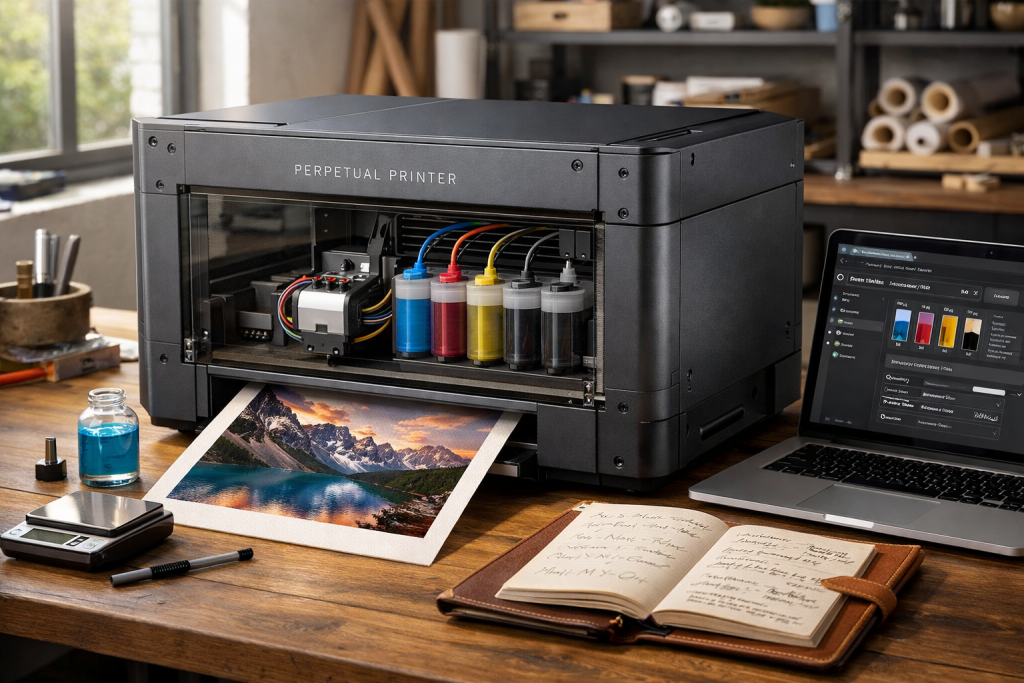
The printer is compact, sturdy, workshop-friendly, and visibly modular. The transparent front panel reveals ink reservoirs, tubing, internal electronics, and the print path, reinforcing the idea that the printer is not a black box.
That visual direction is important. The design says: this machine is meant to be understood.
The proposed architecture includes:
Modular printhead interface.
The printhead is the hardest technical component. A universal interface control document should define mechanical, electrical, and software boundaries so the platform can support multiple future printhead options.
Open control electronics.
The brand concept suggests an open-source microcontroller approach using options such as ESP32 or Raspberry Pi-class systems, depending on the performance requirements.
Sensor-rich ink and paper systems.
Sensors should monitor ink level, viscosity, humidity, temperature, paper feed, nozzle health, cartridge identity, cover state, and calibration targets.
Swappable chassis components.
The physical architecture should allow tool-free or low-tool replacement of trays, access panels, ink modules, printhead assemblies, sensors, and future add-ons.
Open ink ecosystem.
The concept includes DIY ink mixing, third-party cartridge compatibility, color profile customization, and future ink-mixing kits.
Visual placement note: Insert the realistic product render in this section with the caption: A possible Perpetual Printer prototype direction: visible ink reservoirs, accessible internals, modular chassis, and a companion dashboard for diagnostics and control.
Software Stack
The software layer must turn openness into usability.
A technically open printer that is confusing to operate will remain a niche hobby project. A successful Perpetual Printer needs consumer-grade usability with maker-grade transparency.
The proposed stack includes:
Firmware.
A community-maintained firmware layer, potentially inspired by Marlin or Klipper-style open controller ecosystems, adapted for print timing, sensor control, error recovery, and hardware safety.
Web dashboard.
A browser-based dashboard for setup, ink levels, calibration, diagnostics, firmware updates, maintenance logs, module registration, and privacy settings.
Mobile app.
Quick print, scan-to-phone, AR troubleshooting, maintenance reminders, and community repair guide access.
API layer.
A RESTful or local-network API allowing third-party modules, repair tools, dashboards, and workflow automations to integrate without reverse engineering.
AI assistant.
Optional intelligence for predictive maintenance, color matching, ink usage forecasts, computer-vision error diagnosis, templates, worksheets, summaries, and workflow automation.
The development plan also emphasizes freezing interface control documents early and using hardware-in-the-loop testing and versioned test suites before pilots.
That discipline is essential. A modular ecosystem cannot survive if every module behaves differently, every firmware update breaks compatibility, or every repair process depends on tribal knowledge.
AI Integration
AI should not be bolted onto the Perpetual Printer as a buzzword. It should solve the exact problems that make printers frustrating.
The most important AI use case is predictive maintenance. A printer should be able to warn users before failure: drying nozzles, declining color consistency, paper-feed misalignment, ink-flow restriction, humidity risk, or component wear.
The second is AR-guided repair. A user should be able to point a phone at the printer and receive step-by-step guidance: open this panel, remove this module, clean this roller, replace this sensor, recalibrate here.
The third is AI-assisted color and ink management. For advanced users, the system can recommend profiles, estimate ink use, warn about risky formulations, and help match colors across paper types.
The fourth is generative document workflows. The printer can become a productivity tool for families, teachers, freelancers, and small businesses: worksheets, flashcards, shipping labels, inventory sheets, invoice templates, meeting summaries, signage, and craft patterns.
The attached article draft frames AI as a shift from passive peripheral to smart assistant, including nozzle monitoring, automatic cleaning cycles, AR repair, generated templates, photo enhancement, and ink optimization.
The boundary is important: AI should reduce waste, support repair, and improve reliability. It should not become another forced subscription or cloud lock-in.
Development Plan & Strategy
The Perpetual Printer should not jump straight to mass production. The development plan is rightly structured around gates, evidence, and parallel tracks.
Feasibility Gates: G0–G5
| Gate | Core Question | Evidence Required | Pass Criteria |
| G0 Concept | Is the idea worth testing? | Market signals, idea snapshot, early matrix | ≥50% to continue testing |
| G1 Feasibility | Can it be built safely and affordably? | Bench tests, unit economics, risk plan | Key risks mapped and mitigated |
| G2 Alpha | Do subsystems work together? | HIL results, subsystem validation | Critical tests pass |
| G3 Beta | Does it work for real users? | 20-unit pilot, support metrics | CPP and reliability meet target |
| G4 Launch | Can we ship responsibly? | Compliance, QA, supply readiness | Launch-readiness evidence complete |
| G5 Scale | Can the ecosystem grow? | Partner pipeline, contribution velocity | Certified ecosystem expansion |
The development plan defines the primary metric as cost per page and reliability at target duty cycle. That is the right metric pair: one measures economic value, the other measures user trust.
Four Development Tracks
| Track | When to Choose | Advantage | Main Risk |
| Blue-sky | Maximum openness and control are required | Deep differentiation | Slow development, certification burden |
| Hybrid | Speed matters but core UX and interfaces must stay open | Balanced path | Vendor lock-in at print-engine layer |
| Supplier-led | Fast MVP is needed | Quick pilot | Lower differentiation, margin pressure |
| Design-only | The standard matters more than the first device | Low manufacturing burden | Ecosystem cold start |
The development plan describes these same four tracks: blue-sky, hybrid, supplier-led, and design-only.
The most practical near-term path is likely Hybrid: license or source a proven print engine, then differentiate through chassis design, open interfaces, refill systems, repair documentation, dashboard software, and ecosystem governance.
That approach respects the hardest technical reality: printheads are difficult. It allows the team to validate the user promise before attempting total vertical integration.
Key Risks & Mitigations
| Risk | Why It Matters | Mitigation |
| Printhead IP and waveform control | Could block launch or create litigation risk | Early patent review, licensed print engine, defensive publication |
| Reliability gap | Users will not forgive a printer that fails often | HIL testing, endurance rigs, beta pilots, hardened firmware |
| Community cold start | Open source without contributors is just public code | Bounties, grants, documentation, public roadmap |
| Supply volatility | Specialized modules may face delays | Dual sourcing, buffer inventory, supplier scorecards |
| DIY ink confusion | Users may fear mess, clogging, or warranty loss | Tiered ink system: standard refill first, advanced mixing later |
Visual placement note: Add a G0–G5 development-gate timeline after this section. Show the current 67% feasibility score as “Test More,” not “Proceed.”
Alternative Proposals
The Perpetual Printer can enter the market through several strategic wedges. The right choice depends on capital, technical readiness, community strength, and tolerance for risk.
Option 1: Pro Model First
Launch a premium “Perpetual Printer Pro” for designers, artists, small studios, printmakers, and serious home-office users.
This segment is more likely to understand color profiles, refill economics, modular upgrades, and repairability. The product can be priced above mainstream consumer printers while offering lower lifetime cost and stronger control.
Best for: brand credibility, margin, early evangelists.
Risk: higher expectations for print quality and reliability.
Option 2: Education-First
Launch as a STEM and sustainability platform for schools, universities, makerspaces, repair cafés, and technical education programs.
This lowers the pressure to beat incumbents on day-one consumer polish and turns the printer into a teaching system for electronics, mechanics, firmware, circular design, color science, and repair.
Best for: community building, grants, institutional adoption.
Risk: slower path to mainstream consumer scale.
Option 3: Platform-Only
Publish the standard, firmware architecture, module specs, repair documentation, and certification model before scaling hardware.
This positions Perpetual Printer as the “Android of printers”: a reference platform that others can build on.
Best for: low manufacturing exposure, ecosystem ambition.
Risk: standards rarely succeed without a strong anchor product.
Option 4: Microfactory and Repair-Hub Model
Build smaller production and repair loops through local microfactories, makerspaces, and certified repair hubs.
The future consumer goods document highlights modular factories, additive manufacturing, CNC, robotics, IoT-enabled production, and localized repair as pathways for more adaptable, lower-waste manufacturing.
Best for: circular economy, local resilience, reduced logistics.
Risk: quality control and certification complexity.
The strongest sequencing may be: Hybrid Pro pilot → education kits → certified repair hubs → platform licensing.
Criteria for Success
| Category | Specific Target | Why It Matters |
| Total cost of ownership | 30–50% lower 5-year TCO than comparable cartridge printers | Proves economic value |
| Reliability | <5% defect/return rate in first production run | Builds trust |
| Cost per page | Competitive with tank systems | Validates core user promise |
| Community | 1,000+ beta signups and 100+ active contributors before scale | Shows ecosystem energy |
| Ecosystem | 5+ certified module or repair partners within 18 months | Proves platform potential |
| Sustainability | Public repair manuals, replaceable wear parts, 20-year repair roadmap | Makes permanence measurable |
The earlier target of 10K active contributors in 18 months is inspiring but probably too aggressive for the first validation stage. A better phased target is 1,000+ qualified beta signups, 100+ meaningful contributors, and 5+ certified ecosystem partners before scaling.
Conclusion
The Perpetual Printer is more than a better printer concept. It is a challenge to a broken consumer electronics pattern.
For years, users have been trained to expect printers that are cheap upfront, expensive over time, difficult to repair, and dependent on proprietary consumables. The Perpetual Printer reverses the logic: build a durable platform, publish the interfaces, make repair normal, make consumables transparent, and let an ecosystem grow around the machine.
The concept is strongest when framed not as anti-profit, but as a different profit model. Revenue can come from hardware, upgrades, certified modules, repair networks, education kits, support services, licensing, and privacy-respecting diagnostics. The brand concept already points toward this shift: modular upgrades, ink-mixing kits, platform licensing, data services, distributed manufacturing, and local repair.
The opportunity is real. The risks are real too.
A 67% feasibility score means the Perpetual Printer should move forward as a structured test, not a full-scale launch. The next milestone is not mass manufacturing. It is a disciplined validation program: prove the cost per page, prove the reliability, prove the repair process, prove the community, and prove that users will pay for permanence.
If those tests pass, the Perpetual Printer could become more than a product. It could become a reference model for a new generation of consumer goods: durable, modular, open, repairable, and designed to evolve.
Decision posture: Test.
Three Next Steps
1. Join the early community to help define the open interface standard, repair documentation, and first module roadmap.
2. Sign up for the beta pilot and vote on the first priority: refill system, duplex module, label-printing module, AR repair guide, or open dashboard.
3. Download the draft specification and contribute a repair note, firmware issue, module concept, test protocol, or supplier lead.
| Document Name | Short Description |
| Research & Validation Prompts | A comprehensive due‑diligence prompt pack covering TCO analysis, market sizing, ecosystem viability, technical feasibility, supply chain, compliance, financial modelling, SWOT, risk analysis, and strategic critique for the Perpetual Printer. |
| Perpetual Printer Development Plan | Full engineering and program‑management blueprint for building the Perpetual Printer, including tracks (Blue‑sky, Hybrid, Supplier‑led, Design‑only), workstreams, decision gates, risk register, integration plan, and budget skeleton. |
| Perpetual Printer Brand Concept | High‑level brand and product concept describing purpose, business model, technology architecture, use cases, stakeholders, cost model, and sustainability positioning. |
| The Future of Building & Producing Consumer Goods v2 | A macro‑level essay on the shift toward durable, modular, repairable consumer goods, microfactories, circular design, and planned permanence across industries like appliances, electronics, and fashion. |
| Planned Permanence Executive Framework Pack | Executive‑level transformation framework outlining governance, profitability pathways, maturity stages, risk landscape, and feasibility gates for companies shifting from disposable to durable product models. |
| Market.docx | A full market & industry survey of the home printer sector, including market size, segmentation, competitor analysis (HP, Epson, Canon, Brother), trends, and strategic recommendations. |
| Market Drivers.docx | Detailed analysis of technology, behavioural, PESTLE, AI, and 3D‑printing drivers shaping the home printer market, including consumer trends and regulatory pressures. |
Abbreviations & Uncertainty Tags
AI = artificial intelligence. API = application programming interface. CAGR = compound annual growth rate. CPP = cost per page. DRM = digital rights management. HIL = hardware-in-the-loop. IP = intellectual property. OEM = original equipment manufacturer. PESTLE = political, economic, social, technological, legal, environmental analysis. SWOT = strengths, weaknesses, opportunities, threats. TCO = total cost of ownership.