How AI, 3D Printing, Robotic Forming, Scanning, XR, Digital Twins, and Global Supply Chains Are Rewriting Product Development
Preamble
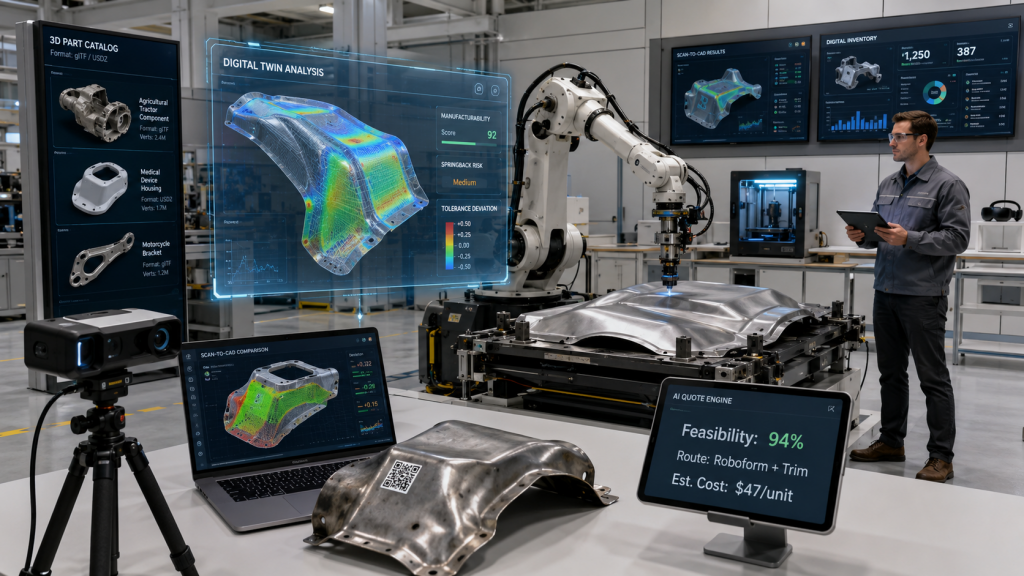
A new manufacturing ecosystem is emerging. It is not simply “3D printing,” “AI,” “robotics,” or “die-less forming.” It is the fusion of these technologies into a new design-and-production architecture: one where physical objects can be scanned, converted into data, modified in software, simulated, visualized in 3D space, produced without expensive fixed tooling, inspected by machines, and stored as reusable digital artifacts.
This shift matters because it changes who can design, who can manufacture, where products are made, how quality is verified, and how countries build industrial capacity. For developed economies, it opens a path toward selective local production without fully abandoning China’s logistics depth and manufacturing maturity. For the Global South, it offers a different route: adaptable, lower-volume, locally relevant production that can grow from repair, education, scanning, prototyping, and digital inventories before scaling into advanced manufacturing.Let me know if you want me to publish part 2: implementation and considerations
As usual references: Robotic foundry
| Document Name | Short Description |
| Discovery Robotic Foundry | A comprehensive exploration of how AI, scanning, XR, digital twins, and flexible manufacturing converge into a governed “Robotic Product Foundry” system. Covers the new manufacturing stack, human‑in‑the‑loop governance, global supply‑chain implications, and the concept of manufacturing intent. |
| Exploratory Strategic Map | A strategic overview of service opportunities emerging from AI, 3D scanning, additive manufacturing, and die‑less forming. Includes service models, industry readiness, stack architecture, and business directions for building a manufacturing‑intelligence layer. |
| People Skill Education | A workforce and education framework describing the new hybrid skills required for AI‑enabled manufacturing. Defines new roles, training layers, maturity timelines, risks, and human‑in‑the‑loop governance responsibilities. |
1. The new ecosystem: a digital thread, not a single technology
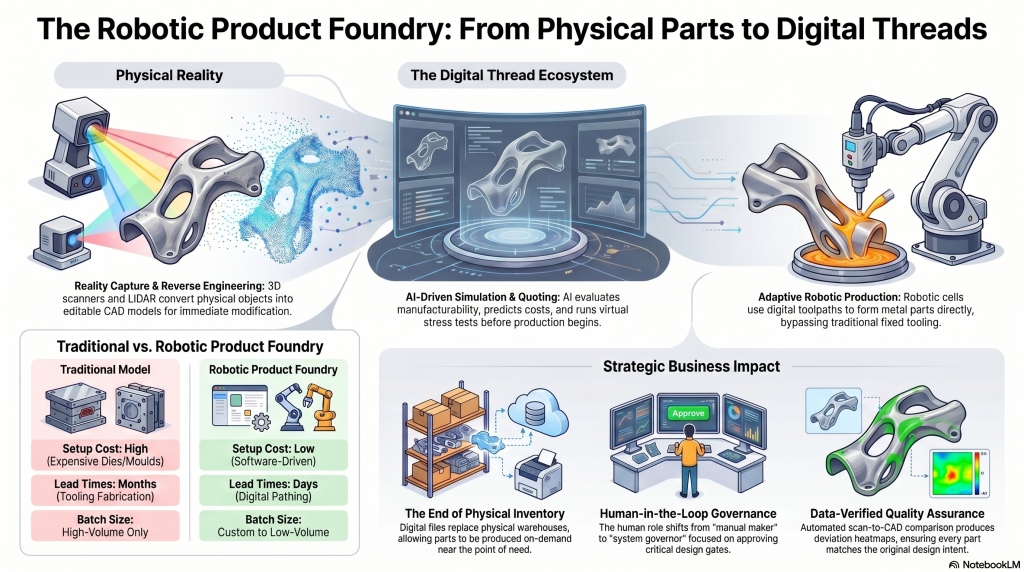
The central design is a digital thread: a continuous information path from idea to model, model to prototype, prototype to production, production to inspection, and inspection back into design. NIST describes digital-thread work as methods, protocols, tools, and product-definition standards that connect design, manufacturing, quality, and product support; it also notes that standards such as STEP, QIF, and MTConnect are part of the model-based enterprise foundation. (NIST)
The new ecosystem has eight connected layers:
| Layer | Technology | Function |
| Reality capture | 3D scanning, LiDAR, photogrammetry, metrology | Captures real products, spaces, defects, bodies, buildings, machines |
| Design intelligence | AI, generative design, CAD, simulation | Creates, modifies, evaluates, and optimizes product forms |
| 3D asset infrastructure | glTF, USD/OpenUSD, CAD, PLM, digital asset management | Stores objects as reusable digital artifacts |
| Visualization | AR, VR, mixed reality, web 3D, configurators | Lets users inspect, configure, teach, sell, and approve in 3D |
| Prototyping | FDM, resin, SLS/MJF, metal AM, CNC, laser/waterjet | Turns digital designs into testable objects |
| Flexible production | Robotic forming, die-less sheet forming, additive, CNC, hybrid cells | Produces parts without traditional high-cost dedicated tooling |
| Inspection and feedback | Scan-to-CAD comparison, CMM, machine vision, sensor telemetry | Validates actual output against design intent |
| Operations layer | MES, ERP, quote engines, supplier routing, digital inventory | Routes jobs, estimates cost, tracks quality, stores decisions |
This is why the change is structural. The factory is no longer only a place where designs are executed. It becomes a learning system.
2. Why die-less forming matters
Traditional stamping, moulding, and forming are powerful at scale, but they depend on expensive tooling. Machina Labs describes the problem directly: creating new dies or moulds can take months and cost millions, limiting fast design iteration and response to demand shifts. Its RoboCraftsman system integrates sheet-metal forming, trimming, scanning, and heat treating in a robotic cell, while RoboForming shapes sheet metal from digitally programmed toolpaths derived from CAD models. (machinalabs.ai)
This is the key shift:
| Traditional model | Emerging model |
| Design part → build tooling → produce part | Design part → simulate path → produce directly |
| High setup cost | Lower tooling burden |
| Best for high volume | Strong for low-volume, custom, urgent, replacement, or regional production |
| Hard to customize | Customization becomes economically plausible |
| Physical inventory | Digital inventory becomes possible |
Machina Labs’ 2025 Toyota pilot and Woven Capital investment show how close this is moving to mainstream industrial adoption. The pilot applies RoboForming to customized production body panels, with the goal of automotive-grade quality and throughput for low-volume manufacturing. (machinalabs.ai)
The limitation is also important: roboforming and incremental sheet forming still face accuracy, stiffness, springback, thinning, and process-control challenges. A 2024 Scientific Reports paper describes robot-assisted incremental sheet forming as highly flexible, especially for low-volume customization, but also notes geometric inaccuracy caused by machine compliance, tool deflection, and material springback. (Nature)
So this is not magic. It is a new manufacturing category moving from specialist use toward broader industrial reliability.
3. The role of 3D scanning and LiDAR
3D scanning and LiDAR are the bridge between the physical and digital worlds.
They allow companies to:
| Use case | Value |
| Reverse engineer legacy parts | Recreate components when no CAD exists |
| Build digital inventories | Store spare parts as digital records instead of physical stock |
| Customize products | Fit products to real vehicles, bodies, spaces, tools, or buildings |
| Inspect quality | Compare finished parts to CAD |
| Create digital twins | Connect real assets to virtual models |
| Estimate cost | Extract size, surface complexity, tolerances, and manufacturing risk |
| Train workers | Build accurate VR/XR learning environments |
Hexagon describes modern reverse engineering as measuring a physical object and building it as a digital 3D model, usually through 3D scanning, scan-processing software, and CAD modelling; it also notes that scanning can capture millions of points quickly, producing point clouds or polygon models that need scan-to-CAD processing. (blog.manufacturing.hexagon.com)
This means 3D scanning is not just documentation. It becomes a manufacturing input.
4. The VR, AR, and 3D-catalog layer
A major next step is the creation of three-dimensional catalogs.
Today, most product catalogs are images, PDFs, SKU tables, and CAD files buried in engineering systems. The emerging model is different:
A product becomes a living 3D artifact: viewable in VR, configurable in AR, manufacturable through CAD/CAM, inspectable through scan comparison, and storable as a digital twin or production-ready asset.
glTF is already positioned by Khronos as the “JPEG of 3D,” with glTF 2.0 released as ISO/IEC 12113:2022 and structured around scenes, nodes, cameras, meshes, buffers, materials, textures, skins, and animations. (The Khronos Group) OpenUSD is moving in parallel as a broader 3D composition and interchange standard; the Alliance for OpenUSD announced its Core Specification as an open standard for 3D content creation and interchange, aimed at interoperability across simulation, digital twins, and world-building. (The Alliance for OpenUSD (AOUSD))
This has large implications.
A company could store a catalogue of parts not as drawings, but as:
| Catalogue object | What it contains |
| Visual model | What the product looks like |
| Parametric model | What can be changed |
| Manufacturing model | How it can be made |
| Simulation model | How it behaves |
| Inspection model | How quality is verified |
| Commerce model | Price, configuration, availability |
| Rights model | Ownership, license, usage constraints |
| Lifecycle model | Version history, repairs, upgrades, field data |
This creates a market for virtual artifacts that are not merely decorative. Some will be sold for virtual worlds, games, training, or brand environments. Others will be sold as production-capable digital assets: “buy the artifact, configure it, preview it, and manufacture it later.”
Digital twins become the serious industrial version of this. NIST notes that digital-twin value depends on real-time, bidirectional data exchange and connection across the lifecycle. (NIST) NVIDIA’s Omniverse ecosystem points in the same direction, describing libraries and microservices for industrial digital twins, robotics simulation, OpenUSD-based interoperability, sensor simulation, physics, and real-time collaboration. (NVIDIA)
5. Thread, Matter, IoT, and connected products
There are two meanings of “thread” here.
First, there is the digital thread in manufacturing: the product-data chain that links design, production, inspection, and lifecycle support.
Second, there is Thread the IoT networking protocol. Thread is not central to robotic sheet-metal forming, but it matters for smart products, connected factories, home devices, distributed sensors, and future product-service systems. The Thread Group describes Thread as an open, IP-based, secure, low-power mesh networking protocol for smart homes that supports reliable communication, low-power sensors and locks, border routers, and Matter interoperability. (Thread Group)
Why does this matter here? Because more products will become:
- connected,
- configurable,
- sensorized,
- updateable,
- inspectable,
- linked to their digital twin.
A custom part may eventually carry a QR code, NFC tag, embedded sensor, or digital passport. The object and its digital record become inseparable.
6. Developed world: local quality versus China’s manufacturing maturity
For developed economies, the new ecosystem does not mean “bring everything home.” That is too simplistic. China’s manufacturing maturity, supplier density, tooling capacity, logistics networks, electronics ecosystem, and scale remain extremely difficult to replicate quickly.
The more realistic future is a hybrid production architecture:
| Product type | Likely best route |
| High-volume consumer goods | China or mature Asian supply chains remain strong |
| Custom, urgent, regulated, strategic, or low-volume parts | Local or regional digital manufacturing becomes more attractive |
| Replacement parts | Digital inventory plus local production |
| Premium quality goods | Local production with traceable quality and brand value |
| Complex electronics | China-linked supply chains remain hard to bypass |
| Industrial repair and maintenance | Local scan-to-produce workflows become valuable |
The World Economic Forum describes China’s current trajectory as an AI-augmented, green-energy-powered, self-reliance-oriented transformation of one of the world’s most formidable industrial bases; it also frames China’s industrial ecosystem as a global manufacturing force shaped by AI, robotics, EVs, solar, and state industrial strategy. (World Economic Forum)
So the developed-world question is not “China or local?” It is:
Which parts deserve local resilience, speed, traceability, customization, and quality control and which parts still benefit from China’s scale, logistics, and supplier maturity?
This creates a new role for developed-world manufacturers: not mass replication of everything, but selective sovereignty in strategic, customized, repair, advanced, and premium categories.
7. Global South: affordable, adaptable industrial growth
For the Global South, the opportunity is different. It is less about reshoring and more about capability building.
The high-end robotic cell is not the starting point. The starting point is:
| Stage | Affordable capability |
| 1 | Design literacy, CAD, repair culture, maker education |
| 2 | 3D scanning, reverse engineering, basic 3D printing |
| 3 | Local prototyping and spare-part development |
| 4 | Shared fabrication labs and technical schools |
| 5 | Regional supplier networks and digital inventories |
| 6 | CNC, sheet-metal, casting, finishing, QA |
| 7 | Advanced robotics, simulation, AI quoting, flexible cells |
UNIDO emphasizes that developing countries still face major industrial challenges in infrastructure, productive capacity, institutional capability, electricity, transport, telecoms, and digital infrastructure; it also argues that developing countries need to equip the workforce, especially in the Global South, to build the foundation for mastering new technologies and driving innovation.
The Global South opportunity is therefore not copying Silicon Valley factories. It is building practical, repair-oriented, locally relevant production capacity.
Best-fit applications include:
- agricultural equipment repair,
- motorcycle and transport parts,
- water-system components,
- medical device maintenance,
- local construction fittings,
- solar mounting hardware,
- small machine replacement parts,
- educational tooling,
- disaster-response fabrication,
- low-cost assistive devices.
The risk is a new digital divide: countries without reliable electricity, broadband, training, standards, finance, and maintenance capacity may buy tools without building ecosystems. The opportunity is to create shared infrastructure: regional scan labs, training centres, open manufacturing curricula, digital part libraries, and cooperative production hubs.
8. Education and usability
Education becomes the bottleneck.
This field needs hybrid workers:
| Role | Skill mix |
| Scan technician | 3D scanning, metrology, file cleanup |
| Product translator | Turns physical need into CAD and manufacturing route |
| AI manufacturing analyst | Uses AI to evaluate cost, risk, manufacturability |
| Digital twin builder | Links models, sensor data, and lifecycle data |
| XR product educator | Builds 3D training, VR manuals, virtual demos |
| Flexible cell operator | Runs robotic, additive, forming, and inspection workflows |
| Manufacturing data steward | Maintains versions, rights, specs, quality evidence |
A UK survey of advanced digital technologies found that cloud computing is widely adopted, AI adoption is moderate, and specialized technologies such as robotics and 3D printing are adopted less frequently; it also identifies high costs, skill shortages, security concerns, and integration challenges as common barriers.
This is why the user experience of the tools matters. The winning platforms will not simply be powerful. They will be teachable, explainable, modular, and safe.
9. Timeline of development
| Period | Development |
| 1980s–1990s | CAD/CAM, CNC, rapid prototyping, early 3D scanning, early digital manufacturing workflows |
| 2000s | Additive manufacturing becomes more accessible; reverse engineering grows in aerospace, automotive, and industrial maintenance |
| 2010–2015 | Industry 4.0, IoT, cloud platforms, digital twins, early connected factories |
| 2015–2020 | China’s industrial upgrading, collaborative robots, maker spaces, AM service bureaus, early AI design tools |
| 2020–2023 | Supply-chain shocks, reshoring debates, remote collaboration, digital inventory interest, stronger scanning and cloud-CAD workflows |
| 2024–2026 | AI copilots, physical AI, robotic forming pilots, OpenUSD/glTF momentum, XR training, smart factories, sensor-rich production cells |
| 2026–2030 | Likely growth of scan-to-manufacture services, AI quoting, 3D catalogs, digital product passports, regional microfactories |
| 2030+ | Possible mainstreaming of flexible production networks: certified digital inventories, robotic cells, distributed part manufacturing, virtual-to-physical commerce |
10. Is this specialized or mainstream?
It will become mainstream in layers, not all at once.
| Layer | Adoption path |
| AI design support | Mainstream quickly |
| 3D visualization and configurators | Mainstream in commerce, education, architecture, automotive |
| 3D scanning | Mainstream in repair, QA, design, construction, heritage, medical |
| 3D printing | Mainstream for prototyping, tooling, fixtures, low-volume parts |
| Die-less robotic forming | Specialist first, then strategic-industrial adoption |
| Digital twins | Mainstream in large firms, slower in SMEs |
| Full autonomous microfactories | Specialist for longer |
The overall field will not replace traditional manufacturing. It will sit beside it and take the jobs that traditional manufacturing handles poorly: low volume, high variety, urgent replacement, uncertain demand, customization, local fit, digital inventory, and rapid development.
11. PESTLE analysis
| Factor | Impact |
| Political | Industrial policy, reshoring incentives, defense needs, supply-chain security, China-plus-one strategies |
| Economic | Tooling costs, labor shortages, energy costs, inventory reduction, local production premiums |
| Social | Demand for customization, repair culture, maker education, local employment, trust in quality |
| Technological | AI, robotics, AM, 3D scanning, OpenUSD, glTF, digital twins, IoT, XR, sensor fusion |
| Legal | IP ownership of scanned parts, product liability, export controls, safety certification, data rights |
| Environmental | Less tooling waste, local production, lower inventory, but higher energy and material questions for some processes |
The strongest drivers are customization, supply-chain resilience, cost of tooling, speed to prototype, labor scarcity, sustainability pressure, and the need to convert physical assets into digital records.
12. Comparison with traditional design and production
| Question | Traditional design/manufacturing | New digital-flexible ecosystem |
| How does design start? | Sketch, CAD, market brief | Scan, AI generation, CAD, customer data, field need |
| How is feasibility checked? | Expert review, prototype, tooling quote | AI scoring, simulation, scan data, route comparison |
| How are prototypes made? | Model shop, machining, 3D print | 3D print, CNC, robotic forming, hybrid methods |
| How is production scaled? | Tooling, dies, molds, supply-chain setup | Digital files, robotic cells, partner networks |
| What is stored? | Inventory, drawings, files | Digital twins, production recipes, scan evidence |
| Who can participate? | Engineers and manufacturers | Designers, SMEs, educators, repair shops, local labs |
| Best for | High volume, stable demand | Custom, low-volume, urgent, adaptive, local, repair |
13. Cost and cost-benefit: what to look out for
The financial case is strongest when traditional tooling is expensive relative to volume.
Use the new tools when:
| Use new ecosystem when… | Use traditional tools when… |
| Volume is low or uncertain | Volume is high and stable |
| Customization matters | Standardization matters |
| Tooling cost is prohibitive | Tooling cost is amortized across many units |
| Speed matters | Unit cost matters above all |
| Legacy part has no CAD | Existing production data is complete |
| Local repair matters | Global supply is cheap and reliable |
| Design may change often | Design is locked |
| Inventory is expensive | Warehousing is cheap and predictable |
| Quality needs scan evidence | Conventional QA is enough |
Hidden costs include software licenses, training, scan cleanup, file repair, material testing, certification, finishing, QA, cybersecurity, data storage, and partner coordination. The mistake is buying hardware before proving demand.
Best first investment is usually capability-light: scanning, CAD, visualization, AI estimation, supplier network, and QA workflows. Heavy robotic cells should come later.
Companion specification: stakeholders, services, stack, and fused technologies
1. Stakeholder analysis
| Stakeholder | Pain points | Features they want |
| Product founders | Slow prototyping, no manufacturing knowledge, high tooling cost | Fast quote, manufacturability score, visual prototype, supplier route |
| SME manufacturers | Skills gap, old machines, inconsistent quoting, low digital maturity | Scan-to-CAD, AI quoting, simple job tracker, partner network |
| Designers | Ideas do not translate into manufacturable objects | Design-for-manufacture feedback, 3D visualization, material guidance |
| Automotive aftermarket | Custom panels and parts are expensive and slow | Vehicle scan, fit validation, configurable panels, low-volume production |
| Industrial maintenance teams | Obsolete parts, downtime, missing drawings | Reverse engineering, digital inventory, emergency production |
| Educators | Hard to teach modern production across tools | Curriculum, VR labs, low-cost scan/print workflows |
| Governments | Weak local industrial capacity, import dependency | Shared labs, workforce programs, digital manufacturing hubs |
| Global South entrepreneurs | Capital constraints, unreliable supply chains | Affordable scanning, repair-first workflows, shared fabrication access |
| Large manufacturers | Legacy systems, quality risk, integration complexity | Digital thread, PLM/MES integration, certified QA, digital twins |
| Customers | Cannot visualize custom products before purchase | AR/VR preview, configurators, transparent price and delivery |
2. Internal stack
| Stack layer | Function |
| Intake portal | Customer uploads photos, scans, CAD, requirements |
| File interpreter | Reads STL, OBJ, STEP, IGES, DXF, glTF, USD, point clouds |
| Geometry analyzer | Measures complexity, thickness, surface area, fit, tolerance |
| AI evaluator | Scores feasibility, risk, process route, cost range |
| Visualization engine | Renders, AR/VR preview, 3D configurator |
| Process router | Chooses print, CNC, forming, casting, stamping, hybrid |
| Quote engine | Estimates material, time, finishing, inspection, margin |
| Partner marketplace | Matches job to scanner, printer, forming shop, CNC, finisher |
| QA engine | Scan-to-CAD deviation, pass/fail, inspection record |
| Digital inventory | Stores production-ready files, metadata, revision history |
| Approval log | Records who approved concept, design, price, partner, production |
This aligns with a governed studio workflow: AI should propose, structure, compare, and prepare, while humans approve irreversible decisions such as design freeze, final pricing, partner choice, and publication or production release.
3. Service portfolio
| Service | Description |
| Scan-to-CAD Pack | Turn physical object into editable CAD and manufacturing files |
| Prototype Acceleration Sprint | Idea → CAD → prototype → scan QA → revision |
| Manufacturing Route Audit | Decide whether to use AM, CNC, die-less forming, stamping, molding, casting |
| Visualization + Estimate Pack | Render, configure, preview, and estimate product cost |
| Digital Inventory Buildout | Convert parts into searchable digital assets |
| Low-Volume Metal Development | Prepare custom metal parts for robotic forming or partner production |
| XR Training Lab | Build VR/AR training environments from CAD and scan data |
| Flexible Factory Roadmap | Plan phased adoption for SMEs or public-sector manufacturing hubs |
| Global South Repair Lab Kit | Education, scanning, 3D printing, repair workflows, local part libraries |
4. What happens when the technologies fuse?
The fused technology will look like a Manufacturing Intelligence Platform.
It will combine:
- 3D scanning,
- AI design review,
- CAD/CAM,
- simulation,
- VR/AR visualization,
- digital inventory,
- robotic forming,
- additive manufacturing,
- supplier routing,
- QA scanning,
- digital twin updates.
Possible names for the emerging category:
| Name | Meaning |
| Scan-to-Factory Platform | Physical object becomes production workflow |
| Adaptive Product Cloud | Products live as configurable digital objects |
| Digital Inventory OS | Companies store parts as data, not stock |
| Physical AI Manufacturing Stack | AI reasons about and controls physical production |
| Virtual-to-Physical Commerce | Customers buy configurable objects that can be virtual, physical, or both |
| Microfactory Operating System | Software layer for local, flexible manufacturing cells |
The most powerful version is this:
A user scans or selects a 3D object, modifies it in VR, receives an AI manufacturability and cost score, approves the design, routes it to the best local or global process, receives scan-verified quality evidence, and stores the final object as a reusable digital twin.
That is the new product-development architecture.
Conclusion
This ecosystem is not a single invention. It is a convergence: AI, 3D scanning, LiDAR, additive manufacturing, robotic die-less forming, VR/AR, digital twins, IoT protocols, 3D asset standards, cloud platforms, and supply-chain strategy are beginning to connect.
For developed economies, the opportunity is not full reshoring. It is selective local production where speed, quality, resilience, customization, repair, and strategic control justify the cost. China will remain central for many high-volume, mature, logistics-heavy categories, but local flexible manufacturing will become more valuable for premium, urgent, regulated, or customized products.
For the Global South, the opportunity is capability-first industrialization: repair, scanning, education, prototyping, local part libraries, shared labs, and gradually more advanced manufacturing. The danger is buying advanced machines without building skills, maintenance systems, standards, finance, and demand.
The future belongs to the organizations that can connect the whole chain: capture reality, structure it as data, visualize it in 3D, estimate it intelligently, manufacture it flexibly, inspect it digitally, and preserve it as a reusable artifact.
That is the new landscape: not just products, but living product systems.
Reference spine
- NIST — digital thread for manufacturing, model-based enterprise standards, and product-definition data. (NIST)
- NIST — digital twin definitions and the importance of real-time, bidirectional lifecycle connection. (NIST)
- Machina Labs — RoboCraftsman, RoboForming, AI robotics, Toyota pilot, Woven Capital investment, and die-less metal forming. (machinalabs.ai)
- Scientific Reports — technical opportunities and limitations of robot-assisted incremental sheet forming. (Nature)
- Hexagon — reverse engineering, scan-to-CAD, digital inventory, 3D scanning, LiDAR, and manufacturing applications. (blog.manufacturing.hexagon.com)
- Khronos — glTF as an ISO-standard 3D asset delivery format. (The Khronos Group)
- Alliance for OpenUSD — OpenUSD Core Specification for interoperable 3D content, simulation, and digital twins. (The Alliance for OpenUSD (AOUSD))
- Thread Group — Thread as an open, low-power, IP-based mesh protocol for connected products and Matter interoperability. (Thread Group)
- World Economic Forum — China’s AI-augmented manufacturing trajectory and current manufacturing transformation. (World Economic Forum)
- UNIDO — Global South industrial development, infrastructure, workforce, and digital capability requirements.
- UK Productivity Institute — adoption barriers and drivers for AI, cloud, robotics, IoT, 3D printing, and digital platforms.