Preamble
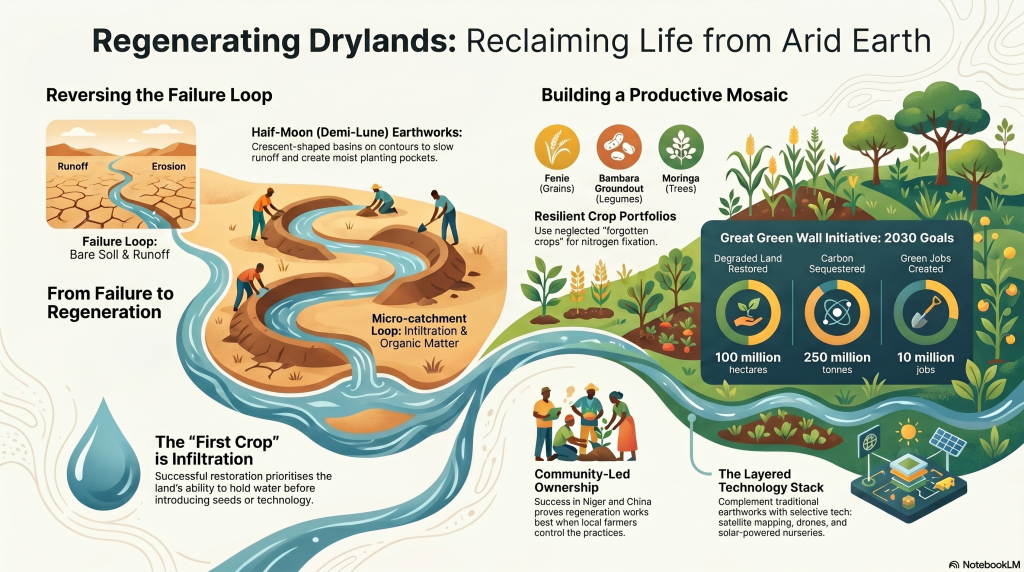
Drylands are often described as empty, marginal, or doomed. That framing is wrong. Many desert-edge and semi-arid regions are not lifeless; they are water-misaligned, soil-depleted, vegetation-broken landscapes where rainfall arrives too quickly, runs off too fast, and leaves too little behind. Regenerative dryland farming starts from a different premise: the first crop is not grain, fruit, or timber. The first crop is infiltration.
Half-moon planting, demi-lune bunds, zai pits, contour trenches, farmer-managed natural regeneration, drought-resilient crops, managed grazing, fog harvesting, recycled water, brackish-water crops, and solar-powered desalination are not separate ideas. They are parts of a wider dryland regeneration stack. At village scale, they help farmers capture occasional rain and rebuild soil. At landscape scale, they can restore watersheds, reduce erosion, support food security, create rural work, and, in limited cases, alter local microclimates. The Great Green Wall has moved in this direction: less a literal wall of trees, more a mosaic of productive, community-managed landscapes across the Sahel. The UNCCD states that the Great Green Wall aims by 2030 to restore 100 million hectares of degraded land, sequester 250 million tonnes of carbon, and create 10 million green jobs. (UNCCD)
The strategic opportunity is to combine low-cost local earthworks with modern science: satellite mapping, LiDAR micro-topography, drones, soil microbiome restoration, resilient indigenous crops, renewable energy, and carefully governed water infrastructure. The warning is equally clear: desert regeneration fails when it becomes spectacle—tree planting without water budgets, mega-projects without maintenance, desalination without brine management, groundwater extraction without recharge, or crop introduction without ecological safeguards.
Why dryland regeneration matters
Dryland regeneration matters because desertification is not only an environmental problem; it is a food, migration, security, employment, health, and sovereignty problem. In the food-system material attached, climate-adaptive agriculture and desert reclamation are framed as the “upstream engine” that can secure ingredient flows for resilient food systems, using drip irrigation, controlled environments, recycled and brackish water, precision agriculture, and half-moon bunds.
The same material identifies dryland crops such as cowpea, Bambara groundnut, moringa, fonio, cassava, millet, sorghum, neem, baobab, acacia, vetiver, and pigeon pea as candidates that can provide food, fodder, soil cover, nitrogen fixation, erosion control, nutrition, and income in harsh environments.
A serious dryland regeneration strategy should therefore pursue four outcomes at once:
- Water capture: slow runoff, increase infiltration, recharge shallow groundwater.
- Soil repair: rebuild organic matter, microbial life, aggregation, and nutrient cycling.
- Vegetation recovery: establish crops, grasses, shrubs, and trees suited to local rainfall.
- Livelihood generation: produce food, fodder, fuelwood, gums, oils, fibres, medicines, and market crops.
The core practice: half-moon planting and demi-lune bunds
Half-moons, also called demi-lunes or semi-circular bunds, are simple crescent-shaped earthworks built along contour lines. Their open side faces upslope, allowing runoff to flow into the basin. The curved bund slows water, traps sediment, concentrates organic matter, and creates a moist planting pocket. FAO describes demi-lunes as semi-circular structures placed on contour for water harvesting in semi-arid areas, with fertility improved when manure or compost is added. (FAOHome)
In the attached food-systems material, half-moon bunds are described as a traditional Sahelian rainwater-harvesting technique now used in Burkina Faso, Niger, Kenya, and Great Green Wall contexts to turn crusted degraded land into productive plots for cereals, fodder shrubs, and trees. The related process document describes the steps clearly: mark contours, break soil crust, dig shallow crescent basins, form earthen ridges, add compost or manure, plant drought-resistant crops or trees, and allow rare rainfall events to infiltrate rather than escape as destructive runoff.
FAO has also reported mechanized half-moon creation using the Delfino plough, which creates large catchments ready for seeds and seedlings and can make soil more permeable than manual digging alone. (FAOHome) TAAT describes demi-lunes as simple rainwater-harvesting pits commonly around 2–3 metres in diameter and 15–30 centimetres deep, though sizes vary by soil, slope, rainfall, labour, and intended crop. (e-catalogs.taat-africa.org)
The principle is powerful because it reverses the dryland failure loop:
Bare soil → runoff → erosion → less infiltration → less vegetation → hotter soil → more runoff
Half-moons create the opposite loop:
Micro-catchment → infiltration → vegetation → organic matter → cooler soil → more infiltration
From half-moons to whole landscapes
Half-moons alone are useful, but they become transformative when combined with other water and soil practices.
| Methodology | Best use case | Benefits | Constraints / failure points |
| Half-moon planting / demi-lunes | Degraded crusted drylands, Sahelian farms, slopes | Captures runoff, improves infiltration, supports cereals, legumes, shrubs, trees | Labour-intensive unless mechanized; fails if poorly aligned to contour |
| Half-moon ponds / micro-basins | Slight depressions, community plots, orchard establishment | Stores short rainfall pulses, supports tree establishment | Mosquito/pest risk if water stagnates; needs drainage design |
| Zai pits / planting basins | Hardpan soils, smallholder fields | Concentrates compost, seeds, and water | Labour-intensive; needs organic matter supply |
| Contour bunds / stone lines | Sloping land, erosion-prone fields | Slows runoff, traps sediment | Requires correct contour layout and maintenance |
| Check dams / gully plugs | Seasonal streams, gullies | Recharges groundwater, reduces erosion | Can fail in extreme floods if under-engineered |
| Farmer-managed natural regeneration | Areas with living rootstock | Low-cost tree regeneration, fodder, fuel, shade | Requires grazing control and tree tenure rights |
| Agroforestry belts | Farms exposed to wind and heat | Shade, mulch, nitrogen fixation, diversified income | Wrong species can compete for water |
| Vetiver contour hedges | Erosion channels and slopes | Deep roots stabilize soil; low spread risk | Not a food crop; needs establishment phase |
| Drip irrigation | High-value crops, orchards, nurseries | Efficient water delivery, lower evaporation | Requires filters, maintenance, capital |
| Hydroponics / aeroponics | Sandy or poor soils, peri-urban desert agriculture | Soil-free production, high water efficiency | Energy, nutrient, technical, and market dependency |
| Fog harvesting | Coastal deserts, high-fog mountains | Passive water source for nurseries or greenhouses | Highly site-specific; not universal |
| Treated wastewater reuse | Near towns and cities | Reliable non-freshwater irrigation source | Requires safety protocols and public trust |
| Brackish-water crops | Saline aquifers or coastal margins | Uses water unsuitable for conventional crops | Salt accumulation must be managed |
| Solar/wind desalination | Coastal deserts with renewable energy | Can support nurseries, orchards, controlled agriculture | Brine, energy, cost, governance, and ecological risks |
The crop layer: what to plant after water is slowed
The wrong crop can turn restoration into failure. The right crop can turn an earthwork into a productive ecosystem.
The attached “Revitalizing Forgotten Crops” framework argues that neglected and underutilized crops matter because many evolved in marginal environments, require fewer inputs, restore soil, diversify diets, and support food sovereignty. It notes that Bambara groundnut can produce protein-rich yields with minimal inputs where soy may require irrigation and amendment, while fonio matures quickly on poor sandy soils.
| Crop / species | Role in dryland regeneration | Benefits | Cautions |
| Pearl millet | Staple grain for hot dry zones | Drought-tolerant, food security | Market development needed in some regions |
| Sorghum | Grain, fodder, biomass | Heat-tolerant, useful residue | Bird pressure and processing constraints |
| Fonio | Fast-maturing ancient grain | 6–8 week maturity noted in attached material; erosion control | Labour and processing bottlenecks |
| Cowpea | Food legume and soil builder | Protein, nitrogen fixation, dryland fit | Pest pressure can be high |
| Bambara groundnut | Protein and ground cover | Grows where other legumes struggle; nitrogen fixation | Under-researched; seed systems weak |
| Pigeon pea | Food, fodder, hedge | Deep roots, nitrogen fixation, windbreak | Needs market and culinary acceptance |
| Moringa | Leaf nutrition, oil, water clarification | Fast-growing, low water needs, multi-use | Over-commercialization risk |
| Neem | Pest management, shade, medicinal uses | Natural insecticidal properties | Ecological fit must be assessed |
| Acacia species | Soil stabilization, gum, fodder | Nitrogen fixation, deep roots | Species selection is critical |
| Baobab | Food, shade, cultural value | Fruit powder, leaves, drought resilience | Slow establishment |
| Vetiver | Erosion control | Deep roots, contour stabilization | Non-food; best as support species |
| Saltbush / Salicornia / sea beans | Saline systems | Brackish-water and saline-soil use | Market and salinity-management constraints |
The attached crop framework also warns that cross-regional crop transfer must be screened for invasiveness, contamination, genetic spillover, seed sovereignty, and ecological fit before pilots scale.
Animals: a restoration tool or a destruction engine
Animals are neither automatically regenerative nor automatically destructive. In drylands, livestock management is decisive.
Used poorly, goats, sheep, cattle, and camels can strip seedlings, compact soil, and destroy young restoration sites. Used well, they provide manure, income, protein, transport, seed dispersal, and controlled vegetation cycling.
The practical model is not “more animals” but right animals, right density, right season, right movement. Restoration zones often need temporary exclusion during seedling establishment, followed by controlled rotational grazing. Livestock corridors, fodder banks, living fences, cut-and-carry systems, and community grazing agreements are as important as planting.
Lessons from the Great Green Wall
The Great Green Wall is important because it shifted the global imagination from “desert as inevitable” to “drylands as restorable.” But its own evolution shows what works and what fails.
The original public image was often a giant line of trees across Africa. The more useful model is now a mosaic: farms, rangelands, watersheds, agroforestry, community nurseries, seed systems, women’s cooperatives, small enterprises, and restoration economies. The attached Part 6 material describes the Great Green Wall as an integrated framework for food security, climate adaptation, job creation, species diversity, local ownership, and benefit-sharing.
Progress has been real but uneven. UNCCD’s Great Green Wall Accelerator says almost 18 million hectares had been restored and 350,000 jobs created across participating countries, while acknowledging challenges. (UNCCD) Reuters reported in 2024 that the initiative was only around 30% complete and likely to miss the 2030 target, with funding, coordination, monitoring, and conflict among the major constraints. (Reuters)
The lesson is not that the Great Green Wall has failed. The lesson is that tree-counting is not restoration. Survival, water balance, soil carbon, farmer income, fodder availability, women’s labour burden, land rights, and long-term maintenance matter more than ceremonial planting days.
Lessons from China, India, and other dryland restoration examples
China’s Loess Plateau is one of the best-known examples of large-scale degraded-land restoration. The World Bank describes it as an effort to restore one of the world’s most erosion-prone landscapes into sustainable agricultural production. (World Bank) A restoration lessons paper reports that World Bank and Chinese government funding helped restore around 4 million hectares, more than double local farmer incomes, reduce erosion by around 100 million tonnes of sediment annually, reduce flood risk, and increase grain production. (press-files.anu.edu.au)
India offers a different lesson: decentralized water harvesting can revive local hydrology. World Bank work on watershed development in India emphasizes rainwater harvesting, storage, and watershed approaches in rainfed regions. (World Bank) In Rajasthan, Tarun Bharat Sangh reports thousands of rainwater harvesting structures and multiple river rejuvenation efforts, while independent summaries describe johads—small earthen water-harvesting structures—as central to groundwater recharge and rural water recovery. (CEEW)
Niger’s farmer-managed natural regeneration is another critical model. The NDC Partnership notes that FMNR has encouraged reforestation on over 5 million hectares and succeeded partly by learning from earlier failed government interventions. (ndcpartnership.org) World Agroforestry similarly describes southern Niger’s re-greening as involving tens of thousands of farmers and around 5 million hectares of once-degraded farmland. (worldagroforestry.org)
The shared pattern: regeneration succeeds when communities control the practice, when water and vegetation are managed together, and when restoration produces visible livelihood benefits.
Mega-scale water ideas: artificial rivers, aquifers, and desalination
The user’s prompt rightly raises a provocative possibility: many desert regions sit above aquifers, face oceans, receive fog, or experience occasional intense rainfall. Could large-scale engineering reconnect water to land?
Yes, but with limits.
Artificial rivers and large water-transfer schemes can create agricultural zones, but they are high-risk if they rely on fossil groundwater, politically contested river diversions, or energy-heavy pumping. Libya’s Great Man-Made River is often cited as a spectacular example of moving fossil groundwater from deep aquifers to coastal cities and farms; however, fossil aquifer water is essentially non-renewable on human timescales, so extraction can become water mining rather than regeneration. (The Guardian) Egypt’s Toshka/New Valley-style projects show the attraction and difficulty of moving water into desert agriculture; NASA describes Toshka as designed to support new agricultural development away from the Nile Valley, while USGS notes that the project relies on Nile water. (NASA Science)
Desalination has a role, especially in ocean-facing deserts with strong solar or wind resources, but it is not a free pass. UNEP warns that desalination produces brine and chemical discharge that can harm marine ecosystems if not properly managed; it notes that many processes create roughly 1.5 litres of brine for every litre of potable water. (UNEP – UN Environment Programme) The attached “mega desal” concept imagines a renewable-powered desalination tower with solar, wind, gravity-fed systems, atmospheric water generation, and brine treatment, but such a design should be treated as an experimental infrastructure concept requiring feasibility testing, environmental review, and staged deployment, not as a ready solution.
Fog harvesting is more modest but promising in specific coastal deserts. Research in the Atacama Desert has examined combining fog harvesting with hydroponic greenhouse vegetable production. (MDPI) Reuters reported 2025 Atacama experiments using mesh fog-capture systems to grow lettuce and lemons, with collected water stored for hydroponics. (Reuters)
The better framing is:
Use mega-water only where it supports regenerative water budgets, not where it enables endless expansion into unsuitable land.
Research and evidence table
| Research / case | What it shows | Transferable lesson | Confidence |
| FAO demi-lunes | Half-moons capture water in semi-arid areas and improve fertility with compost/manure | Low-tech water harvesting can support smallholders | High |
| FAO Delfino half-moon mechanization | Mechanized catchments can speed restoration and improve permeability | Labour bottleneck can be reduced | Medium |
| Great Green Wall / UNCCD | Ambitious restoration, carbon, and jobs target; progress but uneven delivery | Restoration must be monitored beyond pledges | High |
| Loess Plateau, China | Large-scale erosion control and livelihood improvement | Landscape restoration can work with policy, incentives, and watershed planning | High |
| Rajasthan johads, India | Traditional water harvesting can revive local water systems | Decentralized recharge can outperform purely centralized water supply | Medium |
| Niger FMNR | Farmer-led regeneration can restore millions of hectares | Existing root systems and farmer rights matter | High |
| Atacama fog harvesting | Fog can support greenhouse/hydroponic production in suitable zones | Atmospheric water is site-specific, not universal | Medium |
| Forgotten crops framework | Dryland crops can provide nutrition, soil cover, and income | Crop portfolios should be locally screened and market-linked | Medium |
| Desalination studies / UNEP | Desalination expands water supply but creates brine and energy risks | Use only with brine, energy, and ecological safeguards | High |
PESTLE considerations
| Dimension | Key considerations |
| Political | Land tenure, grazing rights, cross-border water agreements, conflict zones, Great Green Wall coordination, local government legitimacy |
| Economic | Farmer labour cost, market access, crop processing, carbon finance, restoration jobs, insurance, equipment finance, maintenance budgets |
| Social | Community consent, women’s labour burden, pastoralist-farmer relations, youth employment, indigenous knowledge, food culture |
| Technological | GIS, LiDAR, drones, soil sensors, drip irrigation, solar pumps, seed banks, desalination, fog nets, AI monitoring |
| Legal | Water rights, seed laws, plant variety protection, environmental permitting, brine discharge regulation, land-use zoning |
| Environmental | Rainfall variability, aquifer recharge rates, salinity, invasive species, biodiversity, soil carbon, erosion, heat stress, pest dynamics |
Gap analysis
| Gap type | Gap | Why it matters | Uncertainty |
| Capability | Many communities lack trained contour mapping, nursery, seed-saving, soil testing, and maintenance capacity | Badly built earthworks fail or wash out | KK |
| Dependency | Restoration depends on land rights, grazing agreements, seed access, compost/manure supply, and local institutions | Without these, adoption collapses after pilots | KK |
| Economic | Benefits such as carbon, erosion control, aquifer recharge, and biodiversity are not always monetized | Farmers may abandon restoration if food/income gains are delayed | KU |
| Regulatory | Water transfer, desalination brine, wastewater reuse, seed movement, and introduced species face complex approval paths | Delays or non-compliance can stop scale-up | KK |
| Behavioral | Farmers may reject crops seen as “poor people’s food” or practices that increase labour without quick payoff | Social acceptance is as important as agronomy | KU |
Unknown unknowns: climate volatility, conflict, pest shifts, extreme rainfall events, political instability, and market shocks can change outcomes in ways that pilot designers may not anticipate. That is the UU zone and a reason to test before scaling.
What has failed before
| Failure pattern | Example / context | Lesson |
| Tree planting without survival systems | Some Great Green Wall efforts criticized for low long-term ecological impact and weak monitoring | Count surviving ecosystems, not planted seedlings |
| Mega-water without water budgets | Fossil aquifer extraction and large artificial-river schemes | Non-renewable groundwater is not regeneration |
| Desalination without brine strategy | Conventional coastal desalination | Brine and chemical discharge must be treated or dispersed safely |
| Crop introduction without ecology screening | Poorly governed species transfer | Screen for invasiveness, pests, genetic contamination, and market fit |
| Top-down restoration | Prior failed government programs in drylands | Farmers need rights, incentives, and local control |
| Irrigation without salinity management | Desert irrigation schemes | Drainage and salt balance are non-negotiable |
| Pilot without market linkage | Forgotten crops grown without buyers or processing | Build value chains before scaling acreage |
Opportunities
The opportunity is not merely to “green the desert.” It is to build regenerative dryland economies.
These could include:
- Local contracting teams that build half-moons, stone lines, bunds, and check dams.
- Community nurseries for acacia, moringa, baobab, neem, fruit trees, and fodder shrubs.
- Dryland crop cooperatives producing millet, sorghum, fonio, cowpea, Bambara, moringa powder, gum arabic, oils, and animal feed.
- Solar-powered seed banks and cold-chain micro-hubs.
- Drone and satellite monitoring services for restoration verification.
- Carbon, biodiversity, and water-benefit finance where governance is credible.
- Fog-water nurseries in coastal deserts.
- Treated wastewater and brackish-water agriculture for non-leafy crops, tree crops, fibre crops, and salt-tolerant species.
- Diaspora-linked ingredient supply chains, as suggested in the attached food-systems work, where reclaimed landscapes feed traceable food products, herbal platforms, hot sauces, beverages, and climate-resilient food ventures.
Practical way forward
A credible programme should not start with a mega-project. It should start with a portfolio of test landscapes.
Phase 1: Diagnose
Map rainfall, slopes, soil crusting, erosion channels, existing vegetation, groundwater, land tenure, grazing routes, and community priorities. Use satellite imagery, local knowledge, and simple field surveys.
Phase 2: Build micro-catchments
Start with half-moons, zai pits, stone lines, contour bunds, check dams, and protected regeneration areas. Establish test plots across soil types and slopes.
Phase 3: Plant mixed portfolios
Use a layered design: annual grains and legumes for food, ground covers for erosion, shrubs for fodder, trees for shade and income, and boundary species for wind protection.
Phase 4: Add technology only where it solves a constraint
Use drip irrigation for nurseries and high-value crops; drones for monitoring; solar pumps where groundwater recharge is understood; fog harvesting only in proven fog zones; desalination only for coastal pilots with brine and energy controls.
Phase 5: Link restoration to income
Farmers need near-term benefits. Build markets for grains, legumes, fodder, gums, oils, seedling sales, compost, carbon payments, eco-restoration services, and food processing.
Phase 6: Scale by watershed, not by publicity
Scale where survival rates, infiltration, soil organic matter, crop yields, income, and community governance are proven.
Risk log
| Risk | Likelihood | Impact | Mitigation |
| Poor rainfall after planting | High | High | Stagger planting, use drought-resilient species, prioritize water harvesting before trees |
| Earthworks fail in storms | Medium | High | Proper contour design, spillways, maintenance training |
| Overgrazing destroys seedlings | High | High | Community grazing agreements, fencing, fodder plots |
| Labour burden too high | High | Medium | Mechanize where possible, pay restoration crews, use food/cash-for-work carefully |
| Wrong species introduced | Medium | High | Ecological screening, native-first policy, trial plots |
| Salinity buildup | Medium | High | Drainage, salt monitoring, crop selection, avoid over-irrigation |
| Desalination brine damage | Medium | High | Brine treatment, regulated discharge, mineral recovery where viable |
| Fossil aquifer depletion | Medium | Very high | Recharge accounting, extraction caps, avoid non-renewable water dependency |
| Elite land capture | Medium | High | Land-rights protections, community benefit-sharing, transparent governance |
| Carbon-credit overpromising | Medium | Medium | Conservative baselines, independent verification, farmer-first contracts |
| Market failure for new crops | Medium | High | Pre-arranged buyers, processing, local consumption first |
| Conflict and insecurity | Variable | Very high | Local risk assessment, avoid fragile zones without trusted partners |
Conclusion
Dryland regeneration is not fantasy, but it is not magic. The most credible path is neither a purely traditional approach nor a purely technological one. It is a layered system: half-moons and contour bunds to hold water; compost, mulch, biochar, and microbes to rebuild soil; resilient crops and agroforestry to produce food and cover; managed grazing to cycle nutrients; and selective technology to monitor, irrigate, process, and finance what works.
The Great Green Wall shows the ambition. Niger’s farmer-managed regeneration shows the power of local ownership. China’s Loess Plateau shows that large-scale restoration can shift erosion and livelihoods when policy, incentives, and watershed design align. India’s johads show that small water structures can revive local hydrology. Fog harvesting, brackish agriculture, and renewable desalination show that new water sources can help—but only when governed within ecological limits.
The central rule is simple:
Do not bring water to bad land management. First change the land’s ability to receive, hold, and multiply water.
Way forward decision
TEST: proceed through staged pilots, not immediate mega-scale rollout. Start with 3–5 representative dryland zones, compare half-moons, zai pits, contour bunds, FMNR, drip-supported nurseries, and resilient crop portfolios, then scale only where water balance, farmer income, survival rates, and governance are proven.
Appendices: Novel Ideas for Regenerative Dryland Food Systems
Appendix A — Novel Concept Portfolio
Regeneration should be treated as systems engineering, not as isolated farming, tree planting, or technology deployment. The guiding sequence remains: fix the water cycle first, then soil, then vegetation, then livelihoods.
| Novel idea | Core concept | Best-fit geography | Value created | Main caution |
| Solar nursery islands | Small solar-powered nursery clusters using AWG, fog nets, rain tanks, and shade structures | Coastal deserts, Sahelian towns, refugee-edge zones | Seedling survival, local jobs, restoration inputs | Do not use AWG where humidity is too low |
| Water-bridge restoration | Temporary AWG/fog/rainwater systems used only during the first 12–24 months of tree and crop establishment | Degraded drylands with restoration potential | Helps seedlings survive until soil-water systems mature | Must not become permanent dependency |
| Hybrid water capture nodes | Fog mesh + solar AWG + rain tanks + greywater treatment feeding one micro-farm or nursery | Fog corridors, mountain drylands, peri-urban arid zones | Multi-source water resilience | Site selection must be evidence-based |
| Half-moon crop laboratories | Experimental plots testing crop mixes inside half-moon basins | Sahel, Horn of Africa, Rajasthan, dry Mediterranean margins | Identifies best crop-soil-water combinations | Requires careful data capture |
| Brackish-water crop belts | Use saline/brackish water for salt-tolerant crops and biomass | Coastal deserts, saline basins | Productive use of marginal water | Salt accumulation and drainage risks |
| Mobile restoration crews | Local youth teams trained to build half-moons, zai pits, contour bunds, check dams, and nursery systems | Any restoration zone | Employment + technical capacity | Requires steady project pipeline |
| Regenerative food processing hubs | Local processing for millet, sorghum, Bambara, moringa, baobab, gums, oils, sauces | Near restored production zones | Converts restoration into income | Market linkage must precede scale |
| Fog-fed greenhouse belts | Fog collectors feeding hydroponic or protected cultivation systems | Atacama-like coastal deserts, fog mountains | High-value vegetables/herbs with low freshwater demand | Only viable in proven fog corridors |
| AWG seed-bank stations | Solar atmospheric water generation supporting seed banks, mother trees, and experimental plots | High-solar, moderate-humidity regions | Protects genetic resources and nursery continuity | Maintenance and unit economics |
| Restoration-as-a-service cooperatives | Community cooperatives paid to restore land, maintain vegetation, and monitor outcomes | Great Green Wall zones, watershed programmes | Carbon, biodiversity, jobs, land repair | Needs transparent benefit-sharing |
| Diaspora-linked dryland ingredient chains | Restored landscapes supply traceable crops into diaspora food, beverages, herbal, and plant-forward markets | Africa–diaspora trade corridors | Premium demand, cultural value, farmer income | Avoid over-commercializing heritage crops |
| Water-rights zoning | Classify areas into restoration-only, mixed-use, and intensive-water zones | Any water-stressed dryland | Prevents water mining disguised as development | Requires political legitimacy |
Appendix B — Solar Atmospheric Water Generation and Fog Harvesting Addendum
Atmospheric water and fog harvesting should be treated as complementary tools, not primary foundations. The foundation remains rainfall capture through half-moons, zai pits, contour bunds, check dams, and FMNR.
Water-source hierarchy
| Tier | Water source | Role in regeneration | Use when | Avoid when |
| 1 | Rainfall capture | Base water budget, infiltration, recharge, erosion control | Rainfall events occur, even if irregular | Never skip this layer |
| 2 | Treated wastewater / greywater | Reliable non-freshwater irrigation | Near settlements, camps, processing hubs | No treatment, monitoring, or social licence |
| 3 | Brackish water | Marginal-water production | Salinity can be monitored and drainage managed | Drainage is poor or salt will accumulate |
| 4 | Fog harvesting | Nursery, greenhouse, drinking-water supplement | Proven fog corridors | Interior drylands without reliable fog |
| 5 | Solar AWG / AWH | Point-of-use water for nurseries, seed banks, emergency supply | Strong solar resource + adequate humidity + maintenance capacity | Ultra-dry air, weak maintenance systems |
| 6 | Renewable desalination | Strategic water for coastal deserts | Strong renewables + brine governance | Brine plan absent or fossil groundwater extraction is hidden underneath |
Design principle: external water should accelerate establishment; it should not excuse poor land hydrology.
Appendix C — Novel Pilot Models
Pilot 1: Infiltration-First Restoration Village
Concept: A village-scale pilot combining half-moons, zai pits, stone lines, FMNR, dryland crops, and community grazing rules.
Core package:
Half-moons + compost + millet/sorghum + cowpea/Bambara + moringa/acacia/baobab + managed grazing.
Success metrics:
Seedling survival, infiltration rate, soil organic matter, crop yield, fodder availability, household income, women’s labour burden.
Decision: Test before scale.
Pilot 2: Solar Nursery Island
Concept: A solar-powered nursery hub that raises drought-resilient seedlings for surrounding half-moon and agroforestry plots.
Water stack:
Rain tank + greywater + solar AWG where suitable + fog mesh where suitable.
Outputs:
Seedlings, grafted trees, fodder shrubs, mother-tree banks, seed-saving, youth employment.
Best use:
Establishment phase for landscape restoration.
Critical risk:
AWG must be gated by humidity, maintenance capacity, and litres-per-day economics.
Pilot 3: Fog-to-Food Coastal Desert Cluster
Concept: In coastal deserts with reliable fog, combine mesh fog collectors with protected cultivation, nurseries, and hydroponic demonstration plots.
Outputs:
Leafy greens, herbs, seedlings, local training, climate-resilient agriculture tourism or research.
Best use:
Atacama-like fog corridors, coastal mountain deserts, hyper-arid zones with persistent fog.
Critical risk:
Fog systems fail if copied into non-fog landscapes.
Pilot 4: Dryland Ingredient Export Corridor
Concept: Link restored dryland farms to local processing and diaspora/global food markets.
Crop candidates:
Millet, sorghum, fonio, Bambara groundnut, cowpea, moringa, baobab, tamarind, gum arabic, desert herbs.
Outputs:
Flours, porridges, snacks, sauces, herbal teas, functional beverage bases, plant-forward protein products.
Why it matters:
Restoration survives when farmers earn from it. The attached persona framework emphasizes that food is not only nutrition; it is sovereignty, memory, diaspora identity, and market opportunity.
Pilot 5: Regeneration Data Commons
Concept: A shared digital system tracking restoration outcomes across pilot landscapes.
Data captured:
Rainfall, infiltration, soil moisture, vegetation survival, crop performance, grazing pressure, AWG/fog output, maintenance events, income effects.
Users:
Farmers, cooperatives, NGOs, research institutions, donors, local governments.
Critical safeguard:
Data ownership and benefit-sharing must be community-governed.
Appendix D — Novel Technology Stack
| Technology | Role | Where it fits | Risk filter |
| Solar AWG / AWH | Establishment water for nurseries, mother trees, seed banks | High solar + moderate humidity zones | Reject where litres/day are uneconomic |
| Fog mesh | Passive water capture | Coastal/mountain fog corridors | Reject without fog-frequency data |
| Low-cost soil sensors | Monitor moisture and salinity | Pilot plots, brackish-water zones | Avoid vendor lock-in |
| Drone mapping | Map contour lines, erosion, survival | Landscape planning and monitoring | Needs local operator training |
| Satellite vegetation index | Track greening and degradation | Programme-level monitoring | Ground-truth results |
| Solar cold rooms | Preserve seedlings, produce, seeds | Processing hubs and nurseries | Needs maintenance model |
| Micro-drip kits | High-value crops and seedlings | Nurseries and controlled plots | Filters and spare parts required |
| Biochar kilns | Soil carbon and water-holding support | Where biomass residues exist | Avoid deforestation for feedstock |
| Composting / biogas | Circular nutrient system | Villages, livestock areas | Needs feedstock and training |
| Mobile processing units | Convert crops into saleable products | Early-stage value chains | Demand must be validated |
Appendix E — Novel Financing Models
| Model | How it works | Best-fit stage | Key risk |
| Restoration contracting | Local crews paid per verified earthwork, seedling, or hectare restored | Pilot to scale | Poor verification |
| Seedling enterprise | Community nurseries sell seedlings to farms, NGOs, government programmes | Early stage | Demand volatility |
| Water-service cooperative | Community manages AWG/fog/greywater systems and charges affordable tariffs | Where water nodes exist | Elite capture or tariff disputes |
| Ingredient offtake contracts | Buyers commit to dryland crops before planting | Crop scale-up | Buyer default |
| Carbon + biodiversity finance | Payments tied to verified restoration outcomes | Later stage | Delayed payments and methodology risk |
| Diaspora pre-order model | Diaspora consumers pre-buy dryland products | Market validation | Quality and logistics |
| Blended finance | Grants de-risk infrastructure; loans/equity fund enterprises | Landscape scale | Governance complexity |
Appendix F — Screening Criteria for Novel Ideas
Before any novel dryland idea is deployed, screen it against five gates.
| Gate | Question | Pass condition |
| Water gate | Does the idea improve the local water budget? | Increases infiltration, reuse, recharge, or efficient productive use |
| Soil gate | Does it improve soil structure, biology, or cover? | Builds organic matter, reduces erosion, protects topsoil |
| Livelihood gate | Does it create income or reduce household risk? | Farmers or communities see benefits within 1–3 seasons |
| Governance gate | Who owns, maintains, and benefits from it? | Community consent, clear rights, benefit-sharing |
| Ecological gate | Could it create harm? | Screened for salinity, invasiveness, depletion, pollution, overgrazing |
Appendix G — Novel Ideas Risk Log
| Risk | Applies to | Impact | Mitigation |
| AWG overpromised in low-humidity zones | Solar AWG | High | Climate suitability testing before purchase |
| Fog systems copied into non-fog sites | Fog harvesting | High | Minimum 12-month fog monitoring or validated local data |
| Water technology distracts from infiltration | AWG, desalination, pumps | High | Make earthworks mandatory first layer |
| Brackish irrigation salinizes land | Brackish crops | Very high | Drainage, salt monitoring, salt-tolerant species |
| Desalination creates brine damage | Coastal desalination | Very high | Brine treatment, regulated discharge, mineral recovery |
| Crop commercialization harms local food access | Dryland ingredient chains | Medium–High | Local food-first allocation and fair pricing |
| Pilot becomes donor-dependent | All pilots | High | Early revenue streams: seedlings, crops, processing |
| Community loses control | Data, carbon, water systems | High | Cooperative governance and transparent contracts |
| Equipment fails after donor exit | AWG, pumps, sensors | High | Local repair training, spare parts, maintenance fund |
| Grazing destroys restoration | Tree/crop pilots | High | Grazing agreements, fodder banks, protected zones |
Appendix H — Updated Way Forward
The strongest updated model is a 3–5 landscape test portfolio.
Each test site should include:
- Infiltration base layer
Half-moons, zai pits, contour bunds, stone lines, check dams, FMNR. - Crop and tree portfolio
Millet, sorghum, cowpea, Bambara, fonio, moringa, baobab, acacia, vetiver, pigeon pea. - One niche water technology only where justified
Fog harvesting, solar AWG, brackish water, treated wastewater, or renewable desalination. - Local enterprise model
Seedling sales, dryland crop processing, fodder, gums, oils, sauces, herbal products, restoration services. - Governance system
Land rights, grazing agreements, water-use rules, cooperative ownership, benefit-sharing, data rights. - Evidence dashboard
Litres captured, infiltration change, vegetation survival, soil carbon, crop yield, income, maintenance cost, failure rate.
Decision: TEST. These novel ideas are promising as a portfolio, but they should be piloted under strict water, ecology, governance, and economic gates before any scale claim is made.
Abbreviations & Uncertainty Tags
AWG / AWH: Atmospheric Water Generation / Atmospheric Water Harvesting.
FMNR: Farmer-Managed Natural Regeneration.
PESTLE: Political, Economic, Social, Technological, Legal, Environmental.
FAO: Food and Agriculture Organization of the United Nations.
UNCCD: United Nations Convention to Combat Desertification.
GIS: Geographic Information System.
AI: Artificial Intelligence.
KK: Known known — evidence is relatively established.
KU: Known unknown — issue is visible, but local data is needed.
UU: Unknown unknown — risks may emerge only during pilots or shocks.