Preamble: Why writers, designers and public bodies need a reverse route into speculation
Science fiction is often judged by a question that is too small. Did it predict the thing? A communicator, a tablet, a living room screen that talks back. The more useful question comes earlier. How did anyone learn to imagine the thing well enough to make it part of a story, a policy, a design brief or a public argument?
That is the missing half of the science-fiction-to-reality conversation. Stories can help turn a possibility into a shared object of attention. But stories themselves do not appear from empty space. They begin with an observation, a tension, a piece of science, a memory, an older culture, an injustice, a fear, an absurdity, or an object that does not yet have a name.
The inverse problem
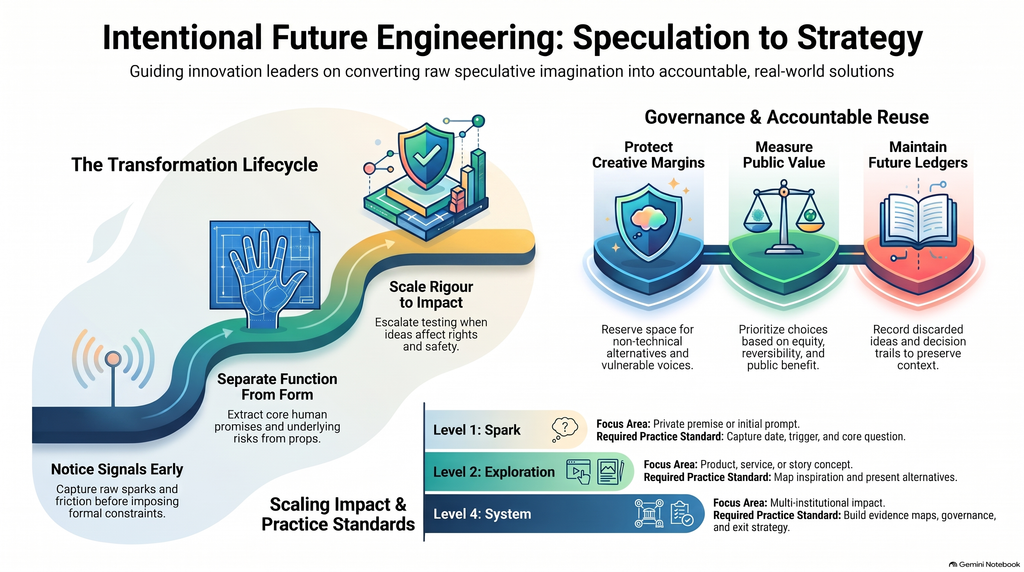
A writer and a futures team can start from the same provocation. Consider human adaptation for life away from Earth. The novelist may ask what happens to kinship, beauty and inequality when people change themselves to survive another world. A public agency may ask what consent, clinical evidence, liability and international rules would be required before any such intervention became imaginable. The first practice seeks a meaningful story. The second seeks a responsible decision. Both have to turn a vague possibility into a coherent world.
This is not a demand that every novelist prepare a policy pack. Nor should a policy team try to write a novel before making a decision. The point is that both benefit from the same core move: make the assumed world visible, then inspect it.
YouTube detailed:https://youtu.be/xwX_-UxYbTg
Reference documents: From Science Fiction to Tomorrow’s Creativity pt 2 description in appendices
A reverse compass for future creation
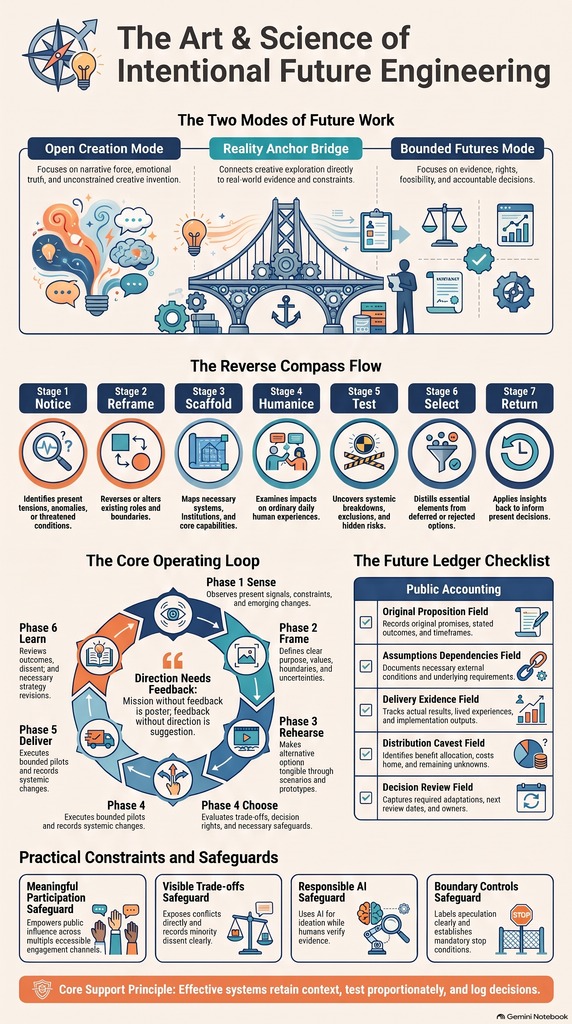
The process starts by noticing rather than forecasting. Something changes, or refuses to change. A population ages. A material becomes scarce. A dialect disappears from a tool that claims to translate. A new medical sensor becomes cheap enough to be ordinary. A future begins as a question about that friction.
| Move | Question to ask |
| Notice | What is strange, unresolved, desired or threatened in the present? |
| Reframe | What changes if this condition becomes normal, scarce, cheap, compulsory or forbidden? |
| Scaffold | What technology, institution, culture and material reality would make that future work? |
| Humanise | How does it change an ordinary day for someone with less power as well as someone with more? |
| Test | What breaks, who is excluded, and which assumption needs to be challenged? |
| Select | What belongs in the story or decision, and what should be saved for another inquiry? |
Research is not the enemy of imagination
Research gives imagination friction. A good future does not need a complete technical manual. It does need enough reality for readers or participants to stand on. Frank Herbert did not need to explain every element of Arrakis for the desert to feel consequential. Water, bodies, ritual, ecology and political power worked together. The visible world carried the weight of a much larger invisible one.
The same applies outside fiction. A furniture company considering an ageing Japan cannot simply ask what chair people might buy in 50 years. It must examine changing body shapes, homes, care arrangements, repair, privacy, manufacturing, local habits and affordability. Then it can ask the more creative question. What becomes possible if body scanning, flexible production and adaptive materials are ordinary?
Two kinds of freedom
Open creative work has the freedom to follow a strange idea beyond current feasibility. Its obligation is coherence. Bounded futures work has the freedom to imagine alternatives before an organisation commits money, law or public trust. Its obligation is accountability. Neither form is inferior. They supply what the other often lacks. Fiction can introduce moral and emotional complexity before the spreadsheet arrives. Applied futures work can show which assumptions would need evidence, ownership and safeguards.
AI should widen the search, not close the question
AI can make this work faster. It can organise spoken notes, search across disciplines, compare alternative scenarios, surface counterarguments and keep a record of sources. It is particularly useful when someone has a strong mental picture but needs help assembling the scaffolding behind it.
It should not decide what a culture means, whose risk is acceptable, whether an account of lived experience is credible, or what makes a story worth telling. Those are human acts of attention and judgement. The practical rule is simple. Use AI to make the question larger and the evidence easier to inspect. Do not use it to make uncertainty disappear.
The ideas left on the cutting-room floor
A writer may cut a transport system because it distracts from the plot. An innovation team may set aside a useful adaptation because it does not fit the current programme. Both should keep a record. Unused concepts can become later stories, research questions, future pilots or warnings. The discarded idea is not automatically a failed idea. It may simply belong to another problem.
Why this matters now
The pace of technological change has made short planning cycles feel sensible. Yet medicine, climate, migration, infrastructure, work and education all create commitments that outlive a quarterly plan. We need methods that can look further without pretending certainty. We need to imagine a future generously enough to recognise opportunity, and critically enough to see harm before it hardens into a system.
The reverse compass offers a practical habit. Begin with a live signal. Borrow widely from science, history, culture, design and human experience. Build only the scaffolding the question needs. Keep uncertainty visible. Let people encounter the consequences. Then decide what belongs in a story, a research agenda, a policy option or a prototype.
The future does not begin when a product launches or a law passes. It begins earlier, when someone learns to make a possibility legible and someone else gets the chance to challenge it.
Appendices
Reference documents : From Science Fiction to Tomorrow’s Creativity pt 2
Appendices
Reference documents: From Science Fiction to Tomorrow’s Creativity pt 2
| Attached item | Short description |
| Science Fiction to Reality Compass Compendium: Audits and Provenance Cards | A research compendium that applies the Compass and Provenance Card method to eight science-fiction concepts, testing claims about fiction’s relationship to real products, services, policy and public expectation. It includes evidence grades, adoption timelines and reusable audit templates. Science Fiction to Reality Compass Compendium Audits and Provenance Cards(1).docx |
| The Reverse Compass | A companion framework that starts with present conditions and works forward into fiction, exploratory futures or bounded decisions. It covers noticing, reframing, scaffolding, human consequences, testing, selection and return. Reverse_Compass_Reality_to_Fiction_and_Bounded_Futures(1).docx |
| Organisational, Strategic, and Evaluative Architecture of Future Imagineering | An applied assessment of Future Imagineering across sectors such as government, defence and healthcare. It identifies use cases, benefits, risks, adoption barriers and success measures. Organisational, Strategic, and Evaluative Architecture of Future Imagineering.docx |
| Intentional Future Engineering Case Studies and Borough Worked Example | A practical public-sector companion showing how a borough could translate manifesto commitments into a revisable public vision, participation system, delivery model and public future ledger. Intentional_Future_Engineering_Case_Studies_and_Borough_Worked_Example(1).docx |
| Imagination and Insight Roadmap and Practice Playbook | A guide for individuals, teams and institutions working between unbounded imagination and accountable practice. It covers originality, creative margin, proportional rigour, personal insight and shared future-making. Imagination_and_Insight_Roadmap_and_Practice_Playbook(1).docx |
| Intentional Future Engineering Framework | A visual summary of the overall method. It shows open creation, the reality anchor bridge, bounded futures, the Reverse Compass flow, operating loop, public future ledger and safeguards. Intentional_Future_Engineering_Framework.png |
| Intentional Future Engineering for Groups and Organisations | A short article on using visioning, narrative, evidence, rehearsal and feedback ethically within organisations and groups. It distinguishes invitation from imposition and explains how visions become credible. Intentional_Future_Engineering_for_Groups_and_Organisations(2).docx |
| Imagination and Insight Roadmap and Practice Playbook | A practice playbook for working across open creation, bounded futures work and the space between them. It explains how personal insight, fantasy, lived experience, research and collective imagination can coexist with proportionate evidence, accountability and ethical safeguards. It includes an insight taxonomy, imagination cycle and guidance for selecting the appropriate level of rigour. Imagination_and_Insight_Roadmap_and_Practice_Playbook (1)(1).docx |
| Future Imagineering Support Directory and Practice Appendix | A practical directory of methods, tools, models, capture modes, templates, archives and AI-supported practices. It supports teams in translating imaginative prompts into requirements, experiments and responsible delivery. Future_Imagineering_Support_Directory_and_Practice_Appendix (3).docx |
Related reading
Foresight Nexus Human AI Extrapolation Framework. https://ideaswiz.com/foresight-nexus-human-ai-extrapolation-framework
Unified Cognitive Foresight Architecture and Governed Embodied AI Agents. https://ideaswiz.com/unified-cognitive-foresight-architecture-governed-embodied-ai-agents
Building Organisations That Anticipate the Future. https://ideaswiz.com/building-organizations-anticipate-the-future-roadmap
From Science Fiction to Deliverables and the Science Fiction to Reality Compass series.