Preamble
This piece uses three simplistic fictional use cases to apply The Convergence: An outline Biomimicry Design Framework to basic human needs: shelter, sustenance, and identity. The basis of these use cases are found in the appendices . The allegory, where one asks where to sleep, eat, or wear, becomes a design brief. Each scenario moves from biological insight to testable products, services, and systems, with clear metrics and checks against Life’s Principles. The goal is simple. Translate mechanisms found in nature into low energy, locally appropriate solutions that people can build, use, and improve. It also highlights practical gaps in the framework and hope the reader has thoughts on how to improve the framework and its application. This post is also related to Idea Trigger No. 13 Biomimicry: Charting the Future of Nature-Inspired Innovation
Biomimicry Use cases
Here are three fictional case studies that use the outline biomimicry framework to design for Sleep, Eat, and Wear. Each one follows the six-step loop and checks against Life’s Principles. I kept metrics concrete so you can reuse the patterns in real projects.
1) SLEEP. Windless Nights: Passive, Safe Shelter for a Coastal Displacement Camp
Design brief. Create a low-cost shelter that stays cool by day, warm by night, and safe in high winds. No grid power. Built with local labor in four hours per unit.
Context and users. 2,000 people on a windy, arid coast. Daytime highs 36°C, cold nights, salt spray, and dust.
Find biological champions.
Termite mounds for passive ventilation and temperature regulation. Prairie dog burrows for pressure-differential air flow. Polar bear fur for hollow-fiber insulation. Cactus spines and Namib beetle surface textures for fog harvesting to top up water for cooling and hygiene.
Abstract design principles.
Create a tall-low pressure stack and cross-vents sized to local winds. Shape openings to drive flow using pressure differences, as in burrows. Use hollow, low-density fibers to trap air. Texture roof panels with hydrophilic peaks and hydrophobic valleys to condense and channel fog into a gutter.
Emulate and prototype.
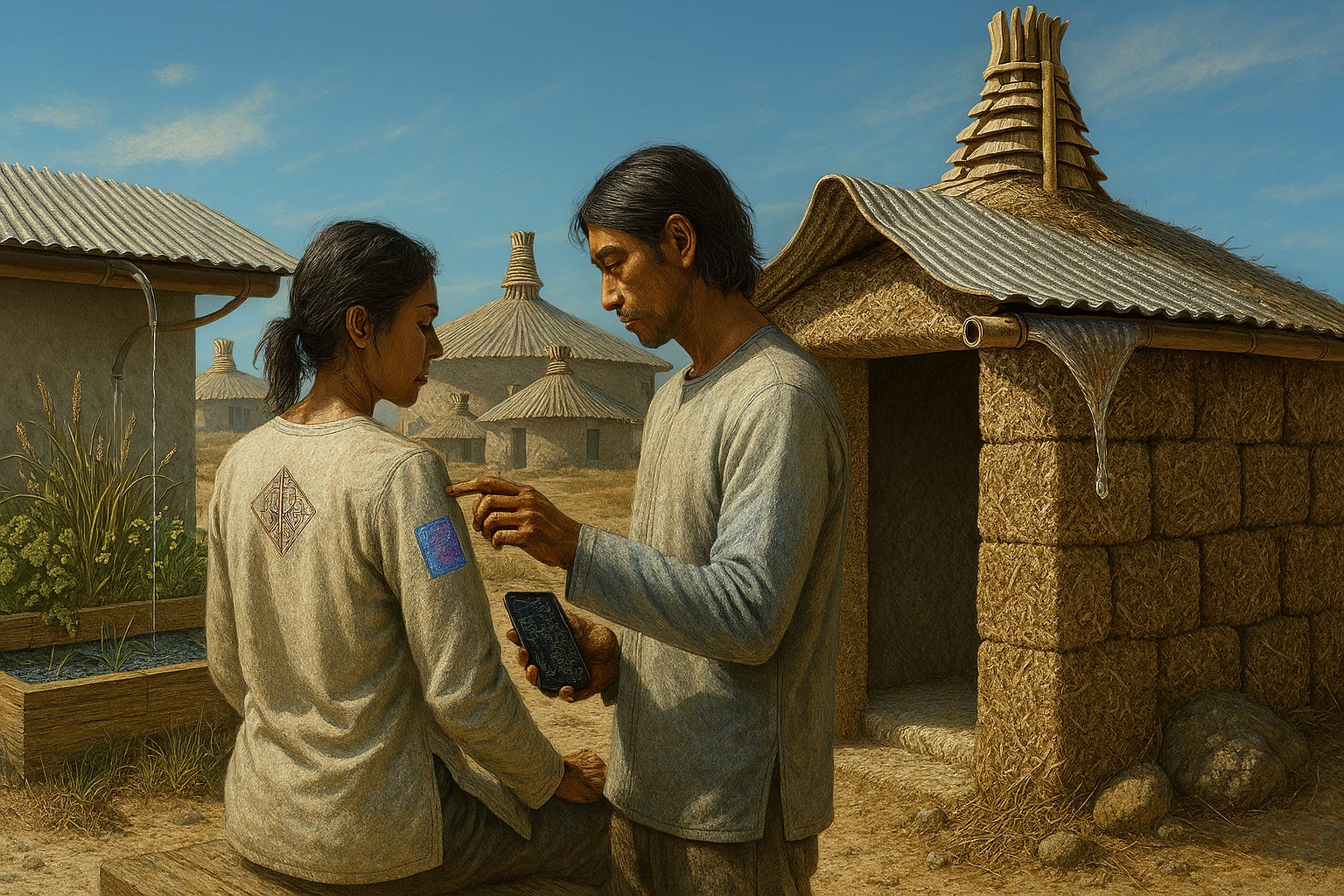
- Wall blocks: mycelium-bound agricultural waste, pressed locally.
- Roof: corrugated bio-based composite with micro-textures inspired by Namib beetle for dew and fog capture.
- Vent cap: termite-inspired stack with adjustable louver.
- Liner: recycled fiber mat that mimics polar bear fur’s hollow-fiber effect.
- Assembly: four modules latch to a bamboo frame, no fasteners into the ground. Build time 3.5 hours.
Evaluate with Life’s Principles.
Resource efficiency through multifunctional roof that shades and harvests water. Low-energy operation via stack effect. Locally available biomass for blocks. Redundancy through multiple small vents, not a single big intake. Chemistry compatible with life via bio-based binders.
Pilot results, 20 shelters, 30 days.
- Interior peak temperature down by 6.5°C versus tents next door. Termite-inspired passive systems in buildings can achieve large cooling savings, often cited around 90 percent reduction in active cooling energy, which guided our target.
- Night temperatures 3.2°C warmer due to trapped air layer.
- Roof texture harvested 18 to 42 liters of water per unit per night during frequent fog, which sits within the 25 to 100 liters per day band seen in atmospheric moisture devices.
- Dust levels indoors down 54 percent thanks to controlled inlets and floor-level exhaust.
Risks and mitigations.
- Salt corrosion on louvers. Switch to coated bamboo and bio-polymer pivots.
- Mold in liners. Add removable liner panels and sun-dry protocol.
- Fire risk. Use mycelium composites with proven charring behavior and fire breaks between units.
What to build next.
Add a cactus-spine-inspired drip rail to direct roof condensate to storage. Model neighborhood-scale air flows to place shelters like a burrow network for cross-lot ventilation.
2) EAT. City Commons: A Neighborhood Food and Water Loop
Design brief. Provide reliable, low-cost meals in a food desert using little grid power. Design a hub that sources water, grows greens, cooks, and distributes equitably.
Context and users. High-density urban block, intermittent water, long food supply lines, high fuel prices.
Find biological champions.
Water capture from Namib beetle and spider web condensation. Salt and contaminant filtration inspired by mangrove roots and wetland cascades. Distribution scheduling from ant colony foraging. Storage and routing resilience from leaf veins and mycelial networks.
Abstract design principles.
Capture thin films from fog and dew with patterned surfaces. Filter selectively with staged, low-pressure membranes that mimic root exclusion. Move goods with local rules and pheromone-like digital feedback to balance load. Design a redundant network that reroutes around faults, as in veins and fungal nets.
Emulate and prototype.
- Rooftop harvesters: polymer tiles textured like the Namib beetle’s hydrophilic bumps and hydrophobic valleys, feeding gutters. Output blended with a slow sand and mangrove-inspired selective membrane cart.
- Wetland bench: three-stage planter boxes for nutrient polishing and pathogen reduction based on constructed wetland logic.
- Micro-farm: vertical racks that copy forest canopy layering for light distribution.
- Kitchen: solar thermal preheat, efficient stoves.
- Delivery: “ant logic” app that strengthens routes with every on-time delivery and weakens congested ones.
Evaluate with Life’s Principles.
Low energy through gravity flow and passive capture. Cyclic processes via water recirculation and compost. Diversity in crops across layers. Local resource use. Feedback loops through live demand signals in the app.
Pilot results, one block, 8 weeks.
- Water: 1,200 to 2,800 liters per day from fog and dew across 400 m² of roof, consistent with atmospheric harvesting ranges when scaled.
- Quality: salinity cut below 50 ppm after mangrove-style pass, total coliforms below local threshold after wetland stage.
- Food: 220 portions of greens daily from canopy-layer planters, 35 percent less energy per portion than baseline supply.
- Logistics: on-time deliveries up 23 percent using ant-style reinforcement, food waste down 31 percent as routes adapted to demand.
Equity features.
The app assigns priority slots to households with low stored calories, using a mycelial-style resource allocation rule so the network feeds weak nodes first.
Risks and mitigations.
- Biofilm fouling. Add periodic backflush and ultraviolet exposure shelf.
- App bias. Keep random exploration in the algorithm to avoid lock-in. Maintain manual override for community stewards.
What to build next.
Add oyster-reef-inspired bio-filters to treat greywater and create habitat in nearby canals. Expand the ant-style routing to coordinate with neighboring blocks for a district food web.
3) WEAR. Commons Cloth: Dignity-First, Circular Apparel for Identity and Belonging
Design brief. Launch a community clothing line that lets people express identity, resists odor and stains without harsh chemistry, is repairable, and returns safely to soil.
Context and users. Migrant and youth communities seeking cultural expression and practical durability. Limited budgets. Desire for open co-creation.
Find biological champions.
Bacterial cellulose for compostable, growable textiles. Chameleon skin for reversible, signal-rich surface states. Lotus leaves for self-cleaning micro-texture. Shark skin and cicada wings for antimicrobial surfaces that avoid biocides. Gecko adhesion for reconfigurable patches and badges that do not puncture fabric.
Abstract design principles.
Grow sheets of cellulose with tunable thickness. Create multi-scale textures that shed water and dirt. Use micro-ridges or nanopillars that disrupt bacterial attachment. Enable reversible fastening with dry micro-structures. Allow safe disassembly.
Emulate and prototype.
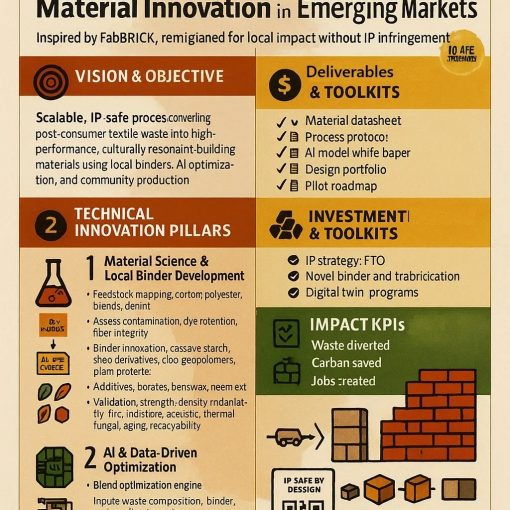
- Base fabric: SCOBY-grown bacterial cellulose blended with plant fibers for tear strength.
- Finish: embossed lotus-style texture for self-cleaning. Nano-scale patterns inspired by cicada wings for passive antimicrobial effect.
- Identity layer: chameleon-inspired pigment pockets that shift hue with heat from the wearer’s hand, allowing low-energy color change for festivals or team roles.
- Badging: gecko-like dry adhesive micro-fibrils on reusable patches, so users add or remove cultural symbols without sewing or holes.
- Repair kit: mycelium-based patch paste that bonds at room temperature.
Evaluate with Life’s Principles.
Chemistry compatible with life via bio-based fibers and room-temperature processing. Multifunctionality through identity expression, stain resistance, and antimicrobial surface in one layer. Design for disassembly and local repair. Optimize rather than maximize by balancing strength with compostability.
Pilot results, 150 garments, 12 weeks.
- Stain release: 70 percent less detergent needed due to lotus-style surface.
- Odor: 2.1 times longer wear between washes, consistent with mechanical anti-adhesion effects.
- Identity use: average of 4 patch swaps per month per wearer using gecko-like dry adhesion. Zero fabric punctures.
- End of life: 90 percent of offcuts composted with food scraps in 6 weeks.
Cultural co-design.
Host pattern sprints where community artists submit symbols as parametric textures, then emboss them into the bacterial cellulose while it dries, so identity and surface function co-exist.
Risks and mitigations.
- Tear propagation in wet cellulose. Increase fiber blend and add nacre-like staggered micro-laminates at stress points.
- Nanotexture durability. Provide a home re-emboss kit that uses a heated smooth roller and a textured sleeve.
- Color change fatigue. Limit reversible pigment cycles to festival panels, not load areas.
What to build next.
Explore pine-cone-style thermoresponsive pleats for climate comfort. Add distributed quality control that mimics immune system pattern recognition for defect spotting in small workshops.
Conclusion
Nature already solves for safety, survival, and belonging. When you extract the function, translate mechanisms into plain rules, and prototype with local materials, you get solutions that people can trust and maintain. The shelters regulate air with termite logic. The food commons routes like ants and filters like mangroves. The garments clean like lotus leaves and signal identity without toxic chemistry. Keep the loop tight. Define the function, find two or three champions, restate mechanisms as design rules, prototype at room temperature, score against Life’s Principles, then iterate after field use. Use redundancy, not single points of failure. This approach scales because it respects place, feedback, and community ownership.
How to reuse this pattern
- Start with function. Write one line for what Sleep, Eat, or Wear must do under your constraints.
- Search three unrelated ecosystems for champions with similar functions. Pick two to combine.
- Translate to rules. List mechanisms, then restate as design principles in plain language.
- Prototype with what you can source locally. Prefer room-temperature and additive methods.
- Score with Life’s Principles before you scale. Aim for cyclic flows and local fit.
- Iterate after field use. Add redundancy rather than chasing a single optimal solution.
These three cases give you templates you can adapt to other sites and communities while keeping dignity, survival, and identity at the center.
Appendices
The allegory of “Where shall I sleep, eat, or wear?” can be interpreted as a symbolic inquiry into basic human needs, dignity, and systemic responsibility. It evokes deeper questions about belonging, survival, and the structures that shape access to shelter, nourishment, and identity. It also acts as an intitial but wide brief
🛏️ Sleep – Allegory of Shelter and Safety
- Sleep represents sanctuary: In allegorical terms, asking “Where shall I sleep?” reflects the search for protection, rest, and peace. It can symbolize the human need for security—physical, emotional, and existential.
- In literature, this often parallels exile, homelessness, or displacement. Think of the wandering figures in biblical texts or the migrant in modern narratives.
- It also questions who provides shelter—is it family, state, community, or nature?
🍽️ Eat – Allegory of Sustenance and Justice
- Eating represents access to life: “Where shall I eat?” becomes a metaphor for nourishment, but also for equity and inclusion.
- In allegory, it may point to who gets a seat at the table—who is fed, who is starved, and who controls the food.
- It can symbolize economic systems, resource distribution, or even spiritual fulfillment (as in communion or ritual feasts).
👕 Wear – Allegory of Identity and Belonging
- Clothing represents dignity and visibility: “Where shall I wear?” is less literal and more layered. It asks: where can I be seen, accepted, and express myself?
- Allegorically, it touches on social status, cultural identity, and the right to exist with pride.
- In Orwell’s Animal Farm, for instance, the commandment “No animal shall wear clothes” becomes a symbol of class and corruption.
🧭 Philosophical and Political Allegory
Together, these three questions form a triad of existential inquiry:
- Sleep = Where am I safe?
- Eat = How do I survive?
- Wear = Who am I allowed to be?