Preamble: The second reckoning is operational
This is a practical companion article for founders, solo builders, citizen developers, and enterprise teams using AI app builders. Part 1 of the vibe coding reckoning named the illusion: AI-generated software can look finished long before it is secure, maintainable, accessible, recoverable, or governable. Part 2 is about what to do next.
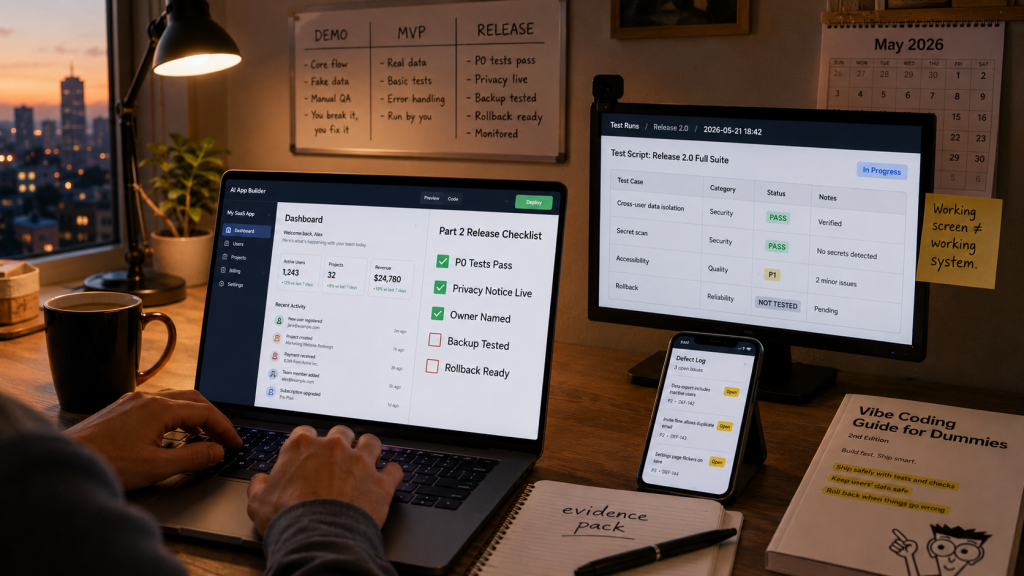
Vibe coding is not the enemy. The enemy is confusing a working screen with a working system. A login form can exist without trustworthy authorization. A database can return records while leaking someone else’s data. A live URL can feel like launch while still lacking backups, logs, rollback, privacy evidence, and an owner.
The second reckoning is therefore practical. It asks every builder to answer three questions before moving forward: What stage is this app really in? What persona is building it? What evidence proves it is safe enough for the next audience?
That is why this article connects the narrative reckoning to the operating documents created in this thread: the beginner guide, the release checklist, the test script, the non-functional requirements, and the documentation suite. The goal is not bureaucracy. The goal is to preserve the speed of vibe coding while preventing false completeness from becoming real-world harm.
The case for building a vibe‑coded app at least at the demo stage rests on three practical reasons.
First, it allows you to play with the technology. You get hands‑on exposure to what the current AI builders can do, how they behave, and where their limits are. It keeps you up to date with the evolving ecosystem and helps you understand the capabilities you can leverage.
Second, a demo acts as a powerful explainer of an idea. Whether your idea is vague or well‑formed, having a working walkthrough helps you express, share, and refine it. A demo often triggers contributions, clarifications, and new insights because people can react to something tangible rather than abstract descriptions.
Third, in engagements with developers or technical teams, a demo becomes an idea generator and alignment tool. In traditional Rapid Application Development and Business Analysis, we use mock-ups to surface requirements. When stakeholders are unsure of what they want, the mock-up becomes the catalyst for discussion. Starting with the final UI is not always ideal sometimes you begin with a gather of requirements from stakeholder, process map, , and only then build the mock-up. But once you have both the process map and the demo, stakeholders can articulate their point of view more clearly. This is especially useful for distinguishing internal user stories from external customer user stories.
The only caution is to always remind people: this is a mock-up, not the final product. Nothing in the demo is guaranteed to appear in the MVP or production release. But as an exercise, it is invaluable visual aid and I believe everyone should go through this process at least once. Especially as the first 2-3 usages of vibe coding platforms are free
How to use the reference documents
Use the documents as a staged operating system. Do not use every document for every experiment. Match the documentation burden to the stage, risk, persona, and audience. Reference documents
| Document | Use it for | Best moment to use it |
| The Vibe Coding Reckoning: 2026 Edition | Understand the core risks, personas, and why requirements matter more when AI generates software. | Before adopting vibe coding as a serious build method. |
| Vibe Coding Guide for Dummies | Plain-English operating manual for demo, MVP, and release. Includes platform gotchas and copy/paste prompts. | At the start of any build, especially for non-programmers and product owners. |
| Vibe Coding NFR Scan | Security, usability, database, AI usage, privacy, and governance requirements that counter common failure modes. | When moving from demo to MVP or when defining SRS/NFRs. |
| Part 2 Checklist & Test Script | Go/no-go checklist, test cases, defect log, release gates, and evidence pack. | Before private beta, public launch, or any real-user test. |
| Deliverables Prompt / Documentation Suite | Creates standalone Vision, Business Case, PRD, Architecture, UX, Branding, Business Rules/IP, Glossary, SRS, and Demo Spec. | For funded MVPs, enterprise apps, regulated workflows, or serious SaaS products. |
The working principle: stage first, tool second
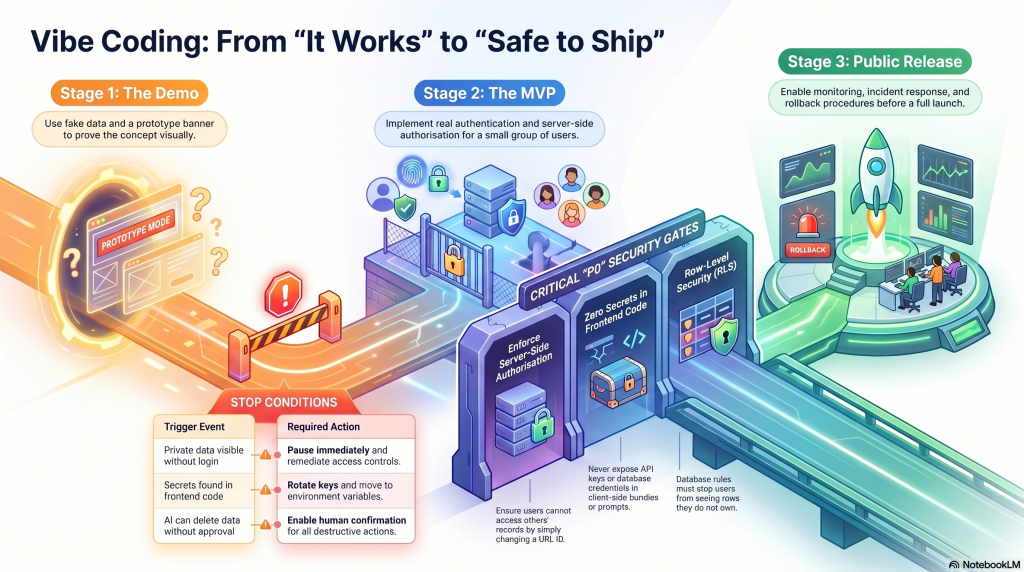
The safest vibe coding workflow does not begin with choosing Lovable, Bolt, Replit, Cursor, or another platform. It begins with the stage.
| Stage | Plain-English meaning | Acceptable evidence |
| Demo | A controlled proof of the idea using fake or low-risk data. | Demo scope, prototype warning, fake data list, walkthrough script, known limitations. |
| MVP | The first version that real users can try with real expectations and possibly real data. | PRD, SRS-lite, access-control tests, privacy notice, backup, logs, owner, defect log. |
| Private beta | A controlled MVP with invited users, limited data, and clear support ownership. | All P0 tests pass; P1 security/privacy items pass or are formally accepted; monitoring and rollback ready. |
| Public release | The product is available beyond a controlled group and must be operated responsibly. | Full release checklist, security/privacy sign-off, monitoring, incident path, rollback, support plan. |
The mistake to avoid is reusing a demo as an MVP without changing the evidence standard. The surface may look similar; the obligation is different.
.As I explained in the earlier Vibe Code Reckoning 2026 , one of my quickest evaluation methods is to ask the AI I’m using whether GPT or any other builder to generate a dummy implementation guide based on my requirement documents. I simply tell the AI: “These are my requirement documents. Create a dummy guide for implementing this in Replit, in Lovable, or in whichever AI platform I’m using. Tell me what documents I need to attach for it to generate a demo, an MVP, or a release and what prompts and master prompt I need.”
The AI then produces a guide that explains which documents to attach, which master prompts to use, and how those inputs enable the creation of a demo, MVP, or full release. I also ask the AI: “Given this stage of development, which documents do I need?” I provide a list of deliverables, and the AI tells me what to create next.
This gives me a fast, lightweight way to avoid over‑documenting. By attaching the right documents into the context window of the vibe‑coding platform, it acts as a check-and-balance system. And because my planning AI is separate from the vibe‑coding AI, I can always ask: “It has generated this what else do I need?” The AI then guides me, ensuring I stay aligned with the correct deliverables for each stage
The four personas and their documentation burden
Different builders need different controls. A non-programmer does not need the same deliverables as a regulated enterprise product team. But everyone needs enough structure to avoid shipping blind.
Persona 1: Creator with no programming experience
This is the founder, creator, product manager, coach, consultant, marketer, operator, or small-business owner using a full-stack AI app builder to turn an idea into a working demo. This person gains the most from vibe coding but is most vulnerable to false confidence.
| Aspect | Guidance |
| Best use of vibe coding | Concept validation, clickable demos, landing-page workflows, simple CRUD tools, mock SaaS flows, internal productivity experiments. |
| Main blind spot | The app may look complete while missing authentication, authorization, RLS, secret handling, backup, privacy, accessibility, and support ownership. |
| Do not do alone | Payments, health/finance/legal workflows, children’s data, employment decisions, customer records, regulated data, or production integrations. |
| Minimum habit | Use a planning AI as architect/reviewer and the vibe platform as builder. Keep fake data until P0 tests pass. |
| Decision rule | Proceed for demos. Test for MVP. Pause for sensitive data or payments without expert review. |
Persona 2: Builder with programming experience
This is the solo developer, technical founder, data analyst, automation specialist, or engineer using AI code editors and app builders as leverage. The risk is not ignorance but over-acceleration.
| Aspect | Guidance |
| Best use of vibe coding | Scaffolding, refactoring, tests, UI assembly, CRUD flows, API glue, prototypes, small internal tools. |
| Main blind spot | Large generated diffs, architectural drift, hallucinated APIs/packages, inconsistent patterns, under-tested NFRs. |
| Do not delegate blindly | Auth, payments, cryptography, migrations, tenant isolation, regulated logic, data deletion, production deployment. |
| Minimum habit | Use Git from the start, small commits, review diffs, run scans/tests, maintain SRS-lite for anything with real users. |
| Decision rule | Proceed for low-risk scaffolding. Test for backend/data/auth changes. Pause for security-critical or irreversible changes without review. |
Persona 3: Enterprise user with no programming experience
This is the citizen developer: a business user inside a company building internal tools, automations, dashboards, or process apps. The biggest risk is shadow AI software touching real business data outside governance.
| Aspect | Guidance |
| Best use of vibe coding | Low-risk internal prototypes, workflow mockups, process experiments, stakeholder demos, productivity aids using approved data. |
| Main blind spot | Shadow IT, unapproved tools, customer/employee data leakage, missing audit trail, no owner, no support model, no retention rules. |
| Do not do alone | Apps touching customer data, employee records, regulated data, production systems, contracts, invoices, security controls, or external users. |
| Minimum habit | Use only approved platforms, create a PRD-lite, identify data classification, get technical/security review before real data. |
| Decision rule | Proceed for mockups. Test for internal pilots. Pause if production data, regulated data, or external users are involved. |
Persona 4: Enterprise programmer or engineering team
This is the professional team using AI coding tools inside a real SDLC. The danger is not that the team cannot understand code; it is that generated volume can outrun review, standards, traceability, and ownership.
| Aspect | Guidance |
| Best use of vibe coding | Boilerplate, tests, migrations with review, documentation drafts, repetitive implementation, internal tools, low/medium-risk services. |
| Main blind spot | Review fatigue, hidden drift, inconsistent patterns, prompt-to-commit traceability gaps, NFR erosion, dependency risk. |
| Do not allow | Unreviewed AI-generated code in production, direct generation into protected branches, unmanaged secrets, bypassed CI/CD, unapproved model/tool use. |
| Minimum habit | AI usage policy, PRD/SRS, architecture notes, CI/CD scans, code owner review, prompt/change evidence, security gates. |
| Decision rule | Proceed when AI is inside the engineering system. Test when generated changes affect architecture/data/security. Pause if governance is bypassed. |
Minimum, optional, and ideal deliverables by persona
The following matrix is intentionally pragmatic. “Minimum” means the least documentation that still prevents obvious harm. “Optional” means useful when complexity grows. “Ideal” means appropriate when the work becomes serious, funded, enterprise-facing, or regulated.
| Persona | Minimum deliverables | Optional deliverables | Ideal deliverables |
| Creator with no programming experience | One-page PRD-lite; demo scope; fake data list; beginner guide; Part 2 checklist for MVP; basic defect log. | SRS-lite; UX/user journey map; data inventory; privacy notice draft; architecture-lite. | Full PRD, SRS, Architecture, UX/UI, Risk Register, DPIA, Security Review, Release Checklist, Runbook. |
| Builder with programming experience | PRD-lite; README; architecture notes; environment variable list; test checklist; Git history. | SRS-lite; threat model; dependency scan report; data model; release notes; runbook. | Full PRD, SRS, Architecture, Test Plan, CI/CD evidence, Risk Register, Security Review, Incident Response Plan. |
| Enterprise user with no programming experience | Approved use-case request; PRD-lite; data classification; owner/support contact; platform approval; prototype disclaimer. | SRS-lite; stakeholder map; DPIA screening; vendor/subprocessor list; user journey; release checklist. | Full Vision, Business Case, PRD, SRS, Architecture, UX, Risk Register, DPIA, Security Review, Support Plan, Change Control. |
| Enterprise programmer/team | PRD or ticket bundle; SRS/NFR references; architecture decision record; code review; CI/CD scans; test results. | Threat model; AI model/tool card; prompt-to-commit traceability; operational runbook; accessibility report. | Full documentation suite: Vision, Business Case, PRD, SRS, Architecture, UX, Business Rules/IP, Glossary, Test Plan, Security Pack, Runbook. |
Minimum, optional, and ideal deliverables by stage
| Stage | Minimum | Optional | Ideal |
| Idea | One-page PRD-lite; target users; problem; core workflow; assumptions. | Business model sketch; competitor notes; glossary starter. | Vision Document and Business Case for funded/enterprise work. |
| Demo | Demo specification; fake data list; prototype banner; walkthrough script; known limitations. | UX sketch; brand starter; lightweight architecture note. | Demo Spec tied to Vision/PRD with stakeholder walkthrough and test interactions. |
| MVP | PRD; SRS-lite; data inventory; owner; Part 2 checklist; P0 test results; defect log. | Architecture-lite; privacy notice; risk register; accessibility checklist; release notes. | Full PRD/SRS/Architecture/UX/Risk/DPIA/Security Review for real data, payments, or regulated contexts. |
| Private beta | All P0 pass; P1 security/privacy tests pass; support owner; backup; logs; rollback. | Monitoring dashboard; incident response contact list; vendor register. | Formal beta sign-off, QA report, DPIA, security review, accessibility evidence. |
| Public release | All P0/P1 pass; privacy/terms live; monitoring; incident path; rollback tested; owner signed off. | Performance smoke test; runbook; support process; dependency scan report. | Full release evidence pack, penetration test where warranted, formal change/release governance. |
How to apply the article in a real build
The safest practical workflow is a lightweight AI-to-AI loop.
| Step | Action | Output |
| 1 | Use a planning AI to create PRD-lite/SRS-lite from the idea. | Clear scope, users, data, roles, risks, tests, stage. |
| 2 | Give the builder AI only the stage-appropriate prompt. | Demo, MVP, or release candidate generated within constraints. |
| 3 | Ask the planning AI to review the output against the PRD/SRS and checklist. | Drift, hallucinations, missing controls, and test gaps identified. |
| 4 | Run the Part 2 test script before real users or public release. | Pass/fail evidence, defect log, release decision. |
| 5 | Upgrade deliverables only when risk increases. | Minimum process for demos; stronger documentation for MVP, beta, release, enterprise, or regulated contexts. |
The practical rule: no evidence, no release
A vibe-coded app does not need heavyweight documentation to exist. It needs evidence to advance. The moment real users, real data, payments, company systems, regulated workflows, or public release enter the picture, the evidence standard rises.
Evidence does not have to be complicated. For a small MVP, it may be screenshots showing auth controls, a test sheet showing cross-user access failed safely, a secret scan, a privacy notice, a backup restore note, and a named owner. For an enterprise release, the evidence becomes formal: PRD, SRS, Architecture, Risk Register, DPIA, security review, runbook, monitoring, and sign-off.
Conclusion: keep the speed, add the guardrails
The future of software creation will include more AI, not less. The question is whether the people using it learn to distinguish generation from readiness.
Part 2 of the vibe coding reckoning is not a call to slow down every experiment. It is a call to stop promoting experiments into products without evidence. Demos can be fast and disposable. MVPs must protect real users and real data. Public releases must be owned, monitored, recoverable, and explainable.
For non-programmers, the discipline is to stay inside safe boundaries and get review before risk escalates. For programmers, the discipline is to keep judgment ahead of speed. For enterprise citizen developers, the discipline is to avoid shadow AI and use governed channels. For enterprise engineers, the discipline is to absorb AI into the SDLC instead of letting it bypass the SDLC.
The best vibe coding practice is therefore not anti-vibe. It is disciplined vibe: clear intent, staged release, minimum viable documentation, explicit NFRs, test evidence, and a hard rule that a working screen is not proof of a working system.
YouTube: https://youtu.be/RlmzWMzUSJ4
Appendix A: Relationship to other documents
| Related document | Relationship to this article | When it becomes necessary |
| Vision Document | Defines purpose, future state, stakeholders, success metrics, and traceability anchors. | Useful for funded products, enterprise sponsorship, or long-lived products. |
| Business Case | Explains why the product is worth building, including ROI, cost/benefit, options, risks, and adoption. | Needed for enterprise funding, investment decisions, or serious SaaS initiatives. |
| PRD | Defines product intent: problem, users, features, priorities, MVP vs non-MVP. | Minimum for MVP; PRD-lite is recommended even for demos. |
| SRS | Defines obligations: functional, non-functional, data, security, accessibility, integration, and test requirements. | Required for MVP/release, and strongly required for enterprise or regulated work. |
| Architecture Document | Defines components, data model, APIs, AI orchestration, integrations, and environments. | Needed when the app has backend logic, database, AI tools, integrations, or multiple environments. |
| UX/UI/User Journey Document | Defines journeys, information architecture, usability rules, accessibility, and screen-level expectations. | Needed before beta and for any user-facing MVP. |
| Branding Document | Keeps generated UI, voice, colors, typography, and demo presentation consistent. | Optional for prototypes; useful for public demos and commercial releases. |
| Business Rules, Formulas & IP Register | Locks down calculations, scoring, eligibility, pricing logic, formulas, and reusable IP. | Required when logic affects decisions, pricing, ranking, scoring, or claims. |
| Glossary | Keeps business, technical, AI, architecture, and security terms consistent across prompts and docs. | Useful from PRD onward; necessary for enterprise teams. |
| Demo / Prototype Specification | Defines demo scope, walkthrough, test interactions, assets, and constraints. | Required when showing stakeholders, investors, clients, or enterprise sponsors. |
| Vibe Coding Guide for Dummies | Plain-English guide for choosing tools, avoiding gotchas, and using demo/MVP/release gates. | Best starting point for beginners and non-programmers. |
| Vibe Coding Part 2 Checklist & Test Script | Checklist, test cases, defect log, release sign-off, evidence pack. | Mandatory before private beta, public launch, or real user data. |
| Risk Register / Risk Profile | Captures risks, owners, likelihood, impact, mitigations, and residual stance. | Required for MVP and release; essential for enterprise work. |
| DPIA / Privacy Pack | Documents personal data, purpose, retention, vendors, rights, and privacy risks. | Required when personal, sensitive, employee, customer, or regulated data is processed. |
| Security Review / Pen Test Report | Documents security checks and vulnerabilities. | Required for public apps, sensitive data, payments, regulated workflows, or enterprise deployment. |
| Runbook / Support Plan | Explains how to operate, monitor, recover, escalate, and support the app. | Required for production release. |
Appendix B: Persona-specific deliverable checklist
| Deliverable | No-code creator | Programmer builder | Enterprise non-programmer | Enterprise programmer/team |
| PRD-lite | Minimum | Minimum | Minimum | Minimum or ticket bundle |
| Full PRD | Ideal for serious MVP | Recommended for MVP | Required beyond prototype | Required for product work |
| SRS-lite | Minimum for MVP | Minimum for MVP | Required for pilot | Required |
| Full SRS | Ideal | Ideal for serious product | Required for real data / production | Required for production |
| Architecture-lite | Optional for demo; minimum for MVP with backend | Minimum | Required for IT review | Required |
| Full Architecture | Ideal | Ideal | Required for enterprise release | Required |
| UX/User Journey | Optional for demo; minimum for MVP | Recommended | Required | Required |
| Data Inventory | Minimum if any personal data | Minimum if any personal data | Required | Required |
| DPIA | If personal/sensitive data | If personal/sensitive data | Required when enterprise/personal data | Required where applicable |
| Part 2 Test Script | Minimum before real users | Minimum before real users | Required before pilot | Required in QA/release |
| Risk Register | Optional for demo; minimum for MVP | Recommended | Required | Required |
| Security Review | External help if real users/data | Required for public/sensitive app | Required | Required |
| Runbook | Optional for demo; needed for release | Needed for release | Required for production | Required |
Appendix C: Minimum viable documentation bundles
| Bundle | Use when | Contents |
| Demo bundle | You are showing the idea to yourself, collaborators, or stakeholders using fake data. | PRD-lite; demo spec; fake data list; walkthrough script; prototype disclaimer; known limitations. |
| MVP bundle | A small set of real users will use the app, or real data enters the system. | PRD; SRS-lite; architecture-lite; data inventory; privacy notice draft; owner/support contact; Part 2 checklist; P0 test evidence; defect log. |
| Private beta bundle | Invited users will test a controlled version with limited data and support. | MVP bundle plus P1 evidence, monitoring, backup/restore note, rollback note, vendor list, beta support plan. |
| Public release bundle | The app will be publicly available or business-critical. | Full PRD/SRS, architecture, UX, risk register, DPIA where needed, security review, test report, accessibility evidence, runbook, incident response, release sign-off. |
| Enterprise bundle | The app is built inside an organization or touches company systems/data. | Vision, Business Case, PRD, SRS, Architecture, UX, Business Rules/IP, Glossary, Risk Register, DPIA, Security Review, Change/Release Plan, Runbook. |
Appendix D: Release decision rules
| Decision | Use when | Implication |
| Proceed | The app is stage-appropriate, evidence is complete, and no P0/P1 blockers remain for the intended audience. | Move to the next stage or release with normal monitoring. |
| Test | Some P1/P2 items remain, but risk is controlled, users are limited, and evidence supports a private beta or pilot. | Limit audience, data, and scope; keep defect log active. |
| Pause | Any P0 item fails, real/sensitive data is exposed, ownership is unclear, or regulated use lacks review. | Do not release; remediate blockers and retest. |
Appendix E: Short prompt pack
Planning AI prompt:
You are my product architect and safety reviewer. I am building a [demo/MVP/release] using [platform]. Create a PRD-lite and SRS-lite with target users, workflows, data, roles, auth needs, database rules, privacy risks, accessibility requirements, launch gate, and tests. Flag anything that should not be built with vibe coding alone.
Builder AI prompt:
Build only the agreed scope. Use fake data unless this is an approved MVP. Do not expose secrets in frontend code. Include error, empty, loading, unauthorized, and recovery states. Provide a change summary listing files, schema changes, access policies, env vars, and tests.
Review AI prompt:
Review this app against the PRD, SRS-lite, and release checklist. Identify missing auth, weak authorization, exposed secrets, public database/storage rules, prompt injection risks, unsafe tool calls, missing logs, missing backups, accessibility gaps, and privacy risks. Return blockers, fixes, and test cases.
Release prompt:
Prepare a release-readiness report. Confirm P0 items pass, P1 items are closed or accepted, privacy notice is live where needed, monitoring and rollback are ready, support owner is named, and defects are logged. End with Proceed, Test, or Pause.
Appendix F: Abbreviations
| Abbreviation | Meaning |
| AI | Artificial Intelligence |
| API | Application Programming Interface |
| CI/CD | Continuous Integration / Continuous Deployment |
| DPIA | Data Privacy Impact Assessment |
| MVP | Minimum Viable Product |
| NFR | Non-Functional Requirement |
| PRD | Product Requirements Document |
| RLS | Row-Level Security |
| SRS | Software Requirements Specification |
| SDLC | Software Development Lifecycle |
Source note
This article is synthesized from the uploaded source documents in this thread: The Vibe Coding Reckoning: 2026 Edition; the Vibe Coding NFR scan; Vibe Coding Guide for Dummies; Part 2 Vibe Coding Release Checklist & Test Script; and the deliverables prompt for a traceable documentation suite. Reference documents