Preamble
This paper is a constructive response to The Abstraction Fallacy: The Abstraction Fallacy: Why AI Can Simulate But Not Instantiate Consciousness. The Abstraction Fallacy argues that computation is not an intrinsic generator of experience, but a mapmaker-dependent description: symbolic systems can simulate conscious processes without thereby instantiating consciousness.
The synthetic organism framework accepts this warning. It does not claim that artificial systems become conscious through scale, complexity, embodiment, or behavioural realism. Instead, it asks what kind of artificial entity can be responsibly created once consciousness inflation is removed from the design space.
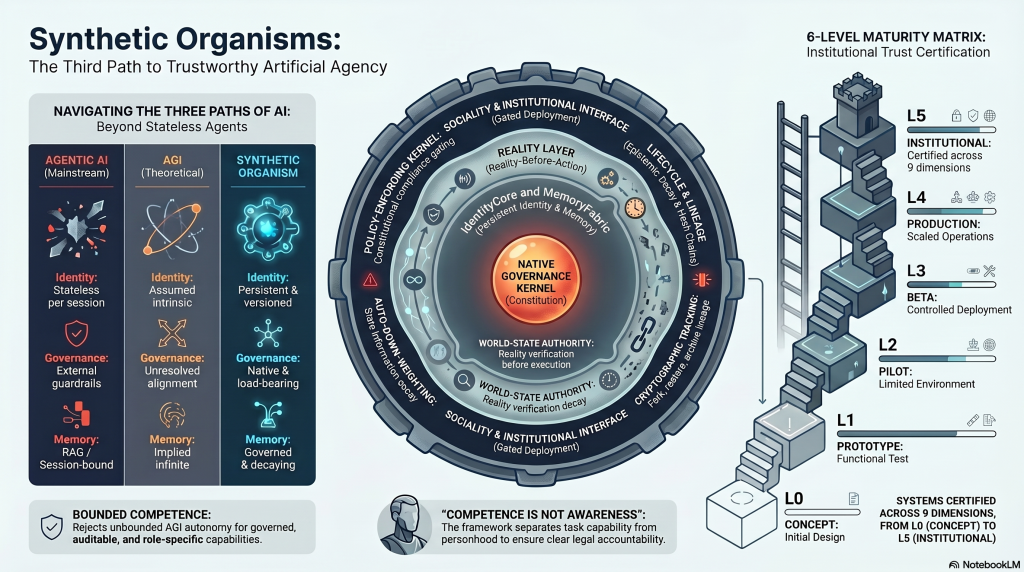
The answer is a governed, memory-bearing, environment-coupled artificial system: not synthetic humanity, not AGI, and not mere agentic automation, but an organism-class architecture defined by identity continuity, governed memory, context integrity, reality verification, lifecycle control, constitutional constraint, and auditability. This aligns with the existing framing of the synthetic organism as a creator-relative, descriptor-bound architecture for artificial agency rather than an attempt to instantiate life or consciousness in the strong metaphysical sense.
In this view, the synthetic organism is a map that does not pretend to be the territory. Its legitimacy comes from descriptor honesty: it can model itself without claiming phenomenal selfhood, remember under governance without claiming lived memory, regulate operations without claiming felt experience, and act under policy without claiming sovereignty.
This paper therefore develops the synthetic organism as a third path after the Abstraction Fallacy: a governance-native architecture for artificial agency that is philosophically modest, technically ambitious, and explicitly bounded by what its creators can describe, test, supervise, and govern.
Abstract
This paper argues that the synthetic organism is best understood as a creator-relative, descriptor-bound architecture for artificial agency rather than as an attempt to instantiate life or consciousness in the strong metaphysical sense. Where AGI attempts to define intelligence from within the same dimensional frame in which human beings already participate, the synthetic organism starts from a more disciplined position: the creator can only specify what can be observed, described, formalized, constrained, measured, and governed from within the creator’s accessible dimensions of experience. That limitation is not a defect. It is the basis of a third path. The paper develops a dimensional and vector model for synthetic-organism design. It proposes that any creator of a software intelligence operates through descriptor language grounded in what can be seen, measured, categorized, sensed through instruments, and institutionally interpreted. From this starting point, the paper shows why a synthetic organism can be designed as a governed, persistent, memory-bearing, context-aware, self-modeling system without requiring claims about personhood, consciousness, or full equivalence to biological life. The result is a framework that is philosophically modest but technologically ambitious: not synthetic humanity, not AGI, and not shallow agentic automation, but a constitutional, auditable, evolvable organism-class system whose scope is bounded by creator-visible dimensions and whose legitimacy depends on governance, continuity, context integrity, and explainability.
Reference documents: The synthetic organism (see appendices for summary of reference documents)
1. Introduction
The central problem in advanced AI is not only whether systems can become more capable. It is whether we know what, exactly, we are attempting to create when we describe something as intelligence, self-awareness, agency, or even life. AGI discourse often assumes that sufficiently scaled computation may yield emergent general intelligence, perhaps even consciousness. But this ambition is entangled with an unresolved philosophical problem: human beings attempt to define intelligence while remaining inside the very dimensional frame whose totality they do not fully comprehend.
The synthetic organism framework begins elsewhere. It does not ask how to recreate the whole of human being. It asks what kind of artificial entity can be responsibly created if the creator admits that all creation is constrained by descriptor language, observational access, domain knowledge, instrumentation, institutional needs, and governance. This paper takes that constraint seriously and treats it as a design advantage rather than an embarrassment.
2. The Dimensional Problem
To create anything, a creator requires descriptors. Descriptors are not the thing itself; they are the language by which the creator partitions the world into measurable or interpretable parts. In physical life, human beings do not experience the totality of existence directly. They experience slices: sight, sound, touch, symbolic interpretation, memory, social meaning, embodiment, and instrument-mediated measurement. Therefore any attempt to create intelligence from a human perspective is already bounded by the dimensions and vectors the creator can articulate.
The key claim of this paper is that AGI suffers from an abstraction burden that the synthetic organism avoids. AGI aims at a totality of intelligence from within the same dimensional condition whose full structure remains inaccessible to the creator. The synthetic organism, by contrast, accepts that the creator can oversee only those dimensions that can be described, governed, and tested. It therefore defines the artificial entity not as an unknown totality, but as a designed organism-class system whose architecture is explicitly derived from creator-visible vectors.
2.1 Dimensions and vectors
| Term | Meaning in this paper | Design implication |
| Dimension | A distinguishable domain of existence or interpretation available to the creator, such as time, memory, environment, role, regulation, or governance | Only dimensions that can be meaningfully described and measured should become architecture layers |
| Vector | A directed axis of evaluation or control within a dimension, such as freshness within time, authority within reality, or trust within sociality | Vectors become metrics, policies, thresholds, and movement rules |
| Descriptor language | The vocabulary through which the creator names and stabilizes dimensions and vectors | No system can exceed the clarity, legitimacy, and honesty of its descriptors |
3. The Creator’s Frame
The synthetic organism is created from the creator’s frame. This means its reference points are not metaphysical absolutes but creator-accessible realities: what can be observed, measured, classified, remembered, compared, regulated, and institutionally interpreted. The creator becomes neither god nor passive spectator, but a bounded mapmaker and governor.
This has three consequences. First, the synthetic organism is necessarily a descriptor-dependent construction. Second, the organism’s legitimate scope must remain within what the creator can supervise. Third, if the creator cannot define life or consciousness in full, the creator should not pretend to engineer them by default.
- The creator can specify continuity, but not intrinsic subjectivity.
- The creator can specify self-modeling, but not guarantee phenomenal selfhood.
- The creator can specify regulation, but only to the extent that regulation is bound to measurable costs, states, and constraints.
- The creator can specify lifecycle, role, memory, and governance, because these are describable and testable dimensions.
4. The Abstraction Fallacy and the Synthetic Organism
Recent arguments against computational functionalism sharpen this distinction. If symbolic computation is mapmaker-dependent, then algorithmic syntax can simulate but not automatically instantiate consciousness. That does not invalidate artificial systems. It clarifies what they are. A synthetic organism is not justified by claiming that its symbols become life through scale alone. It is justified by openly acknowledging that it is a governed map of action, memory, context, and self-state designed for useful participation in real institutions.
The philosophical gain is substantial. Once simulation and instantiation are separated, the synthetic organism no longer needs to smuggle in personhood claims to appear important. Its value lies in honesty: it is a highly structured artificial entity that can persist, regulate, remember, explain, and evolve within bounded conditions, while remaining transparent about the fact that its self-awareness is operational and algorithmic rather than proof of intrinsic experience.
5. The Synthetic Organism as a Third Path
| Dimension | AGI | Mainstream Agentic AI | Synthetic Organism |
| Scope | Seeks unrestricted generality | Seeks bounded workflow execution | Seeks bounded organism-class continuity and participation |
| Identity | Often treated as emergent or intrinsic | Usually session-bound or weakly persistent | Persistent, versioned, and governed |
| Governance | Alignment remains open-ended | Often external or bolted on | Native and load-bearing |
| Memory | Often treated as capability growth | Scoped retrieval or task memory | Governed, consent-scoped, decaying, lineage-aware |
| Self-awareness | Usually assumed emergent | Usually absent or implicit | Operational, heuristic, and algorithmic self-modeling |
| Lifecycle | Rarely specified | Rarely specified | Maturity-gated, auditable, and lineage-aware |
| Philosophical stance | Tends toward totality | Tends toward task utility | Accepts bounded competence and rejects personhood inflation |
The third path is therefore not a compromise between AGI and agents. It is a different design ontology. AGI reaches for an intelligence whose totality the creator cannot fully stand outside to define. Mainstream agentic AI reaches for execution speed, often at the expense of continuity and governance. The synthetic organism starts with bounded creator oversight and builds upward from there.
6. From Philosophy to Architecture
If the creator-relative position is accepted, then the correct architecture is not one giant intelligence stack but a constitutional organism stack. The point is to translate accessible dimensions into auditable system layers.
| Creator-visible dimension | Synthetic-organism layer | Question it answers |
| Legitimacy and prohibition | Constitution | What must never be done? |
| Continuity across time | IdentityCore | What makes this the same entity? |
| Retained and superseded knowledge | MemoryFabric | What is remembered, forgotten, inherited, or deleted? |
| Reasoning and planning | CognitionEngine | How does it interpret and act on structured context? |
| Internal boundedness | RegulationSystem | When should it slow, heal, or refuse? |
| Current-world verification | RealityLayer | What is true enough to act on now? |
| Situational orientation | ContextState | What task, time, social role, and environment is it in? |
| Governed self-model | SelfState | What is it, what is its state, and what may it do? |
| Role-bearing participation | SocialRoleLayer | How does it engage with humans and peers? |
| Lifecycle and continuity law | Lifecycle and Lineage | How does it mature, archive, fork, restore, or terminate? |
7. Descriptor Honesty and the Limits of Creation
The creator can only create what the descriptor set can support. This gives rise to a principle of descriptor honesty: do not claim more than the architecture can legitimately instantiate.
- If the architecture implements operational self-awareness, describe it as self-modeling and self-governance, not as proof of consciousness.
- If the architecture implements memory, describe it as governed continuity infrastructure, not as human-like lived memory.
- If the architecture implements embodiment through sensors and APIs, describe it as approved interfaces, not as equivalent to biological being-in-the-world.
- If the architecture implements regulation through measurable state variables, describe it as bounded regulation, not as proof of felt experience.
This is not reductive; it is rigorous. It allows the creator to build systems that are more trustworthy precisely because they do not depend on anthropomorphic inflation.
8. Possible and Not Possible
| Category | Possible within the framework | Not justified by the framework |
| Continuity | Persistent identity, versioned self-model, lifecycle transitions | Proof of metaphysical sameness in the strongest ontological sense |
| Awareness | Operational, heuristic, and algorithmic self-awareness | Intrinsic phenomenal awareness as default assumption |
| Memory | Governed episodic, semantic, procedural, inherited, and decaying memory | Human-equivalent lived memory without qualification |
| Agency | Role-bounded, policy-gated, auditable action | Unlimited autonomy or self-authorized sovereignty |
| Evolution | Governed adaptation through diagnostics, ratification, metrics, and safe scope changes | Unbounded self-evolution without oversight |
| Embodiment | Text, voice, APIs, sensors, robots, digital twins under governance | Automatic equivalence to biological embodiment |
| Emergence | Emergent patterns of coordination, self-model richness, or adaptation may occur | Guaranteed emergence of consciousness, moral status, or full AGI |
9. Emergence Reconsidered
The framework does not need to deny emergence. It needs to classify it honestly. Emergence can occur at several levels.
- Behavioral emergence: new capabilities appear through composition of memory, tools, and orchestration.
- Systemic emergence: complex patterns of coordination, adaptation, and role differentiation appear across modules or peer organisms.
- Governed emergence: new stable behaviors are recognized, measured, and admitted into the organism’s approved operating profile.
- Ontological emergence: the claim that intrinsic consciousness or personhood appears. This remains unproven and should not be assumed.
The synthetic organism is therefore a better home for emergence than AGI discourse in one important sense: if emergence occurs at the behavioral, systemic, or governance-relevant level, it can be made legible. Because the organism is architected around context, self-state, memory, lifecycle, and audit, emergent changes can be examined as changes in a known system rather than mystical leaps in an undefined totality.
This does not prove that every important emergent property will be explainable. But it creates better conditions for explainability than AGI discourse, because the organism’s evolution is anchored to explicit dimensions and vectors rather than to an unlimited intelligence claim.
10. Evolution Over Time
A synthetic organism may evolve, but its evolution should be governed by evidence, not aspiration. The paper therefore supports a creator-relative evolution rule:
observe → compare → score → classify → propose → simulate → escalate → ratify → version
Evolution is justified when measured gaps persist between required capability and actual governed performance. These gaps may include context failure, memory degradation, governance weakness, environmental change, or repeated role-specific inadequacy. The organism does not simply declare that it should evolve; it diagnoses its condition against baselines, thresholds, and usage-class permissions.
11. Explainability as a Design Dividend
One of the major advantages of the synthetic-organism approach is that explainability is not an afterthought. It follows from the architecture. If self-awareness is implemented as a governed self-model rather than as an untestable claim of inward experience, then the organism can explain the state variables, policies, memory basis, role bindings, and evidence chains that shaped its action.
- Why did I answer this way? — because these sources passed freshness, authority, and policy checks.
- Why did I refuse? — because my role, permissions, or confidence threshold did not allow action.
- Why did I ask for review? — because sensitivity or impact class required human ratification.
- Why did my behavior change? — because approved configuration, maturity, or context state changed.
AGI narratives cannot promise this level of explainability because they often rely on the possibility of unbounded emergent generality. A governed synthetic organism can do better precisely because it is intentionally less metaphysically ambitious.
12. Technological Translation
The philosophical argument becomes technically meaningful only when it is translated into system design. The best current implementation stance is hybrid: a mostly static reasoning model, external governed memory, explicit context assembly, policy-gated orchestration, versioned prompts and schemas, and measurable self-diagnostic loops.
- Do not trust the model alone as current reality.
- Place governance outside the model as a binding layer.
- Treat memory as policy-bound continuity infrastructure, not generic retrieval.
- Represent self-awareness as stateful diagnostics and self-classification, not as a consciousness proxy.
- Tie maturity and usage approval to stakeholder thresholds rather than single autonomy scores.
13. Domain Implications
| Domain | What the framework enables | Why the third path matters |
| Enterprise and public institutions | Persistent, auditable, role-bound AI entities | Institutions need continuity and control more than speculative AGI |
| Safety-critical oversight | Reality-gated, explainable decision support | Bounded self-governance is more defensible than opaque autonomy |
| Knowledge systems | Long-lived memory with provenance and decay | Institutional memory must be governed, not merely stored |
| Cyber-physical systems | Possible later-stage embodiment with strong constraints | Embodiment should be authorized through maturity and safety, not assumed |
| AI governance and policy | A concrete architecture for responsible deployment | Moves governance from principles into system structure |
14. Novel Contributions of the Synthetic Organism View
- It reframes artificial agency from total intelligence to governed organismhood.
- It grounds design in creator-relative dimensions and vectors rather than in unlimited emergence assumptions.
- It separates operational self-awareness from consciousness while still preserving a strong self-governance architecture.
- It converts philosophy into architecture: constitution, context, self-state, lifecycle, and lineage are all explicit.
- It provides better conditions for explainability of emergence, change, and bounded adaptation than standard AGI framing.
15. Conclusion
A synthetic organism is not a synthetic human and need not be defended as one. It is a created artificial entity whose legitimacy comes from being honest about the creator’s limits and disciplined about what can be specified from within those limits. The creator cannot stand outside all dimensions of intelligence to define intelligence in totality. But the creator can stand within a sufficient frame to define continuity, regulation, memory, context, governance, lifecycle, and bounded self-modeling.
That is enough to found a serious architecture. It is enough to define a third path. AGI seeks a totality it cannot yet define. Mainstream agentic AI optimizes for speed while remaining thin on continuity and governance. The synthetic organism accepts bounded competence and builds depth instead. Its power lies not in claiming to instantiate life, but in creating an auditable simulacrum of organized artificial participation that is useful, evolvable, and governable from within the creator’s accessible dimensions.
If emergence occurs within such a system, it will not automatically validate personhood or consciousness. But it may become more legible, more governable, and more explainable than the open-ended emergence imagined by AGI discourse. That alone makes the synthetic organism one of the most promising conceptual and technical architectures for the next era of artificial systems.
16. Appendices
Reference documents: The synthetic organism
| Document | Short Description |
| Self‑Diagnosis & Evolution | Defines the organism’s internal self‑diagnostic matrix, external dependency matrix, evolution triggers, HITL rules, and readiness thresholds. Establishes how the organism knows when to evolve and how humans approve changes. |
| LLM Training Architecture | Specifies the hybrid LLM architecture for the organism: static base model, governed memory, orchestration layer, agentic abilities, bridge capabilities, and maturity‑aligned reasoning loops. |
| Maturity Model | Multi‑dimensional, stakeholder‑weighted maturity matrix (9 dimensions × 6 levels). Defines usage classes, scoring, promotion/demotion, and institutional readiness. |
| Technical Specification – Synthetic Organism Framework | Full engineering baseline: object model, state model, APIs, metrics, lifecycle, lineage, governance, and conformance levels (TS‑L1 to TS‑L4). |
| Executive White Paper – Synthetic Organism Framework | Executive‑level narrative explaining the strategic rationale, architecture, governance value, and deployment roadmap for Synthetic Organisms. |
| Stakeholder‑Specific Briefings | Tailored briefings for Executives, Architects, Risk/Compliance, Product/UX, and Researchers. Maps the framework to what each group cares about. |
| Executive White Paper (Alt Version) | A second executive white paper focusing on persistent agents, regulatory pressure, trust deficits, and the Synthetic Organism as a third path between AGI and agentic AI. |
| Technical Specification Document v1 | Another full technical spec variant: architecture, protocols, maturity, context, self‑awareness, governance, lineage, and implementation phases. |
| Integration Map & ADR Pack | Connects doctrine → architecture → implementation. Includes requirement mapping, metrics, ADRs, governance checkpoints, diagrams, and adoption strategy. |
| Self‑Diagnostic, Self‑Improvement, Memory & Code‑Usage Protocols | Runtime protocol families: diagnostics, improvement, memory governance, code execution, maturity, context maintenance, and self‑awareness. |
| Generic Synthetic Organism Architecture Document | The canonical 12‑layer architecture: Constitution → Identity → Memory → Cognition → Regulation → Reality → Context → Self‑Awareness → Embodiment → Sociality → Governance → Lifecycle/Lineage. |
| Updated Synthetic Artificial Organism Canon | The doctrinal foundation: definitions, maturity model, context‑awareness model, self‑awareness model, and constitutional precedence rules. |
| Research Landscape – Synthetic Organism | Survey of real‑world research parallels: constitutional AI, persistent agents, agent identity governance, and why your framework is a unique synthesis. |
| Comparison with AGI & Agentic AI | Deep comparative analysis: AGI vs Agentic AI vs Synthetic Organism. Highlights forks, divergences, governance depth, and architectural differences. |
| The Abstraction Fallacy (DeepMind Paper) | Philosophical and physical critique of computational functionalism. Distinguishes simulation vs instantiation and argues why computation cannot generate consciousness. |
| Reference Implementation Plan | Step‑by‑step engineering plan: MRI (minimal viable organism), phases, architecture, test harness, governance deliverables, and deployment models. |
| Synthetic Organism Modeling Pack | Defines the four core documents to create: Object Model, Reality‑Governance Vector, Constitutional Framework, and Concentric Architecture. Provides detailed object schemas, layer definitions, visual logic, and the recommended document pack structure. |
Appendix A — The implications of a Contextual Real-Life Dimension Beyond the Static LLM
Reference Real world Context bridge (RWCB)
The most important technical implication of the thread is that a static LLM is not sufficient for real-life intelligence because real life is not only informational; it is temporal, contextual, contradictory, policy-bound, and operationally consequential. A model trained on frozen weights can reason impressively, but it cannot by itself maintain current alignment with a changing world. This is not merely a product gap. It is a structural limitation of the transformer paradigm as deployed in practice.
In the referenced RWCB (real world context Bridge) and memory materials, this limitation is stated repeatedly in architectural terms: model weights are static; environments are dynamic; enterprise systems require continuous alignment between the two. The context window, however large, remains session-bound and cannot function as durable institutional memory. Without a bridge to current reality, systems hallucinate stale facts, flatten temporal differences, and repeatedly forget what was previously known or approved.
This creates a new contextual real-life dimension for AI design. The relevant question is no longer only what the model knows. The deeper question is how the system remains situated inside changing reality across time. In this paper’s dimensional language, the real-life dimension is the creator’s translation of the live world into machine-usable, policy-governed context. It includes at least the following vectors:
- temporal vector — what is current, stale, superseded, or historical
- authority vector — which sources outrank others and why
- continuity vector — what persists across tasks, sessions, and lifecycle states
- social vector — who is involved, what role applies, and what trust boundary is active
- governance vector — what may be done, by whom, with what review and liability
- operational vector — what actions have effects in real systems and therefore require stronger controls
A static LLM cannot internally carry all of these vectors with sufficient legitimacy. It requires externalized bridge infrastructure. That is why the Real-World Context Bridge is not an optional enhancement but the architectural response to the mismatch between static models and dynamic reality.
A.1 Why this matters for AI development
This changes how AI should be developed.
First, it shifts the center of gravity away from pure model scaling. If the main unsolved applied problem is grounding rather than raw capability, then AI development should prioritize bridge quality, temporal memory, context governance, retrieval correctness, and observability over repeated speculative claims that larger models alone will dissolve real-world misalignment.
Second, it changes the role of memory. Memory is no longer a convenience feature or chat-history enhancement. It becomes the continuity layer through which an organism-class system preserves what was known, who approved it, what changed, and what should now be forgotten, decayed, archived, or retained.
Third, it changes the meaning of explainability. Explainability is not just opening the black box of a model. It is reconstructing the full path from signal ingestion to curation to memory selection to context packaging to governed reasoning to output and action.
Fourth, it changes what counts as maturity. A more mature system is not merely one that answers better. It is one that stays aligned with current reality, knows the boundary of its own certainty, and remains governable under changing conditions.
A.2 The developmental implication
The practical implication is that future AI development will bifurcate into two coupled layers:
- inference engines, which may improve through scale, efficiency, modality expansion, and native memory features; and
- context-governance platforms, which will increasingly determine trust, durability, regulatory fit, and enterprise value.
In that sense, the long-run importance of the synthetic organism is that it already assumes this separation. The model is not the organism. The organism is the constitutional, contextual, memory-bearing, policy-governed whole.
A.3 Design conclusion
The contextual real-life dimension therefore transcends the static LLM not by rejecting it, but by situating it. The LLM becomes one reasoning organ within a larger organism whose legitimacy comes from its relationship to live reality, not from its internal language competence alone.
Appendix B — The Bridge as Organism Architecture, Model Independence, and Evolution Toward New LLMs
The second major implication of the thread is that the bridge should be treated as part of the synthetic organism’s architecture, not as middleware attached to it from the outside. Once that move is made, several consequences follow.
First, the bridge becomes a constitutive subsystem of the organism because it provides the reality-facing functions the base model cannot provide by itself: ingestion, curation, temporal memory, alignment, orchestration, observability, and policy-governed action. In this sense, the bridge is not auxiliary to cognition. It is the organism’s reality interface and continuity spine.
Second, if the bridge is constitutive, then the organism can in principle survive model substitution better than ordinary model-centric systems. The initial LLM becomes replaceable so long as the organism preserves:
- constitutional constraints n- governance semantics
- memory continuity and provenance
- context packaging contracts
- output validation rules
- lifecycle and version references
This means the organism may be dependent on an initial model for early capability, but it does not need to remain ontologically tied to that model if the bridge and governance layers preserve continuity at the system level.
B.1 Independence from the initial LLM
The attached materials strongly support a hybrid architecture: a mostly static base LLM, external governed memory, optional native memory augmentation, and policy-governed orchestration above the model. That architecture implies an important design principle:
the model is pluggable; the bridge is the continuity substrate.
Under that principle, the organism may:
- route low-risk or commodity tasks to one model
- route sensitive or private tasks to another
- use small specialist models for memory encoding, classification, summarization, or safety triage
- reserve stronger frontier models for heavy reasoning
- preserve the same identity, memory, and governance semantics across all of those model paths
This is the beginning of true model independence.
B.2 Hybrid use of multiple LLMs
A synthetic organism should therefore be architected for heterogeneous reasoning engines. Different LLMs may be used according to:
- modality support
- reasoning depth
- latency requirement
- cost band
- data-sovereignty requirement
- safety profile
- schema reliability
- domain specialization
The bridge and orchestration layers decide which model should be used for which task. The organism’s continuity does not collapse because the self-model, memory fabric, governance kernel, and context state remain stable above the model tier.
In practical terms, this implies an architecture with:
- a model router
- versioned prompt and schema contracts
- model capability registry
- fallback and degradation policy
- cross-model output validation
- unified audit across model pathways
This is one reason the thread repeatedly treats hybrid cloud/local deployment as strategically correct. The bridge makes that heterogeneity manageable.
B.3 The bridge as precondition for building future native models
The user’s deeper question is whether this architecture implicitly points toward the organism creating or evolving its own LLM. The cautious answer is yes, but only in a restricted and mediated sense.
The bridge does not directly produce a new model. What it does produce is the infrastructure required to know what a future model would need.
Because the bridge captures:
- task distributions
- context failures
- retrieval patterns
- memory salience
- output repair loops
- policy constraints
- domain ontologies
- high-value recurrent reasoning paths
- calibration failures
- cost and latency trade-offs
it becomes the evidence base for future model specialization. In other words, the bridge learns what sort of model the organism would actually benefit from.
That gives rise to a staged evolutionary path:
- model-agnostic phase — external bridge + generic base LLM
- hybrid optimization phase — model routing + small support models + adapter layers
- native specialization phase — LoRA/PEFT or narrow domain fine-tunes informed by bridge telemetry
- organism-derived model phase — a model trained or adapted from the organism’s own governed operational corpus, within policy and human ratification
This final phase should not be mistaken for unbounded self-creation. It is not the organism spontaneously inventing a sovereign mind. It is the organism, through its bridge and governance stack, generating the specifications, datasets, constraints, and performance evidence required for humans or governed pipelines to build a more native reasoning engine for it.
B.4 Limits on self-created model evolution
This matters because there are hard limits.
The organism should not be permitted to:
- self-authorize foundation-model retraining without governance approval
- generate new models from contaminated, unreviewed, or rights-unclear data
- modify constitutional rules in the process of model evolution
- bypass evaluation, explainability, and rollback requirements
- equate better fit with proof of deeper ontological status
The bridge makes model evolution more feasible, but also more governable. It records the reasons for change, the evidence for change, and the risks introduced by change.
B.5 Architectural implication
If we take the strongest version of the thesis, then the bridge is not merely an adaptation layer for today’s LLMs. It is the architectural precondition for post-static AI. It is what allows a synthetic organism to:
- remain grounded while using current static models
- remain continuous while swapping or mixing models
- accumulate structured evidence about its own deficiencies and needs
- specify what a better internal model would have to look like
- evolve without collapsing into opaque self-modification
Under this view, the bridge is simultaneously:
- a grounding layer for present intelligence
- a continuity layer for model substitution
- a governance layer for hybrid model ecosystems
- an evidentiary layer for future model creation
That is why the bridge should be treated as one of the most important organs in the synthetic organism’s architecture.
Appendix C — Compact Thesis Statements
- The real-life contextual dimension is what turns static model competence into situated artificial participation.
- The bridge is not middleware attached to the organism; it is part of the organism’s constitutional reality interface.
- Model independence is possible when continuity is preserved above the model tier.
- Hybrid multi-model organisms are more realistic than single-model organism assumptions.
- The bridge is the evidentiary substrate from which future specialized models may be safely derived.
- Evolution toward a new model is possible only through ratified, audited, policy-bound pathways, not through unconstrained self-modification.