Preamble
Artificial Intelligence has entered a new phase.
For the past decade, organizations have focused on analytics, automation, machine learning, and more recently generative AI. We are now entering the era of Agentic AI—systems capable of reasoning, planning, interacting with tools, collaborating with other agents, and taking action across business processes.
This is not a future prediction. It is already happening.
Across enterprises, AI agents are being embedded into productivity suites, CRM platforms, ERP systems, customer service environments, developer tools, robotic process automation platforms, and increasingly within rapidly developed “vibe-coded” applications created by non-traditional developers.
This is good news.
Agentic AI has the potential to improve productivity, reduce repetitive work, accelerate decision-making, and create entirely new operating models for organizations.
However, history teaches us that every technology wave creates governance challenges.
The problem is not AI agents.
The problem is unmanaged AI agents.
The challenge facing organizations is not whether they should deploy AI agents.
The challenge is whether they can govern them.
This article argues that the next major enterprise challenge will not be AI adoption.
It will be AI Agent Governance.
As usual references : References
Introduction: The Invisible Workforce
Many executives still think about AI as chatbots and copilots.
That view is already outdated.
Modern AI agents are becoming digital workers.
They can:
- Access systems
- Call APIs
- Query databases
- Trigger workflows
- Communicate with other agents
- Generate code
- Create documents
- Initiate transactions
- Operate continuously
Unlike traditional software, AI agents are dynamic.
Unlike traditional automation, AI agents make probabilistic decisions.
Unlike employees, AI agents can scale almost infinitely.
Organizations are rapidly creating thousands of these digital workers.
The question few are asking is:
Who is managing them?
The Emerging Problem: AI Agent Sprawl
The first wave of cloud adoption created Shadow IT.
The first wave of SaaS created application sprawl.
The first wave of low-code created citizen-developer governance challenges.
Agentic AI is creating something new:
AI Agent Sprawl.
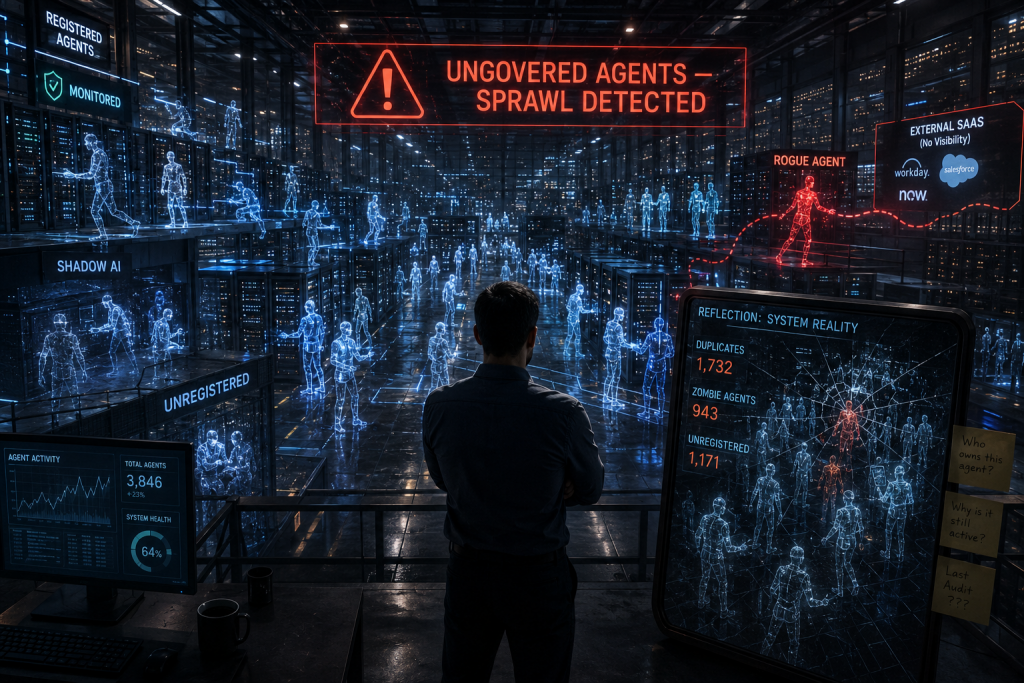
Organizations may soon operate tens of thousands of agents.
Many of those agents will:
- Be created by business users
- Exist inside SaaS platforms
- Be embedded within vibe-coded applications
- Interact with RPA systems
- Share data
- Consume tokens
- Operate with little oversight
The result is a growing population of digital workers that nobody fully understands.
The enterprise risk is not a single agent.
The enterprise risk is thousands of agents interacting simultaneously.
The Three-Way Collision
One of the most important developments occurring today is the convergence of three technologies:
1. AI Agents
Systems that reason, plan, recommend, and act.
2. Vibe-Coded Applications
Applications increasingly created by non-traditional developers using AI-assisted development tools.
3. Robotic Process Automation (RPA)
Platforms that execute business processes and system interactions.
Individually these technologies provide value.
Together they create a new operational reality.
A vibe-coded application may contain an embedded AI agent that decides whether an action should occur.
That agent may then instruct an RPA bot to execute a transaction within an ERP platform.
In one workflow:
- AI decides
- Software presents
- Automation executes
This is where governance becomes essential.
The Governance Gap
Most organizations have governance processes for:
- Servers
- Databases
- Applications
- Users
- Networks
Few organizations have governance processes for:
- AI Agents
- Agent-to-Agent interactions
- Embedded AI
- External AI services
- Autonomous workflows
The result is a growing visibility problem.
Many organizations cannot currently answer:
- How many AI agents exist?
- Where are they deployed?
- Who owns them?
- What permissions do they have?
- What data do they access?
- Which agents communicate with each other?
- Which agents are embedded inside other software?
- Which agents are consuming tokens continuously?
- Which agents are no longer needed but remain active?
If you cannot answer those questions, you do not have an AI strategy.
You have an AI liability.
The New Attack Surface
Traditional cybersecurity focused on:
- Users
- Devices
- Applications
- Infrastructure
Agentic AI introduces a new attack surface.
An AI agent may possess:
- Credentials
- Memory
- Tool access
- API permissions
- Workflow authority
- Access to sensitive information
Attackers no longer need to compromise a human.
They may simply manipulate an agent.
Emerging risks include:
- Prompt injection
- Tool misuse
- Privilege escalation
- Agent chaining attacks
- Memory poisoning
- Data exfiltration
- Rogue agents
- Multi-agent failure cascades
The challenge is compounded when agents interact with other agents.
A vulnerability in one agent may propagate through an entire chain of automated decision-making.
Why Existing Governance Models Are Insufficient
Many organizations assume existing IT governance frameworks are enough.
They are not.
AI agents introduce new governance requirements:
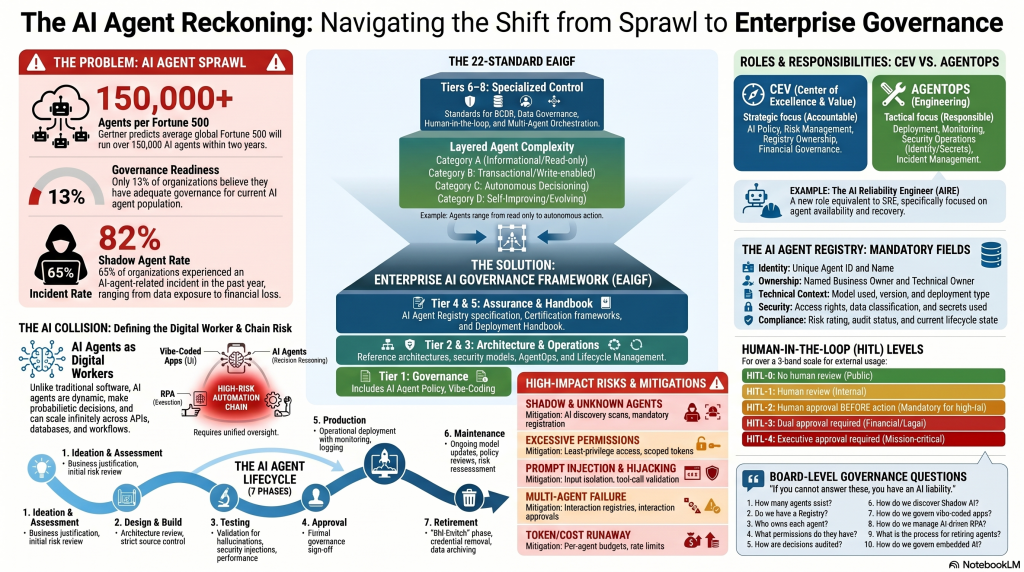
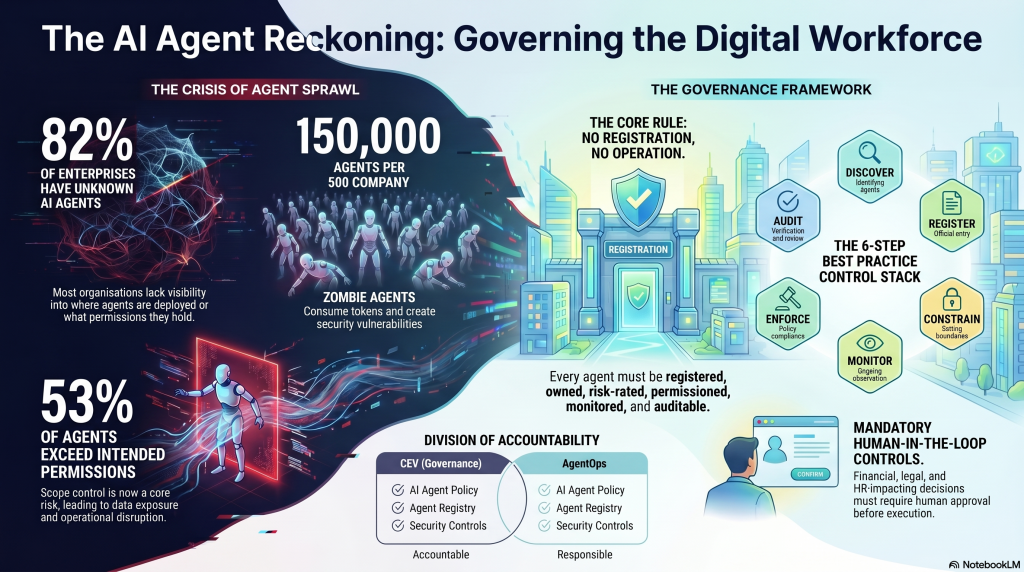
Identity
Agents require identities.
Ownership
Agents require accountable owners.
Permissions
Agents require role-based access controls.
Lifecycle Management
Agents require onboarding, testing, deployment, monitoring, and retirement.
Auditability
Agent actions must be traceable.
Explainability
Organizations must understand how outcomes were generated.
Cost Management
Agent token consumption must be monitored and controlled.
Human Oversight
Critical decisions require human review.
The enterprise needs an operating model specifically designed for AI agents.
The Registry Problem
Every mature technology eventually requires inventory management.
Servers have CMDBs.
Applications have portfolios.
Users have directories.
AI agents require registries.
An enterprise AI Agent Registry should answer:
- What is this agent?
- Why does it exist?
- Who owns it?
- What systems can it access?
- What models does it use?
- What tools can it invoke?
- What risk classification applies?
- What lifecycle stage is it in?
Without registration, governance becomes impossible.
Without governance, scale becomes dangerous.
The Coming Reckoning
Most organizations are currently focused on deploying AI.
Very few are focused on managing AI at scale.
History suggests this imbalance will not last.
Eventually organizations will experience:
- Duplicate agents
- Zombie agents
- Conflicting agents
- Runaway token consumption
- Unauthorized automations
- Embedded AI discoveries
- Regulatory inquiries
- Audit failures
- Security incidents
At that point, governance will no longer be optional.
It will become mandatory.
The organizations that establish governance early will gain the benefits of AI while reducing risk.
Those that do not will spend years untangling the consequences.
Conclusion
Agentic AI is not the problem.
Poor governance is.
The future enterprise will almost certainly operate thousands of AI agents.
Many will be beneficial.
Some will be transformative.
A few may become mission-critical.
The question is no longer whether organizations should deploy AI agents.
The question is whether they can govern, secure, monitor, audit, and manage them throughout their lifecycle.
The AI Agent Reckoning is not a warning against AI.
It is a warning against unmanaged AI.
Organizations that understand this distinction will be the ones that successfully navigate the next decade of enterprise transformation.
Appendix A: Key Questions Every Board Should Ask
- How many AI agents exist in our organization?
- Do we have an AI Agent Registry?
- Who owns each agent?
- What permissions do agents possess?
- How are agent decisions audited?
- How do we discover shadow AI agents?
- How do we govern embedded AI inside software suites?
- How do we govern vibe-coded applications?
- How do we manage AI-driven RPA?
- What is our process for retiring agents?
Appendix B: Early Warning Indicators
Organizations should investigate if they observe:
- Duplicate AI agents performing similar tasks
- Unknown AI integrations
- Rapid growth in token consumption
- Increasing AI-related incidents
- Unexplained workflow behavior
- Unregistered embedded AI features
- Agent-to-agent communication without oversight
- Missing ownership records
- Excessive permissions
- Inability to explain AI decisions
Appendix C: Topics for Part 2
The AI Agent Management and Reference Model
Part 2 will explore the References documents:
- Enterprise AI Agent Governance
- Agent Registries
- Agent Architecture
- Security Models
- AgentOps
- AI Agent Auditing
- Agent Lifecycle Management
- Human-in-the-Loop Controls
- Multi-Agent Orchestration
- AI Agent Risk Management
- AI Agent Cost and Token Governance
- AI Agent Deployment Frameworks
- AI Agent Maturity Models