
Dryland regeneration begins with a simple shift in thinking: the first crop is infiltration. This article examines how half-moon bunds, zai pits, contour stone lines, farmer-managed natural regeneration, resilient crops, managed grazing, fog harvesting, recycled water, and carefully governed renewable water systems can turn degraded drylands into productive living landscapes. It also warns against spectacle-driven restoration, arguing that successful regeneration depends on water budgets, soil repair, local ownership, ecological safeguards, and livelihood pathways.
technology
161 posts

Pre-crime may not arrive as a single dystopian machine. It may emerge through the quiet fusion of lawful systems: facial recognition, ALPR, CCTV analytics, police records, broker data, social media monitoring, digital identity, smart-city infrastructure, and AI summarisation. This article argues that the real danger is convergence, where evidence becomes inference, inference becomes a score, and a score becomes consequence before any person has been accused, charged, or convicted.

Traditional institutions no longer control how expertise is created or shared. In a world shaped by AI, social media, and real-time information flows, new bodies of knowledge are emerging faster than academia and professional accreditation systems can respond. This article introduces Adaptive Knowledge Systems, a framework for building knowledge that is rigorous, socially adaptive, governable, and fit for rapidly changing environments.

Vibe coding has made software creation faster than ever, but it has also made it easier to confuse something that works with something that is safe, scalable, and ready for real users. This article examines what vibe coding actually is, where it breaks down, and how non-programmers, solo programmers, citizen developers, and enterprise teams can use it responsibly. It covers requirements, governance, security, accessibility, demo versus MVP versus production, and the Two-AI workflow as a practical way to stay agile without losing control.

This article examines how an Industrial AI intelligence platform could transform the economics of private label and contract manufacturing. It argues that the real opportunity is not simply automation, but ownership of the intelligence layer that connects retailer brands, contract manufacturers, and factory operations.
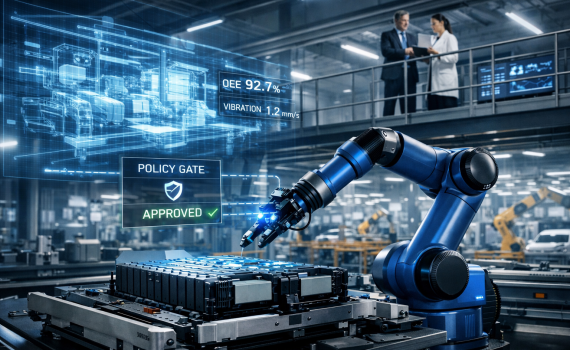
Manufacturing is becoming the next major frontier for AI. This article explores how digital twins, robotics, and industrial intelligence platforms are converging to reshape production, compress engineering cycles, and create a new class of software-defined industrial companies.